

The real power of data-driven marketing is simple: it lets you make decisions based on hard evidence, not guesswork. This shift in thinking is what leads to sharper targeting, a clear return on investment (ROI), and a much deeper understanding of how a customer finds you and why they choose to stay.
Moving from Guesswork to Growth with Data-Driven Marketing

For a long time, marketers were like old sea captains navigating with a brass compass and a paper map. They leaned on gut feelings, past experience, and broad trends to chart a course, hoping they were sailing toward the right destination. Sometimes it worked, but it was often inefficient and nearly impossible to repeat reliably.
Data-driven marketing changes all that. It’s like swapping out that old compass for a live, holographic satellite map. Instead of guessing where your ideal customers are, you can see their exact movements, understand their behavior as it happens, and predict their next step with surprising accuracy. This strategic clarity eliminates wasted time, money, and effort.
The Strategic Shift to Evidence-Based Decisions
This isn't just about adopting new software; it's a complete mindset shift away from "we think this will work" to "we know this works because the numbers prove it." This is what transforms your marketing department from a cost center into a predictable engine for revenue. By analyzing what your customers actually do, what they click, what they buy, and how they engage, you find the actionable insights needed to guide every campaign.
A data-driven approach transforms marketing from an art based on intuition to a science grounded in evidence. It empowers you to stop guessing what customers want and start giving them exactly what they’ve shown you they need.
In today's competitive landscape, making this switch isn't optional, it's essential for sustainable growth. Understanding the different data-driven marketing solutions available is the first step in turning raw information into campaigns that deliver tangible results.
To provide a clearer picture, the table below breaks down the key advantages of this approach.
Key Benefits of Data-Driven Marketing at a Glance
Here’s a quick summary of the main advantages businesses realize when they place data at the heart of their marketing efforts.
As you can see, each benefit directly translates into a tangible business improvement, from efficiency gains to a stronger bottom line.
Achieving Pinpoint Accuracy with Hyper-Personalization

Data allows you to stop shouting into a crowd and start having meaningful, one-on-one conversations. Instead of broadcasting the same generic message to everyone, you can deliver the perfect suggestion to the right person, right when they need it. This is hyper-personalization, and it’s one of the most powerful benefits of a data-driven approach.
By analyzing customer data, such as purchase history, browsing habits, and demographics, you can create messages that truly connect. This information enables you to go beyond basic segmentation and begin predicting what individuals want, sometimes even before they realize it themselves.
From Broad Strokes to Fine Details
Think of traditional marketing as painting with a roller, applying the same color across a vast wall. Data-driven marketing is like using a fine-tipped brush. You can add the precise details that make the entire picture come alive for each individual viewing it.
This precision manifests in various ways. For instance, a B2B software company might observe a prospect repeatedly visiting a page about a specific feature. Instead of sending a generic newsletter, they can automatically trigger an email with a case study demonstrating how that exact feature solved a problem for a similar company. That’s a truly relevant interaction.
The goal of hyper-personalization isn't to be intrusive; it's to be incredibly helpful. It's about delivering value so seamlessly that your marketing feels less like an advertisement and more like a trusted recommendation from a friend.
This shift from interruption to assistance is what builds lasting customer relationships and genuinely drives conversions. It all starts with a deep understanding of your audience, which is why developing effective customer segmentation strategies is such a crucial first step.
Personalization in Action: An E-commerce Example
Imagine a customer, Sarah. She spends time browsing a specific pair of running shoes on your e-commerce site but leaves without buying. A week later, she receives an email. It’s not about a generic store-wide sale; it highlights the exact shoes she was looking at, now with 15% off. The email also links to a blog post comparing that shoe to others designed for her running style. Suddenly, the message feels genuinely useful.
This is hyper-personalization doing its job, and the impact on the bottom line is significant. Email remains the highest-return channel for applying customer data. According to the Litmus State of Email 2025 report, email returns about $36 for every $1 spent on average, and the top 30% of brands earn between $36 and $50 per dollar. That return is why roughly 47% of marketers name email their most effective channel for data-driven tactics. When you personalize messages based on real behavior, engagement and sales climb.
Making Every Dollar Count with Measurable Marketing ROI

One of the oldest marketing challenges is answering the C-suite's simple question: "What did we get for that money?" For years, the answer was fuzzy, relying on broad correlations and brand awareness metrics. The single most important benefit of data-driven marketing is that it finally provides a clear, evidence-backed answer.
This approach transforms your marketing ROI from a vague estimate into a predictable, measurable outcome. It’s the difference between funding a campaign with your fingers crossed and investing in a strategy with a confident projection of its financial return. This is how your marketing department proves it's a revenue engine, not just a cost center.
Connecting Actions to Revenue with Attribution
How do you know which touchpoint sealed the deal? Was it the first blog post a prospect read, the social media ad they clicked last week, or the final email that prompted them to buy? Figuring this out is the job of attribution modeling, a core component of any data-driven strategy.
Instead of crediting only the final click, attribution models distribute value across the entire customer journey. This provides a more accurate picture of which channels and campaigns are most effective at moving prospects toward a sale.
Attribution is like reviewing the game tape after a big win. You don't just celebrate the final score; you analyze every single play that led to it to understand which moves were most critical to the outcome.
By understanding that complete journey, you can confidently invest more in what works and trim underperforming areas from your budget. This intelligence is fundamental to optimizing spend and maximizing profitability.
Focusing on Metrics That Truly Matter
A data-first mindset means shifting your focus from vanity metrics (like page views or social media likes) to the numbers that directly impact the bottom line. Two of the most important are Customer Acquisition Cost (CAC) and Return on Ad Spend (ROAS).
- Customer Acquisition Cost (CAC): This tells you exactly how much you're spending, on average, to acquire a new customer.
- Return on Ad Spend (ROAS): This measures the gross revenue you generate for every dollar spent on advertising.
Tracking these metrics provides an undeniable, crystal-clear view of campaign performance. The payoff is real. Companies that use advanced analytics report 5-8% higher marketing ROI than competitors who do not. The upside grows larger when you nail personalization. McKinsey research shows that getting data-driven personalization right can deliver five to eight times the ROI on marketing spend.
When you know your numbers, you can justify budgets and make strategic investments with confidence. This is the kind of precision that turns marketing spend into predictable business growth.
Building Lasting Relationships and Customer Loyalty
The first sale isn't the finish line, it's the starting point. This is where the real work of building a valuable, long-term relationship begins. One of the greatest benefits of data-driven marketing is its power to turn a single transaction into a loyal, lasting partnership by focusing on Customer Lifetime Value (CLV).
This is where you discover what truly motivates your customers. Data from product usage, support tickets, and repeat purchases tells a story about what they love and what they need next. Instead of guessing how to keep them happy, you can act on hard evidence to build loyalty that lasts.
From Purchase Data to Proactive Support
Understanding what customers do after they buy allows you to anticipate problems. Consider a software company that notices a user's engagement is dropping. That's a classic red flag for churn. Before the customer even thinks about canceling, the company can proactively intervene with a helpful training video or a personal check-in from a success manager.
This kind of proactive support makes customers feel seen and valued, which is the bedrock of genuine loyalty. You're empowered to resolve issues before they become complaints and offer help before it's even requested.
The real magic of post-purchase data is that it turns customer service into a strategic growth driver. You're not just solving problems; you're actively building relationships that create repeat business and enthusiastic brand advocates.
By using data to identify your most valuable customers, you know exactly where to focus your retention efforts. For anyone looking to go deeper, there are plenty of proven customer retention strategies that become even more powerful when fueled by the right insights.
Cultivating Loyalty with Personalized Offers
Effective loyalty programs aren't built on generic, one-size-fits-all rewards. They're shaped by data that reveals what different customer segments actually care about. By analyzing purchase history, you can create intelligent upsell and cross-sell offers that feel more like helpful suggestions than a hard sell.
Here’s how that might look in practice:
- Targeted Upsells: An e-commerce store notices a customer bought entry-level camera gear. They can follow up with a timely email showcasing advanced lenses and accessories, complete with video tutorials.
- Exclusive Rewards: A B2B service provider identifies its top-tier clients and invites them to an exclusive webinar with industry leaders, making them feel like VIPs.
- Predictive Offers: A subscription service analyzes viewing habits to recommend new shows, making the platform feel custom-built for each user’s taste.
This level of personalization does more than just drive another sale; it deepens the customer's bond with your brand. When you consistently demonstrate that you understand their needs and goals, you create a powerful reason for them to stay, turning satisfied customers into sustainable growth.
Stitching Together a Seamless Cross-Channel Customer Experience
The modern customer journey is rarely a straight line. A prospect might first discover your brand through a social media ad, visit your website to learn more, and then finally decide to buy after receiving a perfectly timed email. Without a unified data strategy, each of these touchpoints is an isolated event, leaving you with a fractured, incomplete picture of how someone becomes a customer.
This is where data-driven marketing truly excels, it connects all those scattered dots. By integrating data from your CRM, website analytics, and social media channels, you can build a single, cohesive view of each customer. This allows you to deliver a consistent and compelling brand experience, no matter how or where they engage with you.
Unifying the Customer Journey
Imagine your marketing efforts as an orchestra. Each channel, email, paid search, social media, is a different instrument. When they play from separate sheets of music, the result is noise. A unified data strategy acts as the conductor, ensuring every channel plays in harmony to create a seamless customer experience.
This unified approach makes your entire marketing operation smarter. Instead of guessing which touchpoints matter most, you can see the whole journey laid out. You'll understand exactly how different channels work together to drive conversions, allowing you to optimize your budget and focus on strategies that deliver measurable impact.
A seamless cross-channel experience means your brand feels familiar and helpful everywhere. It's about recognizing a customer's history with you and continuing the conversation, not starting a new one with every interaction.
Cross-Channel Marketing in Action
Let’s consider a practical example. A visitor browses a specific product on an e-commerce site but leaves without purchasing. A data-driven system logs this behavior instantly. A few hours later, that same person is scrolling through their social media feed and sees a retargeting ad showcasing that exact product. The next day, an email lands in their inbox with a limited-time discount on that item, and the sale is closed.
This is the power of an integrated, data-fueled strategy. Retargeting is highly effective. It delivers roughly 10x higher click-through rates and makes retargeted visitors about 70% more likely to convert than standard display ads. The momentum is clear in how buyers spend. A recent Madison Logic survey found that 84% of B2B decision-makers are shifting budget away from traditional impression-based advertising toward data-driven performance marketing. That is how you turn casual browsers into committed buyers.
By understanding the complete journey, you can implement powerful multi-channel marketing strategies that guide customers smoothly from awareness to purchase. This not only boosts conversions but also builds a stronger, more coherent brand that people trust.
Your Roadmap to a Data-Driven Marketing Strategy
Understanding the why behind data-driven marketing is one thing, but building a strategy is another. The good news is you don’t need a massive team of data scientists to get started. A successful shift comes down to a clear plan, the right tools, and a commitment to letting evidence guide your decisions.
This roadmap is about taking smart, manageable steps that create momentum. You can start small, such as with a simple A/B test on an email subject line, and scale up as you prove the value of this new approach.
Define Your Objectives and KPIs First
Before collecting any data, you must define what success looks like. Your goals should be specific, measurable, and tied directly to business outcomes. A vague goal like "increase leads" is far less powerful than a concrete objective like "boost qualified demo requests by 15% in the next quarter."
Once you have a clear objective, you can pinpoint the Key Performance Indicators (KPIs) that truly matter. This focus is critical; it ensures you’re collecting data with a purpose, not just hoarding it.
A data-driven strategy isn't about gathering as much data as possible; it's about gathering the right data that directly answers your most important business questions. Your objectives are the compass that guides every decision you make.
This flow shows a simplified customer journey, tracking how someone moves from a website visit to social media engagement and, finally, to an email interaction.
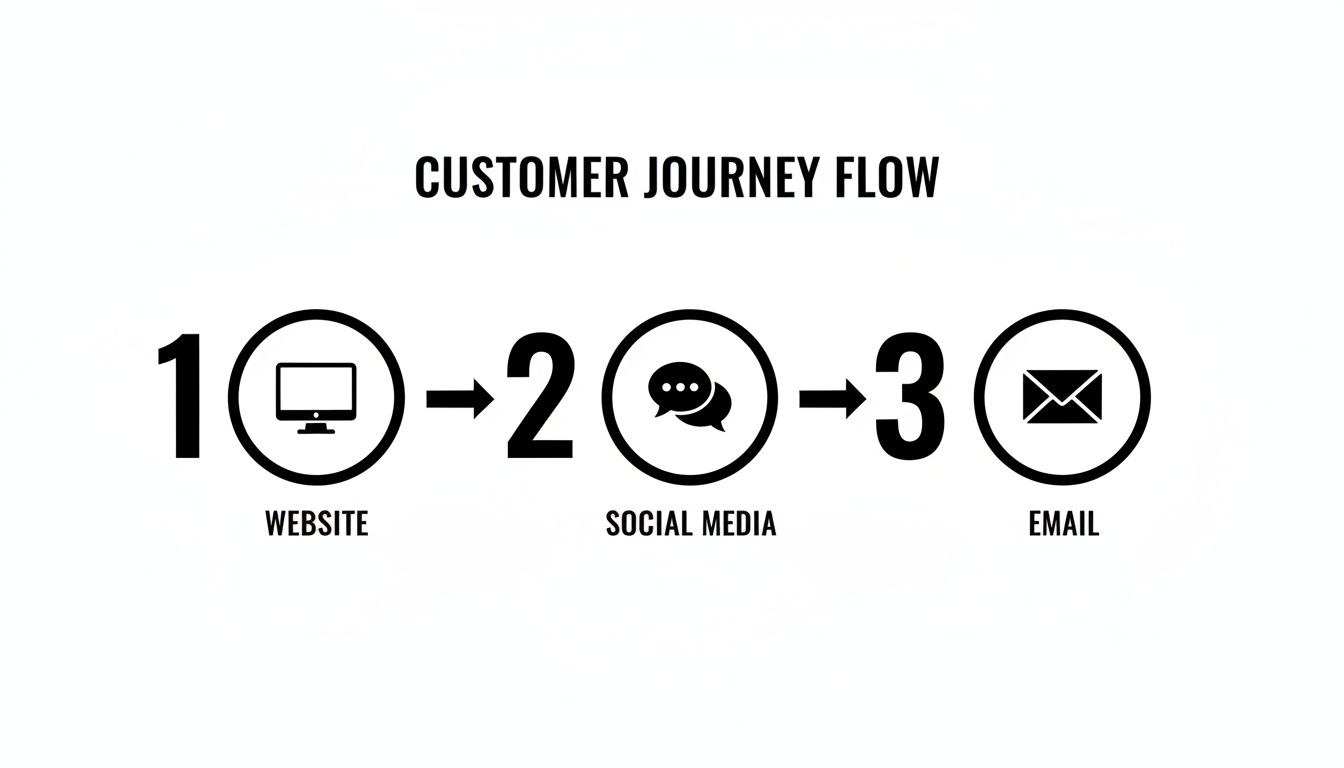
Each of these touchpoints generates valuable data. When you connect the dots, you get a complete picture of the path your customers take.
Build Your Foundational Tech Stack
Your technology stack is the engine that will power this entire operation. You don't need every new tool on the market, but a few core components are essential for turning raw information into smart decisions. A solid foundation typically includes:
Web Analytics Platform: A tool like Google Analytics is non-negotiable. It helps you understand what people are doing on your website, where they came from, which pages they viewed, and where they decided to leave.
Customer Relationship Management (CRM): A CRM like Salesforce or Dynamics 365 acts as your central nervous system. It consolidates all customer interactions into one place, creating a single source of truth for every lead and client.
Marketing Automation Platform: This is what enables you to deliver personalized experiences at scale. This software automates repetitive tasks like email campaigns and lead nurturing, allowing you to connect with people efficiently.
These tools are designed to work together to collect, organize, and activate your data. They help break down silos between marketing, sales, and service, giving you the unified view needed to create a truly seamless customer experience.
Answering Your Questions About Data-Driven Marketing
Adopting a data-first mindset is a significant step, and it naturally comes with questions. Let's address some of the most common ones we hear from marketers ready to make the change.
Where Should a Small Business Start?
You don't need a huge budget or a dedicated analytics team to begin. The best place to start is with the tools you likely already have, such as Google Analytics.
Pick one simple, clear goal. For instance, determine which of your blog posts are generating the most contact form submissions. The idea is to start small, demonstrate that the insights have real value, and then build from there. Get comfortable with the data from a single channel before trying to connect everything at once.
What Are the Most Critical Metrics to Track?
While every business has unique indicators, it's crucial to look past vanity metrics like page views. Focus on numbers that tie directly to your bottom line.
Here are three essentials to get you started:
- Customer Acquisition Cost (CAC): How much does it cost you to win a new customer?
- Customer Lifetime Value (CLV): What is the total revenue you can expect from a single customer over time?
- Return on Ad Spend (ROAS): For every dollar you put into advertising, how much revenue are you getting back?
These metrics paint a clear financial picture of your marketing performance. They are key to making smarter decisions about where to invest your resources.
How Can We Ensure Our Data Is Accurate?
Inaccurate data will undermine your entire strategy. The first step is to establish a "single source of truth", this is typically your CRM. It’s where all customer information should be centralized and standardized.
From there, make it a habit to audit your data sources regularly. You need to catch and fix inconsistencies before they can lead your decisions astray.
The purpose of a data-driven strategy isn't just to collect more data; it's to collect the right data. Clean, reliable information is the bedrock of every successful marketing decision you'll make.
Ready to stop guessing and start growing? Twelverays builds data-driven marketing and CRM solutions that deliver measurable ROI. Learn how we can transform your strategy today.


