

Forget the buzzwords for a moment. Marketing automation is about transforming scattered marketing efforts into a predictable, revenue-generating engine. It’s the difference between hoping leads find their way to sales and guiding them there with precision.
Beyond Buzzwords to Real Business Growth
For most B2B SaaS and professional services firms, the marketing landscape can feel chaotic. You're dealing with scattered leads, tedious manual follow-ups, and a frustrating gap between your hard work and what appears in the sales pipeline. This chaos breeds missed opportunities and makes it nearly impossible to prove marketing's value.
Marketing automation is designed to bring order to that chaos. It's not just another tech tool; it's a strategic engine built to automate repetitive tasks so your team can focus on what they do best: strategy and creativity. Think about the resources poured into campaigns that yield lackluster results. It’s a common frustration, but automation flips the script. In fact, research shows an average ROI of $5.44 for every $1 invested, which translates to a staggering 544% return over three years. You can explore more on marketing automation ROI from Nucleus Research.
Before we dive deeper, let’s get a quick snapshot of the core advantages. This isn't just about efficiency; it's about strategic impact across the business.
Key Benefits of Marketing Automation at a Glance
Benefit Category | Impact Area | Example Outcome |
|---|---|---|
Strategic Growth | Revenue Generation & Lead Quality | A SaaS company uses lead scoring to identify demo-ready leads, increasing sales-qualified leads (SQLs) by 30%. |
Operational Efficiency | Team Productivity & Resource Allocation | A consulting firm automates follow-up emails, saving 10+ hours per marketer each week for strategic planning. |
Customer Experience | Personalization & Nurturing | An e-learning platform sends personalized content based on user behavior, lifting engagement rates by 50%. |
Data & Analytics | ROI Measurement & Attribution | A B2B service provider directly attributes $250,000 in new business to a specific automated nurturing campaign. |
As you can see, the benefits are tangible and directly tied to the metrics that matter most. Now, let’s unpack what this means for your day-to-day operations.
What This Means for Your Business
The real power here is the ability to scale personalized communication. Instead of broadcasting generic messages to your entire list, you can deliver the right content to the right person at the exact moment they’re most receptive. This precision is what effectively moves prospects through the sales funnel, shortening sales cycles and improving conversion rates.
The magic of marketing automation is how it closes the loop between marketing activities and sales outcomes. It makes every marketing dollar accountable by connecting the dots from the first click to the final contract.
Ultimately, the core benefits of marketing automation are deeply strategic. When implemented correctly, these systems help businesses achieve:
Increased Lead Quality: Automated lead scoring spotlights your most engaged, sales-ready prospects, so your sales team isn't wasting time on cold leads.
Enhanced Personalization: Dynamic content and triggered campaigns deliver relevant experiences that resonate with individual buyers, not just personas.
Improved Efficiency: Taking repetitive tasks off your team's plate frees them for the high-impact creative and strategic work that drives real growth.
Measurable ROI: Finally, you get clear attribution. You can draw a straight line from specific marketing campaigns to closed deals and revenue.
This guide will break down each of these advantages, showing you how to put theory into practice and start generating real, measurable results for your business.
How Automation Directly Drives Revenue and ROI
While efficiency is great, the real showstopper for any B2B leader is the direct, measurable impact marketing automation has on the bottom line. It stops being a cost center and starts acting like a powerful revenue engine, tying every marketing activity to a financial outcome. This is how the conversation shifts from vague promises to concrete results, answering the one question every executive cares about: "What's the return on this investment?"
The financial impact kicks in immediately by improving lead quality and shortening sales cycles. By automating tasks like lead scoring and nurturing, the system ensures your sales reps only engage with prospects who have shown genuine interest and fit your ideal customer profile. This focus increases their close rates and reduces time wasted on dead-end leads, which directly accelerates revenue generation.
This graphic gives you a clear visual of how a relatively small investment in automation can generate substantial returns over time.
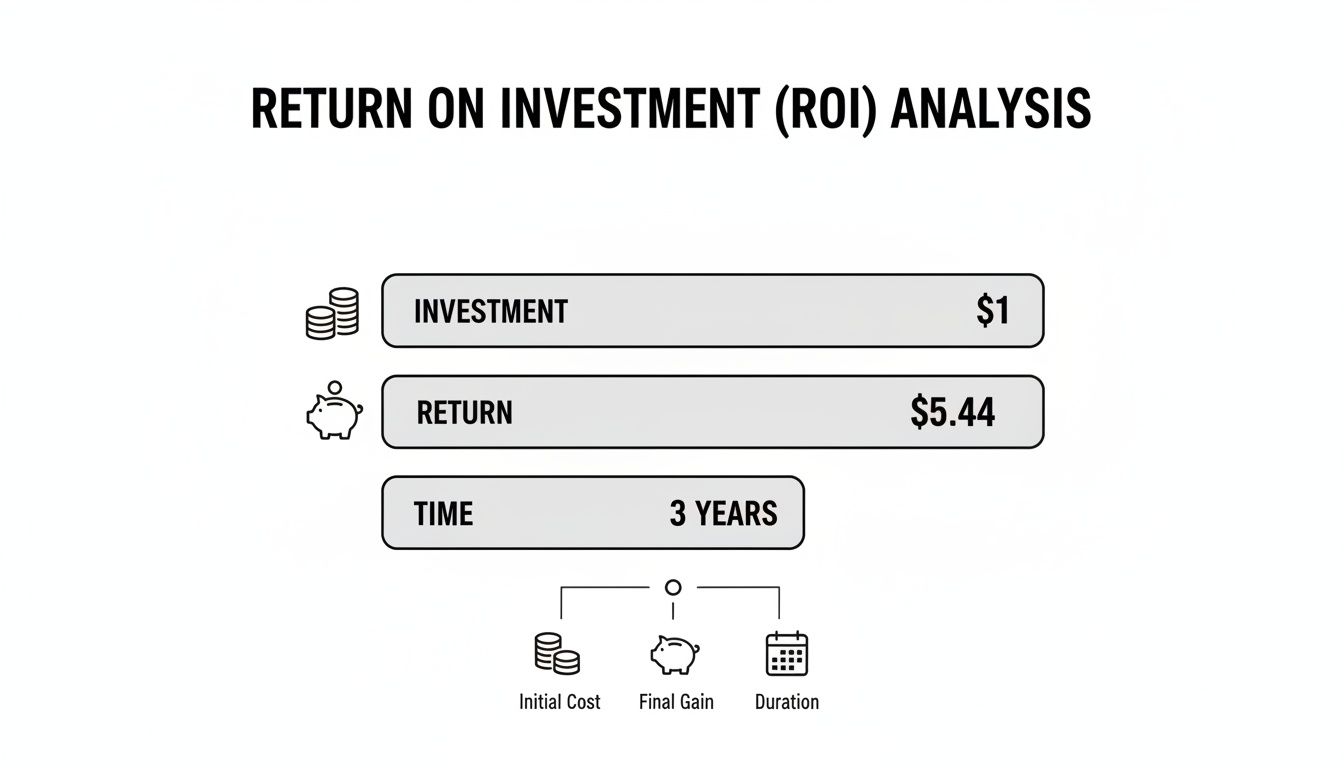
The numbers show a powerful multiplier effect. For every dollar you invest, you can realistically expect to see more than five dollars back within a three-year window.
Calculating Your Potential Return
Let's move from concept to calculation. The ROI of marketing automation isn’t an abstract idea; you can map it out with a simple formula. While you can take a deeper dive into the specifics, let’s walk through a realistic scenario for a B2B professional services firm.
Imagine your firm generates 1,000 new leads a month. Without automation, your manual follow-up process converts at a 2% rate, netting you 20 new clients. If the average lifetime value (LTV) of a client is $10,000, your monthly revenue from these new leads is $200,000.
Now, let's introduce marketing automation:
Improved Nurturing: Automated, personalized email sequences keep your firm top-of-mind.
Lead Scoring: The system automatically flags the most engaged leads for an immediate sales call.
Timely Communication: No lead falls through the cracks because someone forgot to follow up.
These improvements can realistically boost your lead conversion rate from 2% to 5%. With the same 1,000 leads, you’re now closing 50 new clients. At the same $10,000 LTV, your monthly revenue jumps to $500,000: an extra $300,000 per month. This demonstrates how a modest lift in conversion efficiency creates significant revenue growth. You can get more ideas by checking out our guide on how to measure marketing ROI.
By systematically converting more of the leads you already have, marketing automation maximizes the value of your existing marketing spend. It’s not just about doing more; it’s about getting more from what you already do.
Proving Marketing’s Value with Attribution
One of the oldest challenges for marketers is attribution, proving which campaigns actually led to closed deals. Marketing automation, especially when integrated with a CRM like Salesforce or Dynamics 365, finally solves this puzzle. Every touchpoint, from the first email opened to the final demo requested, gets tracked and logged against their contact record.
This creates a crystal-clear, data-backed line connecting a specific campaign to a closed deal. Marketing leaders can walk into the boardroom and confidently show exactly how much revenue their team generated. Proving your value is how you secure bigger budgets and earn a strategic seat at the table.
In fact, this tight alignment between sales and marketing is a massive financial driver on its own. Integrated systems deliver 15-25% higher marketing ROI, boost sales productivity by 14.5%, and cut overhead by 12.2%, freeing up resources for initiatives that drive growth.
Mastering Personalized Lead Nurturing At Scale
Think of marketing automation as your digital concierge, skillfully guiding every prospect through their unique buying journey. We've discussed the financial wins, but let's explore the operational powerhouse that makes it all happen: superior, personalized lead management at a scale impossible to achieve manually.

This is where the real benefits of marketing automation begin to compound. Instead of broadcasting one-size-fits-all messages, you can orchestrate a series of highly relevant, timely communications that speak directly to a prospect's needs. This level of personalization is no longer a luxury; it’s what B2B buyers expect.
The numbers back this up. Companies that excel at lead nurturing generate 50% more sales-ready leads at a 33% lower cost. Automation is the engine that makes this possible, ensuring no prospect falls through the cracks, whether they're just starting their research or are moments away from a decision.
From Manual Follow-Up To Automated Journeys
Picture this: a potential client for your firm downloads a detailed whitepaper. Without automation, that lead lands in a spreadsheet, waiting days before a salesperson makes a generic follow-up call. By then, the initial interest has likely faded.
Now, with marketing automation, the moment that form is submitted, a pre-built workflow activates. This isn't just a single "thank you" email; it's the start of a curated journey.
Modern personalization is about delivering the right message at the right moment, a feat impossible to achieve at scale through manual effort. Automation turns this ideal into a practical reality.
That journey might look something like this:
Immediate Delivery: The prospect instantly receives an email with the whitepaper, building trust from the first touchpoint.
Follow-Up Content: Three days later, the system automatically sends a case study showing how a similar company solved the problem discussed in the whitepaper.
Targeted Invitation: A week later, if they engaged with the case study, they receive an invitation to a webinar that delves deeper into the topic.
Each step is triggered by the prospect's actions, making every communication feel helpful, not pushy. This systematic approach is the bedrock of effective nurturing. If you want to dive deeper into building these systems, you can read our complete guide to lead nurturing automation.
Intelligent Lead Scoring Flags Sales-Ready Prospects
Not all leads are created equal. Some are just exploring; others are ready for a sales conversation. The eternal challenge has been telling them apart. Marketing automation cracks this code with intelligent lead scoring, a system that assigns points to prospects based on their profile and behavior.
This process assigns value to key attributes and actions. For example:
Demographic Fit: A C-level executive at a target account might get +25 points.
High-Intent Actions: Visiting the pricing page could add +15 points.
Content Engagement: Downloading a whitepaper might be worth +10 points.
Low-Intent Actions: Checking out the careers page could subtract -5 points.
Once a lead's score hits a predefined threshold, say, 100 points: the system automatically flags them as a sales-qualified lead (SQL). It then routes them to the appropriate salesperson, complete with a full history of their engagement. This ensures your sales team spends their time on the hottest opportunities, dramatically improving efficiency and close rates.
A Practical Example Of Nurturing High-Value Leads
Consider a management consulting firm targeting C-level executives, a notoriously tough audience. They implement a marketing automation platform to nurture these high-value leads over a 90-day cycle.
Instead of generic pitches, they build a workflow that delivers exclusive content: a proprietary research report, an invite to a closed-door roundtable, and a personalized video message from a senior partner. The entire journey is automated, kicking off the moment someone engages with a LinkedIn ad.
The result? The firm sees a 45% increase in qualified sales appointments with their ideal C-suite prospects within six months. This is one of the core benefits of marketing automation: it empowers you to build and sustain meaningful relationships with key decision-makers, especially over the long sales cycles common in B2B. It's not just about efficiency; it's about executing a sophisticated, high-touch strategy at scale.
Boosting Your Team's Operational Efficiency

Imagine giving your marketing team back their most valuable asset: time. That’s the most immediate, tangible benefit of marketing automation.
Instead of getting bogged down in repetitive tasks like manual email sends, social media scheduling, or routing new leads, your team can focus on what actually moves the needle, strategy, creative development, and market analysis. The small, time-consuming tasks simply vanish from their to-do lists.
Think about the hours consumed by manual data entry or follow-ups for a single campaign. Automation handles it in seconds. We're talking about reclaiming significant chunks of the workweek. For example, teams often save:
5 hours weekly by automating welcome email sequences.
3 hours per campaign by letting the system route and assign leads instantly.
8 hours a week on data entry and reporting, which is cut down to almost nothing.
These aren't just minor conveniences. As you scale, these saved hours compound, giving your team the bandwidth to refine buyer journeys and test new content instead of just keeping the lights on.
Increase Campaign Throughput Without More Headcount
By handing off the grunt work to an automated system, a lean team can manage a much larger pipeline. It’s not uncommon for a five-person team to double the number of campaigns they can effectively run without needing new hires.
This means your marketing budget goes further. Your headcount stays flat, but your results climb. To see the dramatic difference, let's look at a typical workflow.
Manual vs. Automated Campaign Workflow Comparison
This table breaks down the hours spent on common campaign tasks, showing the stark contrast between a manual process and an automated one.
Campaign Task | Time Spent (Manual) | Time Spent (Automated) |
|---|---|---|
Welcome Emails & Nurturing | 5 hours/week | ~1 minute setup |
Social Media Scheduling | 4 hours/week | 15 minutes/week |
Lead Routing & Assignment | 3 hours/campaign | ~2 minutes setup |
Data Entry & Reporting | 8 hours/week | 30 minutes/week |
The numbers speak for themselves. The time saved is substantial, freeing your team to reinvest those hours in creative development and strategic planning that directly impacts the bottom line.
A marketing leader we worked with put it best: "Reclaiming 20 hours a week per marketer completely transforms your capacity. It's the difference between treading water and driving real growth."
Calculating the Cost Savings From Reclaimed Time
These operational gains translate directly into hard cost savings. You can quickly put a dollar amount on this newfound efficiency.
Simply multiply the hours your team gets back by their average hourly rate. For instance, if you reclaim 20 hours a week for a marketer with a blended rate of $50/hour, that’s $1,000 saved every week for just one person.
Identify the average work hours reclaimed per week, per marketer.
Determine the average hourly compensation for your team.
Calculate the weekly and annual savings for each person.
Sum the savings across your entire team to see the total impact.
This calculation is a powerful way to justify the investment in a marketing automation platform, connecting productivity directly to your budget.
Getting the Most Out of Your Efficiency Gains
To ensure these benefits stick, you need a smart implementation plan.
Start by mapping your current workflows, identifying all inefficiencies. From there, select a few smaller, high-impact processes to pilot before a full rollout.
Train your team with hands-on sessions so they feel confident with the new tools.
Integrate with your CRM (like Salesforce or Microsoft Dynamics 365) from day one to keep your data clean and accurate.
Monitor your time savings and look for ways to refine and improve workflows.
Update your documentation to reflect the new, optimized processes.
This structured approach ensures a smooth transition and helps you build on your successes. A solid automation strategy doesn't just save time, it creates a competitive advantage.
For a deeper dive, you can learn more about building out these processes in our guide on marketing workflow automation.
A Quick Example: Efficiency in Action
A B2B SaaS provider was struggling with slow lead handoffs from marketing to sales. By automating the process, they shaved 120 hours of manual work off their team's plate every single month.
They redeployed that time into highly targeted outreach and follow-up, which led to a 25% increase in Sales Qualified Leads (SQLs) without adding a single person to the team.
120 hours reclaimed is like getting three extra workdays from each marketer, every month.
Scheduled sales calls jumped from 20 to 30 per week.
Marketing headcount stayed the same while the sales pipeline grew significantly.
This perfectly illustrates how small, daily efficiency gains snowball into major wins. When you let automation handle the heavy lifting, your team is free to innovate and drive the business forward.
Unifying Sales and Marketing for a Seamless Customer Journey
Ever feel like your sales and marketing teams are speaking different languages? Marketing automation, when connected to your CRM, acts as the universal translator. It breaks down departmental silos, creating a single, shared view of every contact.
This isn't just about sharing data; it's about making smarter, faster decisions. When everyone works from the same playbook, you can instantly see which leads are hot and which need more time. This alignment is where the magic happens.
It means lead scoring automatically passes the baton at the perfect moment. Sales reps can see every email open, webinar sign-up, or pricing page visit, in real time. In return, marketing gets immediate, closed-loop feedback on which messages and campaigns are actually driving deals.
How Lead Scoring Automates the Handoff
Think of lead scoring as an automated gatekeeper that knows exactly when a prospect is ready for sales. It’s a simple but powerful process:
Points are automatically assigned based on a prospect's engagement and profile fit.
Once a lead hits a specific score, the system instantly routes them to the right sales rep.
This removes the manual guesswork and delays that slow down your sales cycle.
Marketing gets instant feedback as sales reps update the lead’s status in the CRM.
Industry data shows that aligning marketing automation with a CRM can boost sales productivity by 14.5% and slash marketing overhead by 12.2%.
This transparency builds trust and ensures no lead ever falls through the cracks. Sales can craft hyper-relevant outreach based on a lead's history, and marketing can fine-tune campaigns based on what's winning deals.
A Real-World B2B Tech Example
A mid-sized B2B tech firm was struggling with slow follow-up times. They integrated their marketing automation platform with Salesforce. The results were staggering. They cut their average lead response time from a painful 48 hours to less than 2 hours.
Within just six months, their sales pipeline grew by an incredible 280%.
Here’s a quick look at their wins:
90% Faster Follow-Up, which kept prospects engaged.
35% More MQLs by letting the system automatically qualify leads.
20% Higher Close Rate because reps had a clear history of every interaction.
Metric | Before | After |
|---|---|---|
Lead Response Time | 48h | 2h |
Pipeline Growth | 100% | 280% |
MQL Rate | 10% | 13.5% |
This shared data stream allowed both teams to work together, refining messaging and timing on the fly. They started meeting weekly to review the pipeline, making campaign adjustments based on what was happening right now, not last quarter.
Want to dive deeper into this topic? Check out our complete guide on B2B marketing and sales alignment.
The Power of a Closed-Loop System
Closed-loop feedback is marketing's secret weapon for proving its value. It finally gives marketers a clear line of sight into which content actually drives revenue. When a sales rep updates an opportunity in the CRM, marketing can directly tie that revenue back to the specific campaigns that influenced it.
This process highlights your top-performing channels and simplifies budget conversations.
Data-Driven Decisions: Marketing can confidently shift budget to the channels delivering the best ROI.
Faster Iteration: Forget quarterly reviews. Teams can test and tweak messaging weekly.
Aligned Goals: When everyone is focused on a shared revenue target, accountability skyrockets.
This synergy transforms marketing from a cost center into a true revenue partner. It also gives sales the contextual insights they need to have smarter conversations and close more deals, resulting in a seamless customer journey with far less friction.
"When marketing and sales share data in real time, the buyer experience becomes proactive rather than reactive.", Twelverays Strategist
An integrated system also makes reporting a breeze. Instead of juggling separate dashboards, both teams work from a single pipeline view. This gives leadership a quick, confident way to gauge campaign health and forecast revenue.
Key Takeaways for Your Teams
Integrating marketing automation with your CRM is how you unlock real collaboration. Smart lead scoring, closed-loop feedback, and shared dashboards are the tools that keep everyone on the same page. The payoff is faster deals and happier customers.
Map every customer touchpoint in the CRM so nothing gets missed.
Define clear, agreed-upon scoring rules and handoff thresholds.
Schedule regular meetings to review and optimize the handoff process.
Train your sales reps on how to read and use the marketing data they now have access to.
By following these practices, your teams will stay aligned even as you scale. Every part of the funnel gets stronger, from the first touch to the final sale. It’s an approach that protects revenue and delights customers with consistent, well-informed interactions.
Companies that truly align marketing and sales see 15-25% higher marketing ROI simply through better collaboration.
Bottom line: integrating marketing automation with your CRM unifies your data, your processes, and your people. It speeds up response times, clarifies what's working, and empowers your teams to win together, delivering the smooth, intelligent journey that B2B buyers now expect.
Your Guide to a Successful Automation Rollout
Knowing the benefits of marketing automation is one thing. Achieving those results is another challenge entirely. The technology is only as good as the strategy behind it, and a thoughtful rollout separates success from an expensive failure. This isn’t about flipping a switch, it’s about building a solid foundation first.
That means starting with your strategy, not the software. Before you even look at a single platform demo, define what success looks like for your business. Are you trying to boost sales-qualified leads by 30%? Shorten your sales cycle? Improve customer retention? Clear, measurable goals will steer every decision you make, from the platform you choose to the workflows you design.
Starting with a Solid Foundation
Once you have your goals locked in, the next step is to get your data in order. Marketing automation runs on data, and plugging it into a messy database is like putting premium fuel in a broken engine. Inaccurate or incomplete data leads to poor personalization, sloppy segmentation, and frustrated prospects who get the wrong message at the wrong time.
Data hygiene is non-negotiable. Before you migrate a single contact, take the time to:
De-duplicate contacts to avoid sending the same message twice.
Standardize data fields so information is consistent and usable.
Segment your audience based on firmographics, behavior, and engagement history.
This initial cleanup prevents massive headaches down the road and ensures your campaigns are built on a reliable source of truth.
The most common mistake we see is businesses launching without a clear strategy. They get mesmerized by tool features instead of focusing on the business problems they need to solve. This often leads to robotic, impersonal content that pushes customers away.
Launching a Pilot Project for an Early Win
Instead of trying to automate everything at once, start small. Pick a single, high-impact process to automate as a pilot project. This approach lets you learn the platform, work out the kinks in a low-stakes environment, and show tangible value to stakeholders quickly. A successful pilot builds momentum and gets the buy-in you’ll need for a broader rollout.
Good candidates for a pilot project include:
A Welcome Email Series: Automate a sequence for new subscribers that introduces your brand and nurtures initial interest.
A Lead Nurturing Campaign: Target a specific segment, like leads who downloaded a particular whitepaper, with relevant follow-up content.
Basic Lead Scoring: Set up a simple scoring model to automatically identify and route the hottest leads to your sales team.
Choosing the right platform and ensuring it integrates seamlessly with your CRM (like Salesforce or Dynamics 365) is another critical piece of the puzzle. This integration creates that unified sales and marketing view, enabling smooth handoffs and true closed-loop reporting.
For a more detailed walkthrough, you can explore our complete guide on successful marketing automation implementation. By following this roadmap, you can move from theory to practice, turning the promise of automation into measurable business growth.
Got Questions? We've Got Answers.
Even the best strategies can hit a few speed bumps. Let's tackle some of the most common questions we hear from B2B leaders when they explore marketing automation. Here are straight answers to clear up any gray areas.
How Much is This Going to Cost Me?
There’s a huge range. You could be looking at a few hundred dollars a month for a solid platform perfect for a growing business, or several thousand for an enterprise powerhouse like Marketo or Salesforce Marketing Cloud.
The final price tag boils down to a few key factors: the number of contacts in your database, the feature sophistication you need (e.g., AI-powered personalization vs. standard email drips), and the level of support you require.
The smartest first step? Define what you actually need before you start shopping. Don't get upsold on bells and whistles you won’t use for a year. Most platforms use a tiered model, so you can start lean and scale your investment as your company and your ROI grow.
Isn't Marketing Automation Just for the Big Guys?
Not anymore. While Fortune 500s have used these tools for years, modern platforms have made powerful automation accessible to everyone. For small and mid-sized B2B firms, it's a massive force multiplier. It lets a lean team punch above its weight class, running sophisticated, personalized campaigns that can compete with companies double their size.
For a smaller team, the biggest win is efficiency. Automating tedious, repetitive tasks that consume hundreds of hours frees up time for the strategic and creative work that actually moves the needle.
What's the Real Difference Between Marketing Automation and a CRM?
They’re two sides of the same coin and work best when integrated. Think of your CRM (Customer Relationship Management) system, like Salesforce, as your sales team's home base. It’s the database of record for every interaction with prospects and customers.
Marketing automation software is purpose-built for the top and middle of your funnel. Its job is to generate leads, nurture them with relevant content, and score their engagement until they're ready to speak with a salesperson. The magic happens when you integrate them. Data flows seamlessly from the first website visit all the way to a closed deal, giving everyone a complete picture.
Can We Just Set This Up Ourselves?
That depends on your team's technical skills and the complexity of your goals. Platforms like HubSpot or ActiveCampaign are designed to be user-friendly, and a tech-savvy marketer can certainly get basic campaigns running on their own.
However, if you're looking at a more complex setup, migrating a messy database, designing intricate workflows, or integrating with a custom CRM, bringing in an expert is a smart move. An experienced agency helps you sidestep common pitfalls, ensures your tech supports your strategy, and dramatically shrinks your time-to-value. You'll see a real return on your investment much faster.
Ready to see how this engine can drive real growth for your business? The experts at Twelverays live and breathe marketing automation, building and fine-tuning strategies that deliver measurable results. Contact us today to get started.
Related service: Revenue operations automation.


