

In today's competitive landscape, transactional relationships are a liability. True business growth stems from deep, strategic partnerships with clients who see you as an indispensable part of their success. But building that level of trust and loyalty doesn't happen by accident; it requires a deliberate, data-driven approach to understanding, serving, and delighting your customers at every turn. Moving beyond generic advice, this guide provides ten advanced, actionable client relationship management tips designed for modern businesses.
You will learn specific, practical methods to elevate your client engagement from reactive service to proactive partnership. We will cover how to implement a 360-degree customer view, develop structured feedback loops, and build personalized communication plans that resonate at every stage of the buyer's journey. Additionally, we will explore sophisticated tactics like data-driven customer health scoring and establishing executive sponsorship programs to solidify high-value accounts.
Each tip is designed for immediate application, providing the strategic framework needed to transform client interactions into lasting, profitable alliances. These are the proven tactics that leading firms use to not only retain their most valuable accounts but also drive significant, sustainable growth. Let's explore the strategies that build truly unbreakable client partnerships.
1. Implement a 360-Degree Customer View with CRM Integration
Fragmented client data is a significant barrier to effective relationship management. A 360-degree customer view solves this by consolidating information from every touchpoint, including emails, support tickets, and website interactions, into a single, unified profile within your CRM. This holistic perspective is one of the most powerful client relationship management tips for any B2B organization, enabling teams to understand client history, preferences, and pain points with complete clarity.
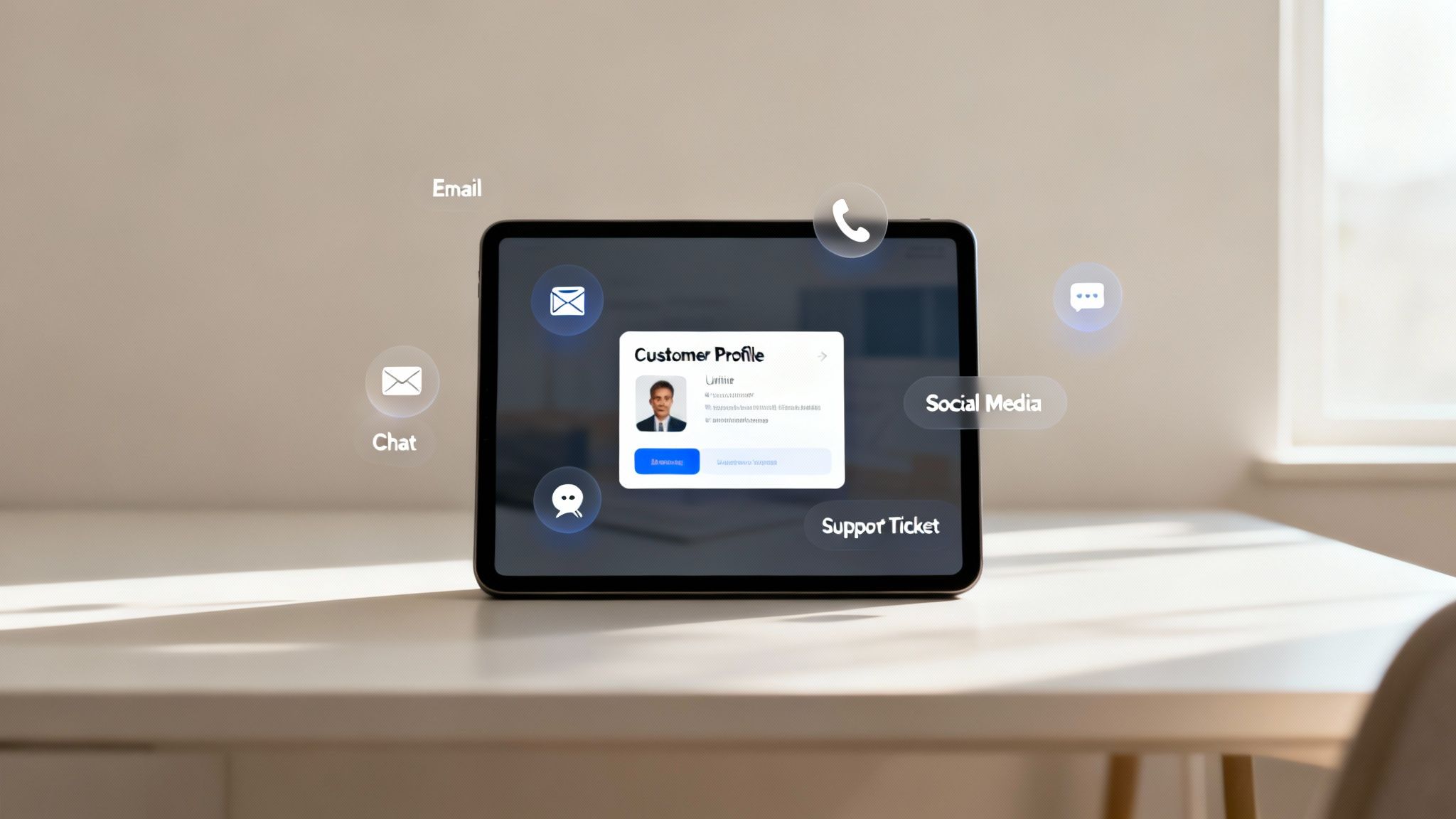
For professional services firms and MSPs, this means account managers can shift from reactive support to proactive, consultative partnerships. Imagine an MSP using Microsoft Dynamics 365 to see a client's entire service history and recent support tickets in a single dashboard before a quarterly review. This allows them to anticipate needs and recommend strategic upgrades, directly fueling revenue growth.
How to Implement a 360-Degree View
Achieving this unified view requires strategic integration and data governance.
- Prioritize High-Value Accounts: Start your integration project by focusing on your most critical accounts to demonstrate a clear return on investment before a company-wide rollout.
- Establish Data Governance: Create firm rules for data entry and management to ensure all information is consistent and reliable across departments.
- Automate Data Capture: Use workflows to pull data from different platforms (like your marketing automation or help desk software) into the CRM, eliminating manual entry and reducing errors.
- Conduct Regular Audits: Schedule quarterly data audits to cleanse outdated information and maintain the accuracy of your client profiles.
This foundational step transforms your CRM from a simple database into an intelligent engine for building deeper, more profitable client relationships.
2. Establish Proactive Account-Based Marketing (ABM) Strategies
Account-Based Marketing (ABM) shifts the focus from a wide, lead-generation net to a targeted approach where marketing and sales align to engage specific high-value accounts. This hyper-personalized strategy treats each target account as a unique market, delivering customized content and experiences that resonate deeply with key decision-makers. This focus on relevance makes ABM one of the most effective client relationship management tips for B2B companies with long sales cycles.
For a B2B SaaS company, this could mean running LinkedIn campaigns with messaging tailored to C-level executives at specific Fortune 500 companies. Similarly, a professional services firm might create industry-specific case studies for target accounts in finance, demonstrating a clear understanding of their unique challenges. This tailored engagement builds stronger initial relationships and shortens the sales cycle.
How to Implement ABM Strategies
A successful ABM program is built on deep alignment between sales and marketing.
- Define Your Ideal Customer Profile (ICP): Analyze historical win data and customer lifetime value to build a precise profile of your most profitable accounts.
- Identify and Prioritize Accounts: Collaborate with your sales team to select a list of target accounts each quarter that align with your ICP and business objectives.
- Create Personalized Messaging: Develop messaging pillars for each target account that address their specific pain points, goals, and industry context.
- Track Account-Level Engagement: Use account scoring to monitor engagement across all contacts within a target account, rather than just individual leads, to identify buying signals.
This focused strategy ensures your resources are spent on prospects most likely to become long-term, high-value clients.
3. Develop a Structured Client Feedback and Feedback Loop System
Merely hoping for client feedback is a passive strategy that leaves growth to chance. A structured feedback loop system creates a formal process to collect, analyze, and act on client insights at key lifecycle stages. This approach transforms client feedback from an occasional comment into a strategic asset, providing one of the most actionable client relationship management tips for continuous improvement and identifying hidden opportunities.

For a B2B SaaS company, this could mean using in-app surveys to gather feature requests after a major update. For a marketing agency, it might involve a formal post-project debrief with key stakeholders to measure impact and uncover needs for the next campaign. The goal is to demonstrate a commitment to partnership and use the insights to enhance service delivery, mitigate churn risk, and spot expansion potential.
How to Implement a Feedback Loop
Building an effective system requires timing, simplicity, and a commitment to action.
- Time Your Requests: Schedule feedback collection at natural transition points like post-onboarding, after project completion, or during quarterly business reviews.
- Keep It Brief: Maximize response rates by keeping surveys and forms short and focused, ideally with 3-5 targeted questions.
- Close the Loop: Always communicate back to clients what you heard and what specific actions you are taking based on their feedback. This proves you are listening and value their input.
- Assign Ownership: Ensure accountability by assigning a clear owner to each action item that emerges from feedback, with a defined timeline for resolution.
By systematizing feedback, you turn client sentiment into a predictable driver of retention and growth, strengthening relationships through a proven commitment to their success.
4. Build Personalized Client Communication Plans Based on Buying Stage
Sending generic, one-size-fits-all messages to every client is a quick way to get ignored. A far more effective approach is to create personalized communication plans that align your messaging, frequency, and channel with each client's stage in the buying journey. This tailored strategy is one of the most impactful client relationship management tips because it ensures your communication is always relevant and timely, transforming interactions from interruptions into valuable guidance.
For a B2B SaaS company, this means sending educational webinars to awareness-stage prospects, then shifting to ROI calculators for those in the consideration phase. A marketing agency might use a monthly newsletter for broad awareness, then switch to tailored case studies for highly engaged prospects. This strategic approach respects the client’s journey, building trust and demonstrating a deep understanding of their evolving needs.
How to Implement Personalized Communication Plans
Creating a scalable personalization strategy requires mapping content to the customer lifecycle.
- Create a Communication Matrix: Map each buying stage (awareness, consideration, decision, retention) to specific message types, ideal channels, and an appropriate contact frequency.
- Use Dynamic Content: Leverage marketing automation to personalize emails with content that reflects a client's industry or past engagement, making every message feel unique.
- Implement a Preference Center: Empower clients by allowing them to choose how often they hear from you and through which channels, reducing unsubscribe rates.
- Segment Your Audiences: Separate your communication streams for new prospects, active customers, and clients nearing renewal to ensure messaging is always contextually appropriate.
By aligning your outreach with the client's current stage, you guide them more effectively through the sales funnel.
5. Create Executive Sponsorship and Relationship Programs
For high-value, strategic accounts, standard account management is not enough. An executive sponsorship program assigns a senior leader to a key client, building a powerful peer-to-peer connection that transcends daily operations. This is one of the most effective client relationship management tips for creating deep, strategic alignment and insulating your most important partnerships from competitive threats. It transforms the relationship from a vendor-client dynamic into a true strategic alliance.
For a professional services firm, this might mean a Partner becomes the executive sponsor for a multi-million dollar account, participating in quarterly business reviews with the client's CEO. Similarly, a SaaS company could create a customer advisory board where its C-suite engages directly with executives from top-tier clients to shape the product roadmap. This level of engagement builds immense trust and creates significant switching costs.
How to Implement an Executive Sponsorship Program
A successful program requires structure, not just ad-hoc meetings.
- Define Sponsorship Tiers: Establish clear criteria for assigning an executive sponsor, such as account revenue or strategic importance. Not every client needs one.
- Structure Executive Engagement: Create formal templates for executive business reviews that focus on strategic goals and performance rather than tactical issues.
- Brief Executives Thoroughly: Equip your leaders with a comprehensive understanding of the client's business, recent interactions, and strategic objectives before any meeting.
- Track High-Level Engagement: Monitor the frequency and quality of executive interactions as a key performance indicator alongside traditional account health metrics.
By fostering these top-level relationships, you ensure that your firm is aligned with your client’s most critical business objectives, securing long-term loyalty and growth.
6. Implement Data-Driven Customer Health Scoring Systems
Waiting for a client to voice dissatisfaction is often too late. A data-driven customer health score provides an early warning system by quantifying account risk and identifying expansion opportunities. This model combines key metrics like product usage, support ticket frequency, and engagement levels into a single, actionable score. This is one of the most effective client relationship management tips because it shifts teams from a reactive to a proactive stance.
For instance, a SaaS company can predict potential churn by tracking a decline in monthly active users. An MSP can score accounts based on renewal history, support ticket trends, and license utilization. This allows account managers to prioritize their efforts, focusing on high-risk accounts that need immediate attention or high-opportunity accounts ripe for upselling.
How to Implement a Customer Health Score
Building an effective scoring system requires a focused, iterative approach.
- Start with Core Metrics: Begin by selecting 4-6 key metrics that have a strong historical correlation with churn or expansion in your business, such as login frequency.
- Weight Metrics Appropriately: Assign different weights to each metric based on its predictive power. For example, a drop in executive engagement might be a stronger churn indicator than a single negative support ticket.
- Create Action Triggers: Establish clear rules for intervention. For example, a "High Risk" score could automatically trigger an escalation to a senior account manager for a strategic review.
- Review and Recalibrate: Your business and clients evolve. Review and adjust your scoring model quarterly based on actual outcomes to ensure it remains accurate and relevant.
By sharing these scores with front-line teams, you empower them to make informed decisions that directly impact client retention and growth.
7. Establish Proactive Service Review Cadences (QBR/EBR)
Moving beyond reactive support requires a structured forum for strategic conversation. Implementing Quarterly Business Reviews (QBRs) or Executive Business Reviews (EBRs) shifts the dialogue from day-to-day operations to long-term value and partnership. This proactive cadence is one of the most effective client relationship management tips for demonstrating your impact on their core business objectives and solidifying your role as a strategic advisor.
For an MSP, this means presenting a review that covers security posture improvements and a technology roadmap, directly linking IT services to the client's growth goals. A digital marketing agency can use a QBR to showcase campaign ROI, competitive benchmarks, and strategic initiatives for the upcoming quarter. This transforms the relationship into a forward-looking partnership focused on mutual success.
How to Implement Effective Business Reviews
A successful review is built on preparation, strategic focus, and clear follow-through.
- Lead with Business Outcomes: Frame the entire conversation around the client's goals. Start with the value and results you've delivered, not a list of tasks completed.
- Create a Structured Agenda: Develop a consistent agenda that covers a performance recap, key wins, current challenges, and a forward-looking plan.
- Involve Key Decision-Makers: Ensure that executives and key stakeholders are in the room. Tailor the content to this audience, focusing on strategic impact over granular metrics.
- Document and Follow Up: End every QBR by documenting clear action items with assigned owners and deadlines. Following up on these items demonstrates accountability and maintains momentum.
8. Create Targeted Retention Programs for At-Risk Accounts
Passively accepting client churn is a major revenue drain. A proactive approach involves developing specialized retention programs for accounts identified as "at-risk" based on declining usage, negative feedback, or competitive threats. Rather than waiting for a client to leave, this strategy uses data to intervene early, diagnose the root cause of dissatisfaction, and demonstrate a renewed commitment to their success. These targeted interventions are crucial client relationship management tips for stabilizing your client base.
This shift from reactive to proactive retention allows you to repair relationships before they are broken. For example, a SaaS company can identify an account with a sharp drop in user activity and proactively reach out to offer free advanced training. An MSP provider can offer strategic service level enhancements to an IT director who has been engaging with competitors, reinforcing their value proposition and preventing churn.
How to Implement a Retention Program
Building an effective retention program requires speed, empathy, and personalization.
- Act Immediately: Once an account is flagged as at-risk, time is of the essence. Delays significantly reduce the probability of a successful recovery, so engage them quickly.
- Diagnose the Root Cause: Schedule a candid conversation to understand the core issues. Avoid making assumptions; listen carefully to their specific concerns.
- Personalize the Solution: Tailor your retention offer to address the client’s unique problems. This could be a pricing adjustment, enhanced support, or new strategic talent on the account.
- Involve Senior Leadership: Having a director or executive join a retention call demonstrates the importance of the relationship and shows a high level of commitment.
A well-executed program can turn a potential loss into a loyal, long-term advocate.
9. Leverage Customer Success Programs with Dedicated CSMs
Shifting from reactive support to proactive partnership is a cornerstone of modern relationship management. A dedicated Customer Success Manager (CSM) program formalizes this shift by assigning a strategic advisor to key accounts. Unlike support teams that fix problems, CSMs focus on ensuring clients achieve their desired business outcomes, driving product adoption, and identifying expansion opportunities. This is one of the most effective client relationship management tips for B2B organizations with recurring revenue models.
For a B2B SaaS company, a CSM might manage a portfolio of accounts, conducting quarterly business reviews to align the software's capabilities with evolving client goals. An MSP can assign CSMs to conduct technology assessments and strategic planning sessions, transforming the relationship from a vendor to an indispensable technology partner. This proactive engagement directly correlates with higher net revenue retention and customer lifetime value.
How to Implement a Customer Success Program
Building an effective CSM program requires structure, clear goals, and strategic resource allocation.
- Segment Your Accounts: Not all clients require a dedicated CSM. Tier your accounts by revenue or strategic importance to assign high-touch resources where they will have the most impact.
- Define Clear Responsibilities: Outline the CSM’s role across adoption, retention, and expansion. Establish key performance indicators (KPIs) like net revenue retention and health scores.
- Establish Engagement Cadence: Create a playbook for CSM activities, such as monthly check-ins and quarterly business reviews, with clear objectives for each interaction.
- Train for Business Acumen: Equip your CSMs with deep knowledge of your clients’ industries and business challenges, not just your product’s features. This empowers them to act as true strategic advisors.
10. Deploy Transparent Reporting and ROI Dashboards Customized per Client
Generic, activity-based reports fail to demonstrate true value and can weaken client trust. Deploying transparent, customized ROI dashboards connects your service delivery directly to the client's business outcomes. This approach transforms reporting from a simple update into a strategic tool for showcasing value, building confidence, and justifying continued investment. For B2B firms, this is one of the most critical client relationship management tips for proving tangible impact and fostering long-term partnerships.

For example, a digital marketing agency can create a dashboard showing lead generation, cost per lead, and revenue impact versus ad spend. An MSP can display uptime metrics, ticket resolution times, and IT cost savings against industry benchmarks. This level of transparency makes it easy for your client-side champion to advocate for your services internally, solidifying your role as an indispensable partner.
How to Implement Customized ROI Dashboards
Effective reporting requires collaboration and a focus on what truly matters to the client.
- Define Success Metrics Together: Partner with clients at the start of the engagement to define what success looks like. Don't assume their KPIs; ask them directly what metrics matter most.
- Focus on Outcomes, Not Just Activity: Shift from reporting on "what we did" (e.g., number of calls made) to "what we achieved" (e.g., pipeline value generated).
- Provide Context and Commentary: Use your dashboards to tell a story. Include trend lines showing performance over time and add commentary to explain variances or highlight key wins.
- Offer Layered Views: Create a high-level executive summary for C-suite stakeholders and more detailed dashboards that allow managers to drill down into specific metrics.
This data-driven approach demonstrates accountability and moves conversations from cost to value.
10-Point Client Relationship Management Comparison
Turning Client Relationships into Your Greatest Asset
Mastering the art of client relationship management is not about executing a single campaign or reaching a one-time goal. It’s a continuous, strategic commitment to building a customer-centric culture that permeates every facet of your organization. The journey from a transactional vendor to a trusted partner is paved with the deliberate actions and systems we've explored, transforming your client base from a revenue stream into your most powerful and sustainable asset.
We've covered a comprehensive suite of strategies designed to forge deeper, more resilient connections. From the foundational 360-degree customer view in your CRM to the proactive engagement of Account-Based Marketing (ABM), the common thread is a shift from reactive problem-solving to proactive value creation. By establishing structured feedback loops, you are actively listening and demonstrating that your clients' voices shape your evolution. This commitment is further solidified through personalized communication plans and executive sponsorship programs, which signal to every client that their success is a top priority.
Key Takeaways for Immediate Action
The true power of these client relationship management tips lies in their synergy. A data-driven customer health scoring system becomes exponentially more valuable when paired with proactive service reviews like QBRs. Likewise, a targeted retention program is far more effective when informed by insights from a dedicated Customer Success Manager. The ultimate goal is to create an ecosystem where value is not just promised but proven. Customized, transparent ROI dashboards are the final piece of this puzzle, closing the loop by tangibly demonstrating the impact of your partnership.
To begin this transformation, resist the urge to tackle everything at once. Select one or two of these strategies that address your most pressing challenges.
- Is your team operating in silos? Start with CRM integration to create a unified, 360-degree customer view.
- Are you losing high-value accounts? Implement a customer health scoring system and a proactive retention program.
- Do clients question your value? Focus on deploying transparent ROI dashboards and establishing a cadence for executive business reviews.
By choosing a starting point and committing to excellence, you initiate a ripple effect that elevates the client experience across the board. This focused approach builds momentum and demonstrates immediate value, making it easier to secure buy-in for broader initiatives. Ultimately, building relationships that last is about consistently showing up, listening intently, personalizing every interaction, and proving your worth time and time again. This isn't just good business; it's the defining characteristic of market leaders.
Ready to build the seamless, data-driven client experiences that define industry leaders? The experts at Twelverays specialize in integrating powerful CRM systems like Dynamics 365 and Salesforce to turn your client relationship management strategies into a powerful competitive advantage. Visit Twelverays to discover how we can help you forge unbreakable client partnerships.
Related Twelverays resource: revenue operations services.


