

A top-tier digital marketing agency for SaaS isn't just a vendor executing tasks; they should feel like an extension of your growth team. But to find that kind of strategic partner, you first have to do some homework. The most critical part of the process happens long before you start Googling agencies.
Define Your SaaS Growth Goals Before You Hire
Jumping into discovery calls without a crystal-clear definition of success is a recipe for wasted time and mismatched expectations. It's easy to say, "we need more leads," but that's not a goal, it's a wish. A great agency can't work with wishes. They need specifics to build a strategy that delivers a real, measurable return on your investment.
The exercise begins by connecting your big-picture business objectives to tangible marketing key performance indicators (KPIs). Instead of vaguely aiming for "growth," you need to define precisely what that growth looks like in numbers.

Translate Business Objectives Into Marketing KPIs
Your marketing goals shouldn’t exist in a vacuum. They need to be a direct reflection of your company's financial and operational targets. The trick is to work backward from the finish line.
Let's look at how this plays out with a few common SaaS objectives:
- Marketing KPI: Generate 400 new Marketing Qualified Leads (MQLs) per month, assuming your historic lead-to-customer conversion rate is 10%.
- Marketing KPI: Boost new user onboarding engagement by 25% using targeted email automation and in-app messaging.
- Marketing KPI: Lower the cost-per-SQL (Sales Qualified Lead) from paid channels by 20% without sacrificing lead quality.
This simple act of translating broad objectives into specific, measurable outcomes is what separates a productive agency search from a frustrating one. It gives potential partners a concrete target to aim for from day one.
Conduct an Honest Audit of Your Current Funnel
Once you have your KPIs locked in, the next step is to pinpoint exactly where you need the most help. This calls for a quick, brutally honest audit of your marketing and sales funnel to find the biggest leaks and opportunities.
It's time to ask your team some tough questions.
Is our top-of-funnel a ghost town? Are we getting enough demo requests and free trial sign-ups? Or is the problem further down, are we struggling to convert those trials into paying customers?
Identifying the primary bottleneck is everything. A company with barely any website traffic needs a completely different strategy than one with tons of leads but a terrible conversion rate. The first needs an SEO-focused digital marketing agency for saas, while the second needs a partner who lives and breathes conversion rate optimization (CRO) and marketing automation.
By the end of this internal review, you'll have a clear, concise brief. This document will do more than just guide your search; it will attract the right kind of agencies, the ones equipped to solve your specific problems. This prep work saves you from wasting energy on calls that go nowhere and sets the stage for a partnership that actually works.
Matching Agency Specializations to Your SaaS Needs
Not all marketing agencies are created equal, especially in the B2B SaaS world. An agency that gets amazing results for an e-commerce brand will almost certainly struggle to navigate the long sales cycles and complex buyer journeys of a SaaS company.
Hiring a generalist is like asking your family doctor to perform brain surgery. They understand the basics, but they lack the deep, specific expertise you need to succeed.
Your first move is to filter out the noise. Look past generic service lists and scrutinize their actual specializations. The goal is to find a digital marketing agency for saas that doesn't just offer services but has deep, demonstrable experience in the specific channels that drive SaaS growth.
The Nuance of SaaS SEO
Almost any agency will tell you they "do SEO." For a SaaS platform, that's nowhere near good enough. Basic on-page SEO or getting you listed in local directories is completely irrelevant for a software company targeting a global audience.
What you're looking for is an agency that truly gets the technical weeds of SaaS websites.
This means they should be bringing up topics like:
- Log File Analysis: Understanding how search engine bots crawl your complex site, especially when critical features are behind a login wall.
- JavaScript SEO: Ensuring your dynamic, feature-rich pages are actually indexed and rendered correctly by Google.
- Schema Markup for Software: Using specific structured data to tell search engines what your product is, how much it costs, and what users think of it.
If an agency's eyes glaze over when you mention these, they're not the right fit.
A real SaaS SEO pro cares less about ranking for a broad term like "project management software." They're obsessed with capturing high-intent traffic with content that compares features, highlights integrations, or solves a specific problem for a user who is ready to buy.
Paid Acquisition Beyond Google Ads
While Google Ads has its place, a specialized SaaS agency knows that the highest-intent leads often hang out on other platforms. Your ideal partner should have a proven playbook for running winning campaigns where buyers are actively comparing software solutions.
These are the channels that really move the needle:
- Software Marketplaces: Running targeted ads on sites like Capterra, G2, and Software Advice puts your brand in front of people in the final stages of making a decision.
- Targeted LinkedIn Campaigns: Using Matched Audiences and Conversation Ads to get in front of specific job titles at your dream accounts, this is crucial for any account-based marketing (ABM) play.
- Content Syndication: Working with industry publications to put your best whitepapers and case studies in front of a relevant, pre-qualified audience.
If an agency’s paid media case studies are all about standard search ads, they probably don't have the sophisticated touch needed to manage a B2B SaaS ad budget effectively.
Mastery of Marketing Automation and CRM
The SaaS sales journey is almost never a one-and-done transaction. It's a long nurturing process that can stretch over weeks, even months. This is where expertise in marketing automation and CRM integration becomes non-negotiable.
You need an agency that can build and manage the systems that turn a free trial signup into a loyal, high-value customer.
A truly competent partner will be fluent in platforms like HubSpot, Marketo, or Salesforce Marketing Cloud Account Engagement (formerly Pardot). They should be able to design complex lead nurturing workflows, build lead scoring models that hand over the hottest prospects to your sales team, and ensure data flows seamlessly between marketing and sales.
Their ability to connect marketing activities directly to pipeline and revenue is what separates a true growth partner from just another vendor.
A Practical Framework for Vetting Potential Agencies
Now, let's get down to the brass tacks of picking the right agency. A polished sales pitch is one thing, but you need a systematic way to look under the hood and evaluate potential partners. It’s all about digging into what actually matters, proven, repeatable success in the hyper-competitive SaaS world.
Your mission is to find an agency that hasn't just worked with software companies, but one that deeply understands the unique challenges and growth levers of your specific business model. A slick presentation is nice, but a history of solving your exact problems is what you're really buying.
This isn't about finding a task-doer; it's about identifying a genuine growth partner who can think strategically about your business. That means looking at their track record through the lens of your SaaS needs.
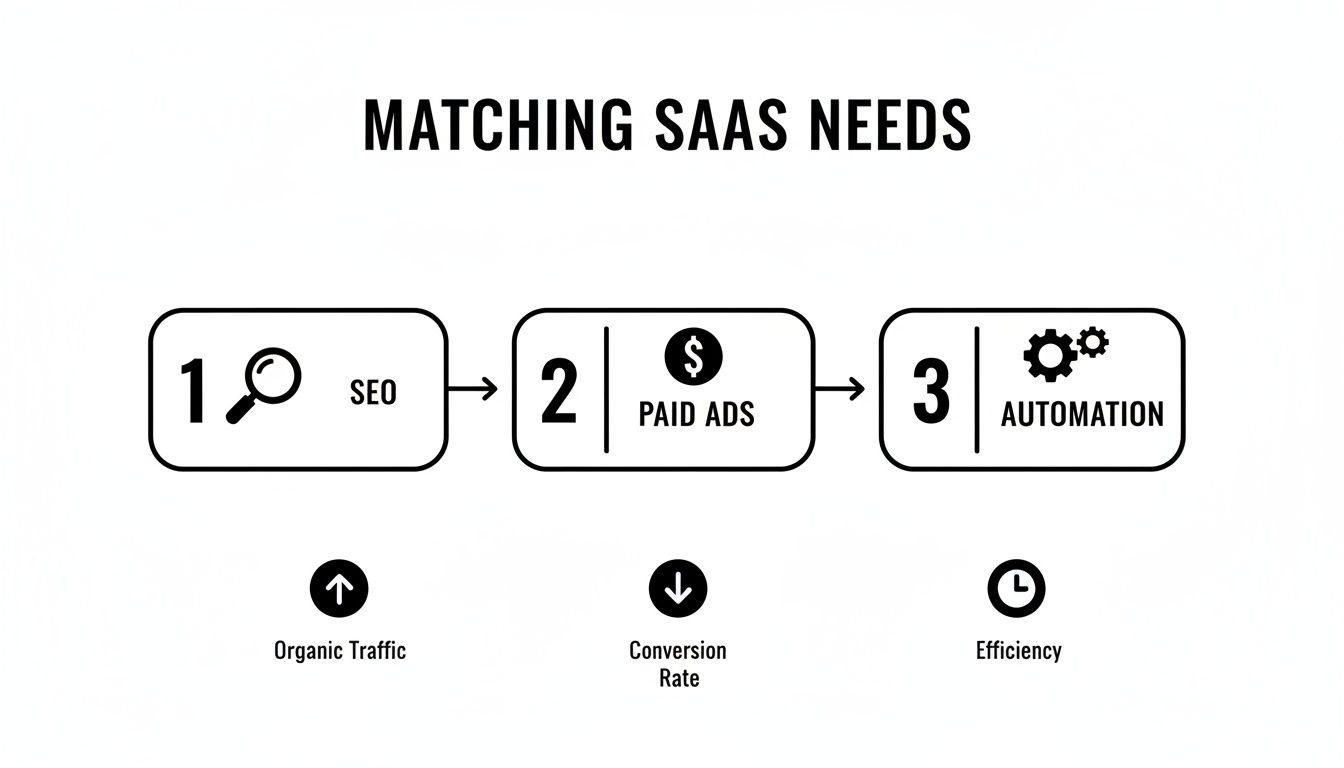
This flowchart nails it. A top-tier SaaS agency doesn't just run campaigns in silos. They integrate SEO for discovery, paid ads for targeted acquisition, and automation for nurturing into one cohesive strategy. This is the only way to effectively navigate the complex SaaS customer journey and turn leads into long-term revenue.
Dissect Case Studies for True Relevance
Any agency can show you a graph that goes up and to the right. Your job is to figure out if that success is actually relevant to you. Don't get distracted by vanity metrics like "increased traffic by 300%." Instead, hunt for evidence that they understand your go-to-market motion.
When you're reviewing their past work, ask yourself these questions:
- Business Model Fit: Did they get results for a product-led growth (PLG) company like yours, or are all their examples traditional sales-led enterprises? The playbooks are completely different.
- Problem-Solution Match: What specific problem did they solve? If you're drowning in low-quality leads, a case study about top-of-funnel brand awareness isn't going to cut it.
- Company Stage Alignment: Have they worked with a company at a similar stage? The strategy for a Series C giant with a monster budget is useless for a seed-stage startup.
An agency that proudly shows how they slashed CAC for a B2B SaaS in your vertical is a far better bet than one with flashy results from a totally unrelated industry.
Scrutinize Their Tech Stack and Reporting Philosophy
The tools an agency uses say a lot about their sophistication. A great agency won't just be familiar with your tech stack; they'll be power users who can suggest optimizations and integrations you haven’t even considered.
Make sure their preferred platforms for analytics, marketing automation, and project management align with your own. If they're all-in on a tool you dislike, it can create massive data silos and operational headaches.
The most revealing part of this process is how an agency talks about results. If their reports lead with vanity metrics like impressions, clicks, or social media followers, it’s a major red flag. True SaaS experts speak your language.
They should be obsessed with the business-critical metrics that directly impact your bottom line.
A conversation with a real growth partner will revolve around:
- MQL-to-SQL Conversion Rates: How efficiently are their marketing efforts creating real sales opportunities?
- Pipeline Velocity: How fast are leads moving through the funnel to become paying customers?
- CAC Payback Period: How many months of revenue does it take to recoup the cost of acquiring a customer?
This focus on revenue is what separates a strategic partner from a vendor who's just checking tasks off a list. To dig deeper into this mindset, check out our guide on finding a data-driven marketing agency.
To keep your evaluation structured, use a simple checklist to score each agency you talk to. It helps remove emotion and bias, giving you a clear, objective comparison.
Agency Evaluation Checklist
This checklist isn't exhaustive, but it provides a solid foundation. By scoring each potential partner against these criteria, you can move beyond the sales pitch and identify the agency that’s truly equipped to help you grow.
Making Sense of Agency Pricing and Crafting RFPs That Work
Let's be honest: agency pricing can feel like a complete mystery. It’s often the biggest hurdle when trying to compare proposals, leaving you wondering what you're really getting for your money. To get past this, you need to understand the common pricing models and shift your focus from cost to how well your incentives align with the agency's.
Once you have a handle on the financials, the next step is building a Request for Proposal (RFP) that does more than just ask for a price list. A great RFP forces an agency to show you how they think, turning a simple price comparison into a search for a true, long-term partner.
Decoding Common Agency Pricing Models
Most SaaS marketing agencies structure their pricing in one of three ways. Each has its own pros and cons, and the best fit for you depends on your need for budget predictability and how well-defined your project is.
A fixed monthly retainer, for instance, is perfect for ongoing, predictable work like content marketing or SEO. On the other hand, a one-off project like a website overhaul or CRM migration is much better suited for a project-based fee where the scope and deliverables are crystal clear.
Here are the main models you'll come across:
- Monthly Retainer: You pay a set fee every month for a pre-agreed scope of work. It's the most common model because it makes budgeting predictable and helps build a deep, collaborative partnership.
- Project-Based Fee: This is a one-time cost for a specific, clearly defined project. It’s great when you know exactly what you need but offers less flexibility if your goals shift.
- Performance-Based Model: Here, the agency's pay is tied directly to hitting specific KPIs, like generating a certain number of MQLs. This model is fantastic for aligning incentives but can be tricky to structure and track properly.
Getting into the weeds of these models is crucial. For a deeper dive into the numbers, our guide on the digital marketing services cost-benefit breakdown offers more detailed financial insights.
Crafting an RFP That Uncovers a Strategic Partner
A weak RFP gets you a price list. A great RFP gets you a strategic plan.
The goal isn't just to compare line-item costs; it's to make potential agencies show you their strategic muscle. You want to see their problem-solving process in action long before you sign any contracts. Instead of asking a generic question like, "What SEO services do you offer?" frame it as a real business challenge you're facing.
Don't just ask an agency what they do. Ask them what they would do for you. Give them a real challenge, like, "Our MQL-to-SQL conversion rate has been stuck at 5% for six months", and ask for a high-level strategic outline of how they'd approach it. Their answer will tell you more than any glossy case study ever could.
Key Components of a Winning SaaS RFP
If you want clear, comparable, and genuinely insightful proposals, your RFP needs to be structured and specific. Vague requests only lead to vague answers, making it impossible to evaluate your options on an even playing field.
Here’s a simple breakdown of what to include:
- Your Company Snapshot: Give a brief intro to your SaaS product, who you sell to, your current tech stack (e.g., HubSpot, Salesforce), and your primary business model (PLG, sales-led, etc.).
- The Core Challenge: Get straight to the point. Clearly explain the main problem you need to solve, using the specific KPIs you defined earlier to frame the challenge with hard data.
- Strategic Questions: Ditch the service checklists. Ask questions that force strategic thinking. For example: "Based on our goal of reducing CAC by 20%, which three channels would you prioritize in the first 90 days, and why?"
- Required Deliverables: Be explicit about what you expect back. Ask for a sample 90-day plan, bios of the team members who would work on your account, and at least two relevant SaaS case studies.
By designing your RFP this way, you push a digital marketing agency for saas beyond their canned sales pitch. You're not just shopping for services; you're evaluating their strategic mind to find a partner who will actually help you grow.
Testing the Waters With a Strategic Pilot Project
Committing to a 12-month contract with a new agency without a trial run is a massive, unnecessary gamble. The smartest SaaS companies de-risk this crucial relationship by starting with a focused, strategic pilot project.
This isn't about getting "free work." A pilot is a structured, paid engagement designed to answer the most important questions a case study or sales pitch never could. Do they communicate proactively? Can they hit deadlines? Does their strategic thinking translate into real-world execution? A 90-day pilot is your best tool for finding out.
Designing a Pilot That Delivers a Clear Verdict
A successful pilot needs a narrow scope and a crystal-clear definition of success. The goal isn't to fix all your marketing problems in 90 days. The real objective is to give the agency a specific, measurable challenge that serves as a real-world test of their capabilities and your collaborative chemistry.
Think of it as a microcosm of the larger partnership. You're testing their process, communication style, and ability to deliver tangible results on a smaller scale before you commit to a full-scale retainer. This approach protects your budget and gives you a concrete basis for a long-term decision.
A well-defined pilot could zero in on one of these areas:
- Paid Acquisition: Task the agency with lowering your cost-per-MQL on LinkedIn by 15% while maintaining or improving lead quality.
- SEO Content: Have them create a single, comprehensive content pillar around a high-intent keyword cluster and measure its initial ranking velocity.
- Conversion Rate Optimization: Challenge them to increase free trial sign-ups from your main pricing page by 10% through A/B testing.
These goals are specific, measurable, and achievable within a 90-day window. Their performance provides a clear "go" or "no-go" signal, removing guesswork from the decision to sign a long-term contract.
Setting the KPIs and Reporting Cadence
Once the pilot's objective is set, the next step is agreeing on how success will be measured and communicated. Transparency is non-negotiable. Any top-tier digital marketing agency for saas will welcome this, as it gives them a clear target to hit and shows their commitment to accountability.
This starts with establishing a shared dashboard. Whether it's in Data Studio (formerly Looker Studio), HubSpot, or another platform, both teams need access to the same real-time data. This eliminates "he said, she said" reporting and creates a single source of truth.
The most crucial element of a pilot isn't just the final result; it's the journey. How an agency handles challenges, communicates setbacks, and pivots strategy mid-campaign tells you everything you need to know about what a long-term partnership will feel like.
From there, define the reporting cadence. Trying to track every metric every day is a recipe for micromanagement and burnout. Instead, structure your communication around different levels of detail appropriate for different timeframes.
Here’s a practical framework we’ve seen work well:
This structured approach ensures everyone is aligned, from daily execution to high-level outcomes. It also sets a professional tone for the relationship, which is vital for a smooth transition into a full-blown partnership. Mastering this initial phase is key, and our guide on client onboarding best practices offers more insights into making this transition seamless.
Ultimately, a successful pilot isn't just about hitting a number; it's about building the foundation of trust and accountability needed for a fruitful, long-term relationship.
Got Questions Before You Hire a SaaS Agency?
Even after you've nailed down a plan, vetted a few partners, and mapped out a pilot project, some questions often remain. Dropping a significant investment on a digital marketing agency for saas is a big move, and it's normal to have lingering thoughts about the budget, the team, and whether it's all really worth it.
Let's dig into the most common questions we hear from SaaS founders and marketing leaders right before they make a decision. Getting straight answers here is often the final piece of the puzzle you need to move forward with confidence.
How Much Should We Actually Budget for a Marketing Agency?
This is always the first question, and the honest answer is: it depends. But there are solid benchmarks. A good rule of thumb for a growth-stage SaaS company is to put aside 20% to 40% of your target annual revenue growth for marketing. For more established players, that number usually levels out to around 10-20% of total revenue.
In terms of what you'll pay an agency each month, retainers can be all over the map. You might see numbers around $5,000 for a single, focused service like technical SEO, or it could climb north of $25,000 for a full-blown, multi-channel growth strategy.
The biggest mental shift here is to stop thinking "cost" and start thinking "investment." A great agency won’t just hand you a price tag. They'll build a business case that ties their fee directly to the metrics that matter most to you, like your Customer Acquisition Cost (CAC) to Lifetime Value (LTV) ratio.
The real question isn't "What's the price?" It's "What's the expected impact on our MRR and pipeline?" An agency that can answer that second question without breaking a sweat is an agency worth your time.
What's the Real Difference Between a Generalist and a Specialized SaaS Agency?
This one is huge. Getting this wrong can set you back months, if not years. A generalist agency might be great at marketing fundamentals, but they're juggling clients from e-commerce, local service businesses, and B2C brands. They don't live and breathe the B2B software world.
A specialized SaaS agency, however, is built from the ground up to understand your business.
That focus shows up in a few critical ways:
- They Speak Your Language: They're not just talking about clicks and impressions. Their world revolves around MRR, ARR, churn, net revenue retention, and expansion revenue.
- They Know Your Model: They’ve been in the trenches with product-led (PLG), sales-led, and hybrid go-to-market strategies. You won't have to explain the basics.
- They Know Where Your Buyers Are: They understand that high-intent B2B buyers aren't just on Google. They have proven playbooks for channels that move the needle, like G2, Capterra, and hyper-targeted ABM campaigns on LinkedIn.
Going with a specialist means you're not paying them to learn your industry on your dime. They can jump right in and start executing, skipping the months of expensive trial-and-error a generalist would need.
Should We Hire an Agency or Just Build Our Own Team In-House?
This is the classic "build vs. buy" debate. It isn't about which one is universally "better", it's about what's right for your company's stage, resources, and speed.
Building an in-house team gives you incredible focus and deep product knowledge. But it's also slow and expensive. Think about the cost of hiring senior-level experts for SEO, paid ads, content, and marketing automation. It's a massive commitment, both financially and operationally.
An agency, on the other hand, gives you instant access to an entire team of specialists for one predictable fee. You get expert-level execution from day one, without the headache of recruiting, hiring, and onboarding.
For most scaling SaaS companies, the answer isn't one or the other. It's both.
The hybrid model is often the sweet spot:
- Hire a senior marketing leader in-house. This person owns the big-picture strategy, your brand, and product marketing.
- Partner with a specialized agency. They handle the hands-on, expert execution on channels that require deep, technical knowledge like SEO, paid media, and marketing ops.
This setup gives you the best of both worlds. You keep strategic control in-house while tapping into a scalable, expert team to drive growth faster than you could on your own. It's a powerful way to level up your marketing without taking on the full weight of building out a massive department from scratch.
Ready to partner with a digital marketing agency that truly understands the SaaS landscape? At Twelverays, we specialize in data-driven strategies that connect marketing efforts directly to revenue growth. Let's talk about hitting your next MRR goal.


