

Effective SEO rank tracking isn’t just about watching your position on a results page; it’s about understanding your digital footprint and its impact on your business. It starts with defining clear, business-centric goals and identifying the keywords that attract qualified leads, not just website traffic. The objective is to establish a performance baseline, enabling you to measure progress and demonstrate the tangible value of your SEO efforts.
We're not chasing vanity metrics. The goal is to tie every ranking improvement to a real, tangible business outcome.
Building Your Foundation for Accurate Rank tracking

Jumping into a rank tracking tool without a solid strategy is like navigating without a map. You'll see movement, but you won't know if you're heading toward your destination. The most critical part of learning how to track SEO rankings is laying a foundation that connects your daily work directly to business growth.
This initial phase is about more than watching keyword positions fluctuate. It’s about establishing a clear "why" behind what you're tracking. Instead of vague goals like "rank higher," you need to set tangible objectives tied directly to revenue.
Defining Your Business-Centric SEO Goals
Your SEO goals should mirror your company's primary objectives. Are you trying to generate more qualified leads for a specific service? Or perhaps drive more demo requests for a new software feature? These high-level goals dictate which keywords truly matter.
Here are a few examples of strong, measurable goals:
Increase organic leads from our "Managed IT Services" page by 15% in the next quarter.
Achieve a top-5 ranking for "B2B SaaS accounting software" to drive 20 additional demo requests per month.
Boost organic traffic to our high-intent case studies by 25% to support the mid-funnel sales cycle.
This strategic shift turns rank tracking from a passive task into an active performance indicator. You can draw a direct line from a ranking increase for a key term to a rise in valuable conversions. To understand how these goals fit into the broader strategy, you can learn more about what search engine optimization is and its role as a core business driver.
A common mistake is tracking a massive, unwieldy list of keywords without context. A much better approach is to focus on a curated list of high-intent phrases that signal a user is close to making a purchase. Quality over quantity is key.
Identifying High-Intent Keywords That Matter
Not all keywords are created equal, especially in B2B. Your keyword research must prioritize phrases that attract decision-makers, not just general traffic. Ranking #1 for "what is cloud computing" might generate clicks, but ranking for "cloud migration services for financial firms" is what acquires clients.
Focus your energy on identifying keywords with clear commercial intent. These are the phrases people use when they're ready to buy, and they often include modifiers like:
"Services"
"Solutions"
"Provider"
"For [your industry]"
"Pricing"
Establishing Your Performance Baseline
Before you can measure success, you need a snapshot of your starting point. This baseline is your benchmark, the "before" photo against which all future progress will be compared.
Document everything: your current average position for target keywords, the organic traffic to key pages, and the number of conversions those pages generate. This data will allow you to demonstrate the ROI of your SEO efforts in the future. With this foundation in place, you’re ready to choose the right tools for the job.
Assembling Your SEO Rank Tracking Toolkit
Once your strategy is defined, it's time to build your toolkit. For anyone serious about how to track SEO rankings, the right set of tools transforms abstract data into a clear performance narrative. The optimal setup combines foundational, direct-from-the-source data with the deep, competitive insights available only through specialized software.
Relying on a single tool is like building a house with only a hammer. You need a mix of instruments, each with a specific purpose, to create a robust system. The goal is to implement a setup that provides accurate data, saves time, and uncovers opportunities your competitors might be missing.
The Non-Negotiable Foundation: Google Search Console
Before considering a paid tool, make Google Search Console (GSC) your first stop. It’s free, essential, and offers a direct line of communication from Google itself. GSC reveals how the search engine views your site, providing raw data on clicks, impressions, click-through rate (CTR), and average position.
While GSC's "average position" can seem vague, its real power lies in its unfiltered honesty. This is your ground truth. You can see the actual search terms people are using to find you, discover keyword opportunities you weren't tracking, and receive alerts on technical issues that could be harming your rankings.
Google Search Console is the bedrock of any rank tracking effort. It’s not just a tool; it’s a direct diagnostic report from the source. Ignoring its data is like a doctor ignoring a patient's vital signs, you’re operating without full visibility.
Leveling Up with Dedicated Rank Trackers
As essential as GSC is, it has its limits. It doesn't provide daily rank updates, granular competitor tracking, or a detailed breakdown of SERP features. This is where dedicated, third-party rank tracking tools become invaluable, offering the advanced capabilities needed for a competitive B2B strategy.
These platforms are purpose-built for deep analysis and provide features GSC simply cannot match.
Daily Keyword Tracking: Get precise, daily updates on your positions. This allows you to react quickly to market shifts or algorithm updates.
Competitor Benchmarking: See exactly how you stack up against your competitors for your target keywords and uncover their strategies.
SERP Feature Analysis: Identify if you are appearing in featured snippets, local packs, or video carousels, critical visibility points that GSC glosses over.
Automated Reporting: Set up custom performance reports to be sent to stakeholders automatically, saving hours of manual work. Our guide on effective search engine rank reporting can help you structure these updates for maximum impact.
Choosing the Right Paid Tools for Your Needs
The SEO tool market is crowded, but a few platforms consistently deliver. Tools like Semrush, SE Ranking, and Advanced Web Ranking (AWR) are favorites among agencies and in-house teams because they provide the depth needed for strategic analysis beyond simple position tracking.
Historical rank tracking, for instance, has become a powerful asset. Advanced Web Ranking (AWR) brings more than two decades of rank-tracking history, tracking tens of millions of keywords across thousands of search engines for more than 24,000 companies, per its own reporting. At Twelverays, we utilize SE Ranking's Historical Data tab for our professional services and eCommerce clients, which shows position history, search volume, and traffic forecasts dating back to 2020.
When selecting a tool, it's helpful to weigh your options.
Comparison of SEO Rank Tracking Tools
Each SEO toolkit is unique, but this table breaks down the key players and their strengths. The goal is to match the tool's capabilities to your specific needs, whether you're just starting out or managing a large-scale enterprise campaign.
Tool | Best For | Key Features | Data Granularity | Pricing |
|---|---|---|---|---|
Google Search Console | Foundational performance and technical health monitoring. | Direct Google data, query analysis, indexation status. | Average positions, daily impressions/clicks. | Free |
Semrush | All-in-one marketing suites needing deep competitor intelligence. | Position tracking, site audits, backlink analysis, ad research. | Daily updates, SERP features, historical data. | Subscription |
SE Ranking | Agencies and SMBs looking for a balance of power and value. | Rank tracking, competitor analysis, keyword research, reporting. | Daily/on-demand updates, local/mobile tracking. | Subscription |
AWR | Enterprises and agencies requiring high-volume, precise data. | Large-scale rank tracking, white-label reports, historical data. | Daily, weekly, on-demand updates across search engines. | Subscription |
Ultimately, the ideal toolkit isn't about finding one perfect tool. It’s about combining the unfiltered truth from Google Search Console with the surgical precision of a dedicated rank tracker. This dual approach provides a complete, accurate, and actionable picture of your SEO performance.
Setting Up Your Tools for Actionable B2B Insights
Owning a powerful SEO toolkit is one thing; its real value comes from proper setup. Simply tracking a long list of keywords won't provide the strategic insights needed to drive B2B growth. The key is to configure your tools to mirror your business goals, turning raw data into a clear roadmap for action.
This approach transforms a rank tracker from a passive scoreboard into an active intelligence system. When you organize and segment your data correctly, you move beyond knowing your rankings to understanding why they matter. This is fundamental to learning how to track SEO rankings in a way that directly impacts your bottom line.
This flowchart breaks down the process, from initial data gathering to producing strategic, actionable reports.
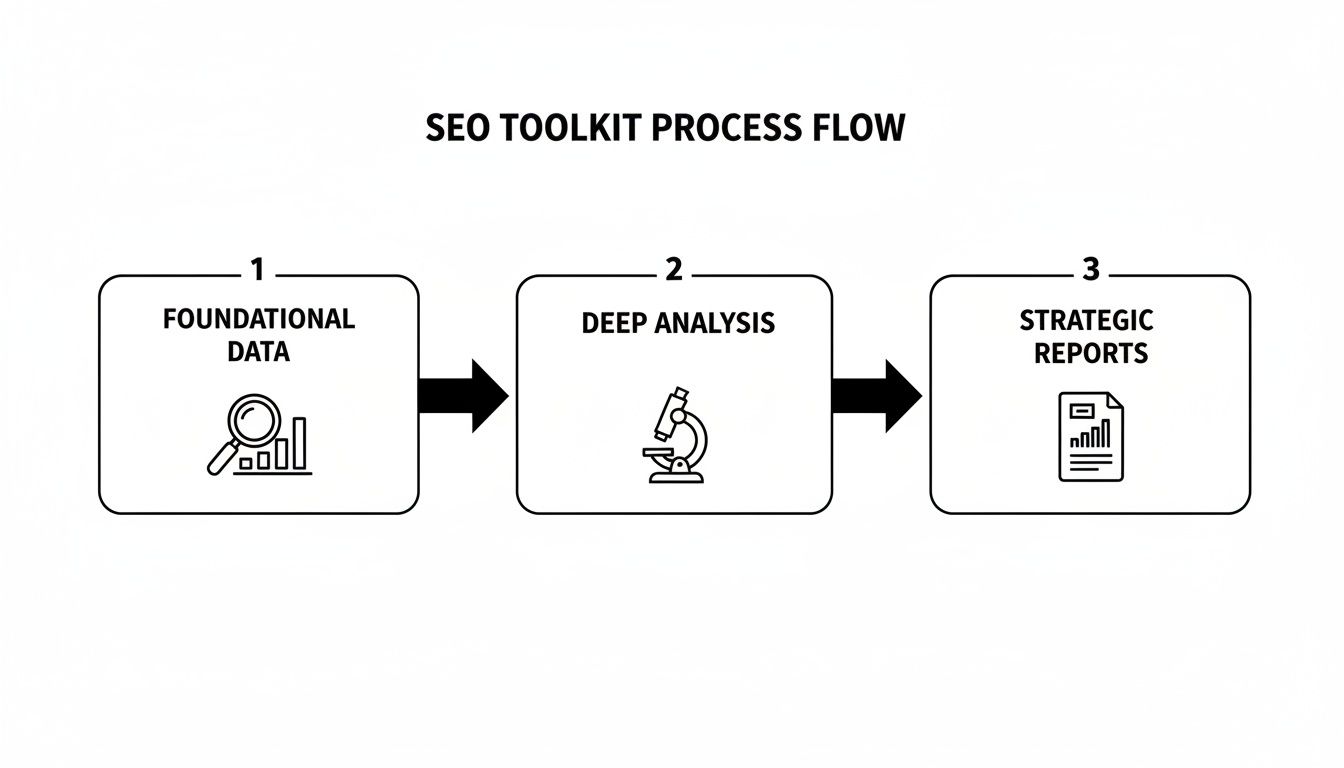
As you can see, effective SEO tracking is not a one-time task. It’s a continuous cycle of collecting data, performing deep analysis, and creating reports that inform your next strategic move.
Organizing Keywords for a Clearer Picture
An unorganized list of 200 keywords is just noise. To derive meaningful insights, you must organize your terms into logical groups that reflect your business operations. This simple step provides immediate clarity and helps you spot performance trends you would otherwise miss.
Consider grouping your keywords by:
Product or Service Line: Tag keywords separately for offerings like "Managed IT Services," "Cloud Solutions," and "Cybersecurity Consulting." This allows you to see which core services have the strongest organic visibility.
Sales Funnel Stage: Group keywords by intent. For example, "what is SD-WAN" is a top-of-funnel (awareness) query, while "SD-WAN providers for small business" is a bottom-of-funnel (purchase-intent) query.
Target Persona: If you're selling to different roles, such as marketing managers and IT directors, create groups for the specific keywords each persona is likely to use.
Competitor Tracking: Dedicate a group to keywords where you are competing directly with your main rival.
This level of organization makes your data infinitely more useful. Instead of just seeing that your rankings "went up," you can identify that your high-intent keywords for your most profitable service line are gaining significant traction.
Segmenting Data by Geography and Device
Not all searchers are the same. A prospect searching on a phone in Chicago will see different results than a decision-maker on a desktop in London. Failing to segment your data by device and location means you're looking at a blended, inaccurate average that hides critical opportunities and threats.
Ensure your rank tracker monitors performance across:
Device Types: Always track rankings separately for desktop and mobile. A sudden drop in mobile rankings could signal a user experience issue on smaller screens that needs immediate attention.
Geographic Locations: If you serve specific cities, states, or countries, you must track your rankings in those precise locations. This is essential for local SEO and for understanding your performance in key markets.
A common blind spot for B2B marketers is assuming all traffic comes from desktops. Mobile's share of B2B queries has been steadily increasing. If you’re not tracking mobile rankings, you’re missing a large piece of the puzzle.
Automating Reports and Setting Custom Alerts
The final configuration step is to automate your monitoring. Manually checking hundreds of keywords daily is an inefficient use of time and prone to human error. Automation ensures you stay on top of performance without getting lost in the details.
Most advanced rank trackers allow you to set up automated reports that are emailed to stakeholders on a set schedule. You can also configure custom alerts for instant notifications of important events. For instance, you could set an alert to trigger if:
A high-priority keyword drops off the first page.
A competitor enters the top three for a term you're targeting.
Your site earns a featured snippet for a key term.
This proactive approach enables you to react quickly to both threats and opportunities. Furthermore, tools like SE Ranking provide historical project data, including traffic forecasts and CPC, going back to February 2020. Daily automated checks do not improve your rankings on their own. They shorten the time between a position change and your response, so you act on movement while it still matters. You can learn more about how to use historical data for forecasting on SE Ranking’s blog. This data-driven approach is essential for demonstrating SEO's value.
For a foundational step in tool setup, check out our guide on how to add a user to Google Search Console.
Connecting SEO Rankings to Business Revenue

The primary purpose of learning how to track SEO rankings isn't just to watch charts trend upward. The real power is in connecting those SERP positions directly to your company’s bottom line. This is where you transition from discussing data to telling a compelling story of business growth.
Your ranking reports should be more than performance logs; they should be indicators of your company's financial health. When you can draw a straight line from a keyword moving up three spots to a tangible increase in qualified leads, SEO ceases to be a cost center and becomes a proven revenue driver.
To achieve this, you must move beyond watching positions and start analyzing what those rankings actually do for your business.
From Ranking Fluctuations to Strategic Insights
First, not every minor dip in your rankings is a cause for alarm. Google's algorithm is in constant flux, so small day-to-day fluctuations are normal. The skill is in distinguishing between background noise and a significant trend that requires a strategic response.
A real trend is a pattern, not a single keyword dropping a few places overnight. For instance, if you notice your entire keyword group for "Managed IT Services" is slowly losing ground over several weeks, it's time to investigate. Is a competitor's new content outperforming yours? Did a recent algorithm update change what Google values for that query?
The most valuable insights come from observing patterns over time. A single data point is an observation; a series of data points is a trend. Avoid reacting to every dip and spike. Instead, look for sustained movement that points to a larger strategic shift in the SERPs.
This is where historical data becomes invaluable. Top agencies rely on historical insights to diagnose performance issues and outmaneuver competitors. For B2B SaaS and professional services, pinpointing the cause of a traffic drop is mission-critical. The cause might be a major Google core update or SERP changes from AI Overviews. The March 2024 core update and spam update were a landmark example: Google called that core update its largest to date. Core updates kept coming through 2025 and into 2026, so the diagnostic question is rarely "was there an update" but "which one, and what did it reward." Historical data provides the context needed for an accurate diagnosis. See how Semrush uses historical data to drive growth for websites.
Correlating Rankings with Core Business Metrics
To prove the value of your work, you must tie ranking improvements to the metrics your leadership team cares about. This means connecting your SEO data with key business performance indicators.
Here’s how to connect the dots:
Ranking Improvements to Organic Traffic: In Google Analytics 4 (GA4), isolate organic traffic to the specific pages you're targeting. When a page's main keyword climbs into the top three, you should see a measurable lift in organic sessions to that URL.
Organic Traffic to Lead Generation: Take it a step further by tracking conversion events in GA4. Did that increase in traffic also lead to more form fills, demo requests, or phone calls? This directly links your SEO efforts to lead acquisition.
Lead Generation to Sales Pipeline: This is the final and most crucial connection. By integrating your analytics with your CRM (like Salesforce or Dynamics 365), you can track if those organic leads are turning into qualified opportunities and, ultimately, closed deals.
This full-funnel view lets a team state with confidence, as an illustration: "Our SEO work for this service line generated $75,000 in new sales pipeline last quarter." The number is hypothetical. The closed-loop tracking that produces it is not.
Integrating Data for a Complete Customer View
A siloed approach to data will always yield an incomplete picture. True insights emerge when you integrate your SEO rank tracker, Google Analytics 4, and your CRM into a single, cohesive system.
This integration creates a closed-loop reporting framework. It allows you to follow a user's entire journey, from their initial search query, through their website visit, to becoming a paying customer.
For example, your CRM might reveal that your highest-value customers consistently find you through the keyword "enterprise cybersecurity solutions." Armed with this knowledge, you know that protecting and improving your rank for that term is a top business priority. It’s no longer just an "SEO keyword"; it’s a primary source of revenue.
By building this integrated view, you elevate the conversation from rankings to revenue. To apply these principles across all your channels, see our guide on how to measure marketing ROI. This approach empowers you to show the tangible, bottom-line impact of your SEO strategy, turning simple ranking reports into undeniable proof of business value.
How to Troubleshoot Common Rank Tracking Problems
Even the most well-executed SEO strategy encounters challenges. Understanding the mechanics of tracking your rankings is only half the battle. The skill that distinguishes professionals is knowing how to diagnose problems when they arise.
Sudden drops and data discrepancies can be alarming, but there is almost always a logical explanation. The goal is not to react to every minor fluctuation but to build a reliable troubleshooting process. This will help you find the root cause, apply the right fix, and maintain tracking accuracy over the long term.
Unraveling Data Discrepancies
A common point of confusion is seeing different ranking data from different sources. You check your rank tracker, then perform a manual search in an incognito window, and the results don't match. This doesn't mean your tools are broken; it reflects how modern search operates.
Several factors can cause this:
Personalization: Your own Google search is heavily influenced by your browsing history, past clicks, and being logged into a Google account.
Location: Google serves different results based on your physical location, sometimes down to your specific neighborhood.
Device: Mobile search results can differ significantly from desktop, as Google prioritizes mobile-friendly sites for phone users.
Your rank tracking tool bypasses these variables by checking your rankings from a neutral, depersonalized location. This provides a stable, objective baseline that is far more useful for strategic decisions than your own biased search results.
Always trust the consistent, unbiased data from your dedicated rank tracking tool over a one-off manual search. Your tool shows what a typical new prospect sees, the metric that truly matters for business growth.
A Diagnostic Checklist for Sudden Ranking Drops
Seeing a keyword you’ve worked hard on suddenly drop in rankings can be unsettling. Before making drastic changes, run through a diagnostic checklist to determine the cause. This prevents knee-jerk reactions that could worsen the situation.
Potential External Factors
First, look beyond your own website. Often, a ranking shift is due to changes in the search environment.
Check for Google Algorithm Updates: Was there a recent Google update? Major updates can reshuffle search results overnight. SEO news sites and forums are the first places to find information about algorithm volatility.
Analyze Competitor Movements: Did a competitor launch new content or overhaul a key page? Significant improvements in their on-page SEO or new, high-quality backlinks can be enough to push your ranking down.
Potential Internal and Technical Issues
If external factors don't provide an answer, it’s time to look at your own site. Technical glitches are a common, and often invisible, cause of performance drops.
Indexation Problems: Use Google Search Console to ensure your key pages are still indexed. An accidental
noindextag or a mistake in yourrobots.txtfile can cause a page to disappear from search results.Manual Actions: While rare, a manual action from Google for violating their guidelines will severely impact your rankings. GSC will display a prominent notification if your site has been penalized.
Site Speed and Core Web Vitals: Has your site's performance declined? A sudden slowdown, especially on mobile, can harm your rankings. Use PageSpeed Insights to check for new issues.
Significant Site Changes: Did you recently migrate your website, change your URL structure, or implement a major redesign? Such events can cause temporary (or, if handled poorly, permanent) ranking drops.
If you're seeing a traffic loss that might be tied to these issues, our guide can help you figure out why your website lost traffic and how to fix it.
Maintaining Long-Term Data Accuracy
Finally, maintaining clean data is crucial for effective troubleshooting. A best practice is to filter out your branded keywords (any search that includes your company name) from your main reports.
While it's important to rank #1 for your own brand, these keywords don't reflect your ability to attract new customers. By creating a separate report or segment for your non-branded, high-intent keywords, you get a clearer picture of your true organic reach. This focused view helps you spot the trends that actually matter, without the noise from branded searches.
Got Questions About SEO Rank Tracking? We've Got Answers.
When delving into rank tracking, several questions frequently arise. Whether you're a marketing director interpreting data or a business owner assessing its bottom-line impact, getting these details right is crucial for a successful SEO initiative. Let's address some of the most common queries.
How Often Should I Be Checking My SEO Rankings?
For most B2B companies, a weekly check-in is the sweet spot. More frequent checks risk getting lost in the daily noise of minor SERP fluctuations.
A weekly cadence provides enough data to spot meaningful trends and react to major algorithm updates without overreacting to a keyword that drops one spot and recovers the next day. Daily tracking is useful for a handful of critical keywords during a major product launch, but for long-term strategy, weekly analysis offers the necessary perspective.
Why Do My Rankings Look Different in My Tool Versus a Manual Search?
This is a classic question. The reason is simple: your manual Google search is personalized. It's shaped by your search history, physical location, and even the device you're using.
Your SEO tool, on the other hand, operates from a neutral, depersonalized location. It provides an objective baseline of what a new prospect, unaffected by previous brand interactions, would see.
For strategic decisions, always trust the consistent, unbiased data from your dedicated tracking tool. It removes the personalization bubble, giving you a more reliable picture of your true market visibility.
What's a "Good" Ranking to Aim for in B2B?
While everyone covets the #1 spot, a truly "good" ranking is one that drives qualified traffic that converts into leads. Your first major goal should be to get on the first page (the top 10), as very few users click to page two.
However, the ranking number isn't everything. You must analyze the SERP itself. If the top results are filled with ads, "People Also Ask" boxes, and video carousels, a #4 ranking might be practically invisible. The real goal is not just a high number, but a visible position that captures clicks from the B2B buyers you want to attract.
Can I Just Use Google Search Console for Rank Tracking?
Google Search Console (GSC) is an absolutely essential tool, but it shouldn't be your only tool for tracking ranks. GSC provides an "average position," which can be misleading as it averages your rank across every impression, location, and query variation.
It's a fantastic source of truth, but it lacks key features needed for a competitive B2B strategy:
Precise, daily ranking data for your most important terms.
Detailed competitor tracking to see how you stack up.
In-depth analysis of SERP features like featured snippets or image packs.
The best approach is to use GSC as your foundational data source and pair it with a dedicated third-party rank tracker. This combination provides the granular, competitive, and actionable insights required to succeed.
At Twelverays, we cut through the noise of complex SEO data to build clear, revenue-focused strategies that deliver measurable growth for B2B and professional services firms. If you want to move past vanity metrics and tie rankings to pipeline, talk to our team.


