

The core difference in the marketing agency vs in-house debate is a classic strategic trade-off. An agency offers immediate access to a full team of specialists for a variable cost. In contrast, an in-house team provides deep brand immersion and direct control, but at a fixed, ongoing overhead.
Ultimately, the right choice depends entirely on your company's budget, current growth stage, and immediate strategic objectives.
Choosing Your Marketing Model: A Quick Guide
Deciding whether to hire a marketing agency or build an in-house team is a pivotal strategic decision for any business. This choice directly impacts your budget, the expertise at your disposal, your operational agility, and your overall growth trajectory. It's not just about who executes the marketing; it's about how you structure your company for success.
An in-house team lives and breathes your brand daily. They possess an intimate understanding of your company culture, products, and customers, which fosters powerful strategic alignment and enables rapid internal communication. This model places you in complete control of your marketing direction.
Alternatively, the agency route provides a turnkey solution, bringing a broad array of specialized skills to the table, from technical SEO and programmatic advertising to complex data analytics. Sourcing, hiring, and retaining that level of talent in-house is both challenging and expensive. An agency offers flexibility and can be more cost-effective, converting fixed salaries into a variable operating expense. For a deeper dive, our guide to outsourcing digital marketing offers additional perspective.

Key Differences at a Glance: Agency vs In-House
To truly understand the marketing agency vs in-house debate, a direct side-by-side comparison is essential. Grasping these core trade-offs is the first step toward making an informed decision tailored to your specific business needs.
The choice isn't about which model is universally "better," but which one provides the right blend of skills, cost-efficiency, and control for your company at its current stage of growth.
The table below offers a high-level summary, breaking down the main distinctions.
Each model presents its own advantages and limitations. The key is to map these attributes against your company’s immediate needs and long-term goals to determine which structure offers the most leverage.
A Realistic Breakdown of Costs and ROI
When analyzing the marketing agency vs in house debate, the conversation inevitably starts with cost. However, simply comparing an agency retainer to an employee's salary provides an incomplete picture. To make a sound financial decision, you must consider the Total Cost of Ownership (TCO) for both models. That's where the true financial narrative emerges.

An in-house team involves much more than salaries. You're committing to fixed, ongoing costs that extend far beyond a monthly paycheck. A realistic budget must account for every layer of this investment to grasp the full commitment.
The True Cost of an In-House Team
Building an internal marketing department is a significant financial undertaking, both initially and over the long term. A listed salary is merely the tip of the iceberg; the hidden costs are what accumulate.
Consider the full scope of expenses:
- Recruitment and Onboarding: Finding, interviewing, and training top talent is a costly process, often amounting to a significant percentage of a new hire's annual salary.
- Salaries and Benefits: Beyond competitive pay, you must factor in comprehensive benefits like health insurance, retirement plans, and paid time off. This adds 25-30% on top of the base salary.
- Essential Tools and Software: Your team requires professional-grade tools for analytics, SEO, social media, and content creation, which can cost thousands of dollars per month.
- Ongoing Training and Development: The marketing landscape evolves constantly. You must invest in continuous education, certifications, and conferences to keep your team's skills current.
To assemble a complete performance marketing team in-house, you would need to hire multiple senior-level experts at competitive market rates. An experienced performance marketer commands a base around $108,000, and senior specialists in major markets push past $165,000 before benefits and overhead. For a mid-sized company, a full senior team drives total annual personnel costs into the $500,000 to $1,000,000+ range. Agencies, by contrast, bundle most of these fixed expenses into a more manageable variable fee.
The Agency Cost Structure Explained
Partnering with a marketing agency fundamentally alters the financial model from a fixed overhead to a variable expense, providing significant flexibility. Agencies typically offer several pricing models, allowing you to select one that aligns with your specific goals.
The core financial benefit of an agency is converting the high fixed costs of a specialized, multi-disciplinary team into a predictable, scalable operational expense.
Here are the most common pricing structures:
- Monthly Retainer: A fixed monthly fee for a clearly defined scope of ongoing services. This model is ideal for long-term strategies like SEO, content marketing, and consistent campaign management.
- Project-Based Pricing: A one-time fee for a specific project with a clear start and end, such as a website redesign, a brand launch, or a targeted advertising campaign.
- Performance-Based Fees: In this model, the agency's compensation is tied directly to achieving specific KPIs, such as lead generation, sales, or cost per acquisition. It’s an effective way to align their success directly with your business outcomes.
While an agency retainer may seem like a substantial figure, it provides access to an entire team of specialists for what you might pay to hire a single full-time employee. This approach eliminates hidden costs like recruitment, benefits, software licenses, and training. Our digital marketing services cost-benefit breakdown is a great resource for understanding what these services entail. This model allows you to scale your marketing efforts up or down as needed, without the heavy commitment of hiring or firing staff, making it a far more adaptable financial strategy.
Accessing Specialized Skills and Expertise
The marketing agency vs in house conversation often comes down to one critical resource: talent. Modern marketing demands a skill set that is both broad and deep, creating a significant challenge for businesses building their teams. This decision directly impacts your ability to compete and grow.
The primary advantage of an in-house team is its profound brand immersion. These employees live and breathe your company's culture, values, and vision daily. With direct access to product, sales, and executive leadership, they can craft marketing that feels deeply authentic and aligns perfectly with company goals.
This institutional knowledge is difficult to replicate. An in-house marketer understands the subtle nuances of your customer base and the competitive landscape in a way an external partner rarely can. Their complete dedication to a single brand provides a focus and consistency that can be a tremendous asset.

The Agency Advantage: Specialist Knowledge on Demand
Realistically, no single in-house team can master every marketing discipline. This is where an agency provides a distinct advantage. Partnering with an agency grants immediate access to a full roster of seasoned specialists across a wide spectrum of fields.
This instant access to diverse expertise is a primary driver for engaging an agency. The talent math backs it up. Robert Half's research found that only 4% of marketing and creative teams have all the talent they need for their priority projects, and 77% of marketing and creative leaders plan to lean harder on contract specialists to close the gap. Agencies justify hiring niche specialists because they serve multiple clients, and they invest in enterprise-level tools and training that are often prohibitive for a single company.
Consider the specialized skills required for a single high-performing campaign:
- Technical SEO Specialists who navigate complex site migrations and algorithm updates.
- Programmatic Media Buyers experienced in managing six-figure ad spends across multiple platforms.
- Data Scientists who can build predictive models to extract deep customer insights from raw data.
- Creative Production Teams capable of producing high-quality video and interactive content at scale.
Hiring, training, and retaining this level of talent is not just expensive; it's a significant operational burden.
The real value of an agency isn't just task execution; it's the immediate infusion of cross-industry knowledge and best practices learned from managing hundreds of campaigns.
An agency team is constantly in the trenches, observing what works, and what doesn’t, across the entire market, not just within your company's bubble. This external perspective can identify blind spots and introduce fresh, innovative strategies that an internal team might overlook.
In-House Mastery: Deep and Narrow Expertise
While an agency offers breadth, an in-house team provides depth. An internal marketer’s singular focus allows them to become a true subject matter expert on your specific product, market, and audience. This deep knowledge is particularly critical for B2B companies with complex sales cycles or businesses in highly regulated industries.
The trade-off is clear. An in-house team may have unparalleled brand knowledge, but they are often required to be generalists. Your marketing manager might have to juggle social media, email campaigns, and content creation, preventing them from achieving true mastery in any single area. If you're curious about the specific roles an agency fills, our guide on what a digital marketing agency does can be helpful.
Ultimately, the choice depends on your objectives. If success hinges on rapidly launching specialized, technical campaigns, an agency's broad expertise is a significant advantage. However, if your marketing relies on deep institutional knowledge and seamless collaboration with other internal teams, the focused expertise of an in-house team may be the better path.
Comparing Control, Agility, and Speed
The discussion around choosing a marketing agency vs in house team invariably turns to operational dynamics. Who can move faster? Who provides more direct control over strategy? The answers are nuanced and highlight the core differences in how each model approaches speed and agility.
With an in-house team, strategic control is absolute. They are your employees, immersed in your company culture, and their priorities are your priorities. This direct oversight allows for lightning-fast internal approvals and tight alignment with shifting business goals. It's an ideal setup for executing quick strategic pivots without the formality of briefing calls or contract amendments.
For instance, if your product team accelerates a feature launch, an in-house marketing group can reallocate resources that same day. This seamless integration ensures marketing operates in lockstep with sales, product, and customer service, creating a cohesive and responsive unit.
The In-House Advantage: Direct Oversight and Cultural Alignment
The true power of an internal team lies in its proximity to the business. They understand internal politics, have immediate access to key decision-makers, and are fully immersed in your company's mission. In this environment, major decisions can be made and acted upon in hours, not days.
This structure excels in scenarios demanding an immediate reaction:
- Responding to Competitor Moves: A rival launches an unexpected campaign? Your team can craft and launch a counter-messaging strategy by day's end.
- Capitalizing on Market Trends: A breaking news story impacts your industry. Your content team can publish a timely, authoritative response within hours.
- Aligning with Sales Needs: The sales team identifies a common customer objection. Marketing can create a new case study or FAQ page to address it that same week.
However, this agility has its trade-offs. An in-house team, particularly a small one, is at constant risk of burnout. When every request is a top priority, capacity becomes stretched, which can lead to rushed work and a loss of long-term strategic focus.
The Agency Edge: Scalable Execution and Process-Driven Speed
A marketing agency, on the other hand, delivers a different kind of speed, one built on established processes, dedicated specialists, and scalable capacity. While they may require a more structured communication cadence, their ability to execute large-scale campaigns or enter new markets can far surpass that of a fledgling in-house team.
An agency’s speed is about having proven workflows and specialized talent ready to launch complex initiatives efficiently and at scale.
For example, launching a multi-channel paid media campaign across five platforms is a significant undertaking. It demands platform specialists, extensive ad creative, and a robust analytics setup. A skilled agency has this entire machine built and ready to activate. An in-house team would likely need to hire for those roles or divert generalists from other critical tasks, slowing momentum. While exploring marketing workflow automation can help close this gap, it doesn't replace specialized expertise.
The primary challenge with agencies is maintaining tight communication. Without a clear and consistent feedback loop, gaps can emerge, leading to misaligned messaging or delays. The most successful agency partnerships are built on a foundation of structured check-ins and a shared understanding of priorities, which ensures execution remains swift and on target. Ultimately, the marketing agency vs in house debate here centers on whether your business prioritizes immediate internal responsiveness or scalable, specialized execution.
Operational Dynamics: Agency vs In-House
To visualize these differences, let's break down the key operational factors that influence day-to-day marketing performance. The table below offers a side-by-side comparison of how each model performs regarding speed, control, and alignment.
This comparison highlights the fundamental trade-offs. An in-house team offers unmatched control and cultural integration, making them incredibly agile for internal adjustments. An agency provides process-driven speed and scalability, excelling at launching specialized, resource-intensive initiatives quickly. The right choice depends entirely on your immediate priorities and long-term growth plans.
Exploring Hybrid Models and Modern Trends
The traditional marketing agency vs in house debate has evolved beyond a simple binary choice. A more flexible and powerful approach has emerged: hybrid structures that combine the best of both models.
This blended model involves building a core in-house team that owns the strategy, brand voice, and deep customer knowledge. This internal group acts as the strategic hub, ensuring every marketing initiative aligns perfectly with broader company goals. They retain ultimate control over the brand’s direction and narrative.
Simultaneously, they engage specialized agencies to handle technical execution, large-scale campaigns, or niche channel management. This provides on-demand access to elite talent without the long-term cost and commitment of hiring full-time.
Crafting a Strategic Hybrid Structure
A successful hybrid model is a deliberate, strategic decision, not random task delegation. The objective is to retain core strengths in-house while leveraging external experts for specialized functions that are too costly or difficult to build internally. The result is a marketing operation that is both nimble and potent.
Here are a few common hybrid structures:
- In-House Strategy, Agency Execution: An internal marketing director sets the vision and KPIs, while an agency handles the day-to-day management of complex channels like programmatic advertising or technical SEO.
- Core Team with Project-Based Support: A company maintains an in-house team for daily marketing activities but brings in an agency for large, one-off projects like a website redesign, a major product launch, or expansion into a new international market.
- Generalists In-House, Specialists Outside: A lean internal team of marketing generalists manages the brand, content, and social media, while outsourcing highly specialized tasks like data analytics, conversion rate optimization (CRO), or advanced CRM integrations to specialist firms.
This hybrid approach strikes an optimal balance: you gain the deep brand immersion and control of an in-house team combined with the scalable, specialized expertise of an agency. It allows a business to be both agile and deeply capable.
This structure is gaining popularity as companies seek to maximize the efficiency and impact of their marketing spend. It offers a solution that can scale and adapt as the business grows or as market conditions change.
The Rise of Strategic Insourcing
In parallel with the hybrid model, there is a clear trend toward strategic insourcing. This involves selectively bringing specific marketing functions back in-house to gain tighter control over performance data, customer insights, and campaign agility. Rather than building a massive internal department from scratch, companies are hiring for a few key roles that provide a distinct competitive advantage.
This shift is driven by a desire for more direct oversight of critical metrics. The ANA's 2023 study found that 82% of its members now run an in-house agency, up from 78% in 2018, and 65% have moved work back from an external agency. The primary motivators are direct access to metrics, tighter budget control, and the ability to iterate on campaigns more rapidly.
For example, a B2B SaaS company might hire an in-house performance marketing manager to own its paid search strategy and budget, giving them direct control over a critical lead generation channel. Meanwhile, they can continue to outsource functions like creative production or top-of-funnel content to an agency partner. This nuanced approach demonstrates how the marketing agency vs in house decision is becoming a more strategic, function-by-function analysis.
An Actionable Framework for Making Your Choice
Having covered the pros and cons, it's time to move from theory to a practical decision-making process for the marketing agency vs in house debate. There is no universally correct answer; the optimal choice is the one that aligns with your company’s specific budget, growth stage, internal skills, and long-term vision. This framework will help you ask the right questions to determine that fit.
The first step is a candid assessment of your internal resources. Do you have team members with the time and foundational marketing skills to lead a strategy? If not, an agency provides an immediate, structured solution without a lengthy hiring process. Conversely, if you have a product expert who is also a natural content creator, building an in-house team around them could be a powerful move.
This flowchart illustrates a modern approach to this decision, showing how different needs can lead toward integrated, specialized, hybrid, or full-service models.
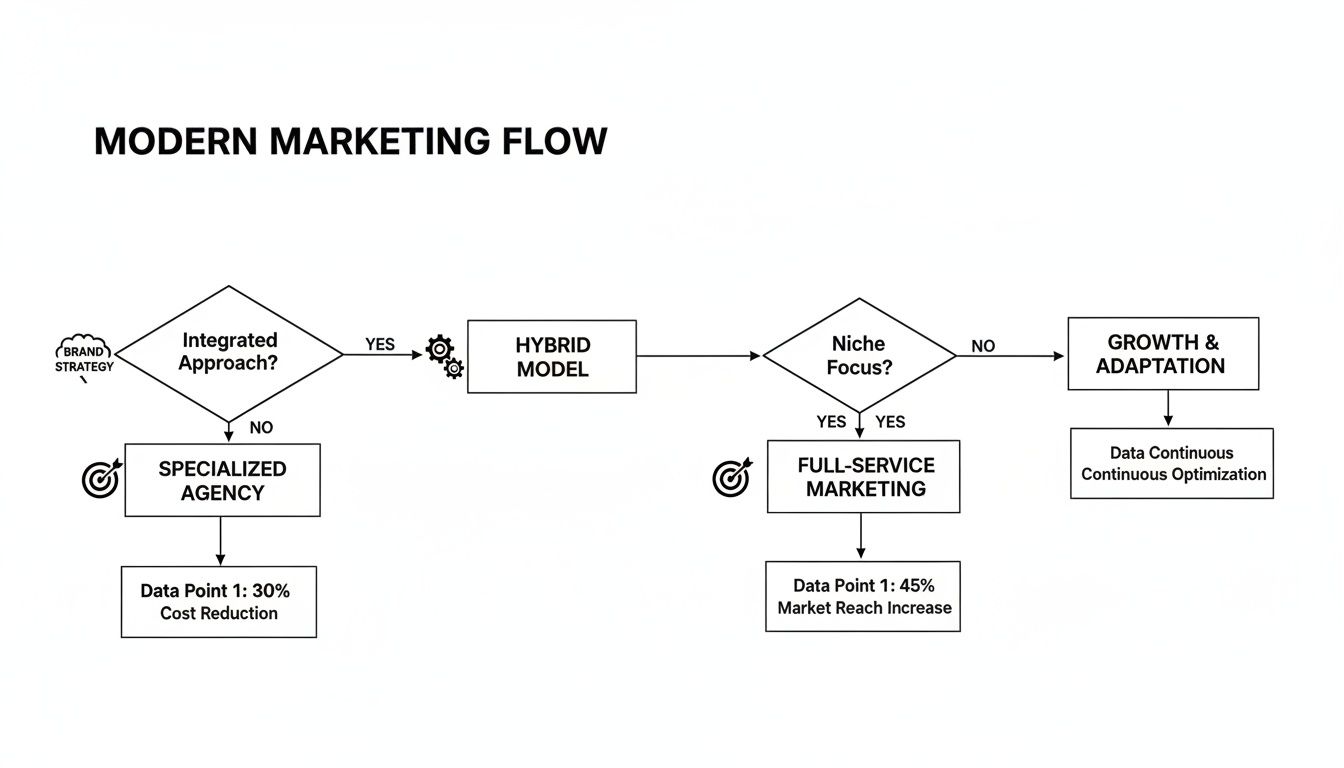
As illustrated, the right path often flows from your core brand strategy, which is why many businesses today adopt a flexible hybrid model or use a specialized agency for targeted, expert execution.
A Checklist for Strategic Decision-Making
Your company's unique situation is the most important factor. High-growth startups might prioritize an agency's ability to scale campaigns rapidly, while a mature enterprise may derive more value from the deep integration and brand control of an in-house team. Use this checklist to clarify your needs and determine the best path forward.
Assess Your Growth Stage
- Startup/Early Stage: Is your primary focus rapid market entry and lead generation? An agency’s established processes can accelerate growth from day one.
- Scaling/Growth Stage: Are you struggling to manage multiple marketing channels effectively? A hybrid model or a specialized agency can fill critical skill gaps without disrupting momentum.
- Mature/Enterprise: Is brand consistency and deep institutional knowledge your top priority? An in-house team offers unparalleled control and alignment with your company culture.
Evaluate Your Budget Realistically
- Can you afford the full cost of an in-house hire? Remember to include benefits, tools, and ongoing training, which can easily exceed $100,000+ per senior role. If not, an agency converts this fixed overhead into a predictable variable expense.
- Is your budget likely to fluctuate quarterly? An agency contract typically offers more flexibility to scale your investment up or down compared to the commitment of a full-time salary.
Analyze Your Core Competencies
- Which marketing functions are central to your value proposition? If deep, nuanced product knowledge is essential for content creation, that function should likely remain in-house.
- What technical skills are you lacking? It is almost always more efficient to outsource complex, specialized tasks like technical SEO or programmatic ad buying to an agency that specializes in those areas.
Your final choice should empower your business, not constrain it. The goal is to select a structure that provides the exact blend of control, expertise, and scalability your company needs to achieve its objectives right now.
Choosing the right partner is as critical as choosing the right model. If you decide the agency route is the best fit, it’s important to know what to look for. To assist with this, we've compiled practical guidance in our article on how to choose a digital marketing agency.
By thoughtfully working through these questions, you can move confidently from debating the marketing agency vs in house options to implementing the structure that will drive real, measurable results for your business.
Got Questions? We've Got Answers
Even after a detailed breakdown of the pros and cons, some specific questions may remain. This is normal. Choosing between building an in-house team and hiring an agency is a significant decision. Let's address some of the most common questions to provide further clarity.
Isn't an Agency Just More Expensive Than Hiring Someone?
Not necessarily, and this is a common misconception. When you compare an agency's monthly retainer to a single employee's salary, the in-house option can appear cheaper. However, it's crucial to consider the Total Cost of Ownership (TCO).
Hiring an in-house employee involves more than just their salary. You must account for:
- Recruitment costs to find and screen the right candidate.
- Benefits packages, which add another 25-30% on top of their base salary.
- Software and tools, which can cost thousands of dollars annually for a comprehensive marketing stack.
- Ongoing training to ensure their skills remain current.
When all these factors are considered, one senior marketer on your payroll can easily cost more than an agency retainer that provides access to an entire team of specialists, from SEO experts to paid media buyers. An agency converts a significant fixed cost into a predictable, flexible expense.
How Do I Make Sure an Agency Actually "Gets" My Brand?
This is a valid concern. It's natural to feel that no one will understand your brand as well as someone who lives and breathes it every day on your team. However, a strong agency partnership is designed to bridge this gap through a deep, structured onboarding process.
View your agency as an extension of your team, not just a vendor. The goal is immersion. Provide them with your brand guidelines, allow them to interview key stakeholders, and share your customer personas.
A top-tier agency will proactively seek to understand your business. They will establish regular, open communication and build a clear feedback loop to ensure every piece of work perfectly captures your brand's voice, values, and goals.
If I Build My Own Team, Who Should I Hire First?
If you've decided to build an in-house team, a strategic approach to hiring is key. Instead of hiring for every specialty at once, build a solid foundation first.
A logical hiring sequence often looks like this:
- Marketing Manager or Content Manager: Start with a strategic hub. This role should be filled by a strong writer and strategist who understands your audience and can create foundational content, such as blog posts and case studies, that your sales team can leverage.
- Digital Marketing Specialist: Once your content engine is running, hire a generalist to manage distribution. This person will handle social media, email marketing, and possibly basic paid search campaigns.
- Specialized Roles: As your budget and needs grow, you can begin adding specialists, such as a dedicated SEO expert or a paid media buyer.
This phased approach allows you to build a capable team without overextending your budget as you transition from the marketing agency vs in house debate to implementation.
Ready to stop debating and start growing? Twelverays brings together specialized expertise and a genuine understanding of your business goals to build data-driven campaigns that get real, measurable results. See how our tailored approach can work for you.


