

Video social media marketing is the practice of creating and sharing video content on social platforms to achieve specific business goals. The concept is straightforward: use the compelling nature of video to tell your brand’s story, engage your audience, and drive actions that contribute to your bottom line.
Building a Winning Video Marketing Strategy
Before you press record, you need a plan. A clear strategy is what distinguishes a successful video campaign from a costly, time-consuming flop. Effective video social media marketing isn't about producing videos and hoping for the best; it’s about establishing a foundation that directly supports your business objectives. Skipping this step risks creating content that looks great but accomplishes nothing.
This planning is more critical than ever. In 2026, video is not a "nice-to-have", it's a dominant force, with 91% of businesses using it as a core marketing tool, according to Wyzowl. The investment reflects this trend: the global digital video advertising market is projected to grow from roughly $140 billion in 2025 to an estimated $189 billion in 2026. This shows the immense confidence marketers have in its return on investment.
Set Concrete and Measurable Objectives
First, you must be specific. Forget vague goals like "increase engagement." You need to define concrete, measurable objectives that align with your company's broader goals. What does a "win" look like for your professional services firm?
Your objectives must be trackable. Here are a few real-world examples for a B2B company:
- Generate Qualified Leads: Increase marketing qualified leads (MQLs) from social media video CTAs by 15% this quarter.
- Boost Client Retention: Create a video series for existing clients that reduces churn by 5% over the next six months.
- Improve Brand Recall: Launch a thought leadership video campaign to increase unaided brand recall among target industry executives by 10%.
When you set clear KPIs from the start, every video you create has a purpose and a method for measuring success. This clarity transforms your video efforts from a creative project into a reliable growth engine.
Develop Detailed Audience Personas
You cannot create content that resonates if you don't know who you're talking to. This is where detailed audience personas are non-negotiable. They ensure your videos speak directly to the challenges, goals, and realities of your ideal clients. A generic message aimed at "everyone" will almost always connect with no one.
A well-defined buyer persona acts as your North Star for content creation. It informs the tone, topics, and formats that will best capture the attention of the decision-makers you need to reach.
Consider this: a video for a CFO should focus on ROI, cost savings, and financial efficiency. Conversely, a video for a Head of IT needs to address technical integration, security, and workflow improvements. To get this right from the beginning, see our guide on how to create buyer personas that will inform every part of your strategy.
Map Out the Content Journey
Finally, you need to map out a content journey that guides prospects from their first touchpoint to a purchase decision. Not every video should be a hard sell. A strategic approach uses different types of video to nurture potential clients through each stage of the marketing funnel.
This ensures you deliver the right message at the right time. Here’s a potential framework:
- Awareness Stage: Begin with high-level, educational videos. These capture attention and introduce your brand as a thought leader. Think short, insightful clips on LinkedIn addressing a common industry pain point.
- Consideration Stage: Now, go deeper. This is the time for content that showcases your expertise. Webinars, detailed tutorials, or client testimonials demonstrating how your solution works are perfect here.
- Decision Stage: This is where you build trust and drive action. In-depth case studies, product demos, or personalized video messages can provide the final proof points a prospect needs to close the deal.
Choosing the Right Platforms and Video Formats
Selecting the right social media platform for your video is as crucial as the message itself. In the B2B world, a scattergun approach is a surefire way to waste resources. Strategic video social media marketing is about placement, you must be present where your ideal customers are already active and in a professional mindset. It's not about being on every platform; it's about mastering the ones that matter to your audience.
Your choice of platform dictates everything that follows, shaping the video's length, style, and tone. A video that performs exceptionally well on LinkedIn might fall completely flat elsewhere. The key is to match your content to the audience's expectations and the platform's native environment.
Before you even think about production, your strategy needs a solid foundation. These three elements are the pillars that should guide every decision you make.
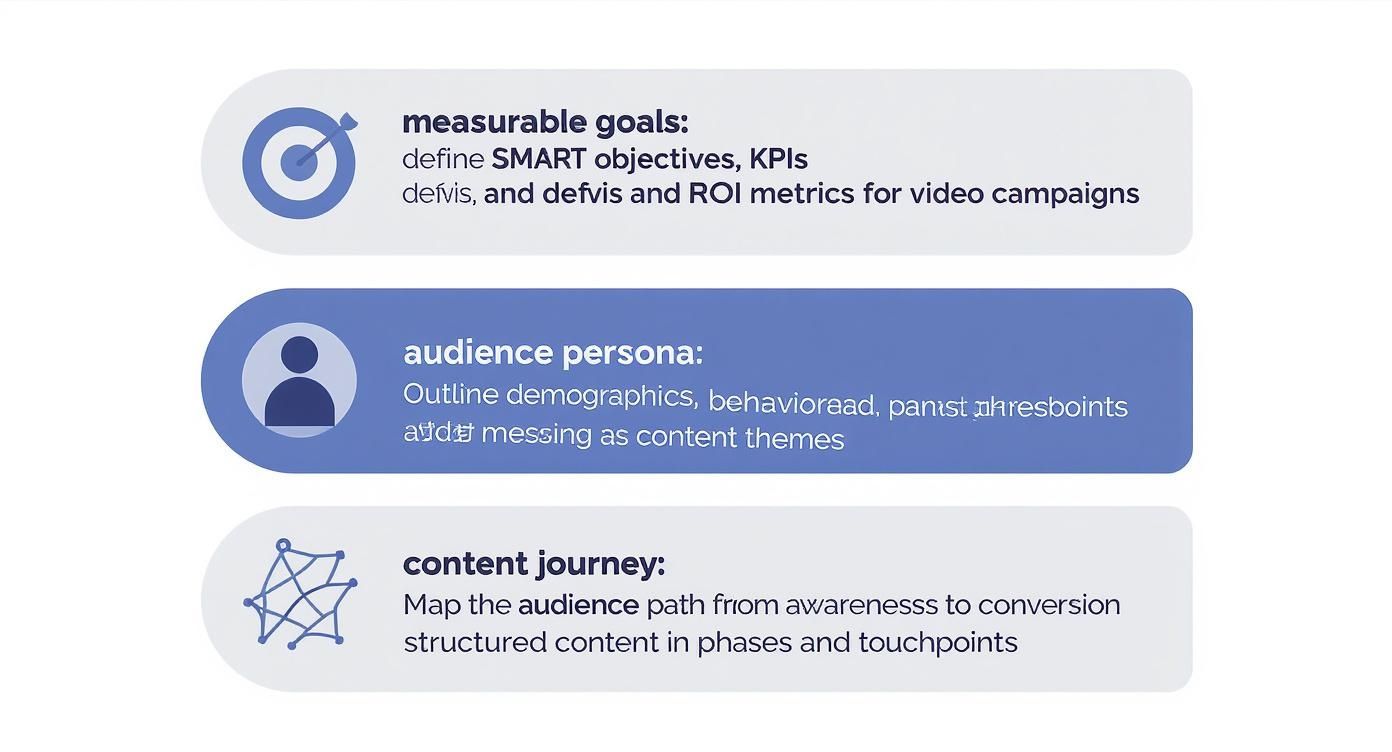
This reinforces the point: your platform and format choices must be tied to clear goals, a deep understanding of your audience, and their stage in the buying journey. Each piece of the puzzle informs the others.
Aligning Platform Strengths with B2B Goals
For professional services and B2B companies, the social media landscape primarily consists of a few key players. Each offers a distinct advantage depending on your objectives.
LinkedIn: This is the undisputed champion for B2B engagement. It’s the primary destination for thought leadership and professional networking. Users on LinkedIn are in a mindset geared toward career growth, industry news, and business solutions. Videos here should be polished, insightful, and add tangible value, think expert interviews, concise explainer videos, or company culture pieces designed to attract top talent.
YouTube: As the world's second-largest search engine, YouTube is your library for deep, evergreen content. Professionals use it to find detailed tutorials, comprehensive case studies, webinar recordings, and product demos. It’s the ideal platform for building a repository of helpful resources that solidify your authority over the long term.
While these are the main hubs, don't dismiss other platforms for specific goals. For instance, X (formerly Twitter) can be excellent for sharing quick video clips from an event or reacting to breaking industry news.
The goal isn't just to post a video. It's to start a conversation on a platform where your ideal clients are already listening. Your video should feel like a natural, valuable part of their feed, not a jarring interruption.
Matching Video Formats to Audience Intent
Once you’ve selected your platforms, the next step is choosing video formats that feel native to that environment. The format should feel like it belongs there.
Here’s a quick rundown of how different platforms stack up for B2B video, the audience mindset on each, and what you can realistically achieve.
B2B Social Platform Video Format Comparison
This table illustrates that a deep-dive webinar thriving on YouTube would be out of place on X. You must tailor the format to the context.
While established platforms are your bread and butter, the video marketing landscape is constantly evolving. Research from Wyzowl's 2026 State of Video Marketing report shows that 82% of video marketers still use YouTube, though short-form video is now the most-used and most-effective format. Around 85% of marketers say short-form delivers their best results, and short-form adoption is near universal. Live video remains a smaller play, used by roughly 36% of marketers. This reflects a major shift in how people consume content.
Let's break down some of the most effective formats for B2B today.
Short-Form Vertical Video (Reels, Shorts, TikTok)
These snappy clips, usually under three minutes, are designed for immediate attention. The most effective length is shorter still: Wyzowl finds 30-to-60-second videos work best, followed by one-to-two-minute clips. For B2B, they're surprisingly effective for:
- Quick, actionable tips related to your industry.
- Behind-the-scenes glimpses of your company culture.
- Busting common myths or misconceptions in your field.
And while platforms like TikTok are often seen as purely B2C, many service-based businesses have found success there. If this piques your interest, our guide explains how to utilize TikTok to market your services.
Educational and How-To Videos
These are your longer-form workhorses, ideal for YouTube and for promotion on LinkedIn. They position your brand as a helpful expert by solving a specific problem for your audience. Think software tutorials, process breakdowns, or strategic guides that your audience can immediately use.
Client Testimonials and Case Studies
Nothing builds trust faster than social proof. A professionally produced client testimonial video is a powerful and authentic endorsement of your work. These are perfect for your website, LinkedIn profile, and YouTube channel, helping prospects in the final decision-making stage see the real-world impact you deliver.
Nailing Your Video Production Process
The idea of producing video content can be intimidating. Many B2B teams assume they need a Hollywood-sized budget or a massive production crew to get started. That’s a myth.
The key to successful video production is a simple, repeatable system. It's about creating a workflow that takes you smoothly from initial concept to the final, polished video. This enables you to create a steady stream of professional content without exhausting your team or budget.
Pre-Production: Where the Real Work Happens
The most critical part of video production occurs long before you press record. Solid pre-production is your roadmap; it prevents costly reshoots and ensures your final video is sharp and on-brand. Rushing this stage is a common mistake that almost always leads to unfocused content.
Two elements are non-negotiable here: storyboarding and scripting.
- Storyboarding: You don't need to be an artist. A storyboard simply outlines each shot or key visual. It can be a series of rough sketches or text boxes that map out the visual flow. This simple step ensures your story is coherent before you film a single frame.
- Scripting: Even for a casual "talking head" video, a script is essential. It keeps you on point and ensures your message is concise. For B2B content, every word counts. A good script guides the viewer to the key takeaway without any fluff.
This preparation guarantees your message is crystal clear and aligned with your goals before you spend a dime on filming.
Focus on Gear That Actually Moves the Needle
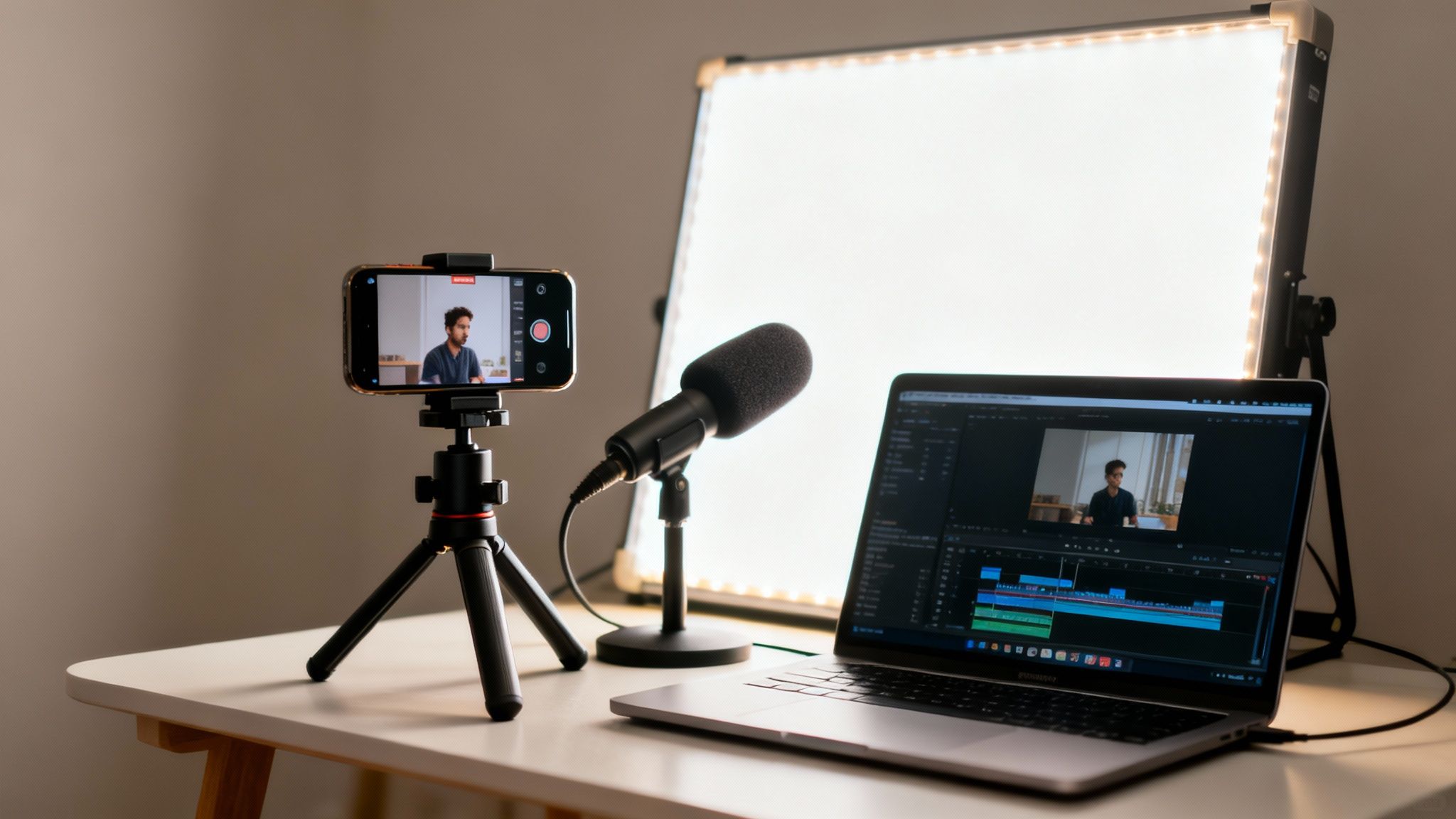
High-end cameras are nice, but they aren’t what separate professional-looking video from amateur work. The secret comes down to two things: lighting and audio.
Viewers will forgive slightly grainy video, but they will click away in seconds if the sound is poor.
A modern smartphone camera paired with a good microphone and decent lighting will outperform a professional camera with bad audio and lighting every time. It's not even close.
Here’s where to invest for the biggest impact:
- Audio: Invest in a quality external microphone. A simple lavalier (lapel) mic or a USB microphone can make a world of difference for under $100. It eliminates echo, cuts background noise, and makes your speaker sound crisp and clear.
- Lighting: You don’t need a complex studio rig. A basic three-point lighting kit or even a single ring light can provide that professional look. Good lighting removes distracting shadows and makes everything feel clean and polished.
Getting these two elements right is foundational. If you're serious about building a reliable in-house setup, exploring audio-visual production solutions can offer deeper insights into creating a scalable, professional system.
Editing: The Final Polish
Post-production is where you assemble raw footage and add the professional touches that make your content stand out. Modern editing software has become incredibly user-friendly, so don't be intimidated.
As you edit, ensure you add these three crucial elements to every video:
- Branded Graphics: Always include your logo, brand colors, and consistent title cards or lower thirds (text identifying the speaker). This reinforces your brand identity and gives your content a cohesive, professional feel.
- Clear Captions: A large percentage of social media videos, especially on platforms like LinkedIn, are watched with the sound off. Adding captions ensures your message lands regardless of how someone is watching and makes your content more accessible.
- A Compelling Call-to-Action (CTA): What should viewers do next? Every video needs a clear, obvious next step. Whether it’s “Download our new report,” “Visit our website,” or “Schedule a demo,” your CTA should be visible on-screen and mentioned in the script.
By building a workflow around these pillars, solid planning, great audio and lighting, and efficient editing, you can consistently produce high-impact video for your social channels without a massive budget.
How to Promote Your Video Content
You've created a fantastic video. That's a great accomplishment, but it's only half the battle. Without a smart promotion strategy, even the most polished content will fail to reach its audience. A brilliant video that no one sees is a huge missed opportunity, so let's discuss how to turn your effort into tangible results.
For video social media marketing to be effective, you need a two-pronged approach: one part organic promotion, one part paid amplification. This combination is how you get your content in front of the decision-makers who matter.

Driving Reach with Organic Strategies
Before allocating a budget to your video, you need to maximize its value through organic channels. This approach builds a sustainable foundation, giving your content a longer shelf life so potential clients can discover it long after the initial launch.
First, optimize your video for search, especially on platforms like YouTube and LinkedIn where professionals actively look for solutions. Put yourself in your audience's shoes: what search terms would they use to find your video? Weave those keywords into your video title, description, and tags. This simple adjustment transforms your video from just another post into a valuable, discoverable asset.
Another powerful and often underutilized organic tactic is employee advocacy. Your team members have professional networks filled with potential clients and partners. Encourage them to share your new video on their personal LinkedIn profiles. It’s a simple, authentic way to extend your reach and build trust through familiar faces.
Amplifying Your Message with Paid Campaigns
Organic reach is essential, but it has limits. To guarantee your video reaches a specific, targeted audience and delivers predictable outcomes, paid promotion is necessary. Paid social campaigns allow you to break free from the confines of your existing followers and target prospects with surgical precision.
This is where the strategy becomes highly effective. On a platform like LinkedIn, you can be incredibly specific with your targeting:
- Job Title: Want to reach VPs of Operations or Chief Financial Officers? No problem.
- Industry: Need to focus on professionals in tech or financial services? Done.
- Company Size: Only want to target enterprises with over 1,000 employees? You can do that.
This level of control ensures your ad budget is spent communicating directly with people who fit your ideal client profile. Your video becomes a laser-focused lead generation tool.
The real power of paid promotion isn't just reaching more people; it's about reaching the right people. By combining insightful video content with precise targeting, you create a reliable engine for generating high-quality leads.
A/B Testing for Peak Performance
Never assume your first ad is your best one. To maximize your investment, you must constantly optimize through A/B testing. The goal is to run multiple versions of your ad simultaneously to see what truly resonates with your audience.
Start by testing a few key variables. You could try two different thumbnails to see which one earns more clicks, or experiment with different ad copy to find the most compelling hook. For short-form video, you can supercharge your campaign with Reels ads by testing different opening clips or calls-to-action.
Let data be your guide. For example, here’s a simple A/B test for a B2B video ad promoting a new software feature.
After running the campaign, you might find that Variation B's direct headline and "Watch Demo" CTA drove a higher click-through rate. That's a powerful insight. You can then allocate your budget to the better-performing creative. This continuous cycle of testing and optimizing is what separates a decent campaign from a truly great one.
Measuring Video Performance and Proving ROI
To justify your video strategy and keep it funded, you must look beyond vanity metrics. Likes and views are nice, but they don't directly contribute to the bottom line. The real objective is to track key performance indicators (KPIs) that connect your video efforts to tangible business outcomes, like generating qualified leads and closing deals.
Securing an ongoing budget for video social media marketing depends on demonstrating its value in the language of business: revenue. This means getting comfortable with metrics like audience retention, click-through rates (CTRs), and video-driven conversions. It’s about drawing a clear line from a video on LinkedIn to a new client contract.
Moving Beyond Surface-Level Metrics
The first step is shifting from passive consumption metrics to active engagement and conversion data. A video with 10,000 views sounds impressive, but if 95% of viewers dropped off after three seconds, it achieved very little. True performance is measured by how your content influences audience behavior.
This is where a metric like Audience Retention becomes incredibly valuable. Platforms like YouTube provide detailed graphs showing the exact moment viewers lose interest. This data is pure gold. A consistent drop-off at the same point in several videos might indicate a confusing message or a slow section. That's direct, actionable feedback for your next production.
Another critical metric is the Click-Through Rate (CTR) on your CTAs. If your video ends with a prompt to download a whitepaper or book a demo, the CTR reveals how compelling that offer was. A low CTR is a clear sign of a disconnect between your video's content and the action you're requesting.
Tying Video Metrics to Business Goals
To prove a true return on investment, you must connect video performance data to your company's revenue. This requires a system that can attribute leads and sales back to specific video campaigns. It’s the final and most crucial piece of the ROI puzzle.
The most effective way to manage this is by integrating your social media analytics with your Customer Relationship Management (CRM) system, such as Salesforce or Microsoft Dynamics 365.
By connecting video engagement data to your CRM, you create a powerful feedback loop. You can see not just who watched a video, but whether that viewer eventually became a paying customer. This closes the attribution gap and provides undeniable proof of ROI.
For a deeper dive into this process, check out our guide on measuring social media ROI, which offers a more detailed framework for connecting your marketing efforts to actual revenue.
Key Performance Indicators for B2B Video Marketing
To get a complete picture of your campaign's health, you need to track the right KPIs at each stage of the marketing funnel. This helps you identify what's working so you can allocate resources for maximum impact.
Here's a breakdown of the essential KPIs to watch.
Key Performance Indicators for B2B Video Marketing
This structured approach transforms measurement from a simple reporting task into a strategic tool for continuous improvement.
Creating a Data-Driven Feedback Loop
Ultimately, measuring performance isn't just about creating a report; it's about making your next video better than your last. Once you know which videos are driving the most qualified leads, you can double down on those topics and formats.
For instance, you might discover that your short, animated explainer videos on LinkedIn have a 20% higher conversion rate for demo requests than your talking-head videos. That’s a powerful insight. It tells you exactly what kind of content your audience finds most valuable when they are seriously considering a solution.
This data-driven approach removes guesswork from your content strategy. It empowers you to refine your messaging, optimize your CTAs, and consistently produce videos that don't just get views, they generate revenue. This is how you transform your video social media marketing from a cost center into a predictable, profitable growth engine.
Answering Your Top Video Marketing Questions
Even with a solid strategy, venturing into video marketing for your B2B company can feel like entering uncharted territory. Questions inevitably arise. It's normal to encounter a few challenges as you begin, and you need clear, straightforward answers to maintain momentum.
Think of this section as a quick-reference guide to solve common problems. Getting these details right will sharpen your approach and ensure your resources are well spent. Let’s clear up the hurdles that can slow you down.
How Long Should My B2B Social Media Videos Be?
There’s no single correct answer. The ideal video length depends on the platform and your objective. The key is to match your video's duration to audience expectations on that specific channel.
- For quick scrolls on LinkedIn or X: Keep it concise, aim for 30-90 seconds. You’re competing for attention in a crowded feed, so your goal is to land one powerful message quickly.
- For in-depth learning on YouTube: This is where longer content excels. Videos over 10 minutes: such as detailed tutorials, webinar replays, or deep-dive case studies, perform very well. People visit YouTube specifically to learn, so they are prepared to invest more time. To delve deeper, our guide on how YouTube SEO can help you skyrocket your views explains how to optimize this kind of long-form content.
The golden rule? Deliver value from the very first second. Whether your video is 30 seconds or 30 minutes, its length is justified as long as it keeps the viewer engaged and delivers meaningful information from start to finish.
What's a Realistic Budget for a Small B2B Company?
You do not need a massive budget to create video that gets results. For a smaller B2B company, the focus should be on smart, targeted investments rather than expensive equipment. The smartphone in your pocket likely shoots incredible 4K video.
Focus your initial budget where it has the biggest impact:
- Quality Audio: This is non-negotiable. Poor audio will ruin an otherwise great video. A clear, crisp external microphone is the single most important piece of gear you can buy, and excellent options are available for under $100.
- Basic Lighting: You don't need a full studio setup. A simple ring light or a two-point LED panel kit can make a significant difference, eliminating shadows and giving your videos a clean, professional look for a modest investment.
Beyond that, your biggest investment is your time, planning, scripting, and editing. With a few hundred dollars in essential gear, you can begin producing a steady stream of effective videos.
How Often Should I Post Video Content?
Consistency will always triumph over frequency. It is far better to produce one high-value, well-planned video each week than to churn out five rushed, low-quality clips. In fact, overwhelming your audience with mediocre content can be counterproductive.
For most B2B companies, a great starting point is posting one or two high-quality videos per week on your primary channel, such as LinkedIn. This pace is manageable for small teams and allows you to build a reliable presence without sacrificing quality or burning out.
Once you establish a rhythm, you can analyze your performance data to determine if it makes sense to increase your posting frequency.
At Twelverays, we specialize in transforming your video marketing efforts into a predictable engine for business growth. Our data-driven strategies connect your content directly to your CRM, proving ROI and maximizing your impact. Move beyond guesswork and start generating measurable results. Schedule a consultation with our experts today.


