

A CRM strategy is more than just the software you purchase; it’s the high-level plan for how your company will manage and nurture customer relationships to fuel sustainable growth. It's a business philosophy that aligns your people, processes, and technology toward a single, unified goal: putting the customer at the center of everything you do.
Defining Your CRM Strategy: Beyond the Software

It’s a common mistake to think that buying a powerful CRM platform like Salesforce or Dynamics 365 is the strategy. This misconception is a primary reason why many companies end up with expensive software that functions as little more than a glorified, underused digital rolodex.
Think of your CRM software as a high-performance vehicle, it’s incredibly powerful, but useless without a skilled driver (your team), a race plan (your processes), and a clear finish line (your business goals). A genuine CRM strategy is the architectural blueprint for the entire operation. It dictates how you'll leverage that powerful engine to create superior customer experiences, shorten sales cycles, and build lasting loyalty.
Without this strategic foundation, even the most advanced platform is just an expensive database collecting digital dust.
Shifting from a Tool-First to a Strategy-First Mindset
The core purpose of a CRM strategy is to standardize and elevate every interaction your business has with its contacts, including current customers, leads, and future prospects. By creating a unified approach, you ensure every touchpoint is consistent, intelligent, and meaningful.
A strategy-first mindset means you:
- Define success first: Establish clear, measurable goals, like "reduce customer churn by 15%" or "shorten the average sales cycle by 10 days", before evaluating software features.
- Align your teams: Marketing, sales, and customer service break down their operational silos. They begin working from a single source of truth, creating a seamless and unified customer journey.
- Master your data: Implement clear processes for how data is gathered, managed, and used, transforming scattered information into a reliable asset for strategic decision-making.
This proactive approach is non-negotiable in today's market. The global CRM market is projected to grow from USD 86.4 billion in 2026 to USD 161.3 billion by 2033, underscoring its critical importance. Yet, despite over 91% of companies with more than 10 employees using a CRM, only a fraction feel their customer interactions are truly effective.
That gap is where strategy thrives. It’s the crucial difference between merely owning a tool and executing a plan that delivers tangible results.
To clarify, let's compare the two directly.
CRM Strategy vs. CRM Software at a Glance
This table makes it clear: the strategy is the plan, and the software is the tool you use to bring that plan to life.
Why the Distinction Matters
Grasping the difference between the software and the strategy is the key to unlocking real business value. The platform provides the means to manage customer data, but the strategy offers the reason and the method. It connects your team's daily activities to your overarching business goals, ensuring your investment delivers a tangible return.
For a deeper dive into the technology itself, you can learn more about what CRM systems are and how they work in our detailed guide.
A CRM strategy turns random customer interactions into a deliberate, unified system designed for growth. It's the conscious decision to place the customer at the very center of your operations and build your processes outward from there.
Ultimately, this strategic view transforms your CRM from a passive record-keeping tool into an active engine for generating revenue and building customer loyalty.
The Four Pillars of a Winning CRM Strategy

A robust CRM strategy is not just a document; it's a living framework built on four crucial pillars. Think of it like building a house, if all four cornerstones are strong and balanced, the structure will support sustainable growth.
If you neglect even one, the entire initiative becomes unstable, leading to a wasted investment, frustrated teams, and a tool that creates more problems than it solves. Let’s break down each pillar.
Pillar 1: People
This is the most underestimated pillar, yet it is arguably the most critical. Your CRM is only as effective as the people who use it daily. Without buy-in from your team, even the most advanced platform is just expensive shelfware.
Success here isn’t about forcing adoption; it's about demonstrating value. Your team must see the CRM as a tool that helps them succeed, not another administrative burden. This means involving them early, providing comprehensive training, and appointing internal champions who can support their colleagues.
A CRM platform is adopted one user at a time. The strategy must answer the fundamental question for every employee: "What's in it for me?" If it helps them close more deals, resolve issues faster, or eliminate tedious tasks, adoption will follow.
Pillar 2: Process
This pillar is about mapping how your business interacts with customers. It requires documenting the entire customer journey, from the initial marketing campaign to sales negotiations and post-purchase support. A well-defined process is essential for creating smooth, efficient operations.
When you formalize your workflows, you can identify bottlenecks, redundant steps, and points where information is lost. For example, a clear process ensures a seamless handoff of a marketing lead to a sales representative, preserving valuable context. This creates consistency and predictability across the organization.
It also highlights opportunities for automation, such as routine follow-up emails, task creation, or lead routing. Nailing down these processes is fundamental to building a high-performing operation and a cornerstone of effective sales pipeline management best practices.
Pillar 3: Data
If your strategy is the blueprint, data is the fuel. However, just as a car requires clean fuel, your CRM needs high-quality data to perform optimally. This pillar focuses on data hygiene, governance, and accessibility.
Your data strategy must answer several key questions:
- What data is essential? Define the specific fields your sales, marketing, and service teams need to perform their jobs effectively.
- How will we maintain data integrity? Establish rules for data entry and schedule regular clean-ups to remove duplicates and correct errors.
- Who owns the data? Assign clear ownership to ensure accountability for data quality within each department.
The objective is to establish a single source of truth: a reliable, centralized database that everyone trusts. With clean and complete data, you can derive meaningful insights, personalize customer interactions, and forecast with confidence.
Pillar 4: Technology
Finally, we have the technology itself, the CRM platform that brings your strategy to life. This is where tools like Salesforce or Dynamics 365 come into play. The key is to select a platform that aligns with your pre-defined processes and goals, not the other way around.
Don’t be swayed by an endless list of features. Your choice should be grounded in practical needs:
- Scalability: Can this platform grow with your business over the next five years?
- Integration: Does it integrate seamlessly with other critical tools, like your marketing automation or ERP software?
- Usability: Is the interface intuitive enough for your team to adopt it without significant friction?
The right technology becomes the central nervous system of your business, connecting departments, housing your valuable data, and empowering your people to execute the strategy you’ve carefully constructed.
Connecting Your CRM Strategy to Business Goals
A CRM strategy without clear business goals is an expensive exercise in futility. To realize a genuine return on your investment, you must tie your strategy directly to the tangible, measurable outcomes your leadership team values.
Think of your CRM as an engine designed to drive specific business objectives. The key is to define what success looks like before you get lost in the software's features. This means setting clear, quantifiable targets that align with your company's broader vision.
Setting SMART Goals for Your CRM
The goal "improve customer relationships" is too vague to be actionable. An effective CRM strategy is built on SMART goals: Specific, Measurable, Achievable, Relevant, and Time-bound. This framework forces clarity on your objectives and how you will measure success.
For example, a vague goal can be transformed into a SMART one:
- Specific: Increase the lead-to-customer conversion rate for our flagship product.
- Measurable: Achieve a 20% increase in the conversion rate.
- Achievable: This target is challenging but attainable based on current performance and planned initiatives.
- Relevant: This directly supports our primary business goal of increasing annual recurring revenue.
- Time-bound: We will achieve this target within the next two quarters.
This level of clarity provides a clear finish line and a concrete method for measuring the strategy's effectiveness.
A well-defined CRM strategy translates high-level business ambitions into concrete actions and measurable results. It answers the question, "How will this investment make our business stronger, more profitable, and more competitive?"
Key Performance Indicators to Track on Your Dashboard
Once your goals are set, you need to track your progress. This is where Key Performance Indicators (KPIs) come in. These are the specific metrics you will monitor on your CRM dashboard to assess if your strategy is on track. While the ideal KPIs vary by business, several are universally critical.
Here are some of the most important KPIs to monitor:
- Customer Acquisition Cost (CAC): This metric reveals the average cost to acquire a new customer. A successful CRM strategy should help lower this number by improving targeting and lead nurturing efficiency.
- Customer Lifetime Value (CLV): This is the total profit you can expect from a single customer over the entire relationship. Your CRM should help identify your most valuable customers and implement strategies to retain them. To explore this further, see our guide on increasing customer lifetime value.
- Sales Cycle Length: This measures the time it takes to convert a lead into a paying customer. Your CRM strategy should aim to shorten this cycle by automating tasks, refining lead qualification, and empowering sales with timely information.
- Customer Churn Rate: This is the percentage of customers who stop doing business with you over a given period. A low churn rate is a strong indicator that your customer service and relationship management efforts are successful.
Focusing on these core KPIs provides an unfiltered view of your business's health. This data-driven approach closes the gap between your strategic plan and real-world results, enabling you to justify your CRM investment and prove its ROI.
Building Your CRM Implementation Roadmap
Translating a CRM strategy into a functional system can seem daunting. The key is a structured, phased roadmap that breaks the project into manageable steps, ensuring each stage builds logically on the last and prevents the project from derailing.
A clear implementation roadmap transforms a complex technical project into a predictable business initiative. It provides stakeholders with clarity, sets realistic expectations for your team, and creates a direct line from your vision to a tangible return on investment.
Phase 1: Discovery and Goal Setting
Before considering any software, you must conduct a thorough analysis of your current state. This discovery phase involves documenting your existing sales, marketing, and customer service processes. Engage with your teams to understand what works, identify pain points, and locate the biggest bottlenecks.
This initial audit forms the foundation for defining success. With these insights, you can finalize the SMART goals and KPIs discussed earlier. This is a non-negotiable first step to ensure your CRM is designed to solve real business problems.
Phase 2: Platform Selection and Design
With a clear understanding of your requirements, you can begin evaluating tools. Assess platforms like Dynamics 365 or Salesforce based on how well they align with your specific processes and goals. Consider scalability, integration capabilities, and user experience.
Once a platform is chosen, the design phase begins. Here, you map out your ideal workflows and define data fields within the CRM. You will answer practical questions like, "What information is mandatory for every new lead?" or "What are the precise stages of our sales pipeline?" For a closer look at this critical decision, you can explore our detailed guide on how to choose a CRM system.
Phase 3: Implementation and Data Migration
This is the technical phase where the system is configured according to your design specifications. Custom fields are created, automation rules are written, and dashboards are set up to provide necessary visibility. This is also when you'll address one of the most significant challenges: data migration.
Moving your data isn't a simple copy-paste task. It requires a meticulous process of cleaning, de-duplicating, and formatting to ensure you start with a single source of truth. Launching a CRM with messy data is one of the fastest ways to undermine user adoption and doom the project.
Getting this right is essential. It ensures the data fueling your new system is clean, reliable, and ready to deliver valuable insights from day one.
Phase 4: User Training and Adoption
The success of a CRM rollout depends on your team's willingness to use it. This phase is about empowering them with effective training and ongoing support. Don't just show them how to use the system; explain why it benefits them, by saving time, automating tedious tasks, or helping them close more deals.
A best practice is to identify internal "champions", enthusiastic users who can assist their colleagues. Fostering a supportive environment where questions are encouraged is crucial for long-term adoption.
Phase 5: Ongoing Optimization and Review
A CRM implementation is never truly "done." The final phase is a continuous cycle of reviewing, tweaking, and improving. You must constantly monitor your KPIs to ensure you are meeting the goals set in Phase 1. Additionally, you should continually gather user feedback to identify friction points and opportunities for enhancement.
Your business is not static, and neither should your CRM strategy be. Treating optimization as an ongoing process ensures your CRM evolves with your company, delivering increasing value over time.
This iterative approach ensures your CRM continues to provide a strong return. The goal is to make every interaction count, a process this flow chart illustrates perfectly.
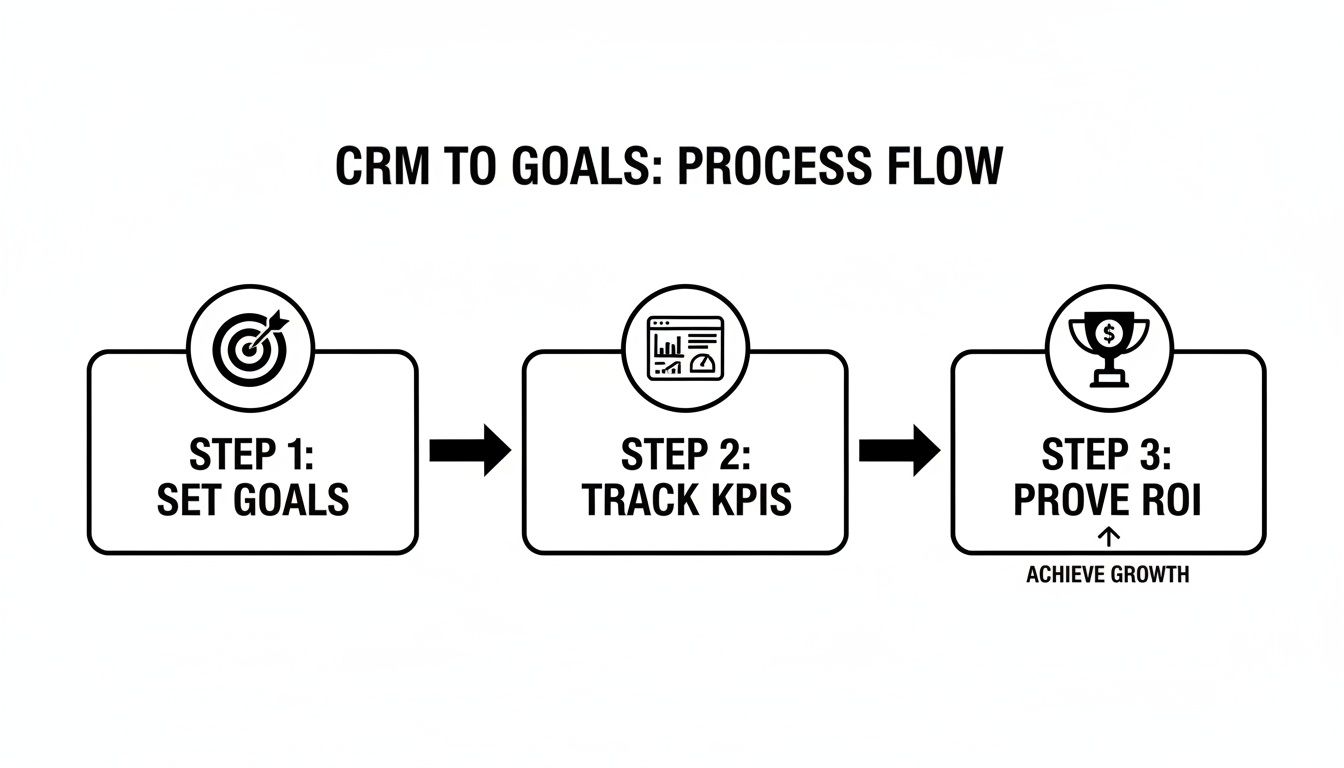
This visual demonstrates that every action within your CRM should be directly traceable to a core business objective. This is how you measure success and prove tangible ROI.
Common CRM Strategy Pitfalls to Avoid
Even the most well-crafted CRM plans can fail if you are not aware of common pitfalls. Understanding these potential landmines is your best defense, turning potential disasters into opportunities to build a smarter, more resilient strategy from the start.
Many CRM projects fail not because of faulty software, but because the strategy overlooks the human element. Learning from the mistakes of others is the fastest path to success. By proactively addressing these issues, you can create a plan that delivers on its promise.
The Technology-Only Trap
This is the most common mistake: treating a CRM project as a simple IT installation. When the conversation is limited to technical specifications and features, you lose sight of the people who must use the system daily.
The result is a technically sound system that is impractical for your sales, marketing, and service teams. It becomes a roadblock rather than a tool, leading to low user adoption and turning a major investment into an expensive, unused database. To understand why this occurs so frequently, explore our deep dive on the common failures of CRM.
How to Fix It: Frame the project as a business transformation initiative, not a software rollout. Involve heads of sales, marketing, and service from day one. The focus should be on solving their problems and improving their workflows, with technology as the enabler.
Launching with Messy Data
Imagine your CRM is a high-performance engine. Pouring sludge into the gas tank will cause it to sputter and fail. Migrating messy, duplicated, and incomplete data into your new system has the same effect.
It is a recipe for disaster. If your team cannot trust the information, incorrect contact details, outdated deal statuses, they will abandon the system. Bad data leads to flawed insights, wasted time, and a complete erosion of confidence in the platform.
- How to Fix It: Conduct a full data audit and cleansing process before migrating any records. While tedious, this step is critical. Then, establish clear data governance rules for how new information is entered and maintained. This upfront effort ensures your CRM is built on a foundation of clean, reliable data.
A Vague Definition of Success
Another classic error is launching a CRM strategy without clear, measurable goals. Objectives like "improve customer relationships" or "boost efficiency" are too ambiguous to be useful. Without specific targets, you have no way to measure success or calculate ROI.
This lack of clarity results in a rudderless project. Teams are not aligned, and stakeholders cannot see the value. Eventually, leadership will demand to see a return on their investment, and you will lack the data to justify it.
How to Fix It: Define SMART (Specific, Measurable, Achievable, Relevant, Time-bound) goals before you begin. Instead of a vague objective, aim for something concrete, such as, "Reduce the average sales cycle length by 15% within six months" or "Increase customer retention by 10% in the next fiscal year." These KPIs provide a clear finish line and a method for proving the strategy's value.
To help you stay on track, we've summarized these common issues and their solutions.
Common Pitfalls and Proactive Solutions
By keeping these points in mind, you are not just avoiding failure; you are actively building a foundation for a CRM strategy that becomes a true business asset.
Frequently Asked Questions About CRM Strategy
Even with a solid plan, questions often arise when implementing a CRM strategy. Addressing these early on builds the confidence needed to drive meaningful change. Here are some of the most common inquiries from business leaders.
How Often Should a Business Review Its CRM Strategy?
Your CRM strategy should be a living document that adapts with your business. Plan for a formal, in-depth review at least annually to ensure it remains aligned with your overarching business goals.
However, you should monitor your core KPIs more frequently, ideally on a monthly or quarterly basis. This allows for agile adjustments. You should also trigger a more comprehensive review whenever there are:
- Major shifts in your sales process or customer buying behavior.
- The launch of a new product line or service.
- Consistent user feedback highlighting friction points or new opportunities.
What Is the Difference Between a CRM Strategy and a Sales Strategy?
This is an excellent question, and the distinction is crucial. A sales strategy is a component of the broader CRM strategy. It is laser-focused on the specific tactics and workflows your sales team uses to meet quotas and generate revenue.
In contrast, your CRM strategy is the overarching framework that unites sales, marketing, and customer service. It is the connective tissue that ensures every customer-facing team operates from a single, unified playbook. This creates a seamless and consistent customer experience, from the first marketing touchpoint to a support ticket years later.
In short: The sales strategy helps you win deals. The CRM strategy ensures the entire customer relationship, before, during, and after the sale, is strong.
Can a Small Business Have a CRM Strategy Without Expensive Software?
Absolutely. A CRM strategy is fundamentally about your philosophy and processes, how you manage relationships, not the specific tool you use. The core principles of understanding your customer, mapping their journey, and using data to make informed decisions are universal, regardless of business size.
You can start with a well-organized spreadsheet or a free version of a popular CRM tool. The key is to begin by mapping your customer journey, standardizing how you track interactions, and defining what success looks like. The strategy always precedes the software; the software is merely the vehicle for executing that strategy as you scale.
Ready to build a CRM strategy that drives real growth? The experts at Twelverays specialize in creating and implementing custom CRM solutions with platforms like Dynamics 365 and Salesforce. Let's connect and turn your customer data into your most powerful asset.


