

A Marketing Qualified Lead (MQL) isn't just another contact in your database. Think of them as the person who’s moved from window shopping to actively asking for help. They've engaged with your marketing in a way that signals genuine interest, essentially raising their hand to say, "Hey, I'm paying attention." This simple shift is a game-changer for focusing your team's efforts where they'll have the most impact.
Decoding the Marketing Qualified Lead
Picture a visitor wandering through a huge bookstore. At first, they're just a prospect, browsing different aisles. That's casual interest.
But then, that same person walks up to a staff member and asks for specific books on landscape photography. Everything changes. They’ve just signaled clear intent. In the world of sales and marketing, that's what an MQL is.
An MQL isn't quite ready for a sales call, but they're well past the "just looking" phase. They've taken specific actions, like downloading a whitepaper, signing up for a webinar, or repeatedly visiting your pricing page, that flag them as a serious candidate for future business.
Why This Distinction Matters
Drawing a clear line between MQLs and other contacts helps your marketing and sales teams operate more intelligently. Instead of sales wasting time on leads who are still just kicking the tires, marketing can nurture these interested individuals with content that guides them closer to a decision.
This targeted approach offers several key advantages:
Smarter Resource Use: It frees up your sales team to focus their valuable time on leads who are far more likely to convert.
Better Lead Nurturing: Marketing knows which topics the MQL is interested in, so they can deliver relevant content that answers their specific questions.
A Healthier Sales Pipeline: By systematically qualifying leads, you build a more predictable and robust pipeline filled with genuinely interested prospects. You can dive deeper into how MQLs differ from sales-ready leads in our detailed guide on Sales Qualified Lead vs Marketing Qualified Lead.
The MQL concept gained prominence with the rise of inbound marketing for a good reason: the financial case is strong. Classic benchmark research from The Annuitas Group found that nurtured leads make 47% larger purchases than non-nurtured leads. Treat that figure as a directional, dated data point rather than a current promise. The principle holds: nurturing the right leads pays off. You can see it among other marketing-automation benchmarks.
A Marketing Qualified Lead is the critical bridge between marketing's broad outreach and sales' focused efforts. It’s the moment a lead says, "I'm listening," giving your team the green light to start a meaningful conversation.
The MQL in Context: The Journey from Prospect to Customer
To fully grasp what a Marketing Qualified Lead is, you have to see where it fits in the larger journey someone takes from being a stranger to a loyal customer. Leads don't just appear ready to sign a contract; they evolve through distinct stages, each requiring a different approach from your marketing and sales teams.
It all starts with a Prospect. This is anyone in your target market who could become a customer but hasn't interacted with you yet. Think of them as anonymous visitors to your site or names on an acquired list, a vast pool of unproven potential.
From there, the journey becomes more interesting as a prospect shows genuine intent, moving from a passive browser to someone marketing can actively engage.
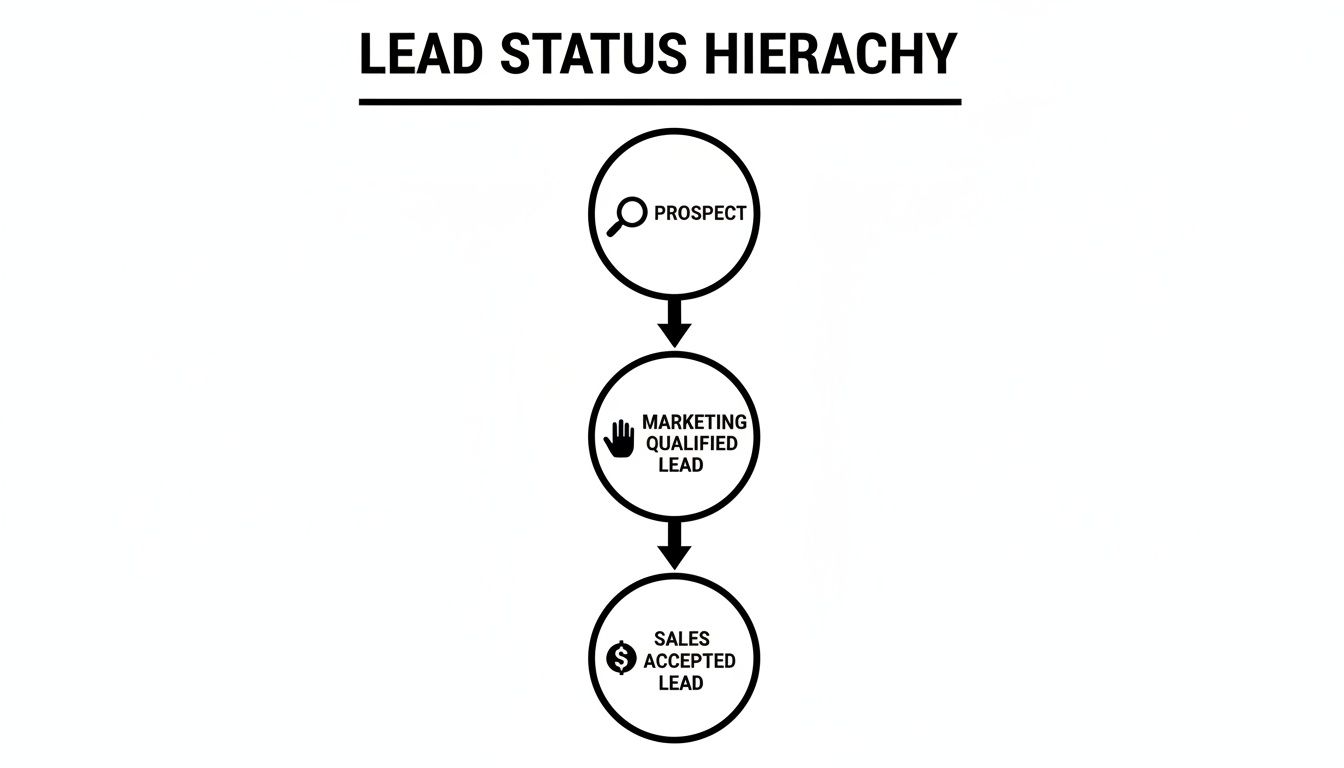
This diagram shows that crucial moment when a prospect raises their hand, signaling they’re ready for marketing to step in and start a conversation.
How a Lead Evolves
The transformation occurs when a prospect takes a real, measurable action, like downloading a whitepaper, signing up for a webinar, or requesting a demo. At that point, they become a Marketing Qualified Lead (MQL). This is the "hand-raise" moment. They've gone from being a face in the crowd to an active participant seeking answers to a problem. This is the perfect time for strategic lead nurturing automation to guide them with helpful, relevant content.
But the journey doesn't stop there. After marketing has done its part, the next stages are about achieving seamless sales alignment.
Sales Accepted Lead (SAL): Think of this as a quality control checkpoint. The MQL is passed to the sales team, who reviews it to ensure it meets the agreed-upon criteria. It’s a vital step to prevent sales from wasting time on unqualified leads.
Sales Qualified Lead (SQL): Once accepted, the lead becomes an SQL. This means a sales representative has connected with them, confirmed a real need, verified their budget and authority, and established a potential purchase timeline. An SQL is no longer just a lead; it's a genuine sales opportunity.
This deliberate progression creates a smooth, logical flow from initial interest to a real sales conversation. It’s how you prevent premature sales pitches and maximize the value of every interaction.
The transition from MQL to SQL isn’t just a handoff; it’s a strategic baton pass. Success depends on both teams running in sync, guided by a shared understanding of what a truly qualified lead looks like at each stage.
Comparing Lead Stages in the B2B Sales Funnel
To master these concepts, it helps to see them side-by-side. Each stage has its own definition, unique characteristics, and clear team ownership. When these lines become blurred, friction arises between sales and marketing, leads fall through the cracks, and effort is wasted. A clear framework is the best prevention.
The table below breaks down the B2B sales funnel, clarifying the specific roles and signals associated with each lead status from initial awareness to a sales-ready opportunity.
Lead Stage | Definition | Key Characteristics | Responsible Team |
|---|---|---|---|
Prospect | An individual or company that fits your ideal customer profile but has not yet engaged with you. | Unaware of your solution; no direct interaction; part of a broad target audience. | Marketing |
Marketing Qualified Lead (MQL) | A prospect who has shown interest by engaging with marketing content and meets qualification criteria. | Has downloaded content, attended a webinar, or visited key web pages; shows problem awareness. | Marketing |
Sales Accepted Lead (SAL) | An MQL that the sales team has reviewed and agreed to pursue. | Meets the pre-defined criteria for sales follow-up; validated by sales development reps (SDRs). | Sales & Marketing |
Sales Qualified Lead (SQL) | A lead that has been vetted by sales and confirmed to have a real, near-term purchase intent. | Has a defined need, budget, and authority to purchase (BANT); actively in a buying cycle. | Sales |
This level of clarity isn't just an organizational exercise, it's the foundation of a high-performing revenue engine. When everyone knows their role and what to look for, the entire process becomes smoother and more effective.
Defining Your Ideal MQL Qualification Criteria
Defining what a “marketing qualified lead” means for your business is the most critical step in building a lead generation engine that works. Without clear, agreed-upon rules, your marketing team is essentially tossing leads over a fence, hoping something sticks, only for sales to reject most of them. The solution is a solid framework that evaluates both who the lead is and what they’ve done.
Think of it like a detective building a case. You need the suspect’s profile (the "who") and evidence of their actions (the "what") before you can confidently pursue them. Your MQL criteria function the same way, standing on two pillars: explicit and implicit data.
The Two Pillars of MQL Qualification
Explicit data is the information a person provides directly. It's the "who" in the equation, the facts they fill out on a form. This data acts as your first filter, helping you determine if they match your Ideal Customer Profile (ICP), the blueprint of your perfect customer. If your ICP is a bit fuzzy, our guide on how to create buyer personas is an excellent place to start.
Key explicit data points typically include:
Firmographics: Company-level details, like industry, annual revenue, or employee count.
Demographics: Individual-level information, such as job title, seniority, and location.
For MSPs and B2B SaaS companies, this is where you can sharpen your focus. Zeroing in on the right industries improves lead quality. Forrester's research underscores the cost of weak fit: in a lead-centric model built on traditional MQLs, the inquiry-to-closed-won rate runs under 1%, which is why Forrester now pushes teams toward ICP fit and buying-group context over MQL volume. Tight ICP alignment is one of the strongest levers on downstream conversion. You can read Forrester's case in The End Of MQLs.
Implicit data, on the other hand, is all about behavior. It's what you observe a lead doing as they interact with your brand online. These digital breadcrumbs are powerful because they reveal interest and intent, giving you clues about where they are in their buying journey.
Common implicit signals to watch for:
Website Engagement: Are they repeatedly visiting high-value pages like pricing, case studies, or your main services page?
Content Consumption: Did they download a bottom-of-funnel asset like an implementation guide, a detailed whitepaper, or a competitor comparison checklist?
Direct Engagement: Have they taken a more active step, like attending a webinar, requesting a demo, or using an interactive ROI calculator on your site?
A lead's profile tells you if they could be a customer. Their behavior tells you if they want to be a customer. An MQL is where both signals intersect.
Bringing It All Together with Real-World Examples
The real power emerges when you combine these two data types into a clear-cut definition of an MQL. This isn't just theory, it’s about setting up practical, automated rules in your marketing platform to separate the window shoppers from the serious buyers.
Let’s walk through a couple of scenarios to see this in action.
Example 1: The High-Priority MQL
Explicit Data: Director of IT at a 500-person technology company in North America (a perfect ICP match).
Implicit Data: They downloaded an in-depth implementation guide and attended a live product webinar last week.
Verdict: This is a top-tier MQL. Their profile is a direct hit, and their actions signal strong interest and active research. This lead needs to get to a sales rep, fast.
Example 2: The Not-Yet-Ready Lead
Explicit Data: A user with a student email address from an unknown organization.
Implicit Data: They read one top-of-funnel blog post.
Verdict: Not an MQL. While there’s a flicker of interest, their profile is off-target, and their engagement is minimal. This lead shouldn't be deleted but belongs in a long-term nurturing sequence, not on a salesperson's dashboard.
By setting these data-driven rules, you ensure that marketing qualifies leads that sales will be excited to contact. It transforms your funnel from a leaky pipe into a well-oiled machine.
Building a Lead Scoring Model That Works
Once you've defined your qualification criteria, you need a way to automatically identify a marketing qualified lead the moment they meet those standards. That's what lead scoring does, it’s the engine running in the background, analyzing every lead and flagging the best ones for sales. It turns MQL identification from a manual guessing game into a precise, data-driven system.
Think of it like a video game where leads earn points for meaningful actions. Once they reach a "high score," they unlock the next level: a conversation with your sales team. This system assigns value to both who a lead is (explicit data) and what they do (implicit data), providing a complete picture of their potential.
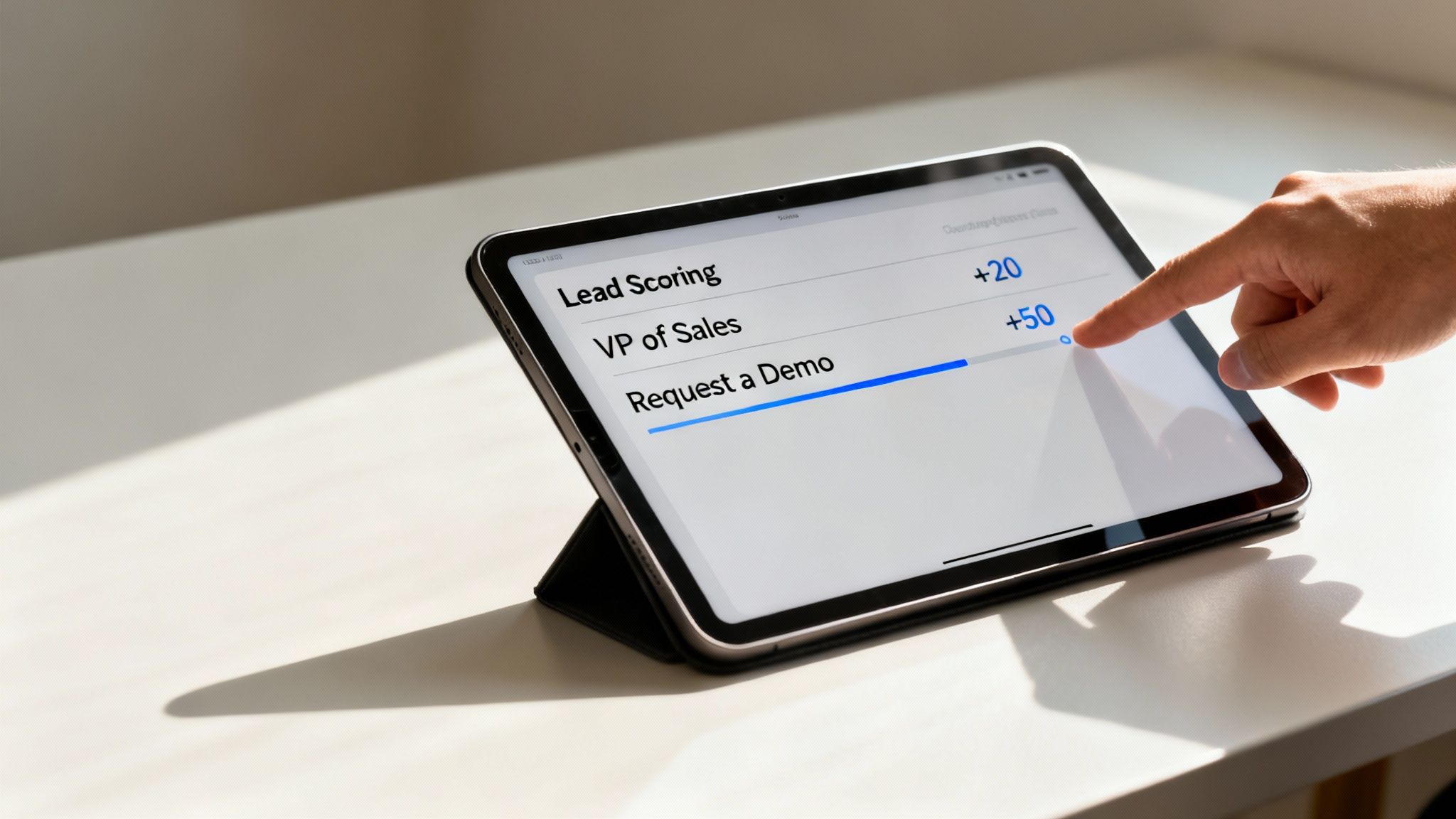
This systematic approach ensures only the most engaged, best-fit leads land on your sales reps' desks, boosting both efficiency and morale.
Assigning Points to Demographics and Behaviors
The core of any effective lead scoring model is assigning points to specific attributes and actions. The goal is simple: create a system where a higher score directly correlates to a higher likelihood of that lead becoming a customer. The best way to achieve this is by modeling the system after your best existing customers.
It's helpful to break scoring into two main categories:
1. Explicit Score (Fit): This score is based on firmographic and demographic data. It answers the question, "Is this the right type of person from the right type of company?"
Job Title: A 'VP of Sales' might be a perfect fit, earning them +20 points, while an 'Intern' likely gets 0 points.
Industry: If you specialize in B2B SaaS, a lead from the 'Technology' sector is a great match. Give them +15 points.
Company Size: If your ideal customers have '500+ employees', that's worth +10 points.
2. Implicit Score (Intent): This score is based entirely on behavior, the digital body language that signals buying intent. It answers, "How interested is this person in solving their problem with us?"
High-Value Actions: Requesting a demo or filling out a contact form is a major signal, easily worth +50 points.
Content Engagement: Downloading a detailed case study shows serious interest. Add +15 points.
Website Activity: Visiting your pricing page three times in a week is a strong indicator. Add +10 points.
These are just starting points. The real power comes from customizing scores based on your own data. For a deeper look, check out our guide on lead scoring best practices.
Setting the MQL Threshold
Once your point system is in place, you need to set the MQL threshold, the score a lead must reach to be officially designated an MQL. For example, you might decide that any lead scoring 100 or more is automatically passed to sales.
This number shouldn’t be a guess. It needs to be a collaborative decision between sales and marketing, grounded in historical data. Analyze your closed-won deals: what was the average score of the leads that became customers? Use that as your starting point.
The MQL threshold is the gatekeeper of your sales pipeline. Set it too low, and you flood sales with unqualified leads. Set it too high, and you risk starving your reps of viable opportunities.
Advanced Scoring Techniques
A basic model is a fantastic start, but you can achieve greater accuracy with more sophisticated techniques. Two powerful methods are negative scoring and predictive scoring.
Negative Scoring: This involves subtracting points for actions or attributes that indicate a poor fit. For instance, a visit to your 'Careers' page might deduct -10 points, as it likely signals a job seeker, not a buyer. A lead from a direct competitor could be -50 points.
Predictive Scoring: This is where you leverage AI and machine learning. The system analyzes your historical data to identify subtle patterns that correlate with conversion, then builds a model to predict lead quality. It moves beyond manually assigned points to a system that gets smarter over time.
By integrating these methods, you create a dynamic scoring system that continuously refines itself. Layering technographic signals helps too. Knowing a lead already runs a modern CRM such as Salesforce tells you they invest in revenue infrastructure, which often raises their score. The consistent pattern across benchmarks: qualified, ICP-aligned leads convert at materially higher rates than unqualified ones. This is especially vital for sectors like government and nonprofits, where ROI is heavily scrutinized.
Creating a Seamless MQL Handoff to Sales
Defining a marketing qualified lead and building a smart lead scoring model are huge milestones. But they mean little if the handoff to sales is clumsy. This is the moment a theoretical MQL becomes a real sales opportunity. If you drop the baton here, all the preceding work is wasted, and a warm lead quickly goes cold.
To prevent this, you need to integrate your MQL strategy directly into your daily sales and marketing workflow. This involves more than sending an email notification; it requires a structured, automated process that guarantees speed, accountability, and clear communication. Without a solid handoff, even the most promising leads can get lost in a CRM black hole.
Establishing the Rules of Engagement with an SLA
The foundation of a great handoff is a Service Level Agreement (SLA). Think of it as a formal playbook, agreed upon by both sales and marketing leaders, that outlines the rules of engagement. It eliminates guesswork and sets crystal-clear expectations for everyone involved.
An effective MQL-to-Sales SLA should define a few key elements:
The MQL Definition: It should restate the exact criteria (demographic, firmographic, and behavioral scores) that officially make a lead an MQL.
Handoff Protocol: This details the specific trigger for the transfer, like an automated status change and lead assignment in your CRM (e.g., Salesforce or Dynamics 365).
Response Time: This is critical. The SLA must state exactly how quickly a sales rep is expected to follow up with a new MQL. Speed of follow-up tracks directly with conversion, so make it tight and measurable.
Follow-Up Cadence: It should also outline the number of contact attempts a rep will make, for example, six touches over two weeks via email and phone, before disqualifying the lead or returning it to marketing for more nurturing.
This level of detail is vital for creating a truly aligned process. You can explore more strategies in our guide on B2B marketing and sales alignment.
An SLA isn't just a document; it's a peace treaty between sales and marketing. It replaces assumptions with agreements, ensuring both teams are working toward the same goal with a shared understanding of their responsibilities.
Automating the Handoff and Closing the Loop
With a solid SLA in place, you can let technology do the heavy lifting. Your CRM should be configured to instantly notify the correct sales rep the moment a lead’s score crosses the MQL threshold. This real-time alert is your best chance to capitalize on peak interest.
However, the process can't be a one-way street. A closed-loop feedback system is essential for long-term success. This means sales needs an easy way to report back on the quality of every MQL they receive directly within the CRM. They should be able to accept the lead, disqualify it (with a specific reason), or send it back to marketing for further nurturing.
This feedback is invaluable. It gives marketing direct insight into which campaigns are generating high-quality MQLs that sales loves and which ones are delivering duds. This data-driven loop is the key to continuously refining your lead scoring model and MQL criteria based on what's actually happening on the front lines.
The payoff is real. Healthy MQL-to-SQL conversion sits around 15%, and the broad industry benchmark runs roughly 13% to 21%, with top performers reaching 30% or more. Tight definitions and a disciplined handoff are what move you up that range. You can review the MQL-to-SQL benchmarks for context.
Measuring Success and Optimizing Your MQL Strategy
You’ve defined your criteria and mapped out the perfect handoff. But how do you know if your MQL program is actually driving growth? Generating a high volume of leads you call MQLs is meaningless if they don't convert. True success is measured by revenue impact, which requires a relentless focus on data and continuous improvement.
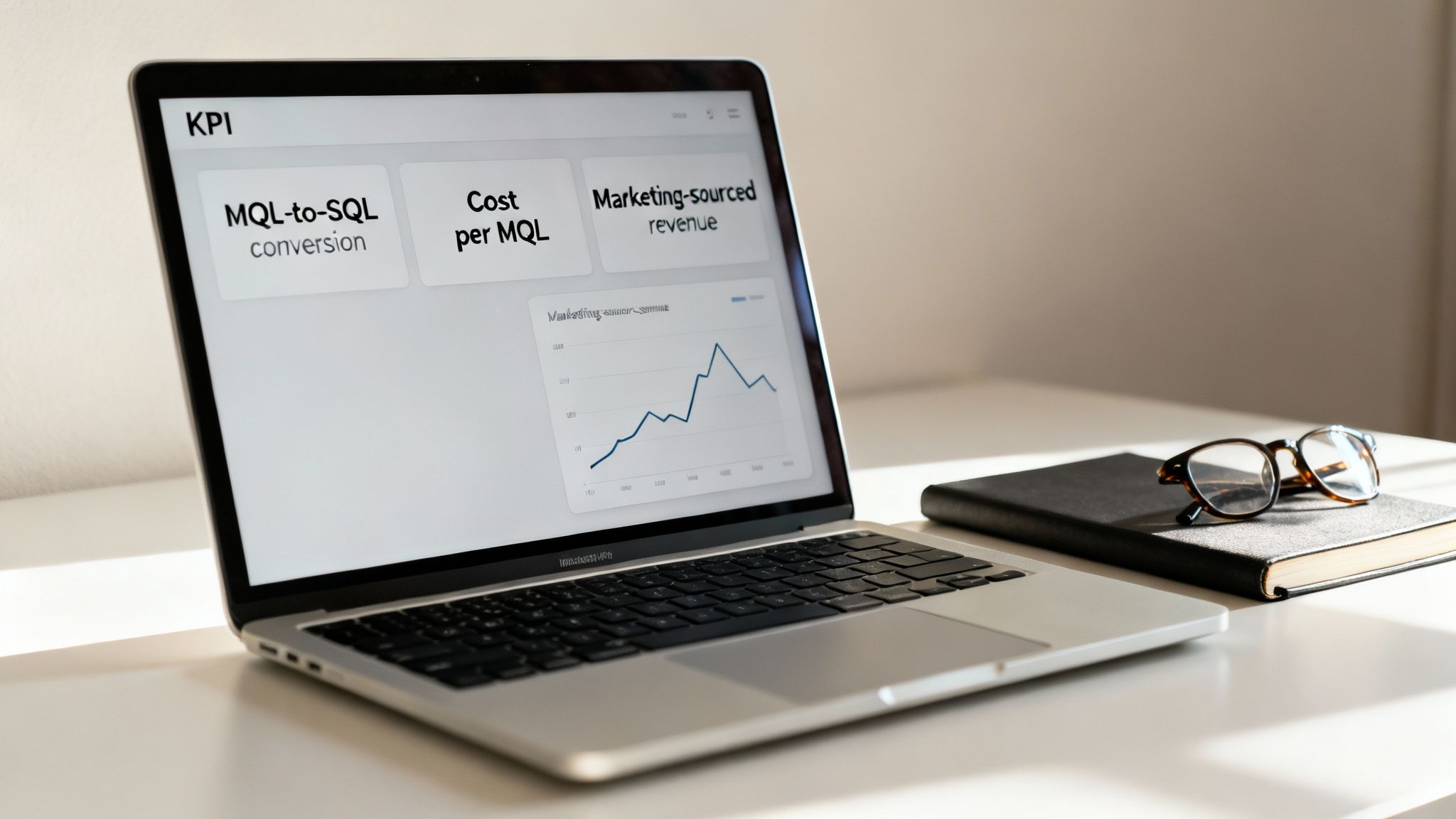
This is where you shift from building the engine to fine-tuning its performance. By tracking the right metrics, you can diagnose problems early, prove marketing ROI to leadership, and turn a decent MQL strategy into a revenue-generating machine.
Key Performance Indicators You Must Track
To get a real sense of the health and effectiveness of your MQL funnel, you need a go-to dashboard of essential KPIs. These numbers provide a clear window into what’s working, what isn’t, and where to focus your energy.
Here are the non-negotiables for any serious MQL program:
MQL-to-SQL Conversion Rate: This is the ultimate litmus test for MQL quality. It tells you what percentage of marketing-qualified leads the sales team accepts and converts into legitimate opportunities. A low number here is a major red flag that marketing and sales are misaligned.
Cost Per MQL: This is straightforward: divide your total marketing spend over a period by the number of MQLs generated. It's crucial for understanding campaign efficiency and budgeting for future growth.
Lead-to-Customer Conversion Rate: This KPI tracks the entire journey, showing you what percentage of your MQLs ultimately become paying customers. It's a powerful indicator of overall funnel health.
Marketing-Sourced Revenue: This is the metric the C-suite cares about most. It directly ties your MQL generation efforts to closed-won deals, answering the ultimate question: "How much revenue did marketing bring in?"
Tracking these KPIs isn't just about making reports. It’s about creating a feedback loop. When a metric like the MQL-to-SQL rate dips, it's a clear signal to revisit your lead scoring or have a frank conversation with the sales team.
Troubleshooting Common MQL Challenges
Even the most well-planned strategies encounter obstacles. As you analyze your data, you’ll likely uncover common challenges that require targeted solutions. Being proactive is what separates the pros from the amateurs.
A full-funnel strategy, like the one we use at Twelverays, makes the difference. By combining paid search with strategic web development, we generate MQLs that are built to qualify, not just to fill a form. The result is leads that hold up at the sales handoff. Speed compounds it: fast follow-up consistently lifts MQL-to-SQL conversion, and slow, misaligned handoffs waste the qualification work marketing already did. When Bersin and Associates tightened lead scoring, converted leads rose 79 percent even as the volume sent to sales dropped, proof that handoff discipline beats raw lead count. (MarketingSherpa case study)
To optimize your own funnel, watch for these common problem areas:
Misaligned Definitions: If your MQL-to-SQL rate is low, the prime suspect is a mismatch in definitions. Schedule recurring meetings with sales to review lead quality, recalibrate your scoring, and ensure everyone is working from the same playbook.
Poor Data Hygiene: Inaccurate or incomplete data in your CRM will sabotage your lead scoring and qualification efforts. Implement data cleansing protocols and make key fields mandatory on your forms. Clean data is the foundation of accurate scoring.
Slow Sales Follow-Up: A warm lead cools off incredibly fast. If leads are going stale before sales reaches out, it’s time to review your SLA and CRM automations. Ensure reps are alerted instantly and held accountable for prompt follow-up.
By continuously monitoring your KPIs and proactively tackling these challenges, you transform your MQL strategy from a static process into a dynamic, self-improving system that consistently delivers quality leads and measurable revenue.
Your MQL Questions, Answered
Even with a solid plan, questions often arise when you put theory into practice. Let's tackle some of the most common ones we hear about marketing qualified leads.
How Do MQLs Impact The Sales Cycle?
MQLs act as an accelerator for your sales team. They significantly shorten the sales cycle because much of the initial qualification work is already done. By handing over leads who have shown genuine interest and are a good fit for your business, marketing allows reps to focus on conversations that are far more likely to close, reducing dead-end calls and accelerating the journey to a signed contract.
What Industries Benefit Most From An MQL Strategy?
While any business can benefit, those with longer, more considered sales processes see the greatest returns. This typically includes sectors where customers conduct extensive research before making a purchase.
Key industries include:
B2B SaaS: Buyers often compare features, read reviews, and consume content long before requesting a demo.
Professional Services: Firms in law, consulting, and marketing need to build trust and demonstrate expertise over time.
High-Value eCommerce: For expensive products, customers require significant information and reassurance before they are ready to buy.
These industries rely heavily on educating prospects, making the MQL framework the perfect tool for identifying when someone transitions from "just browsing" to "seriously considering."
A common challenge is maintaining alignment between marketing and sales. If the two teams aren't regularly reviewing lead quality and tweaking scoring criteria, the definition of an MQL can become diluted, leading to friction and wasted effort.
What Are The First Steps To Implementing an MQL Program?
The first step is to get your marketing and sales leaders in the same room.
Your primary goal is to establish a crystal-clear, unified definition of your Ideal Customer Profile (ICP). From there, you can agree on the specific actions and behaviors that signal a lead is ready to talk to sales. This initial alignment is the foundation of the entire program and ensures everyone is working from the same playbook from day one.
At Twelverays, we build the data-driven marketing and CRM systems that connect genuine interest to real revenue. Our work in SEO, paid media, and CRM integration is all about helping you attract, qualify, and convert the leads that matter. Let's move beyond guesswork and build a predictable engine for growth.


