

Choosing the best ecommerce platform for SEO isn't about finding a single 'winner', it's about selecting the architectural foundation that aligns with your growth ambitions.
For most businesses, Shopify offers a powerful, user-friendly start. Conversely, WooCommerce provides those with technical expertise virtually limitless customization. Your choice here directly shapes your ability to attract organic traffic and, ultimately, drive sales.
Why Your Ecommerce Platform Is Your Most Critical SEO Asset

Selecting an ecommerce platform is the single most important SEO decision you'll make. This isn't just a digital storefront; it's the technical bedrock upon which your entire organic marketing strategy rests. Everything from site speed and URL structure to content management and schema markup is either enabled or constrained by your platform's core architecture.
Making the right choice from the start saves you from costly migrations and crippling technical debt down the line. A platform with robust, native SEO features provides a significant competitive edge, allowing you to focus on strategy rather than grappling with technical limitations. This guide moves beyond basic feature lists to offer a strategic framework for matching a platform’s capabilities to your business objectives.
The Foundation of Organic Growth
The financial upside of a well-optimized platform is immense. A Reboot Online analysis of over 25,000 eCommerce sites found the average brand ranks for 1,783 keywords, driving approximately 9,625 organic visits a month.
Acquiring that same traffic through paid advertising would cost an estimated £11,790.58 every month. That figure alone underscores the value of a strong organic presence.
Your platform dictates how effectively you can execute the SEO tactics that generate these results. To explore this relationship further, see our guide on how ecommerce SEO directly increases sales. Next, we’ll dissect how platform choice controls the core pillars of SEO, providing the insights needed to select a partner for long-term growth.
"Think of your ecommerce platform as the engine of your SEO car. You can have the best driver and the most aerodynamic design, but without a powerful, well-tuned engine, you'll never win the race."
Core SEO Capabilities: What Matters in an Ecommerce Platform
Before comparing platforms, it's vital to establish the evaluation criteria. These are the non-negotiables that separate an SEO-friendly platform from one that will consistently hinder your efforts. The table below outlines the core capabilities we'll be assessing.
These four pillars form the basis of our analysis. A platform excelling in these areas provides the necessary tools to build a dominant organic presence.
Comparing Technical SEO Foundations

A platform's technical SEO capabilities are its nuts and bolts, they directly control how search engines find, understand, and rank your store. Seemingly minor details, such as URL structure or canonical tag implementation, can have a massive impact on your site's health and visibility. This is where the best ecommerce platform for SEO truly distinguishes itself.
We'll move beyond simple checklists to explore the nuanced technical strengths of four major players: Shopify, BigCommerce, WooCommerce, and Adobe Commerce (the enterprise edition of Magento; the free, self-hosted edition is Magento Open Source). Understanding these differences is key to avoiding significant SEO challenges later on.
URL Structure and Canonicalization
The degree of control you have over your URLs is crucial for technical SEO. Clean, logical URLs help both users and search engines understand your site's hierarchy. Meanwhile, proper canonicalization is your primary defense against duplicate content issues that can dilute ranking power.
Shopify offers a simple, out-of-the-box solution at the cost of control. It forces a fixed URL structure, adding prefixes like /products/ and /collections/. You can edit the handle, but the /collections/ segment cannot be removed. Canonical tags are handled automatically. That is fine for beginners and a limitation for complex stores.
Conversely, WooCommerce, as an open-source platform built on WordPress, provides total freedom. You can customize every part of your URL, creating a structure that perfectly mirrors your product hierarchy. This flexibility is powerful but demands careful management, as a poor setup can create significant SEO problems. Plugins like Yoast SEO offer precise control over canonicals.
The key difference here is control versus convenience. Shopify automates URL management to prevent errors, whereas WooCommerce trusts you with full control, offering higher potential for optimization but also a greater risk of mistakes.
BigCommerce strikes an effective balance. It provides clean URLs by default but allows more customization than Shopify, letting you edit URL paths without forced prefixes. This makes it a strong middle-ground option.
Adobe Commerce aligns with WooCommerce, offering deep, granular control over URL rewrites. It is engineered for massive, complex catalogs where this level of customization is essential for managing thousands of product variations.
Schema Markup and Structured Data
Schema markup, or structured data, helps search engines understand the context of your content. When implemented correctly, it can earn you rich snippets in search results, significantly boosting click-through rates. Native support for this is a major advantage.
- Shopify & BigCommerce: Both platforms excel at automatically adding essential product schema (price, availability, reviews). This is a huge benefit for merchants without technical expertise, ensuring their products are eligible for rich results from day one.
- WooCommerce: Basic schema is often included in themes, but achieving comprehensive structured data typically requires a dedicated SEO plugin. This offers more flexibility for custom schema types but necessitates manual setup.
- Adobe Commerce: Provides robust options for structured data, but implementation and management almost always require a developer, especially for custom attributes.
Robots.txt and Sitemap Control
Your robots.txt file instructs search engine crawlers on which pages to avoid, while your sitemap directs them to pages you want prioritized. The ability to edit these files is non-negotiable for advanced SEO.
Shopify once locked the robots.txt file. That is no longer true. You edit it by adding a robots.txt.liquid template to your theme: allow or disallow URLs, block specific crawlers, add crawl-delay rules, and append extra sitemaps. You can even set per-domain rules across Shopify Markets storefronts. It runs through a Liquid template rather than a raw file, so it is slightly less direct than WooCommerce, but the control is there. To go deeper on what crawlers do with these rules, see our guide on how search engines work with crawling and indexing.
WooCommerce, BigCommerce, and Adobe Commerce give you full, direct access to the robots.txt file. You hold complete authority over crawl instructions, a useful feature for any serious ecommerce store.
A Look at Content and On-Page SEO Capabilities
While technical SEO builds a solid foundation, content is what earns customers and builds authority. Your chosen platform must be more than a digital cash register; its ability to support a robust content strategy, from in-depth blog posts to high-converting landing pages, is a critical factor in your success. The best ecommerce platform for SEO doesn't just list products; it becomes a resource that attracts traffic throughout the entire customer journey.
This is where the distinction between a pure ecommerce tool and a content-first platform becomes clear. You need the ability to create, manage, and optimize content seamlessly alongside your product catalog. This includes everything from the ease of adding internal links to the level of control over on-page elements.
Blogging and Content Hubs
For any serious ecommerce brand, publishing high-quality content is essential. This is where the core philosophies of these platforms truly diverge.
Shopify provides a simple, built-in blogging engine. It allows you to publish articles, add images, and adjust basic on-page elements like title tags and meta descriptions. For many small and medium-sized businesses starting with content marketing, it is perfectly adequate.
However, if content is the engine of your growth strategy, WooCommerce holds a distinct advantage. Built on WordPress, the world's most dominant content management system (CMS), it offers unparalleled flexibility and power. You gain access to a vast ecosystem of plugins, advanced editors like Gutenberg, and the freedom to build complex resource centers without limitations.
The decision boils down to this: Shopify offers integrated simplicity, while WooCommerce delivers unmatched content creation power. If your plan involves becoming a thought leader through a deep and varied content library, a WordPress-based solution is almost always the superior choice.
BigCommerce also includes a native blog. It’s functional, but like Shopify's, it lacks the advanced capabilities of a dedicated CMS, positioning it as a solid middle-of-the-road option for standard blogging needs.
On-Page Element Customization
Beyond blogging, your platform must provide direct control over the on-page SEO elements that signal your pages' topics to search engines.
This means easy customization of:
- Title Tags: Arguably the most important on-page ranking factor.
- Meta Descriptions: Your sales pitch in search results, critical for click-through rates.
- Header Tags (H1, H2, H3): Provide structure and signal content hierarchy.
- Image Alt Text: Crucial for image SEO and accessibility.
All the major players, Shopify, BigCommerce, and WooCommerce, offer straightforward ways to edit these elements. They differ, however, in the ease and scalability of the process. With WooCommerce, plugins like Yoast SEO or Rank Math unlock bulk editing and templating features, saving an incredible amount of time for stores with thousands of products.
For more advanced techniques, explore our detailed guide on ecommerce SEO strategies to further refine your approach.
Landing Page and Resource Creation
An often-overlooked yet critical capability is creating custom, non-product pages for marketing campaigns, lead magnets, or detailed guides.
On Shopify and BigCommerce, creating a unique landing page layout almost always requires a third-party page builder app. These apps can be powerful, but they add another subscription cost and layer of complexity to your tech stack.
Here again, WooCommerce shines by leveraging the power of WordPress. Modern WordPress page builders allow you to create stunning, highly optimized landing pages natively. This provides complete design freedom without relying on an external app. For businesses running sophisticated marketing campaigns that require bespoke user experiences, this flexibility is a game-changer.
Analyzing Performance Speed and Mobile Experience
In SEO, speed is paramount. Since Google integrated Core Web Vitals as a ranking factor, page load and response times are no longer negotiable. A slow site doesn't just frustrate users, it actively harms your rankings.
This is where the platform architecture, hosted vs. self-hosted, becomes a critical consideration. Choosing the best ecommerce platform for SEO requires examining how it handles the technical demands of a fast, mobile-first world. Your platform's performance capabilities effectively set the ceiling for your success.
Hosted vs Self-Hosted Performance
Hosted SaaS (Software as a Service) platforms like Shopify and BigCommerce offer a significant advantage: a managed, optimized environment. They handle server maintenance, security patches, and performance tuning, allowing you to focus on selling.
These platforms are built on powerful global infrastructure, including Content Delivery Networks (CDNs) that cache your store's assets worldwide. The result is fast load times for customers, whether they are in London or Los Angeles. For most businesses, this hands-off approach delivers excellent performance without the associated headaches.
It boils down to control versus convenience. A hosted platform like Shopify provides reliable speed out of the box, but you operate within their ecosystem. A self-hosted solution like WooCommerce gives you full control, but performance is 100% your responsibility.
Conversely, a self-hosted platform like WooCommerce places performance squarely on your shoulders. You choose the host, configure the server, and manage every optimization. While this provides incredible flexibility, it's a double-edged sword. A cheap hosting plan or a poorly configured server can cripple your site, undermining all other SEO efforts.
Core Performance Features Compared
When evaluating a platform's speed potential, you must assess its built-in optimization tools. These features are crucial for achieving strong Core Web Vitals scores and providing a superior mobile experience.
Here’s a quick comparison of how the major players handle performance essentials:
- CDN Integration: Shopify and BigCommerce include a global CDN as part of their package. With WooCommerce, you’ll need to select a host that offers a CDN or configure one yourself.
- Image Compression: All platforms offer solutions, but execution varies. SaaS platforms typically have built-in tools or tightly integrated apps. WooCommerce relies on plugins like Smush or ShortPixel for automatic compression and next-gen format delivery (e.g., WebP).
- Code Minification: This process removes unnecessary characters from code to reduce file sizes. Shopify and BigCommerce handle most of this automatically. For WooCommerce, a good caching plugin like WP Rocket is necessary to manage CSS and JavaScript minification.
The Mobile Experience Imperative
Mobile commerce is now the standard. With Google's mobile-first indexing, the mobile version of your site is what primarily determines your rankings. A clunky mobile experience can be fatal to your SEO success.
All major platforms provide mobile-responsive themes, which is the baseline requirement. However, true mobile optimization extends beyond screen size adaptation. It encompasses lightning-fast load times over cellular networks, easy-to-tap navigation, and a frictionless checkout process.
SaaS platforms like Shopify tend to have an edge here, as their themes are vetted for performance across all devices. With WooCommerce, the responsibility falls on you to choose a lightweight, well-coded theme and avoid overloading it with plugins that can degrade the mobile experience. Ultimately, the best platform facilitates a fast, seamless journey for your mobile customers.
Thinking Ahead: Scalability and Headless Commerce
Choosing an ecommerce platform for SEO isn’t just about meeting today's needs; it's a strategic investment in your future growth. As your business expands, with more products, increased traffic, or new markets, your platform must scale without creating SEO obstacles. A platform that cannot scale becomes a liability, eventually necessitating a painful and expensive migration just as you should be capitalizing on your momentum.
This is where platform architecture becomes paramount. Solutions like Shopify and BigCommerce offer managed scalability, handling servers and infrastructure, which is ideal for businesses focused on growth rather than technical maintenance. Conversely, for large enterprises with vast catalogs or complex international SEO requirements, the granular control offered by Adobe Commerce (Magento) or a heavily customized WooCommerce setup may be the only viable path to manage performance at scale.
Future-Proofing with Headless Commerce
For businesses playing the long game, a more advanced approach is to go headless. In a traditional ecommerce setup, the front-end (what customers see) is tightly coupled with the back-end (the engine managing products, orders, and payments). A headless architecture decouples these two components. This allows you to use a powerful back-end, like commercetools or Shopify Plus, while building a completely custom, high-performance front-end with modern frameworks like React or Vue.js.
This separation provides absolute freedom over your site’s structure, speed, and user experience, all critical SEO factors. You are no longer constrained by a pre-built theme's limitations. Instead, you can create a lightning-fast storefront engineered from the ground up to excel in Core Web Vitals and deliver a flawless mobile experience.
For sophisticated B2B and SaaS companies, headless isn't just a buzzword; it's a real competitive edge. It gives you the ultimate flexibility to build unique digital experiences and protect your SEO strategy from the constraints of a monolithic platform.
Building a Defense Against SERP Volatility
Control over your front-end grows more valuable as search engines evolve. AI Overviews now appear on a sizable and growing share of queries. Through 2025 they climbed from a small minority of searches to a peak near a quarter of all results before settling lower, and the rollout has been volatile. Some sites saw meaningful click-through-rate drops where they appeared.
The intent picture matters more than the headline number. Ahrefs analyzed 146 million SERPs and found AI Overviews skew heavily informational: 99.9% of AIO-triggering keywords were informational. Branded queries triggered an AI Overview only 13% of the time. Commercial and transactional ecommerce queries, the ones that drive revenue, were far less affected. That is the case for building a resilient SEO foundation around revenue-driving keywords, which the fine control of a headless setup makes much easier.
When you own your front-end, you can react instantly to algorithm updates, implement cutting-edge schema, and modify page templates without waiting for platform-wide rollouts. This agility is what separates market leaders from the competition. A headless architecture transforms your ecommerce platform from a simple store into a flexible foundation for long-term, defensible organic growth.
Making the Right Choice for Your Business
Selecting the best ecommerce platform for SEO is not about finding a single “perfect” solution. It’s about identifying the right strategic partner for your specific business model. The optimal choice will always align with your technical resources, growth plans, and content ambitions. What works for a startup can quickly become a bottleneck for a growing enterprise.
This flowchart helps visualize the decision-making process based on your primary growth needs.
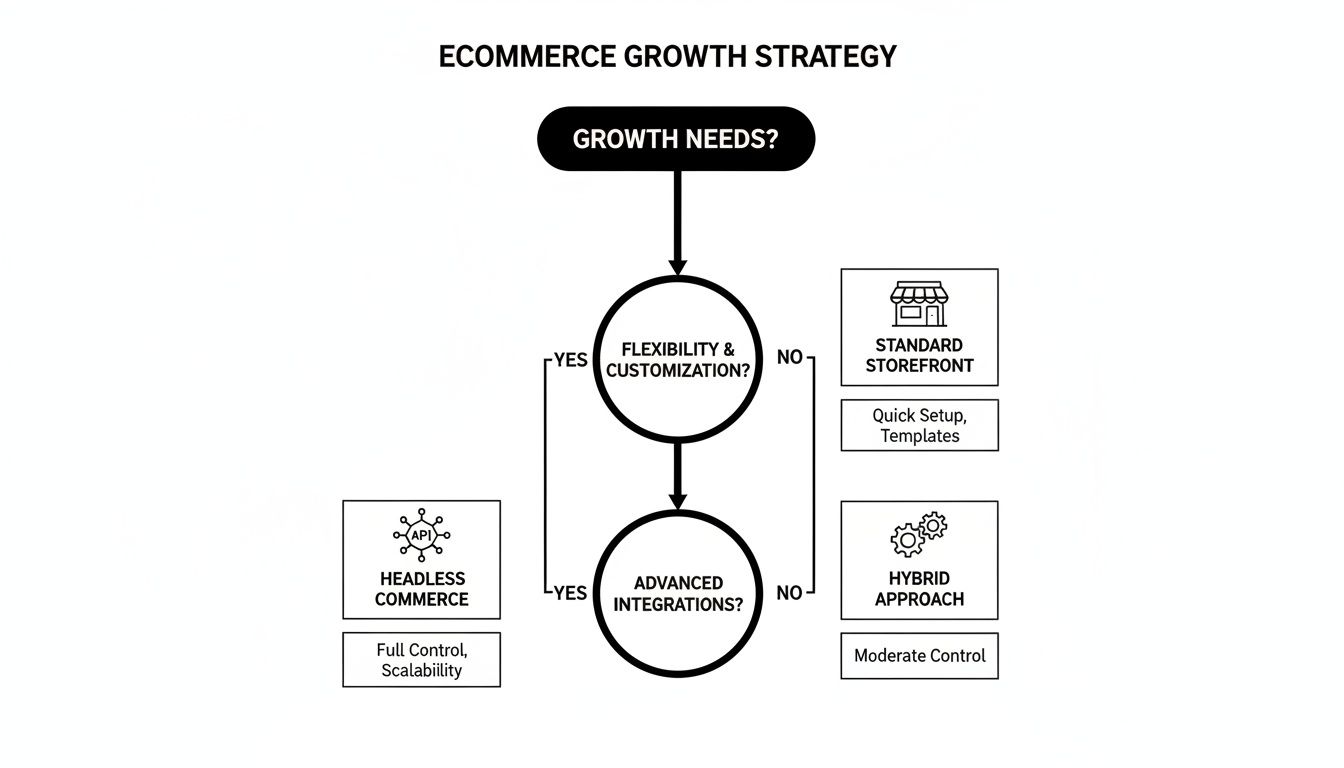
As illustrated, the fundamental choice is between a standard, integrated storefront for streamlined operations and a headless architecture for maximum flexibility and performance. This single question emphasizes how long-term goals should inform your platform choice from the outset.
Tailoring the Platform to Your Business Stage
Your company's current size and future vision are the most critical factors. A platform offering simplicity now might lack the depth required for a complex, multi-regional expansion later. Budget is part of this too, and entry pricing is easy to compare: Shopify Basic and BigCommerce Core both start at $39 a month, while WooCommerce core and Magento Open Source are free software where your real cost is hosting and development.
For startups and small businesses needing to launch quickly, a SaaS solution like Shopify is often the most practical choice. Its managed environment eliminates technical overhead, allowing you to focus on products and marketing. The trade-off is less control over technical SEO details, but for many, this convenience is a winning formula.
Conversely, businesses driven by content marketing often find WooCommerce offers superior flexibility. Built on WordPress, it provides unmatched power to create rich content hubs and execute sophisticated on-page SEO strategies. This path requires more technical expertise but grants complete command over your digital footprint. For a broader comparison, consider this review of the 12 best ecommerce platforms of 2026.
The right platform isn't just a tool; it's a business asset. The decision should be based on a clear-eyed assessment of your team's capabilities, your budget, and, most importantly, your strategic roadmap for the next three to five years.
Matching Platform Power to Enterprise Needs
As businesses scale, their needs evolve. Massive product catalogs, international sales, and B2B functionality demand more robust solutions.
BigCommerce strikes an excellent balance, offering strong out-of-the-box SEO features with better scalability than Shopify, making it a powerful contender for mid-market businesses. For large enterprises with complex requirements and in-house development teams, Adobe Commerce (Magento) provides unparalleled power. Its open-source nature allows for extensive customization, which is essential for managing vast inventories and complex technical SEO implementations.
Ultimately, the best platform is the one that fuels your growth without creating friction. By carefully weighing your business needs against each platform’s core strengths, you can make a strategic decision that positions you for long-term SEO success.
Got Questions? We’ve Got Answers.
When evaluating ecommerce platforms, numerous questions arise, particularly concerning SEO. Let's address some of the most common inquiries to help guide your decision.
How Much Does URL Structure Really Matter For SEO?
A great deal. A clean, logical URL structure is a cornerstone of effective on-page SEO. Well-crafted URLs provide clear signals to both users and search engine crawlers about a page's content, improving user experience and crawl efficiency.
For example, a URL like /products/mens-running-shoe-model-x is far more effective than /prod_id=89123. The former uses relevant keywords and clearly communicates the page's topic. Platforms like WooCommerce and BigCommerce offer excellent control over URL customization, whereas Shopify's more rigid structure is simpler but less flexible.
A great URL acts like a signpost. It should be descriptive, concise, and easy for both humans and search engines to understand at a glance, directly impacting click-through rates from search results.
Can I Switch Ecommerce Platforms Without Losing My SEO Rankings?
Yes, it is possible, but it requires extreme care. A meticulously planned migration is essential to switch platforms without losing your hard-earned SEO rankings. A rushed or sloppy migration can be disastrous, causing a sharp decline in traffic and revenue.
The process is complex but manageable if you execute the critical steps correctly. The single most important component is creating a comprehensive 301 redirect map. This map ensures every old URL permanently points to its new equivalent, telling search engines where the content has moved and passing along valuable link equity.
Your migration checklist must also include:
- Content Mapping: Auditing all valuable content to ensure every piece is transferred to the new site.
- Technical Audit: Conducting a full SEO audit on the new site before and after launch.
- Performance Monitoring: Closely tracking rankings, traffic, and crawl errors immediately following the migration.
Is A Self-Hosted Platform Better For SEO Than A Hosted One?
Neither is inherently "better"; the right choice depends on your business's specific needs. The decision between a self-hosted platform (like WooCommerce) and a hosted one (like Shopify) is a trade-off between total control and convenience.
A self-hosted platform grants unlimited control over every technical SEO element, from server configuration to URL structure. For businesses with the technical resources to manage this, it's a significant advantage. However, you are responsible for all aspects of performance, security, and maintenance.
Conversely, a hosted platform manages the technical heavy lifting for you, providing a stable, secure, and typically fast environment out of the box. This frees you to focus on marketing, but you relinquish fine-grained control over the server and some core files. The best ecommerce platform for SEO is the one that aligns with your team's skills, budget, and long-term goals.
Choosing and optimizing the right platform is a major step toward sustainable growth. At Twelverays, we specialize in creating data-driven SEO strategies that align with your platform's strengths to drive measurable results. Discover how our tailored digital marketing solutions can elevate your business.


