

Building a sales funnel that consistently turns strangers into customers requires a solid blueprint. This isn't about haphazardly throwing marketing tactics at a wall; it's a strategic process of defining your goal, deeply understanding your audience, and mapping every step of their journey with precision.
Your Blueprint for a High-Converting Sales Funnel
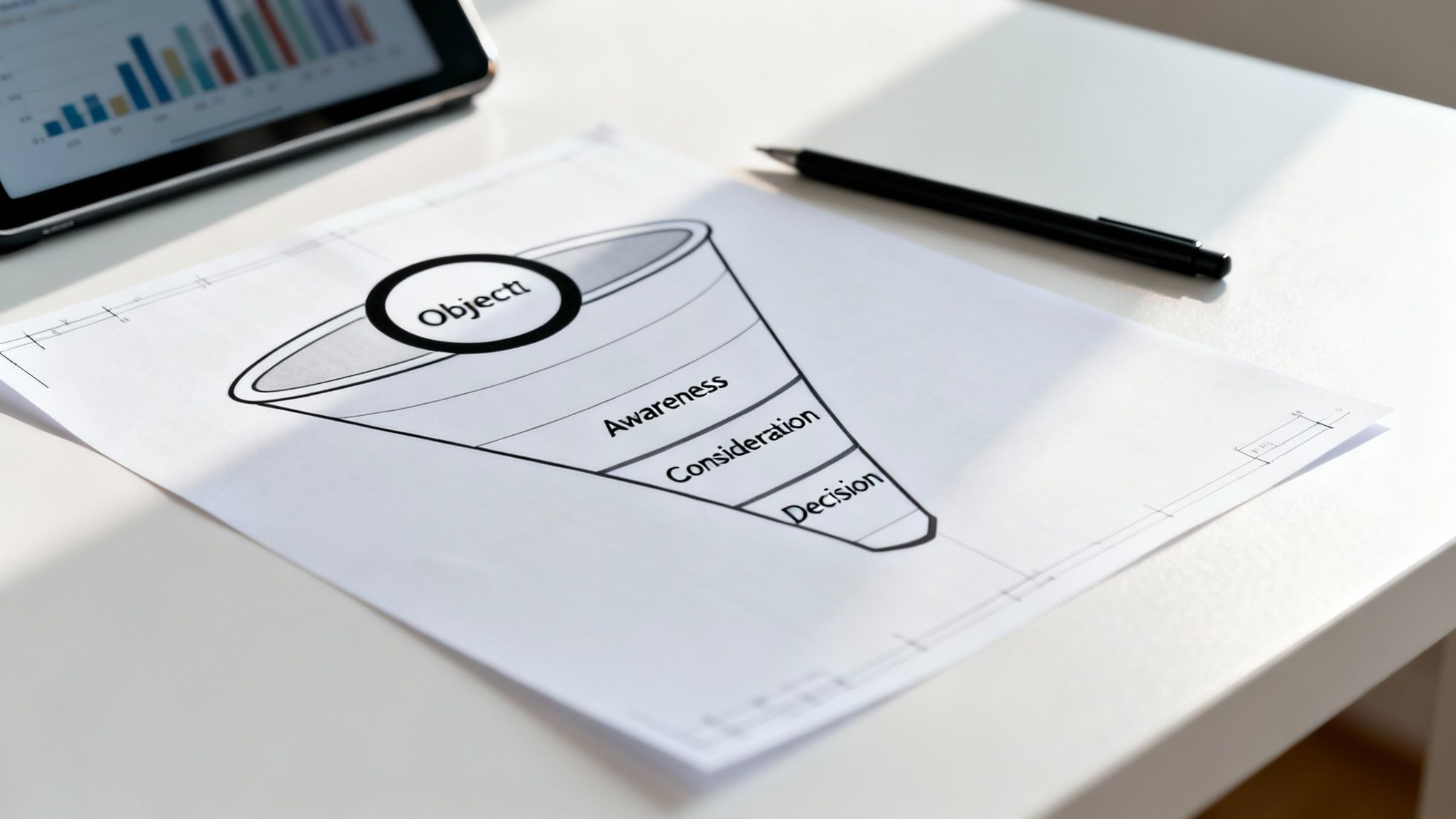
Before writing a single line of ad copy or choosing a landing page template, pause. An effective sales funnel is a deliberately crafted journey, not a random collection of marketing assets. Skipping this foundational step is like building a house without a blueprint, you're almost guaranteed to end up with serious structural issues.
The core principle is simple: every element must work in concert toward one clear, measurable goal. This strategic alignment prevents wasting resources on activities that don't drive results and ensures every touchpoint serves a specific purpose.
Defining Your Funnel's Core Objective
First, what is the single action you want someone to take? A crystal-clear answer is non-negotiable. A funnel without a specific objective is just creating noise. Your primary goal will shape everything, the content you create, the ads you run, and the technology you employ.
Common funnel objectives include:
- Generating qualified leads for your sales team.
- Driving direct purchases for an e-commerce product.
- Booking demos or consultations for a SaaS or service business.
- Securing sign-ups for a webinar or live event.
Your funnel's objective is its North Star. If an activity doesn't directly support that objective, it's a distraction. For instance, if your goal is booking demos, measuring success by social media likes is a vanity metric that derails your focus.
Mapping the Essential Funnel Stages
Even the most complex funnels follow a logical path that mirrors a customer's decision-making process. Understanding these stages allows you to align your marketing with their mindset, delivering the right information at the right time to build trust and momentum.
This journey is a core component of any effective plan. You can explore this further by reviewing a sample digital marketing strategy to see how these pieces connect. A well-mapped funnel ensures you're guiding, not just selling.
Let's examine the most common framework. Breaking the journey into these distinct phases ensures you meet prospects where they are, providing value long before asking for the sale.
The Core Sales Funnel Stages Explained
Here's a breakdown of the classic sales funnel stages. Getting this sequence right is critical for building a relationship that leads to conversion.
Understanding this flow is the first step. Next, we'll explore how to populate each stage with the right content and offers to maintain forward momentum.
Mapping Your Customer Journey with Empathy
Great sales funnels aren't built on guesswork; they're built on genuine understanding. To guide someone through a journey, you must first walk in their shoes. This means going beyond surface-level demographics and into the psychology of your ideal buyer.
To build a funnel that resonates, you need to map the customer journey with real empathy. This process begins by creating detailed buyer personas: semi-fictional representations of your ideal customers, grounded in hard data and market research. A well-crafted persona doesn’t just tell you who your customers are; it reveals why they make the decisions they do.
Uncovering the 'Why' Behind the Buy
Your mission is to uncover the real-world pain points, motivations, and buying triggers that influence your audience. Raw data is your most valuable asset. Set aside assumptions and start digging into the information you likely already possess.
Here are a few practical ways to get started:
- Analyze Customer Support Tickets: Your support team is on the front lines, hearing unfiltered frustrations daily. Look for recurring themes and note the exact language customers use to describe their problems.
- Interview Your Sales Team: Sales reps know what makes a prospect hesitate and what gets them excited. Ask about common objections, buying signals, and the biggest deal-breakers they encounter.
- Run Simple Surveys: Use a tool like SurveyMonkey or a Google Form to ask your audience about their biggest struggles. Keep it short, focused, and easy to complete.
This research provides the qualitative insight needed to build a funnel that feels helpful, not pushy. You shift from selling a product to offering a solution to a problem they are actively trying to solve.
A persona is more than a list of job titles and company sizes; it's a story. It should describe "Marketing Mary's" frustration with juggling spreadsheets and her desire to prove her team's ROI. When you understand her story, you know exactly how to help.
Translating Insight into Funnel Stages
Once you have a clear picture of your customer’s mindset, you can align your strategy with their reality. This involves mapping their specific problems and questions to the traditional funnel stages, ensuring your content meets them at the right moment. This process is critical. For a deeper dive, especially for B2B, check out our guide on B2B customer journey mapping.
Let's break down how this looks in practice.
Top of Funnel (ToFu): The Awareness Stage
At this point, your prospect is aware of a problem but doesn't necessarily know the solution. They are using broad, informational search terms. Your job is to provide educational, no-strings-attached content that builds trust.
- Their Question: "Why is my website traffic so low?"
- Your Content: A blog post titled "10 Common Reasons Your Website Isn't Getting Traffic" or a short, helpful video on SEO basics.
Middle of Funnel (MoFu): The Consideration Stage
Now, they understand the problem and are actively researching solutions. They’re comparing options and reading reviews to find the best fit. Your content needs to position you as a credible authority.
- Their Question: "How can I improve my website's SEO?"
- Your Content: A detailed guide, a webinar comparing different SEO strategies, or a case study showing how a similar company grew its organic traffic by a meaningful margin.
Bottom of Funnel (BoFu): The Decision Stage
The prospect is ready to commit. They are looking for final validation that your offer is the right one. Your content here should remove any last-minute friction and make it easy to say yes.
- Their Question: "Is this SEO service the right choice for my business?"
- Your Content: A free consultation, a detailed pricing page, powerful customer testimonials, or a live demo of your platform.
By aligning every piece of your funnel with your customer's internal monologue, you create a seamless and persuasive experience. That empathy is what separates a high-converting sales funnel from one that falls flat.
Crafting Irresistible Lead Magnets and Landing Pages

With the customer journey mapped, it's time to build the front door to your sales funnel. This is where your strategy becomes a tangible asset designed to turn a casual browser into a qualified lead. It all comes down to two components: a compelling lead magnet and a high-converting landing page.
A lead magnet isn't just a freebie; it's a strategic sample of the value you provide. It must solve a specific, urgent problem for your audience so effectively that they eagerly exchange their email address for it. Think of it as the first handshake, it has to be confident and immediately prove your expertise.
Designing a High-Value Lead Magnet
The best lead magnets deliver a quick win. They aren't overwhelming 100-page ebooks but focused resources that provide instant clarity or save time. The goal is immediate gratification, which showcases your expertise.
These formats consistently deliver results:
- Checklists: A simple, scannable checklist like "The 15-Point SEO Audit for B2B Websites" is highly valuable, easy to digest, and immediately actionable.
- Templates: Resources that save work are always popular. A "Content Calendar Template for SaaS Companies" or a "Monthly Budget Spreadsheet" provides instant, tangible value.
- Webinars: A live or on-demand webinar on a trending topic like "How to Triple Your Lead Flow Without Increasing Ad Spend" positions you as an authority and builds a direct connection.
- Free Tools: A simple calculator, site analyzer, or diagnostic tool can be a lead-generation machine, providing immense value while attracting highly qualified prospects.
Your lead magnet is the first promise you make to a prospect. Deliver exceptional value upfront to earn the trust needed to guide them further. Underwhelm them here, and you've likely lost them for good.
The Anatomy of a Landing Page That Converts
Once you have an irresistible offer, you need a dedicated, distraction-free place to present it: a landing page. Unlike your homepage with its multiple links and messages, a landing page has a single objective: to get the visitor to take one specific action.
This is where nurturing begins. A long-cited industry figure puts it bluntly: roughly 79% of leads never convert, and the common cause is a lack of follow-up. Getting the click is only the first step. Companies that excel at lead nurturing generate 50% more sales-ready leads at a 33% lower cost, per Forrester Research. The payoff at this stage is real. Disciplined landing-page strategy and testing can lift conversion rates by close to 300%. You can explore more sales funnel statistics and benchmarks if you want the underlying numbers.
So, how do you build a page that performs? It comes down to a few core principles.
Key Elements of a High-Converting Landing Page
- A Compelling Headline: Grab attention and clearly state the primary benefit. It must match the language and promise of the ad that brought them there.
- Persuasive Copy: Keep it concise and focused on the prospect's pain points. Use bullet points to make benefits easily scannable.
- Minimalist Design and Clear Visuals: Use ample white space to let the content breathe. A high-quality image, like a mockup of your ebook, makes the offer feel more tangible. The design should guide the eye to the form.
- A Simple Form: Only ask for essential information. For a top-of-funnel offer, a name and email are usually sufficient. Every extra field increases friction.
- A Clear Call-to-Action (CTA): The CTA button should be prominent. Use action-oriented text that reinforces value. Replace "Submit" with something like "Download My Free Checklist" or "Get Instant Access."
This example from Unbounce nails the basics: a clean design, a benefit-driven headline, concise copy, and a standout CTA.
Notice the absence of navigation? That's intentional. It focuses the user's attention on the value proposition and the desired action. For more practical advice, read our guide on how to optimize landing pages for better results. Small, principled tweaks can yield significant performance gains.
Automating Your Nurture and Sales Sequences
You've created a compelling lead magnet and a high-converting landing page. Now, the real relationship-building begins. This is no time for a generic email blast. Instead, it’s your opportunity to start a personalized conversation at scale, guiding prospects from casual interest to genuine buying intent.
The goal is to deliver the right message at the right moment, building trust and demonstrating value long before you ask for the sale. We achieve this by designing automated email sequences, or nurture flows, that feel less like a marketing campaign and more like a helpful, one-on-one dialogue.
Segmenting for Hyper-Relevance
Before sending a single automated email, you must know who you're talking to. Sending the same message to a CEO who downloaded a high-level report and a junior manager who grabbed a checklist is a surefire way to be ignored. Effective automation starts with smart segmentation.
Segmentation involves grouping leads based on specific criteria, allowing you to tailor your messaging to each group’s unique context and problems.
Common segmentation strategies include:
- Behavioral Segmentation: Based on their actions. Did they visit your pricing page? Attend a webinar? Open your last three emails? Every action signals their level of interest.
- Demographic Segmentation: Using firmographic data like company size, industry, or job title. An email to a startup founder should sound different from one sent to an enterprise director.
- Lead Source: Grouping leads by how they found you (e.g., organic search, paid social ad, referral) provides crucial context for a natural-feeling conversation.
Think of segmentation as creating different conversational tracks. A lead who downloaded a case study is likely further down the funnel than someone who just skimmed a blog post. Your automated follow-up must reflect that reality to be relevant.
Crafting Your Core Nurture Sequences
Once your segments are defined, you can build the automated sequences. While you can create dozens of variations, most successful funnels rely on a few foundational sequences. For a deeper look at the mechanics, review our complete guide on lead nurturing automation.
Let's break down the essential flows.
1. The Welcome and Delivery Sequence
This is your first impression immediately after opt-in. It must be prompt, clear, and fulfill your promise.
- Goal: Instantly deliver the lead magnet and set expectations.
- Content: The first email should contain a direct link to the requested asset. The next few emails (2-3 emails over several days) can introduce your brand's mission and point to other high-value content.
2. The Educational and Authority-Building Sequence
This is where you prove you can solve their problem. This sequence is about giving, not taking.
- Goal: Build trust and establish authority by providing pure value.
- Content: Over several emails (4-6 emails over 2-3 weeks), share your best educational content, such as insightful blog posts, webinar invites, or helpful video tutorials that directly address their pain points.
3. The Conversion-Focused Sequence
After building trust and demonstrating expertise, you have earned the right to make an offer. This sequence gently pivots from education to presenting your solution.
- Goal: Guide ready-to-buy leads toward a specific action, like booking a demo or starting a trial.
- Content: This flow often begins with a case study or customer story that bridges the gap between their problem and your solution. It then logically moves toward a clear call-to-action, such as an invitation for a strategy call.
Integrating Marketing Automation with Your CRM
Effective automation is only half the story. A seamless customer journey requires a smooth handoff from marketing to sales. This means integrating your marketing automation platform (like ActiveCampaign or HubSpot) with your CRM system (like Dynamics 365 or Salesforce).
This integration allows critical information to flow between systems. For instance, when a lead reaches a certain score by taking specific actions (like visiting the pricing page three times), they can be automatically flagged in the CRM as a Marketing Qualified Lead (MQL). This triggers an alert for a sales rep to follow up, armed with the full context of that lead's journey.
This automated handoff is critical for capitalizing on buying signals the moment they appear. The timing and context dramatically impact results. For example, sales call conversion rates change by industry and deal size. Deals between $500 and $10,000 close at an average rate of 25.73%, but that number drops to just 9.09% for deals in the $5 million to $10 million range, according to Focus Digital's 2025 analysis. Tailoring your funnel, including when and how sales gets involved, is essential for closing more deals.
Measuring Funnel Health and Optimizing Performance
A sales funnel isn't a "set it and forget it" machine. It’s a dynamic part of your business that requires constant attention to perform optimally. Without tracking the right metrics, you’re just guessing where the leaks are and wasting money on ineffective tactics.
Data turns guesswork into a reliable growth engine. By tracking key performance indicators (KPIs) at each stage, you can pinpoint problems and systematically improve performance month after month. This process is the difference between a funnel that sputters out and one that consistently drives revenue.
Defining Your Core Funnel Metrics
To understand your funnel's health, you need a dashboard. Whether in your CRM or an analytics tool, a single view of your funnel from top to bottom allows you to quickly identify underperforming stages.
Here are the essential metrics you should be tracking:
- Cost Per Lead (CPL): Your baseline cost to acquire one lead. This is fundamental for understanding the efficiency of your top-of-funnel activities.
- Landing Page Conversion Rate: The percentage of visitors who complete the desired action on your landing page. A low rate often indicates a disconnect between your ad and your offer or a flaw in the page design.
- Lead Qualification Rate: The percentage of raw leads that become Marketing Qualified Leads (MQLs) or Sales Qualified Leads (SQLs). This metric tells you if you are attracting the right audience.
- Customer Acquisition Cost (CAC): The total sales and marketing cost to acquire one new customer. This is the ultimate measure of your funnel's financial health.
Mastering these numbers is non-negotiable. For a deeper dive, check out our guide on key digital marketing performance metrics.
Funnel optimization isn't about massive, risky overhauls. It's about making small, data-backed tweaks that compound over time. A 5% gain at three different stages does more than add up to 15%. The stages multiply, so the lift in final sales is larger than the parts suggest.
A Framework for Continuous Optimization
Once you have your data, you can start making improvements. The most effective method is systematic A/B testing. The concept is simple: you change a single element, an email subject line, an ad headline, a CTA button color, to see which version performs better.
The process is straightforward:
- Form a Hypothesis: Start with an educated guess based on your data. For example, "Changing the CTA button from 'Submit' to 'Get My Free Guide' will increase landing page conversions because it is more specific and value-driven."
- Run the Test: Use a testing tool to show 50% of your traffic the original (Version A) and 50% the new version (Version B).
- Analyze the Results: Let the test run long enough for statistical significance, then determine the winner.
- Implement the Winner: Make the winning version the new control and plan your next test.
By constantly testing, you build a funnel that improves based on what your audience actually does, not what you assume they'll do.
Benchmarking Your Funnel Performance
Knowing your numbers is one thing, but knowing how they compare to industry standards is another. Benchmarks provide a valuable gut-check for your performance and help you set realistic goals. Treat the ranges below as illustrative starting points, not hard targets. Real numbers move sharply by industry, channel, company size, and deal size.
Key Funnel Metrics and Illustrative Starting Ranges
These are averages, and your results will depend on your industry, offer, and audience. However, if your metrics fall significantly short of these ranges, it’s a clear sign that a specific stage needs attention.
Lead quality also has a massive impact. For instance, a referral from a happy customer will almost always convert at a higher rate than a cold lead.
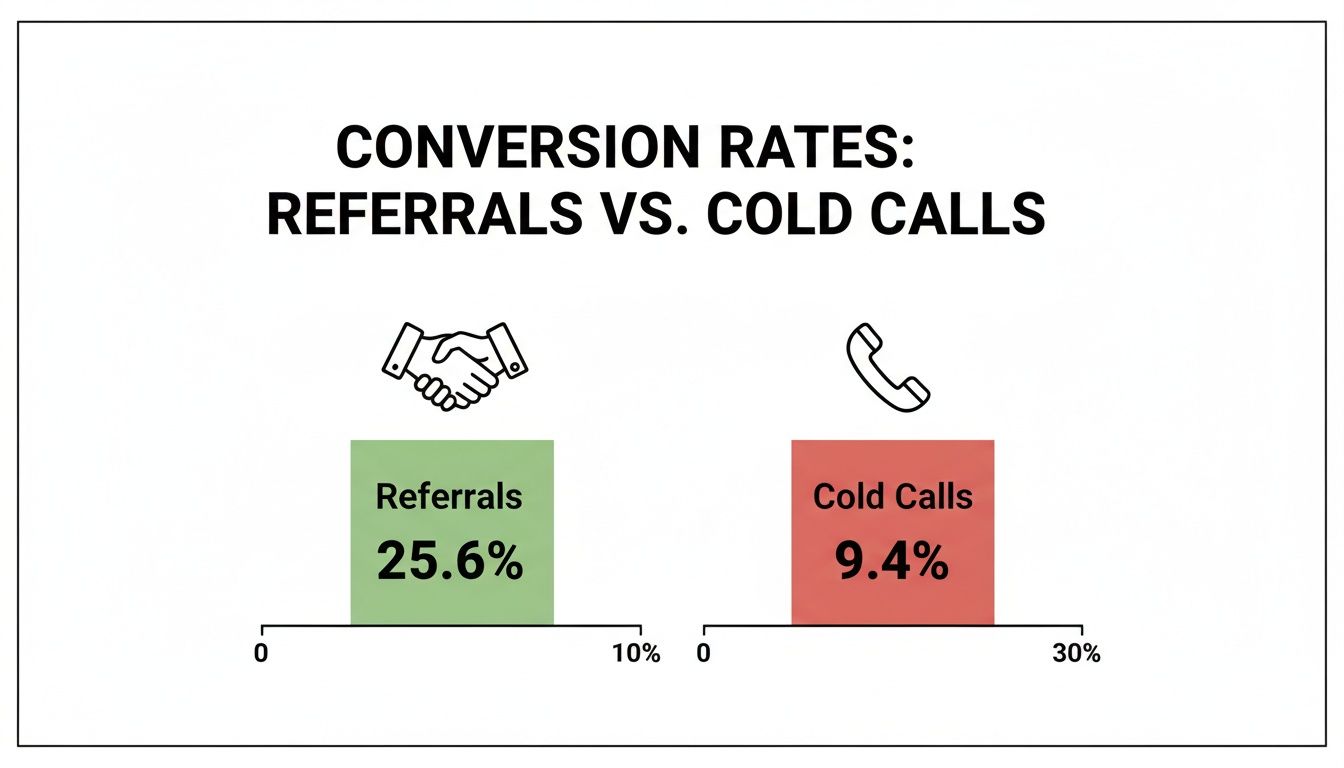
This highlights a key point: it’s not just about filling the top of your funnel. It's about filling it with high-quality prospects from your most effective channels. By consistently tracking, testing, and optimizing, you can ensure your sales funnel becomes an increasingly powerful and profitable asset.
Common Questions About Building a Sales Funnel
Even with a detailed plan, questions are bound to arise when building and refining your funnel. Let's address some of the most common ones.
What Is the Difference Between a Sales Funnel and a Marketing Funnel?
This is a common point of confusion because the two are deeply connected, and the terms are often used interchangeably. It's helpful to think of them as two halves of the same customer journey.
A marketing funnel is the wider, top portion. Its main job is to cast a wide net, generate awareness, attract an audience, and capture leads with valuable content like blog posts and webinars. It’s all about education and building initial interest.
The sales funnel is the narrower, bottom portion that takes over once a lead is qualified and shows buying intent. Here, the focus shifts to direct conversion activities: nurturing interest, handling objections, presenting offers, and ultimately, closing the deal.
In a seamless operation, marketing nurtures prospects until they signal they're ready for a sales conversation, at which point the handoff occurs.
The marketing funnel says, "Here's why you should listen to us." The sales funnel says, "Here's why you should buy from us." A successful strategy needs both working in perfect harmony.
How Long Does It Take to Build a Sales Funnel?
The timeline can vary dramatically based on complexity.
A Simple Funnel: This might include a landing page, a single lead magnet, and a basic 3-5 email welcome sequence. If the content is ready, a skilled marketer can often get this live in one to two weeks.
A Complex Funnel: A sophisticated B2B funnel with deep segmentation, CRM integration with a tool like Salesforce or Dynamics 365, multiple nurture paths, and paid ad campaigns will take longer. Realistically, expect this to take four to eight weeks to build, test, and launch properly.
My advice? Don't wait for perfection. Start with a Minimum Viable Funnel (MVF). Get it live, start collecting data, and iterate based on real-world performance.
What Are the Most Common Mistakes to Avoid?
Most failing funnels can be traced to a few critical, avoidable errors. Steering clear of these will put you miles ahead of the competition.
The biggest mistakes include:
- Guessing the Customer Journey: Building a funnel on assumptions instead of actual customer research, sales feedback, and analytics is the fastest way to miss the mark.
- Offering a Weak Lead Magnet: A generic or low-value offer attracts low-quality leads and results in poor engagement from the start.
- Neglecting the Follow-Up: The real relationship is built through nurturing. Capturing a lead and then doing nothing with it leaves the vast majority of potential revenue on the table.
- Not Tracking Key Metrics: Flying blind is not a strategy. Without tracking conversion rates at each stage, you have no way of knowing where your funnel is leaking or how to fix it.
Which Tools Are Essential for Building a Sales Funnel?
While you can patch a funnel together with various free tools, a scalable setup relies on a core stack of four essential platforms.
Here’s a breakdown of the foundational toolkit:
As your funnel matures, you may add tools for webinars, social media scheduling, or booking calls (like Calendly). But these four categories form the bedrock of any serious sales funnel operation.
Building a high-performing sales funnel is a strategic imperative for sustainable growth. By applying the principles in this guide, you can create a systematic, repeatable process for turning strangers into loyal customers. If you're looking to implement these strategies with expert guidance, Twelverays can help.
Discover how our data-driven approach can build the sales funnel your business deserves.


