

To scale your consulting business, you must shift from a freelancer's mindset to a firm's operational strategy. This means moving beyond just executing client work to actively building the business itself. The entire process rests on three foundational pillars: defining a hyper-specific niche, crafting a value proposition that solves a tangible, high-stakes business problem, and implementing pricing models that reflect your expertise, not just your time.
Mastering this foundation is what separates consultants stuck in a cycle of billable hours from firms that achieve profitable, year-over-year growth.
Build Your Foundation for Sustainable Growth
Many consultants hit a revenue ceiling, not because they lack expertise, but because they lack a strategic foundation. They are trapped in a model of trading hours for dollars, where the only path to increased income is working more, a direct route to burnout.
Breaking free from this trap requires making deliberate choices about who you serve, what you promise, and how you charge. This isn't mere administrative work; it's the bedrock of a scalable business. The first step is to abandon the generalist approach. While offering a wide range of services might feel safe, it turns you into a commodity. True growth, the kind that commands premium fees and attracts ideal clients, comes from becoming the definitive expert for a specific problem.
Define Your Hyper-Specific Niche
"Marketing consultant" is far too broad. It’s a title that gets lost in a sea of competition.
Consider the alternative: a "lead generation consultant for B2B SaaS companies in the fintech space." This level of specificity is powerful. It accomplishes two critical objectives: it eliminates the majority of your competition and instantly positions you as an authority. When a company faces a critical problem, they don’t seek a jack-of-all-trades; they look for a specialist who has solved their exact problem repeatedly.
To find your ideal niche, identify the intersection of these three elements:
- Proven Expertise: Where have you delivered your most impactful, measurable results?
- Market Demand: Which industries have a pressing, well-funded need for your core skills?
- Personal Interest: What work are you genuinely passionate about? This passion is essential for the deep focus required to become a thought leader.
A generalist HR consultant, for instance, will consistently struggle to stand out. However, one who specializes in creating retention strategies for remote-first tech startups can command a premium and attract a steady stream of ideal clients. This specialization is a key component of effective marketing for service companies.
Craft a Compelling Value Proposition
Once your niche is defined, your value proposition must address their most significant pain point directly. The conversation must shift from what you do (your services) to the results you deliver.
A weak value proposition is: "I offer SEO services."
A strong one is: "I help B2B software companies double their qualified demo requests in six months through targeted SEO." The difference is profound.
Your value proposition is the promise you make to your clients. It should clearly articulate the tangible, measurable business outcome they can expect, positioning your fee as an investment rather than an expense.
This clarity is crucial. It justifies premium pricing and attracts sophisticated clients who are focused on ROI, not simply finding the lowest-cost provider.
Select the Right Pricing Model for Growth
Your pricing model is the engine of your scalability. While hourly billing is common, it imposes a hard limit on your earning potential. To truly grow, you must decouple your revenue from your time.
- Project-Based Fees: A single, flat fee for a clearly defined project. This model rewards efficiency and expertise; as you become faster and more effective, your effective hourly rate increases.
- Value-Based Pricing: This is the ultimate goal for scalable consulting. You price your work based on the value it generates for the client. If your strategy is projected to save a client $1 million, a $100,000 fee is a logical investment for them, regardless of the hours it took you to develop.
- Retainers: Ideal for ongoing advisory work where a client requires consistent access to your expertise. A retainer provides predictable, recurring revenue, the financial foundation of any stable business, and works best when clients view you as a long-term strategic partner.
The optimal model depends on your services and client relationships, but the objective remains the same: move away from any structure that penalizes experience and efficiency. By establishing a sharp niche, a clear value proposition, and a scalable pricing model, you build the launchpad necessary to grow your consulting business.
Architecting Your Client Acquisition Engine
A solid foundation is vital, but a consistent flow of qualified leads is what fuels predictable growth. To scale beyond sporadic referrals, you must build a client acquisition engine that operates systematically.
This isn’t about pursuing every opportunity. It's about implementing a strategic, multi-channel approach that consistently attracts the right clients, those who already recognize their need for your specific expertise. The goal is to replace hope with a reliable system, engineering a pipeline that remains full even when you're immersed in client delivery.
Build Authority with Content and SEO
In consulting, trust is paramount. One of the most effective ways to build trust at scale is by creating high-value content that directly addresses your ideal client's most pressing questions. Your blog, guides, and articles act as your best salesperson, demonstrating your expertise 24/7.
When a potential client searches online for a solution, you need to be the authority they find. This is where Search Engine Optimization (SEO) becomes a strategic asset. By targeting long-tail keywords: the specific phrases your niche audience uses, you attract highly qualified traffic. For example, instead of a broad term like "marketing consulting," you would focus on a specific query like "customer retention strategies for SaaS companies."
Thought leadership isn't just sharing what you know; it's revealing how you think. High-quality content builds trust long before a sales call ever occurs, positioning you as a credible expert rather than just another vendor.
This strategy transforms your website from a static brochure into a dynamic lead-generation machine. Every article becomes another entry point for your ideal prospect. For a deeper dive, review our guide on how to get consulting clients using these powerful inbound methods.
Engage Decision-Makers with Targeted Paid Campaigns
While content and SEO build long-term momentum, sometimes you need to reach the right people immediately. This is where targeted paid advertising delivers focused, timely reach.
For consultants, platforms like LinkedIn are invaluable. They allow you to place your message directly in front of key decision-makers based on their industry, job title, company size, and other specific criteria.
A successful campaign relies on precision, not broad appeal. Imagine a consultant specializing in CRM implementation for manufacturing firms. They could run a LinkedIn campaign targeting COOs and VPs of Operations in that sector, promoting a case study that shows the measurable efficiency gains a comparable manufacturer saw after the rollout. Specificity like that earns the click.
The chart below illustrates the foundational pricing models you'll often discuss in high-level engagements, showing the progression from billing for time to billing for tangible results.
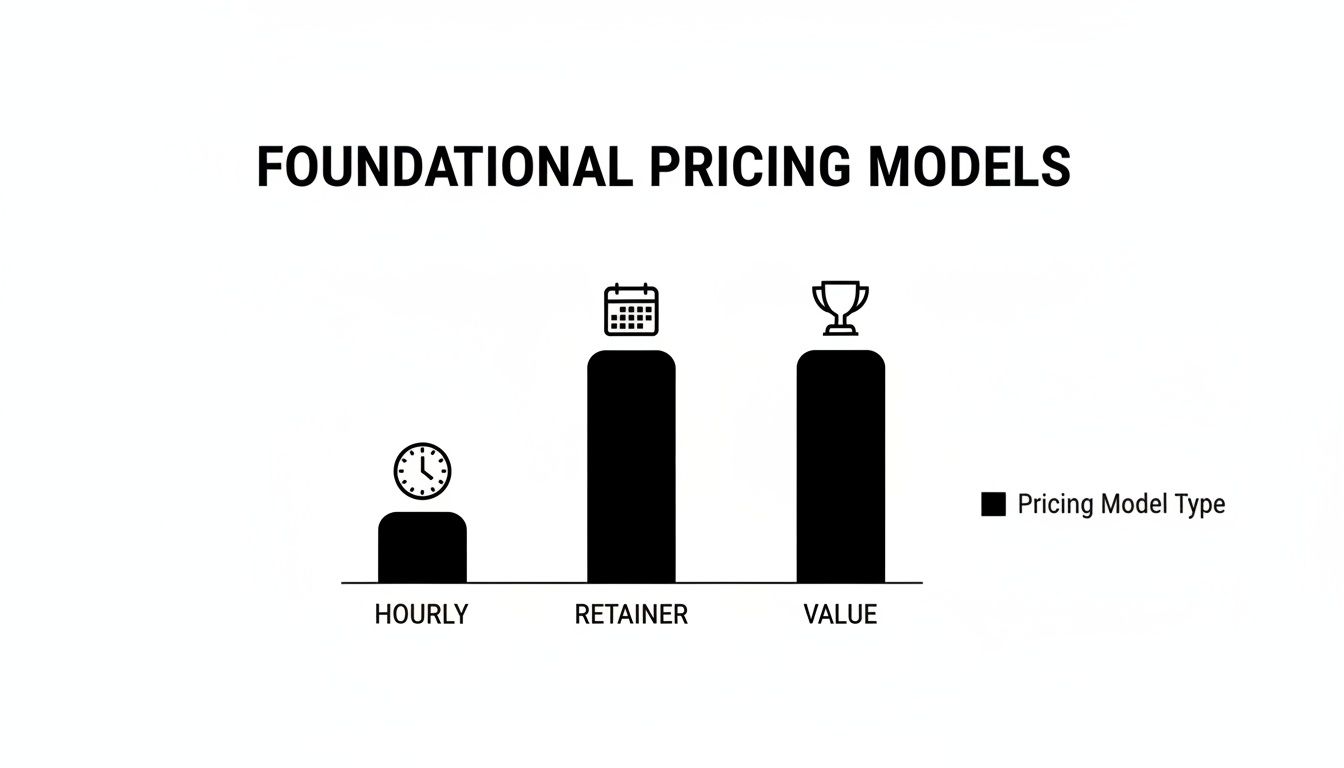
This demonstrates the journey from trading hours for dollars to aligning your fees with the actual ROI you deliver, a critical concept when positioning high-value services.
Foster Strategic Partnerships and Referral Networks
Never underestimate the power of a warm introduction. Strategic partnerships and referral networks are often the source of your highest-quality leads because they come with pre-established trust.
The key is to be proactive and systematic. Don't simply wait for referrals to happen.
Identify other professionals who serve the same clients you do in a non-competing capacity. For instance:
- A financial consultant could partner with a law firm specializing in business acquisitions.
- An IT security consultant might collaborate with a managed service provider (MSP).
- A marketing consultant could team up with a web development agency.
Building these relationships requires a "give to get" mindset. Offer value first by referring clients, sharing useful insights, and being a genuine resource. Over time, these alliances can become a reliable and powerful engine for growth.
Client budgets are expanding fastest for performance-driven digital and CRM-led engagements. Global ad spend already surpassed $1 trillion for the first time in 2026, with digital channels now making up roughly 69% of that total, so consultants who can connect paid media, SEO, and CRM are positioned to capitalize on this shift.
Mastering a Consultative Sales Process
Once your client acquisition engine is running and leads are flowing, the next critical stage is converting those conversations into high-value engagements. Many firms falter here, resorting to outdated sales tactics that feel pushy and transactional.
The secret to closing premium deals isn't selling harder; it's shifting your mindset. Stop selling services and start guiding clients to a solution. This is the essence of a consultative sales process.
This approach transforms the dynamic. You are no longer a vendor seeking a signature; you are a strategic partner collaborating with a potential client to solve a complex business problem. The process is built on genuine curiosity, active listening, and demonstrating your expertise in real-time. This naturally leads to higher close rates and stronger client relationships from the start.

The Art of the Discovery Call
Your first call with a prospect is the most important stage of the entire process. The goal is not to pitch; it is to diagnose. You must move beyond the surface-level symptoms to uncover the root cause of their pain.
This requires asking intelligent, open-ended questions that encourage conversation and reflection. Avoid any question that can be answered with a simple "yes" or "no."
Instead, use prompts that open up the discussion:
- "Walk me through what's happening that made you decide [stated problem] is a priority right now."
- "If we could solve this completely, what would the ideal outcome look like for your team six months from now?"
- "What have you already tried to address this, and what were the results?"
Questions like these transform the call from a sales pitch into a collaborative problem-solving session. You are not just collecting data; you are helping the prospect gain clarity. A great discovery call delivers value before a contract is ever signed, solidifying your status as the expert they need.
Crafting Proposals That Actually Close Deals
Following a successful discovery call, the proposal is your opportunity to formalize the solution you've outlined. A common mistake is sending a lengthy document that merely lists services and prices. That isn't a proposal; it's a price list.
A winning proposal is a business case. It sells the outcome, not the activities. It should feel like a direct summary of your conversation, demonstrating that you listened intently and truly understand their unique challenges.
A great proposal doesn't just list what you'll do; it articulates the value of the result. Frame your fee as a smart investment by clearly connecting your solution to a tangible ROI, whether through increased revenue, cost savings, or risk mitigation.
A proposal that secures a signature almost always includes these key components:
- The Situation: A concise summary of their current challenges, using their own language from the discovery call.
- The Goals: Clear, measurable objectives that you mutually agreed upon.
- The Solution: Your strategic approach, focusing on the "what" and "why" of your methodology, not just a task list.
- The Investment & ROI: A clear breakdown of your fee, positioned as an investment measured against the value you will deliver.
This structure elevates your proposal from a simple quote to a strategic document that your champion can use to gain internal buy-in. We explore this further in our guide on sales pipeline management best practices.
Handling Objections and Negotiation with Confidence
Objections are not rejections; they are typically requests for more information or reassurance. The most common objections revolve around price, timing, or internal resources. A consultative mindset equips you to handle these not as roadblocks, but as opportunities to reinforce your value.
When a prospect says, "Your price is higher than we expected," do not immediately offer a discount. Instead, get curious.
A powerful response is, "I understand. Could you help me understand what you were comparing it to?" This simple question reopens the conversation and shifts the focus back to value versus cost.
By the time you reach negotiation, it should feel like the final collaborative step before beginning a partnership, not a confrontation. If you've executed the discovery and proposal stages effectively, the client should already be convinced of the solution's value. The negotiation is simply about finalizing the terms to ensure a win-win that launches a successful, long-term relationship.
Scaling Operations with Tech and Talent
Once your sales process is refined, the next major challenge is delivery. Managing a growing client list with the same solo-operator tactics is a direct path to burnout and inconsistent quality. To grow your consulting business sustainably, you must build an operational backbone that can support increasing complexity.
This means integrating the right technology and, eventually, the right people. The goal is to create systems that allow you to manage more work while freeing you to focus on high-value client strategy and business development, the activities that drive real growth.

Ditch the Spreadsheets: Get a Real CRM
Your inbox and a collection of spreadsheets are not scalable. As your pipeline and client roster expand, you need a single source of truth to manage every relationship. A Customer Relationship Management (CRM) system is no longer a "nice-to-have"; it is mission-critical for scaling.
A robust CRM, like Salesforce or Dynamics 365, becomes your command center. It tracks every interaction, from a lead's first visit to your website to ongoing communications with long-term clients. This provides a comprehensive view of your pipeline, helps prioritize follow-ups, and ensures nothing is overlooked. For a detailed guide, see our article on how to choose a CRM system that fits your business needs.
The real power of a CRM for a consultant is its ability to transform chaotic data into actionable intelligence. You begin to see patterns in your sales cycle, identify your most profitable client profiles, and build a repeatable process for nurturing every relationship.
Automate the Grunt Work
How much of your day is consumed by low-value, administrative tasks? Consider the time spent creating invoices, scheduling meetings, sending routine follow-up emails, or generating basic reports. These tasks are necessary but detract from the time you could be spending on high-impact client work or closing new deals.
Automation is the key to reclaiming that time. By setting up workflows for these repetitive activities, you embed efficiency into the core of your business.
Consider these simple yet transformative automations:
- Scheduling Tools: A tool like Calendly eliminates the time-consuming back-and-forth of booking meetings.
- Email Sequences: Implement automated nurture sequences in your CRM for new leads to ensure consistent follow-up without manual effort.
- Project Management: Use platforms like Asana or Trello with automated reminders and task assignments to keep client projects on track.
When you combine this operational efficiency with modern marketing technology, the results are amplified. Consulting firms that integrate AI and automation are better positioned to scale. HubSpot's 2026 State of Marketing report finds nearly 49% of marketers now use AI to create personalized content, and 91% of those say it lifts engagement. High-growth firms treat AI as leverage on every workflow.
Making Your First Hire
There comes a point where even the most advanced tech stack has its limits. Bringing on your first team member is a significant step, but it is the only way to scale beyond your personal capacity. The key is to be deliberate about who you hire and why.
Your first hire should not be a duplicate of yourself. Instead, they should fill a specific gap that is hindering business growth.
- Virtual Assistant (VA): Often the ideal first hire. A skilled VA can immediately take over administrative tasks like scheduling, invoicing, and email management, freeing up your time instantly.
- Junior Consultant: If you need more capacity for client work, a junior consultant can handle the more tactical, repeatable aspects of delivery, allowing you to focus on high-level strategy and client relationship management.
- Specialist: If a particular service (like running paid ads or technical SEO) is consuming too much of your time, hiring a specialist can elevate your service quality while increasing your own capacity.
Remember that cultural fit is as crucial as technical skill. You are building a small, cohesive team. Look for individuals who are proactive, adaptable, and share your commitment to client success. A poor hire can be a significant drain on your time and resources, so invest heavily in the vetting process to find the right person to help you scale effectively.
Driving Retention and Long-Term Value
Landing a new client is an achievement, but the real work, and profit, begins after the contract is signed. While the pursuit of new business is important, client acquisition is expensive. The path to sustainable, predictable growth is through retaining and expanding the relationships you already have.
The objective is to evolve from a service provider to an indispensable partner. This transition is not a matter of luck; it is the result of a meticulously engineered client experience. It starts with a flawless onboarding process and continues with proactive communication that consistently reinforces the value you provide. The goal is to make it an easy decision for clients to continue working with you and, ultimately, to invest more in your services.
Master the First Impression with Structured Onboarding
The first 90 days of a client relationship are critical. This is your opportunity to set the tone, manage expectations, and validate their decision to hire you. A disorganized start can quickly lead to buyer's remorse and create doubts that are difficult to overcome.
A structured onboarding process is a strategic tool for building confidence. It should clearly outline timelines, define roles and communication channels, and establish what success looks like at each stage.
Your onboarding playbook should always include:
- A formal kickoff meeting: Bring all stakeholders together to align on goals, scope, and the definition of success.
- A shared project workspace: Use a tool like Asana or a shared drive to centralize all communication, documents, and deliverables, eliminating the need to search through emails.
- A defined communication rhythm: Establish a clear schedule for check-ins, such as weekly status calls or monthly strategy reviews, to ensure the client is always informed.
This structured approach removes ambiguity and demonstrates professionalism from the outset, laying a solid foundation for a lasting partnership.
Prove Your Worth with Proactive Communication
Once a project is underway, your value is demonstrated not only through your work but also through how you communicate its impact. Never make a client ask for an update. Proactive, insightful reporting is your best tool for demonstrating ROI and reinforcing your value.
Your reports should be more than a list of completed tasks. Frame your updates around the outcomes those tasks achieved. Tie everything back to the business goals established during the kickoff meeting.
A great report doesn’t just say what you did; it tells a story of progress. Use data to illustrate how your efforts are moving the needle on the metrics that matter most to your client's bottom line.
This type of proactive communication cements your role as a strategic partner who is as invested in their success as they are. This is a fundamental component of increasing customer lifetime value and turning satisfied clients into advocates for your firm.
Turn Partnerships into Recurring Revenue
The most successful firms understand a powerful secret: their best source of new business is their existing client base. Identifying opportunities to upsell or cross-sell should not feel like a sales pitch; it should be a natural extension of your relationship, stemming from a deep understanding of their evolving challenges.
As you become more integrated with a client's business, you gain a unique perspective on their operations, future goals, and hidden weaknesses. This vantage point positions you perfectly to recommend additional services that will drive even greater results.
This is where you deepen, rather than just defend, the relationship. The 2026 agency landscape rewards focus, not sprawl. Promethean Research found average agency revenue growth rebounded to 7.5% in 2025, up from 5% in 2024, and the strongest performers were firms that sharpened their offering rather than bolting on services for the sake of breadth. The lesson for consultants is precise: expand within your lane. Add services that solve the next problem your existing clients face, not unrelated lines that dilute your positioning.
Consultancies that listen and adapt their offering to clients' emerging needs outperform those that stand still. By anticipating what is next for the clients you already serve, you create new pathways to deepen relationships and raise revenue per client.
Got Questions About Scaling Your Consultancy? We've Got Answers
As you begin the journey of growing your consulting business, questions are inevitable. The path from a solo consultant to a thriving firm is filled with common challenges and critical decisions. Let's address some of the biggest questions consultants face when it's time to scale.
When Is the Right Time to Hire My First Employee?
This is a major milestone and often a source of stress. The right time isn't determined by a specific revenue target. It's a combination of being overbooked, having a consistent pipeline, and understanding the true value of your time.
You are likely ready when you are consistently turning down good projects due to a lack of bandwidth. Another key indicator is spending more than 20% of your week on administrative or other low-value tasks that prevent you from focusing on client strategy and business development.
Hiring too early can strain your cash flow. Waiting too long can lead to burnout and missed opportunities. A good first step is to map out the exact tasks you would delegate. If offloading that work would free you up to land even one more project, the hire will likely pay for itself.
Your first hire should be a solution to a bottleneck, not just another expense. Whether it's an administrative assistant to clear your plate or a junior consultant to boost delivery capacity, the goal is simple: buy back your time to focus on activities that grow the business.
How Do I Keep Cash Flow Healthy While Growing?
Rapid growth is exciting, but it can disrupt your cash flow if not managed carefully. As you take on larger projects and hire staff, your expenses often increase before the revenue from those new clients is received. This gap can put a significant strain on your business.
To manage this, adopt a few smart financial habits:
- Structure Your Contracts for Cash Flow: Require an upfront deposit, often in the 30-50% range, before any work begins. For longer engagements, use monthly retainers instead of milestone-based payments to ensure predictable income.
- Build a Cash Buffer: Make it a rule to maintain at least three to six months of operating expenses in a business savings account. This safety net allows you to handle late payments or unexpected costs without panic.
- Monitor Your Financials Closely: Don't wait until the end of the quarter to review your finances. Get in the habit of reviewing your profit and loss statement, cash flow statement, and accounts receivable weekly. This will help you identify potential issues long before they become crises.
Solid cash flow management is the lifeblood of your consultancy. It provides the stability needed to make strategic moves that fuel genuine growth.
Should I "Productize" My Services?
Productizing, turning a custom service into a standardized, fixed-price offering, is a game-changer for scaling. It simplifies your sales process, makes your pricing transparent, and allows you to create a repeatable delivery process.
This approach works well for services you provide frequently, such as a strategic roadmap, a systems audit, or a competitive analysis. For example, instead of offering vague "SEO consulting," you could offer a "B2B SaaS SEO Foundation Package" for a set price.
The benefits are significant:
- Faster Sales Cycles: Clients know exactly what they are getting, which reduces the back-and-forth often associated with custom proposals.
- Higher Margins: As your team standardizes the process, they become more efficient, which directly improves your bottom line.
- Easier to Scale: A well-defined, productized service is far easier to delegate to a junior team member than a complex, open-ended custom project.
However, productizing is not a universal solution. It works best for solving common, well-understood problems with a predictable process. For unique, complex challenges, a custom, value-based approach is still superior. The most successful firms often offer a healthy mix of both.
How Do I Know If I'm Tracking the Right KPIs?
What gets measured gets managed. As you grow, vanity metrics like website traffic or social media followers become less relevant. You need to focus on the Key Performance Indicators (KPIs) that reveal the true health and profitability of your business.
For a growing consultancy, your essential KPIs fall into three main categories:
- Financial Health: Monitor Monthly Recurring Revenue (MRR), Gross Profit Margin, and Customer Lifetime Value (CLV). These metrics indicate whether your growth is profitable and sustainable.
- Sales Pipeline: Track your Lead Velocity Rate (the month-over-month growth of qualified leads), Average Deal Size, and Sales Cycle Length. These KPIs measure the performance of your client acquisition engine.
- Client Success: Closely monitor your Client Retention Rate and consider using a Net Promoter Score (NPS). A business built on happy, long-term clients is built on a solid foundation.
Focusing on these core metrics allows you to make data-driven decisions and steer your firm toward sustainable, long-term growth.
Ready to stop guessing and start building a predictable growth engine? At Twelverays, we specialize in helping professional services firms implement the data-driven marketing and CRM systems needed to attract high-value clients and scale sustainably. Learn how we can help you build your playbook for success.


