

Before spending a single dollar on advertising, you must build a rock-solid foundation. A common mistake service companies make is jumping straight into tactics like SEO or paid search without answering the most critical question: "Who are we, and who do we serve?"
The answer to that question dictates every marketing decision that follows.
Without this clarity, your marketing becomes an expensive guessing game. Your budget is stretched thin, your messaging sounds generic, and you end up attracting clients who are a poor fit, leading to project headaches and razor-thin profit margins.
Building Your Foundation for Sustainable Growth

Defining Your Ideal Client Profile
The absolute cornerstone of any winning strategy is the Ideal Client Profile (ICP). This goes far deeper than basic demographics. For a service business, an effective ICP is a detailed persona that maps out their psychology, their biggest challenges, and what triggers their decision to buy.
Forget just listing company size or industry. A truly powerful ICP answers questions like:
- What specific, recurring problem keeps them awake at night? Are they losing money from inefficient operations? Worried about compliance risks? Struggling to find their next customer?
- What was the trigger that prompted their search? Did they just fail an audit? Did a key employee quit, leaving a massive operational gap? Or did a competitor launch something that makes them look outdated?
- Who actually makes the decision? You must identify the economic buyer (who signs the check), the technical user (who uses your service), and the internal champion who will advocate for you in meetings.
For instance, an IT consulting firm's ICP isn't just "manufacturing companies with 50-200 employees." A real ICP is: "The Operations Director at a mid-sized manufacturing firm who is frustrated with production downtime from legacy systems and is under pressure from the board to boost efficiency by 15% before the next fiscal year."
See the difference? That level of detail transforms your entire marketing approach.
To get this right, you need to document it. Here’s a simple template to get you started. This should be a living document that guides your entire team.
Ideal Client Profile (ICP) Template for a Service Company
Use this template to document your ideal client, ensuring your marketing messages are always on target and attract high-value leads.
Nailing this down ensures you stop wasting money talking to the wrong people and start attracting clients who see you as the optimal solution.
Finding Your Unique Market Position
Once you know exactly who you're targeting, you can carve out your unique space in the market. This isn't just about spying on competitors; it's about a sharp analysis focused on the gaps they leave behind.
Your goal isn't to be better; it's to be different. Find underserved needs, common complaints about other providers, and the unique value only you can deliver. That becomes the core of your message.
Take a hard look at your top three competitors. Comb through their websites, case studies, and client reviews. Are they all competing on price? Position your firm on premium quality and white-glove service. Do they offer a huge, generic suite of services? Double down on a niche they're completely ignoring.
Understanding how your ideal client perceives you in relation to everyone else is what turns marketing from an expense into an investment. This foundational work ensures your strategy is built on solid ground. And as you start bringing these high-value clients in, you'll need a system to manage them. That's where you can start to develop a CRM strategy to keep every relationship organized from day one.
Your Engine for Consistent Client Acquisition
Now that you have a solid foundation, it’s time to build the engine that brings in a predictable stream of qualified leads. Marketing for service companies isn't about throwing random tactics at a wall; it’s about creating a cohesive system where different channels work together to engage your ideal clients at the right moment.
This system typically rests on three core pillars: Search Engine Optimization (SEO) for long-term organic growth, paid search to capture immediate-intent leads, and paid social for hyper-specific outreach. When these components work in harmony, you build a powerful and reliable client acquisition machine.
Uncovering High-Intent Service Keywords
The first step for both SEO and paid search is in-depth keyword research. Your goal is to move past generic terms and zero in on the exact phrases your Ideal Client Profile (ICP) uses when they're actively trying to solve a problem.
Step outside your internal jargon and think about the language they use to describe their pain points.
- Problem-Aware Keywords: Phrases like "inefficient manufacturing process" or "data security compliance risks" capture prospects who are just beginning to understand their problem.
- Solution-Aware Keywords: Terms like "IT consulting for manufacturers" or "cybersecurity audit services" attract those who are actively comparing different types of solutions.
- High-Intent Keywords: Queries like "best IT consulting firm near me" or "get a quote for cybersecurity audit" are buying signals from someone ready to make a decision. These are your money keywords.
Focusing on these long-tail, high-intent keywords is critical. It ensures the traffic you attract is composed of highly qualified prospects who are far more likely to convert.
Capturing Active Searchers with Paid Search
While SEO is a long-term asset that builds value over time, paid search (PPC) delivers immediate visibility. It allows you to capture active demand right now. For modern service companies, it’s an indispensable tool. US search advertising generated roughly $114 billion in ad revenue in 2025, per the IAB/PwC Internet Advertising Revenue Report, and businesses use PPC to reach high-intent leads. WordStream's 2026 benchmarks put the average click-through rate for Google search ads at roughly 6.6% across industries. That's a significant volume of clicks turning into client conversations. You can explore more powerful marketing statistics on Salesforce.com.
To maximize your investment in Google Ads, structure your campaigns around your specific service offerings. Each service should have its own ad groups targeting a tight cluster of related keywords. This keeps your ad copy hyper-relevant to the search query, which boosts your Quality Score and lowers your cost-per-click.
Don't make the classic mistake of sending all your ad traffic to your homepage. Create dedicated landing pages for each ad group that speak directly to the user's search query and present a clear, compelling call-to-action, like "Request a Consultation."
This targeted approach ensures you’re maximizing your return on ad spend by focusing on conversions, not just clicks. For a deeper analysis, check out our guide on how to optimize lead generation for your PPC campaigns.
Reaching Decision-Makers with Paid Social
Paid search is fantastic for capturing existing demand, but what about creating it? That's where paid social, especially on a platform like LinkedIn, is unmatched. It allows you to get your message directly in front of the key decision-makers in your ICP, even if they aren’t actively searching for your solution.
LinkedIn's targeting capabilities are incredibly powerful, letting you build audiences based on:
- Job Title: Target the "Director of Operations" or "CFO."
- Company Size: Focus on firms with 50-200 employees.
- Industry: Limit your campaign to the manufacturing sector.
- Company Name: Run account-based marketing (ABM) campaigns targeting a specific list of dream clients.
Your goal on LinkedIn is often not an immediate lead but rather building awareness and sharing valuable content that positions your firm as a thought leader. Offer insightful articles, whitepapers, or webinar invites that address your ICP's biggest challenges. By providing value first, you build trust and ensure your company is top-of-mind when a buying trigger occurs.
By orchestrating these three channels, SEO for sustained organic growth, paid search for immediate lead capture, and paid social for precision targeting, you build a resilient, scalable engine that consistently delivers qualified opportunities.
Integrating Your CRM for a Seamless Lead Flow
Generating leads is a great start, but it's only half the battle. What happens after a potential client fills out a form can make or break your entire sales process.
Without a robust system, high-value leads inevitably fall through the cracks, marketing efforts feel disconnected from sales results, and your ROI remains a mystery. This is where many service companies stumble.
That's precisely why integrating your marketing channels directly into a Customer Relationship Management (CRM) system like Salesforce or HubSpot is non-negotiable. It creates a single source of truth, connecting every touchpoint from the first ad impression to the final signed contract. This integration is what turns marketing from a perceived cost into a transparent, revenue-driving machine.
Establishing a Cohesive Data Flow
At the heart of any effective CRM setup is a seamless data flow. When a lead comes in from any channel, a Google Ad, a LinkedIn campaign, or an organic search visit, that information must be instantly and accurately captured in your CRM.
This requires careful planning. You must map the data fields from your forms and ad platforms to the corresponding fields in your CRM.
For example, a contact form on your "Request a Consultation" landing page should automatically populate CRM fields such as:
- Lead Source: "Google Ads - Cybersecurity Campaign"
- Contact Info: Name, Email, Phone, Company
- Key Pain Point: A custom field capturing their answer to "What's your biggest IT challenge?"
Getting this right eliminates manual data entry, which is slow and prone to human error. A clean, automated flow ensures your sales team receives rich, contextual information the moment a lead enters the pipeline. For a deeper dive into the mechanics, our guide on what CRM integration is breaks down the technical aspects.
The journey from a prospect's initial research to becoming a client is a clear path, and your CRM is built to track and optimize every step.
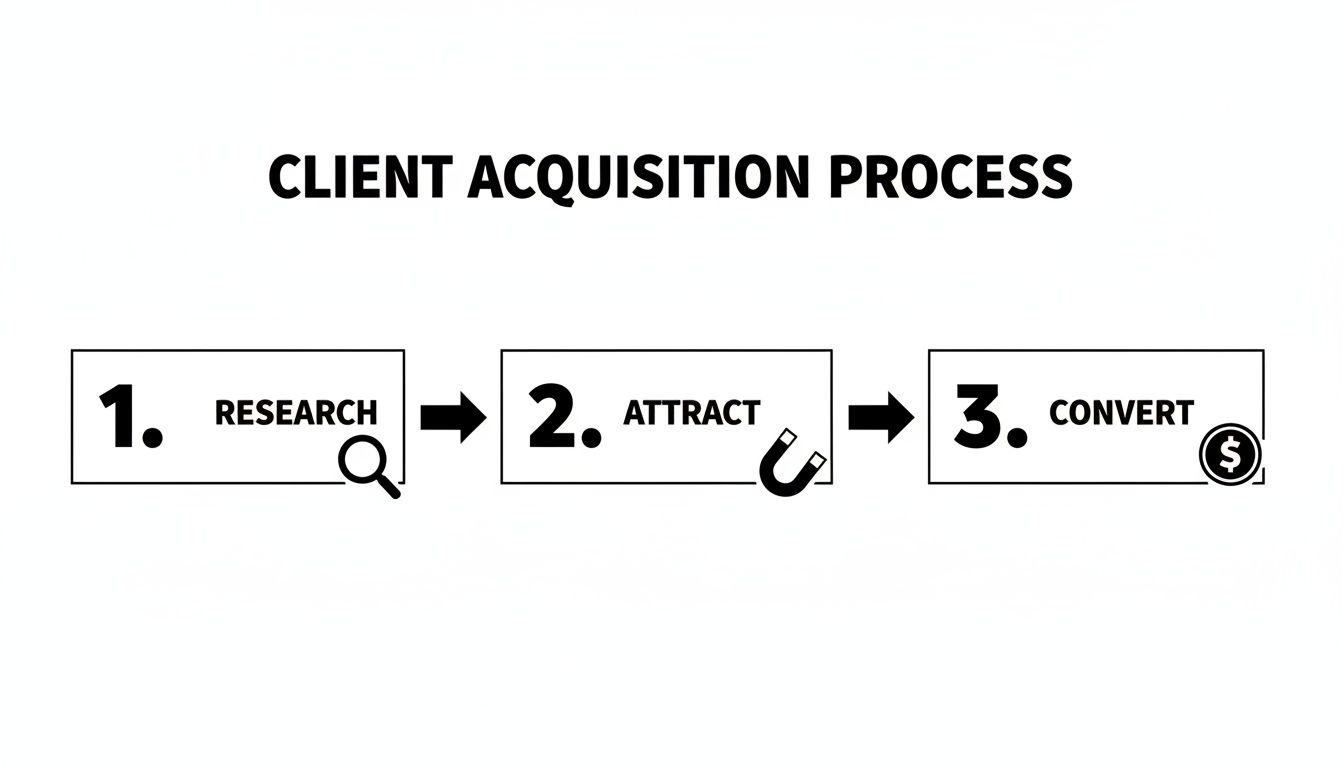
This visual underscores that every interaction is part of a larger, measurable process, highlighting why a central system is essential for effective management.
Automating Lead Management and Gaining Visibility
Once your data is flowing cleanly, the true power of an integrated CRM emerges: automation and visibility.
You can set up rules that automatically assign leads to the right salesperson based on territory, service interest, or company size. This simple step can shave days off your response time, a critical advantage. Lead-response research consistently finds that the company that responds first wins the large majority of deals. Speed wins.
A well-integrated CRM also lets you build powerful dashboards for a crystal-clear view of the entire customer journey. You can finally track the metrics that actually matter:
- Lead-to-Opportunity Rate: What percentage of marketing leads are sales-qualified?
- Channel Performance: Which channels, SEO, PPC, or Social, are generating the most valuable leads?
- Sales Cycle Length: How long does it take to close a deal originating from a specific campaign?
This level of insight is impossible when your data is scattered across disconnected spreadsheets and platforms.
By connecting marketing efforts directly to sales outcomes within your CRM, you eliminate guesswork. You can definitively prove which campaigns are working and make data-backed decisions on budget allocation.
This is what turns raw data into actionable business intelligence, allowing you to see exactly how your marketing activities are fueling the sales pipeline in one unified view. That immediate visibility is key to agile decision-making and effective marketing for any service company.
Mastering Lead Qualification and Nurturing
Leads are flowing in from your marketing channels, but not every lead is created equal. A critical step in building an effective marketing engine is separating genuinely interested prospects from casual browsers. Sending every inquiry to your sales team is a surefire recipe for wasted time and a frustrated sales force.
The goal is to build a system that methodically qualifies and nurtures leads until they are ready for a sales conversation. This process ensures your team spends its time with high-potential prospects who are already educated and engaged with your brand. Getting this right will dramatically boost your conversion rates and can significantly shorten the sales cycle.

Building a Simple Lead Scoring Model
Lead scoring is the engine that drives smart qualification. It’s a method of assigning points to each lead based on their profile and interactions, helping you prioritize who receives immediate attention. You don't need a complex algorithm; a simple, practical model is far more effective than none at all.
Start by breaking your criteria into two main buckets:
- Firmographic Data: This is about who they are. Does this lead match your Ideal Client Profile? Assign points based on company size, industry, and the person's job title. A "Director of Operations" at a 100-person manufacturing firm should score higher than an intern at a small startup.
- Behavioral Data: This is about what they do. A prospect’s actions on your website are strong indicators of their intent. Someone who downloads a detailed case study or visits your pricing page is showing more interest than someone who just skims a single blog post.
Here’s what a simple scoring system could look like:
Once a lead reaches a specific threshold, say, 70 points: they are automatically flagged in your CRM as a Marketing Qualified Lead (MQL). This triggers a handoff to the sales team for personalized follow-up.
Designing Value-Driven Nurturing Sequences
What about leads who don't hit the MQL threshold? They aren't dead ends; they just aren't ready to buy yet. This is where lead nurturing comes in. Instead of a hard sell, you build trust by delivering genuine value over time, typically through automated email sequences.
The purpose of nurturing isn't to constantly ask for the sale. It's to educate, solve smaller problems, and position your company as the go-to expert. When their need becomes urgent, you'll be the first one they call.
An effective nurturing sequence is strategic. It guides prospects through a logical journey of education and trust-building. Each email should build on the last, answering common questions and addressing your ICP's pain points.
For instance, a nurturing flow for a prospect who downloaded an introductory guide might look like this:
- Email 1 (Day 2): Share a case study showing how a similar company solved the problem mentioned in the guide.
- Email 2 (Day 5): Offer a link to a short video explaining a common mistake companies make when trying to solve this issue themselves.
- Email 3 (Day 10): Invite them to a free webinar that provides a framework for tackling the broader challenge.
Throughout this process, you continue to score their engagement. If they click through the case study and register for the webinar, their lead score increases, potentially tipping them over the MQL threshold. This blend of qualification and nurturing creates a powerful, self-optimizing system that feeds your sales pipeline with genuinely warm leads. For a complete framework, our article on mastering lead nurturing automation provides a step-by-step guide.
Measuring ROI and Scaling Your Marketing Efforts
Let's discuss the bottom line. Marketing for a service company isn't an expense; it's an investment. And like any good investment, its value must be proven with hard numbers, not just vanity metrics like clicks or impressions.
Knowing which Key Performance Indicators (KPIs) to track is what elevates a marketing department from a cost center to a genuine growth engine. It’s the only way to make smart, data-backed decisions that fuel sustainable growth.
From Vanity Metrics to Business Impact
When it comes to service marketing, the most important numbers boil down to the relationship between the cost to acquire a new client and the revenue that client generates over their lifetime.
Let's break down the three metrics that truly matter.
Customer Acquisition Cost (CAC) is your reality check. It’s the total sales and marketing spend required to land one new client over a specific period.
- Formula:
(Total Sales & Marketing Spend) / (Number of New Customers) = CAC
If you spent $20,000 on sales and marketing last quarter and onboarded 10 new clients, your CAC is $2,000. This number is the foundation for understanding your marketing profitability.
Customer Lifetime Value (LTV) represents the total revenue you can reasonably expect from a single client throughout your relationship. It quantifies what a client is really worth.
- Formula:
(Average Annual Contract Value) x (Average Customer Lifespan in Years) = LTV
If your average client pays $15,000 a year and typically stays for four years, that client's LTV is $60,000.
Now for the crucial part. The LTV to CAC ratio is the ultimate measure of your marketing's profitability and scalability. For a healthy service business, a ratio of 3:1 or better is a strong benchmark.
In our example, an LTV of $60,000 against a CAC of $2,000 yields an outstanding 30:1 ratio. That's a clear signal that your marketing engine is highly effective. For a more detailed breakdown, our guide on how to measure marketing ROI explores more advanced formulas.
Using Data to Make Scaling Decisions
Once you have these core metrics dialed in, you can move from simply reporting on past performance to actively steering your strategy. The data in your CRM and ad platforms is a goldmine for determining where to allocate your next dollar.
The goal isn't just to measure what happened; it's to predict what will happen next. Analyze which channels deliver not just the most leads, but the leads with the highest LTV to CAC ratio.
This is how you build a scalable model.
- Double Down on Winners: If your data shows LinkedIn Ads are bringing in clients with a 5:1 LTV:CAC ratio, while another channel is barely breaking even at 1:1, the path forward is clear. Shift your budget to the proven performer.
- Test and Iterate Methodically: When exploring a new channel, start with a small, controlled budget and set clear goals. For example, aim to acquire three pilot customers at a target CAC within 90 days. If you hit the mark, it’s time to scale up. If not, you've learned a valuable lesson without a major financial loss.
This analytical approach removes emotion and guesswork from your growth strategy. By relentlessly optimizing for the highest-value clients, you create a marketing model that doesn't just grow, it scales profitably.
Got Questions About Marketing Your Service Company? We've Got Answers.
Even the best-laid marketing plans encounter questions. When you're in the trenches trying to grow your service company, it’s natural to wonder if you’re making the right decisions.
Let's address some of the most common questions we hear from business leaders and marketers to provide the clarity needed for confident action.
How Much Should a Service Company Really Budget for Marketing?
This is the classic "it depends" question, but we can apply a practical framework. Instead of picking a random percentage, your budget should be tied directly to your growth goals and your Customer Acquisition Cost (CAC).
As a general rule, most B2B service companies allocate 5-10% of their total revenue to marketing. But this is just a benchmark.
A smarter approach is to work backward from your goals. Let's say your objective is to generate $500,000 in new annual revenue. If your average client has a lifetime value (LTV) of $50,000, you need to sign 10 new clients. If you've determined your target CAC is $5,000, then you need a marketing and sales budget of at least $50,000 to achieve that goal.
A new company entering a crowded market may need to invest more aggressively, perhaps 12-20% of projected revenue, to gain traction. An established firm with strong word-of-mouth referrals might be fine closer to the 5% mark.
SEO or Paid Ads? Which One Matters More?
This isn't an either/or choice; it's a strategic decision of "both, but when." SEO and paid ads play distinct yet complementary roles in a robust marketing plan.
- Paid Ads (PPC) deliver immediate results. They put you in front of people who are actively searching for a solution right now, making them indispensable for launching a new service or quickly generating leads.
- SEO is a long-term strategy. It's about building a sustainable asset that attracts organic traffic and establishes your authority over time. Leads from SEO are often highly qualified and come at a lower cost once you achieve rankings.
The optimal approach is to use them in concert. Launch paid ad campaigns to generate immediate leads and gather valuable keyword data. Simultaneously, make a steady, consistent investment in an SEO strategy that will deliver returns for years to come.
How Long Until I Actually See Results From My Marketing?
This is a critical question, and the answer depends entirely on the channels you're using. Setting realistic expectations is essential to avoid abandoning a sound strategy prematurely.
Think of marketing as a marathon, not a sprint. While some channels provide quick wins, a truly powerful marketing engine is built with consistent, focused effort over quarters, not just weeks.
We're a Small Service Business. Do We Really Need a CRM?
Yes. Unquestionably. Believing a CRM is only for large corporations is a common and costly mistake for small businesses.
A system of spreadsheets and sticky notes quickly becomes unmanageable as you grow. Leads are dropped, follow-ups are forgotten, and opportunities are lost. A CRM, like Salesforce or Dynamics 365, provides a single source of truth.
It enables you to:
- Track every lead from initial contact to a signed contract.
- Automate follow-ups to ensure nothing is missed.
- Visualize your entire sales pipeline at a glance.
Implementing a CRM early builds the right habits and creates a scalable foundation for growth. It is far easier to set up when you have 10 clients than when you're trying to manage 100.
At Twelverays, we build the integrated marketing and CRM systems that service companies use to create predictable growth. If you’re tired of the guesswork and ready to implement a strategy that’s driven by data, not hunches, we should talk. See how we build client acquisition engines at https://twelverays.agency.


