

Improving customer engagement isn’t about chasing trends; it’s about moving beyond generic transactions to create valuable, personalized experiences at every touchpoint. The goal is to build genuine relationships using data-driven insights, proactive communication, and seamless channel integration.
When you get this right, customers feel understood and valued. That connection is the foundation of loyalty and sustainable growth.
Why Old Engagement Tactics No Longer Work
The traditional ways of engaging customers are obsolete. In an era of endless choice and economic uncertainty, generic email blasts and one-size-fits-all offers fall flat. Today's customers aren't just buying a product; they're investing in brands that offer a genuine connection and consistent value.
Transactional interactions are a thing of the past. Customers now expect you to anticipate their needs, sometimes even before they do. This isn't just a signal for a new marketing campaign; it's a call for a fundamental change in how you approach the entire customer relationship.
The Urgency for a Modern Approach
This pressure to adapt is a measurable reality. 77% of consumer products marketers globally say they need to significantly transform how their organization operates. This statistic from a global consumer products engagement report reflects the pressure brands face from rising costs and eroding loyalty. Shoppers crave authentic connections, not just another sales pitch.
This kind of change goes beyond adopting new technology. It demands a complete mindset shift, forcing you to rethink how your entire organization is structured and operates. If you're interested in digging deeper, explore our guide on building a successful digital transformation strategy.
This playbook is designed to cut through the noise and provide a modern framework for building relationships that last. We’ll walk through actionable strategies that cover the entire customer lifecycle, from making a powerful first impression to creating long-term brand advocates.
What This Playbook Covers
To help you build a resilient and effective engagement strategy that drives real business results, we've broken down the core components into an actionable roadmap.
Here's a quick look at the key pillars we'll be covering in this guide.
| Key Pillars of Modern Customer Engagement |
| :--- | :--- | :--- |
| Pillar | Objective | Key Channels & Tools |
| Integrated Data Foundation | Create a unified customer view to understand behavior and needs. | CRM (Salesforce, Dynamics 365), CDP, Analytics Platforms |
| Actionable Channel Tactics | Turn every interaction into a growth opportunity. | SEO, Paid Social/Search, Email Marketing, Customer Service |
| Personalization at Scale | Deliver relevant experiences without losing the human touch. | Segmentation, AI-driven tools, Marketing Automation |
| Meaningful Measurement | Track KPIs that truly matter for long-term growth. | Customer Lifetime Value (CLTV), Churn Rate, NPS |
This table provides a high-level view, but we'll dive deep into each area, offering practical steps and real-world examples to help you put these concepts into practice.
The core idea is simple: stop treating engagement as a series of isolated campaigns. Instead, build a cohesive system where every touchpoint reinforces your brand's value and strengthens the customer relationship. This is how you move from just talking at customers to building loyalty with them.
Build Your Foundation With Integrated Data
Guesswork is the enemy of great customer engagement. To create experiences that resonate, you must move beyond assumptions and build your strategy on a solid foundation of integrated data.
This means creating a unified ecosystem where every piece of customer information connects. The goal is to paint a complete, vivid picture of who your customers are and what they need.
It's not just about collecting data; it's about connecting it. When your systems are truly integrated, insights from SEO can inform paid ad targeting. Behavioral data from your website flows directly into your CRM. Without that cohesion, you operate with blind spots, leading to disjointed and ineffective outreach.
The process is a cycle: use data to personalize experiences, then measure the impact to gather more data for the next round.
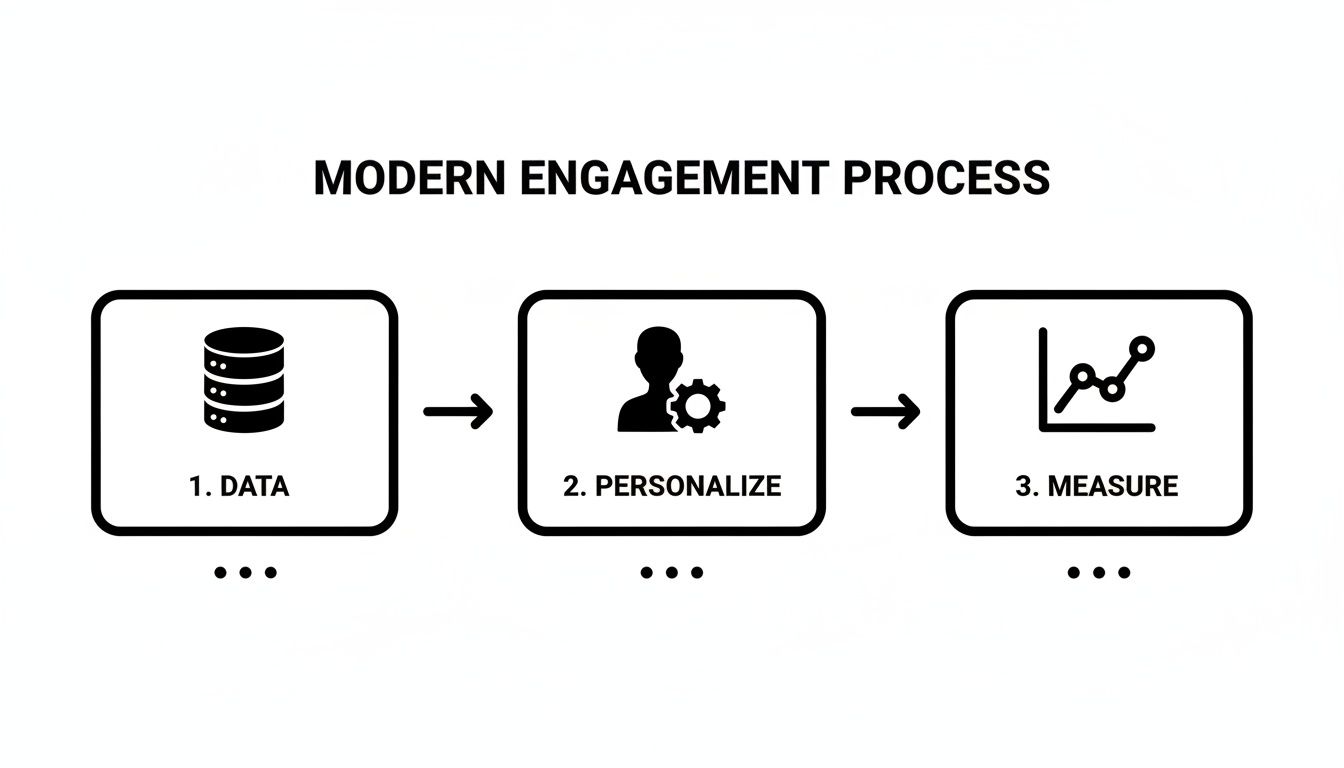
As you can see, it all starts with clean, centralized data. That’s the fuel. It powers personalization, and the results from those personalized interactions must be measured to make your next effort even smarter.
Unifying Your Data Ecosystem
First, break down the silos between your core platforms. For most businesses, this means connecting your CRM, like Salesforce or Dynamics 365, to all your marketing and sales channels. The aim is to create a single source of truth for every customer interaction.
Once your systems are integrated, powerful things start to happen.
For example, a lead from a paid search campaign converts on your website. That information shouldn't remain isolated in your ad platform. It should automatically update their profile in your CRM, noting the exact campaign and keywords that brought them to you. That context is pure gold for your sales team.
This unified view also lets you see the entire customer journey, not just fragmented snapshots. You can track how a user first found you through organic search, later engaged with a paid social ad, and eventually became a high-value client. This holistic perspective is the key to understanding how to improve customer engagement effectively.
From Messy Data to Actionable Segments
Data integration is only half the battle. The data itself must be clean and reliable. Inaccurate or duplicate records can sabotage even the most brilliant strategies, so regularly auditing and cleaning your database is non-negotiable. It ensures your personalization is based on truth, not noise.
With clean, centralized data, you can move on to meaningful segmentation. Go deeper than basic demographics and group your audience based on their actions.
- Engagement Level: Group users by how recently they've interacted with your emails, website, or sales team. A disengaged segment might receive a re-engagement campaign, while a highly active one could get an exclusive offer.
- Purchase History: For a B2B company, this might mean segmenting by the type of service they've bought or their contract value. A client who has only used one service is a perfect candidate for a cross-selling campaign.
- Content Consumption: Track which blog posts, case studies, or webinars a user has viewed. This lets you tailor follow-up messages around topics you already know they care about.
Building this unified data hub is the most critical investment you can make in your engagement strategy. It transforms your CRM from a simple address book into a dynamic, intelligent engine that powers every other marketing and sales activity.
A Real-World Scenario
I once worked with a B2B SaaS company that was struggling with low trial-to-paid conversion rates. Their paid search data, email marketing platform, and Salesforce instance were completely disconnected. They had no idea which leads were most likely to convert or why others were dropping off.
By integrating their systems, they uncovered a game-changing insight. Leads who had downloaded a specific technical whitepaper and attended a product demo webinar converted at a far higher rate.
Armed with this knowledge, they built a new workflow:
- Any lead who downloaded the whitepaper was automatically added to a nurturing sequence in their marketing automation platform.
- That sequence promoted the high-value webinar, tailoring the messaging based on the lead's industry data from Salesforce.
- Sales reps received a real-time alert in their CRM when one of these high-intent leads registered for the webinar, allowing for timely, personalized follow-up.
The result was a significant lift in conversions and a much more efficient sales process. This is a perfect example of the direct link between a strong data backbone and superior customer engagement. For a deeper look, you can explore more about the various customer data integration solutions that help build this kind of foundation.
Turn Every Interaction Into an Opportunity
Once your data foundation is solid, the real work begins. Every customer touchpoint, from a routine service call to an automated email confirmation, is an opportunity to build a stronger relationship. It's also a chance to lose one.
The key is to shift your perspective. Stop seeing these interactions as simple operational costs. Instead, view them as powerful revenue drivers and loyalty builders.
This isn't just a theory; it's a proven growth lever. Intentional, service-related interactions don't just solve problems, they actively multiply revenue. Research shows that customers with service engagements have a 19% higher customer lifetime value (CLTV) compared to those without. This data, from a broad study of over 15,700 consumers, proves these moments are prime opportunities for upsells, cross-sells, and major satisfaction gains.
The goal is to proactively engage customers at critical moments in their journey. This means making every single interaction count, whether it happens over email, paid social media, or even SMS.

Transforming Channels Into Conversation Starters
Different channels serve different purposes, but they should all work together to create a single, seamless conversation. The trick is to play to each one's unique strengths while keeping your brand voice consistent across the board.
- Email Marketing: Move beyond generic newsletters. Use behavioral data from your CRM to trigger automated, yet deeply personal, emails. For example, if a customer browses a specific service page but doesn’t convert, a follow-up email offering a relevant case study can be incredibly effective.
- Paid Social and Search: Your ads shouldn't stop after the first click. Use retargeting to re-engage existing customers with content that adds value. You could promote an advanced webinar to clients or show them ads for complementary services based on their purchase history.
- SMS and Direct Messaging: This is your channel for high-impact, time-sensitive communication. Think appointment reminders that slash no-shows or exclusive, limited-time offers for loyal customers. The immediacy of SMS makes it perfect for driving urgent action.
The big picture here is to orchestrate these channels. A customer might see a paid social ad, click through to your site, and later receive a personalized follow-up email. When done right, this feels helpful and intuitive, not intrusive or creepy.
Upselling and Cross-Selling With Finesse
One of the fastest ways to grow revenue is by deepening your relationship with existing customers. However, aggressive upselling can quickly kill trust. The key is to position new offers as solutions to problems you already know they have, thanks to your integrated data.
For instance, a client using your entry-level software package might start hitting their usage limits. This is a perfect trigger for your CRM to alert their account manager. The resulting outreach isn't a cold pitch; it's a timely, helpful suggestion to upgrade. For more on this, our guide on lead nurturing automation dives into more strategies for these types of targeted communications.
Platforms like Salesforce Marketing Cloud are designed to manage these complex, multi-channel journeys from a single dashboard. This unified view allows marketers to visualize and automate interactions across email, mobile, and advertising, ensuring every message feels like part of a coherent strategy.
Mini-Case Study: A Professional Services Firm
We worked with a professional services firm that wanted to increase client lifetime value but struggled to spot cross-selling opportunities. Their most valuable client data was locked in their Dynamics 365 CRM, completely siloed from their marketing efforts.
By integrating their CRM with their paid social channels, they were able to build highly specific custom audiences.
- Audience Creation: They created a segment of clients who had used their tax advisory services but not their wealth management services.
- Targeted Campaign: This specific audience was then targeted on LinkedIn with ads featuring content about long-term financial planning.
- Personalized Follow-Up: When a client from this audience engaged with an ad, their account manager received an automated notification in Dynamics 365 to start a consultative conversation.
This targeted approach led to a significant jump in clients adopting multiple services, directly boosting their lifetime value. It’s a perfect example of how to improve customer engagement by turning data insights into proactive, revenue-generating actions.
Master Personalization at Scale With AI
Personalization is no longer a nice-to-have; it's the baseline. Customers expect you to understand their needs and deliver tailored experiences. But as your business grows, creating that one-to-one connection with every person can feel overwhelming.
This is where AI and marketing automation come into play. These are practical tools that let you deliver hyper-relevant experiences at a scale that was once impossible. The goal is to use technology to make your brand feel more human, not less.
A smart approach goes beyond slotting a first name into an email template. It involves sophisticated systems that can anticipate customer needs, adapt content on the fly, and offer instant support, all while getting smarter with every interaction.

Deploying AI for Smarter Engagement
AI is a practical toolkit for elevating every customer interaction. Its power lies in processing massive amounts of data to spot patterns your team could never catch, paving the way for more proactive and intelligent engagement.
Here are a few ways this works in the real world:
- Conversational AI for 24/7 Support: Chatbots and virtual assistants can handle common questions instantly, freeing up your human agents to tackle more complex, high-value problems that need a personal touch.
- Predictive Analytics to Anticipate Needs: AI models can analyze past behavior to predict what customers will do next. This means you can spot a customer at risk of churning and intervene with a targeted offer, or identify someone ready for an upsell.
- Dynamic Content That Adapts in Real Time: Instead of sending the same email to your entire list, AI can tailor the content for each person based on their recent browsing or purchase history.
These AI-driven tactics are changing the game. Done right, they deliver real results: businesses that deploy conversational AI well consistently report higher customer satisfaction and faster resolution times. The stakes are high. According to PwC, 32% of customers stop doing business with a brand they love after a single bad experience, and 59% walk away after several. Every interaction counts.
Keeping the Human Touch in an Automated World
The biggest mistake you can make with automation is letting it strip away the genuine connection that builds loyalty. Think of AI as a way to augment your team's abilities, not replace them. Let technology handle the repetitive, data-heavy lifting so your people can be more strategic and empathetic.
The ultimate goal is to balance efficiency with empathy. Use automation to manage scale, but always preserve channels for genuine human connection when it matters most.
So, how do you strike that balance?
- Define Clear Handoff Points: Know exactly when a chatbot needs to pass a conversation to a human agent. This ensures customers with complex issues get the personal attention they need without frustration.
- Use AI to Inform, Not Dictate: Give your sales and service teams AI-powered insights. An account manager can enter a client meeting already equipped with data on their recent support tickets, product usage, and marketing engagement.
- Personalize Your Automation: Don't let your automated messages sound robotic. Use data to make them feel personal and relevant. Referencing a past purchase or interaction shows you're paying attention.
Ultimately, the best strategy for how to improve customer engagement with AI is a hybrid one. If you're looking for platforms to help, check out our guide on the 12 best AI tools for digital marketing. The right tech stack makes your brand feel more responsive and intelligent, creating a better experience for everyone.
Measure What Matters for Real Growth
A great engagement strategy is just an idea until you can prove it works. To get buy-in and justify your efforts, you have to connect your actions to tangible business outcomes. Many strategies fall flat because they chase vanity metrics instead of focusing on what actually moves the needle.
This section is about tracking the Key Performance Indicators (KPIs) that truly matter. We'll push past likes and shares to focus on the metrics that signal genuine growth and demonstrate the ROI of your hard work.
Moving Beyond Vanity Metrics
It's easy to get distracted by numbers that look good in a report but have little impact on revenue. High email open rates or a spike in social media followers might feel like a win, but they don't tell the whole story. To truly understand how to improve customer engagement, you must dig deeper.
The goal is to measure the financial impact of your actions. Are your personalized email campaigns leading to more repeat purchases? Is proactive customer support reducing subscription cancellations? These are the questions that unlock meaningful insights.
True measurement isn't about tracking every possible data point; it's about tracking the right ones. Focus on metrics that directly reflect customer loyalty, retention, and profitability. This is how you shift the conversation from "engagement" as a buzzword to engagement as a core driver of business growth.
Core Engagement KPIs You Must Track
To get a clear picture of your strategy's performance, you need a dashboard that prioritizes a handful of essential metrics. While every business is unique, there are a few non-negotiable KPIs that every team should be watching.
Customer Lifetime Value (CLTV): This is the ultimate health check for your customer relationships. CLTV predicts the total revenue you can expect from a single customer over their entire time with you. A rising CLTV indicates that your engagement efforts are creating more loyal, high-spending customers.
Churn Rate: This metric tracks the percentage of customers who leave over a specific period. A high churn rate is a massive red flag, signaling that your engagement strategy isn't keeping customers happy. Even a small dip in churn can have an outsized impact on long-term profitability.
Repeat Purchase Rate: This straightforward yet powerful indicator of customer loyalty measures the percentage of customers who have bought from you more than once. A healthy repeat purchase rate proves you're delivering enough value to keep people coming back.
These three metrics tell a complete story. CLTV shows the big-picture value, churn points to retention leaks, and repeat purchase rate proves you’re building lasting loyalty. For a more detailed look, check out our guide on how to measure customer engagement the right way.
A Simple Framework for Continuous Optimization
Measuring KPIs is only half the battle. The magic happens when you use that data to constantly test, learn, and refine your approach. You don't need a complex system; a simple A/B testing framework can deliver powerful results.
Start by picking one area to improve, like your onboarding email sequence. Then, form a clear hypothesis. For example: "Adding a short, personalized video to our welcome email will increase click-through rates and reduce churn within the first 30 days."
Next, set up the test:
- Group A (Control): Receives the standard welcome email.
- Group B (Variant): Receives the new email with the embedded video.
Let the test run until you have a statistically significant sample size, then analyze the results. Did the video make a difference? If so, roll out the winning version. If not, learn from it and move on to your next hypothesis.
This simple, iterative loop of testing and optimizing is the engine of any successful engagement strategy. It transforms your plan from a static document into a dynamic system that adapts and improves over time, ensuring every decision is backed by data that drives real growth.
Your Customer Engagement Questions Answered
Even with the best playbook, real-world questions will always arise. Building an effective customer engagement strategy is a continuous process of learning and tweaking. To help you move forward, I’ve answered some of the most common questions I hear from marketing leaders.
These are straight-to-the-point answers designed to provide clarity for your next step.
How Do I Start Improving Customer Engagement on a Small Budget?
Starting small doesn't mean you can't make a big impact. Focus your limited resources on low-cost, high-impact activities that build momentum without a massive budget.
Your existing CRM and email list are goldmines. You don't need to overhaul everything at once.
- Pick one touchpoint to fix: Zero in on a single, critical moment in the customer journey. The post-purchase email sequence is a perfect place to start. Make it more personal and helpful to build a relationship, not just confirm a transaction.
- Create simple segments: You don't need a fancy data science team. Group your email list based on basic purchase history or recent activity. Sending a more relevant message to these groups costs nothing extra but can significantly lift response rates.
- Lean on free tools: Use Google Analytics to find where people are dropping off on your site. Fixing one high-traffic page with a poor user experience is a huge, budget-friendly win for engagement.
The goal is to score a few quick wins that prove the value of a more focused approach.
How Do I Choose Between Dynamics 365 and Salesforce?
This is a massive decision with no single "right" answer. The best CRM depends entirely on your existing tech stack and specific business goals. Both are powerful platforms that excel in different scenarios.
Don't ask which CRM is "better" in a vacuum. Ask which one fits your company's operational DNA and long-term vision.
Here’s a simple way to frame the decision:
Before you decide, think hard about the complexity of your sales process, your marketing automation needs, and your team's technical skills.
What Is the Best Way to Measure Engagement ROI?
To prove the return on your engagement efforts, you must connect your activities directly to financial outcomes. It all comes down to linking actions to dollars.
Start by tracking the Customer Lifetime Value (CLTV) of your most engaged customers and compare it to your less engaged segments. If you can show that the engaged group is quantifiably more valuable, you have a clear financial win.
Next, keep a close eye on your churn rate. A steadily dropping churn rate is a direct benefit to your bottom line, as keeping a customer is almost always cheaper than acquiring a new one.
Finally, rigorously use tracking parameters (like UTM codes) and CRM data to attribute specific sales to your campaigns. Did that personalized email sequence lead to a direct purchase? Did a webinar for existing clients result in upsells? Answering these questions is how you move your reporting from vanity metrics to real revenue impact.
What Is the Biggest Mistake Companies Make in Customer Engagement?
The single biggest mistake is viewing engagement as a series of disconnected campaigns instead of a unified strategy. Sending a monthly newsletter and posting on social media isn't a strategy, it's a checklist.
Real engagement is about creating a seamless, personal, and consistent experience at every single touchpoint. This means the first ad a person sees should feel connected to the support call they make two years later.
To get there, you must break down the organizational silos that separate marketing, sales, and customer service. Without a central source of truth for all your customer data, your efforts will always feel disjointed and ineffective. Solving that is the core challenge you need to overcome to truly master how to improve customer engagement for the long haul.
At Twelverays, we specialize in building the integrated, data-driven strategies that turn customer interactions into measurable growth. We help businesses connect their CRM, marketing, and sales data to create the kind of seamless experiences that build lasting loyalty. If you're ready to move beyond guesswork and achieve sustained impact, let's talk about your strategy.


