Key Takeaways
- A digital transformation strategy is a documented plan that aligns people, process, technology, and data around one measurable business outcome, not a shopping list of new software.
- Creating a digital transformation strategy starts with an honest audit of legacy systems, followed by KPIs that tie directly to revenue.
- A digital transformation strategy framework breaks the work into vision, planning, pilot, and scale phases so each stage builds toward the next.
- A digital transformation roadmap converts the strategy into a sequenced quarterly timeline with named owners, budgets, and exit-criteria KPIs per initiative.
- An enterprise digital transformation strategy only holds up when CRM and MarTech systems share one connected data flow instead of running in silos.
A digital transformation strategy is a detailed blueprint for fundamentally changing how a business operates. It’s not just about buying new software; it's about leveraging technology, people, and processes to deliver exceptional value to customers. This is the roadmap that guides an organization from simply using digital tools to becoming a digital-first enterprise.
What Is a Digital Transformation Strategy?

It’s easy to confuse digital transformation with a simple tech upgrade, but it’s a much deeper business evolution. Think of the difference between a paper map and a live GPS. The map is a static tool, but the GPS is an integrated, intelligent system that adapts in real-time to find the best possible route. That’s transformation.
That's the real divide between digital strategy and business transformation: one plans the shift on paper, the other proves it happened in daily operations. This isn't about "digitizing" old processes, like scanning paper files to a PDF. True transformation means rethinking how your business operates from the ground up. It forces you to ask critical questions: How can we use data to make smarter decisions? How do we rebuild workflows to be more efficient and client-focused? How can technology empower our teams to innovate?
The goal is to align people, processes, technology, and data with modern customer expectations. For a professional services firm, this could mean ditching siloed spreadsheets for an integrated CRM that provides a 360-degree view of every client interaction. This is how you build lasting relationships and drive sustainable growth.
More Than Just a Buzzword
Digital transformation has become a non-negotiable for modern businesses, and the global investment numbers confirm it. The massive shift to remote and hybrid work models accelerated this trend, compelling companies to adopt cloud technologies and reimagine their operations.
Worldwide spending on digital transformation reached $2.5 trillion in 2024, according to Statista and IDC data. IDC forecasts it will reach $3.9 trillion by 2027. This isn't just a fleeting trend; it's a core driver of competitive advantage and business resilience.
A genuine digital transformation strategy isn't about chasing the latest tech. It's about building a resilient, agile organization that can anticipate customer needs and adapt to market shifts.
The Four Pillars of a Digital Transformation Strategy
A successful strategy is built on four interconnected pillars. Neglecting any one of them can cause even well-funded projects to falter. For businesses like professional services firms, understanding how these pillars support each other is crucial, a topic we explore in our guide to digital transformation in professional services.
These pillars form the foundation of your entire plan. Here’s a breakdown of what they cover.
| Pillar | Description | Business Focus |
|---|---|---|
| People | Fostering a culture that embraces change, encourages continuous learning, and empowers employees. | Skills development, change management, and employee adoption. |
| Process | Re-engineering core workflows for efficiency, rather than just automating flawed systems. | Operational efficiency, client experience, and workflow optimization. |
| Technology | Selecting and implementing tools, from cloud infrastructure to AI, that directly support business goals. | Strategic IT investment, platform integration, and scalability. |
| Data | Establishing governance and analytics to turn raw information into actionable, decision-driving insights. | Business intelligence, data security, and informed decision-making. |
By building your strategy around these four pillars, you create a holistic plan that goes beyond the "what" of technology to address the "why" and "how" of sustainable business growth. This is what sets the stage for real, lasting change.
What Is a Digital Business Transformation Strategy?
A digital business transformation strategy is the business-led version of the plan. It starts with commercial outcomes: revenue growth, client retention, cost per acquisition, margin. Technology choices come second and must trace back to one of those outcomes.
The distinction matters because many programs run the other way. IT selects platforms, then the business hunts for use cases. That sequence produces shelfware. A business-led strategy inverts it: leadership names the three or four commercial results the company must hit, then maps the systems, data flows, and process changes that produce them.
In practice, a digital business transformation strategy answers four questions:
- Which revenue or margin outcome does each initiative serve?
- Which customer journey changes, and how will customers feel the difference?
- Which operating process gets redesigned, not just automated?
- Who owns the result, and which KPI proves it worked?
Every section that follows applies this business-first lens.
Creating a Digital Transformation Strategy: The Four Pillars in Practice
Creating a digital transformation strategy means building a balanced ecosystem where four key components work in harmony: people, processes, technology, and data. If any one of these pillars is weak, the entire structure becomes unstable, turning a promising initiative into an expensive misstep.
Understanding how these elements interrelate is the key to lasting change. It's the difference between applying a digital coat of paint to old habits and building a truly digital-first organization. Let's explore each component.
People: The Cultural Foundation
Technology is a powerful tool, but it's your people who drive the change. Without their buy-in and active involvement, even the most sophisticated software will fail to deliver value. A people-first approach focuses on building a culture that embraces change and continuous learning.
This means moving away from rigid, top-down directives and empowering teams with the skills and autonomy to innovate. A classic example is Microsoft. Under CEO Satya Nadella, the company shifted from a "know-it-all" to a "learn-it-all" mindset. This cultural pivot was the engine for their own digital renewal, encouraging employees to experiment, learn from failure, and collaborate across departments.
At its heart, a digital transformation strategy is a change management strategy. It’s about guiding your team through uncertainty and demonstrating how new ways of working lead to collective success.
Processes: Redesigning for Real Efficiency
A common pitfall is automating a broken or inefficient workflow. That makes a bad process run faster, but it doesn't solve the underlying problem. True transformation requires rethinking core business processes to make them simpler, smarter, and customer-centric.
Consider a professional services firm's client onboarding process. The traditional method might involve manual data entry across multiple disconnected systems, leading to errors and delays. A transformed process would use an integrated CRM to automatically capture data from the first conversation, trigger automated welcome sequences, and provide every team member with a complete view of the client's journey. This isn't just digitizing a checklist; it's creating a fundamentally better experience.
Technology: The Strategic Enabler
Technology should always serve your strategy, never the other way around. Adopting the latest tech trend without a clear business case is a recipe for wasted resources. The key is to select tools, like cloud platforms, AI, and integrated software, that directly support redesigned processes and empower your people. Selecting that stack, and governing how it is provisioned and secured, is the core work of a digital transformation IT strategy.
In today's competitive landscape, a digital transformation business strategy is the blueprint for modernizing operations, enhancing customer engagement, and staying ahead. Global spending on digital transformation will approach $4 trillion by 2027 per IDC, which underlines its critical importance. The vast majority of organizations now run core operations on cloud, with worldwide end-user public-cloud spending reaching $723 billion in 2025 per Gartner, powering the flexible, remote-ready operations that are now standard.
Data: The Fuel for Intelligent Decisions
Data is the connective tissue that enhances the other three pillars. In a transformed organization, data is not a byproduct of business; it's a core asset that informs every decision. This requires a serious commitment to data governance, analytics, and building a data-literate culture.
Effective data management ensures the information flowing from new technologies and processes is clean, accessible, and secure. Systems like a Customer Data Platform (CDP) become invaluable, unifying customer information from all touchpoints into a single profile. By turning raw data into actionable insights, you can refine processes, personalize customer experiences, and empower your team to make smarter, faster decisions. To see how this fits into a modern data strategy, check out our guide on what a customer data platform is.
Building Your Digital Transformation Strategy Framework
A digital transformation strategy framework is the structured roadmap that turns ambitious ideas into tangible actions, breaking down a complex initiative into manageable phases. The four stages of digital transformation give the work its sequence: vision and assessment, strategic planning, pilot implementation, and scaling. This approach helps build momentum, demonstrate value early, and keep the entire project aligned with business needs.
Without this framework, transformation efforts can quickly become chaotic, with different teams pursuing disconnected projects that fail to deliver a cohesive impact. By mapping out the journey, you create clarity, secure stakeholder buy-in, and draw a clear line from your current state to your desired future.
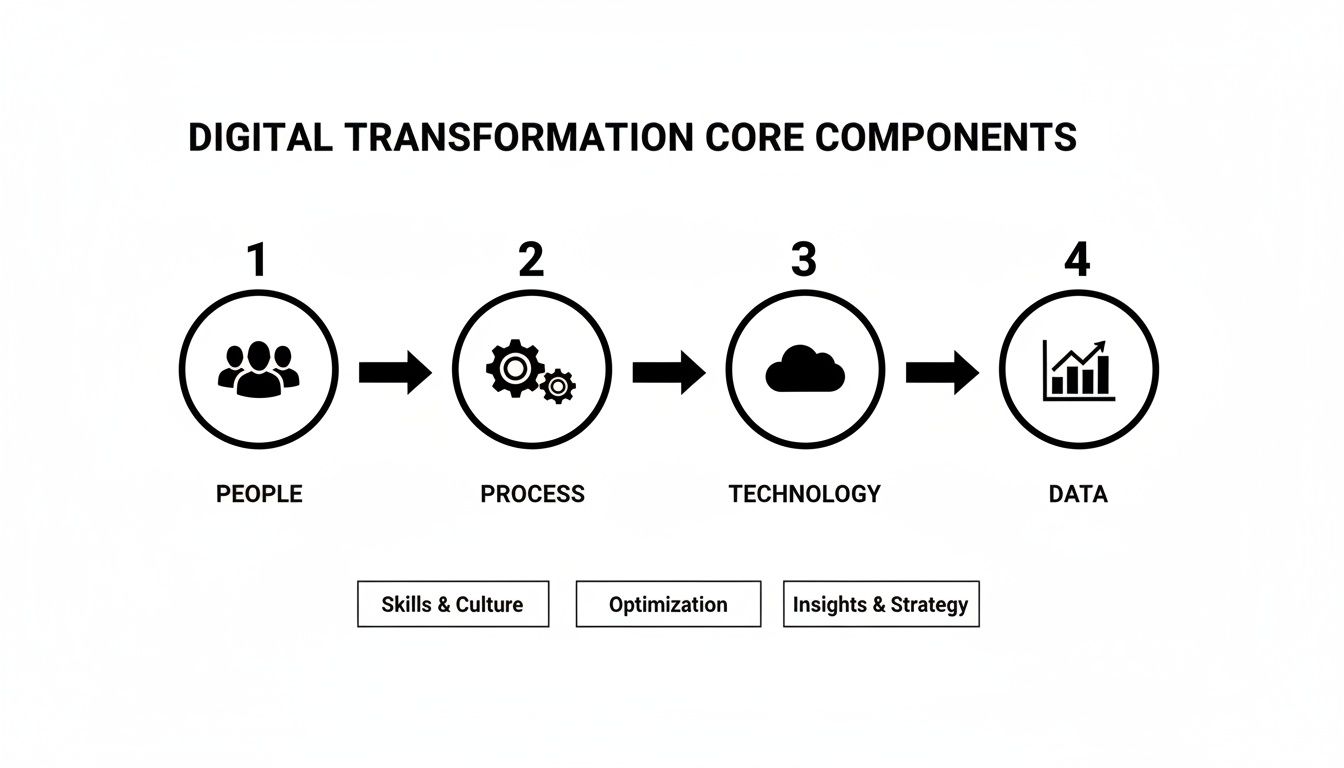
This visual highlights that a successful framework is not just about technology; it's a holistic system where each component depends on the others to function effectively.
Phase 1: Vision and Assessment
First, you must define your "why." Before considering any software, you need a crystal-clear vision of what you aim to achieve. Is the goal to increase operational efficiency by 25%? Are you trying to improve client retention rates or enter a new market?
Once the vision is established, conduct a thorough assessment of your current state. This involves mapping existing processes, auditing your technology stack, and evaluating the digital skills of your team. This baseline analysis is critical for identifying the biggest gaps and the most promising opportunities.
Phase 2: Strategic Planning
With a clear vision and a detailed assessment, you can move to strategic planning. This phase is about making choices and setting priorities. Since you can't transform everything at once, focus on high-impact, high-visibility initiatives that deliver early wins.
For each prioritized project, define specific, measurable goals and the key performance indicators (KPIs) you'll use to track success. This is also when you must secure leadership buy-in. A strong business case that connects your proposed projects to bottom-line outcomes, like revenue growth or cost savings, is essential for obtaining the necessary resources.
A common mistake is building this plan in isolation. Effective strategic planning brings together cross-functional teams from IT, marketing, sales, and operations to ensure the roadmap reflects the entire organization's needs.
Phase 3: Pilot Implementation
Before a full-scale rollout, test your ideas with small, controlled pilot programs. Pilots are an invaluable way to learn, gather real-world feedback, and refine your approach with minimal risk. For example, you could test a new CRM automation sequence with a single sales team or trial a new project management tool in one department.
The goal here is learning, not perfection. These small-scale tests allow you to work out kinks, understand adoption challenges, and prove the value of an initiative before committing significant investment. A successful pilot provides powerful proof points that build confidence for a wider launch. If you're making significant changes, you might also need to update your data infrastructure. Learn more about key considerations in the best practices for data migration.
Phase 4: Scaling and Optimization
Once a pilot proves its worth, it's time to scale. This phase involves methodically rolling out the validated solutions across the organization. This requires a detailed implementation plan, comprehensive employee training, and clear communication to manage the change effectively.
Transformation doesn’t end at rollout. This phase should transition into a cycle of continuous improvement. Establish a governance framework to monitor your KPIs, gather ongoing user feedback, and make iterative adjustments to optimize performance. This ensures your digital transformation strategy remains a living part of your business, capable of adapting to new challenges and opportunities.
Digital Transformation Roadmap: From Strategy to Timeline
A digital transformation roadmap is the delivery view of the strategy: a sequenced timeline showing which initiative ships when, who owns it, and what it must prove before the next one starts. The strategy explains why the change matters. The roadmap shows the order of the work.
Build it in quarters, not years. Long horizons invite drift; a quarterly cadence forces each initiative to show measurable progress while the plan stays adjustable. A strong digital roadmap strategy has four properties:
- Sequenced dependencies: data cleanup lands before the CRM migration, and the CRM migration lands before marketing automation.
- Named owners: every initiative has one accountable leader, not a committee.
- Exit criteria: each phase defines the KPI threshold that unlocks the next investment.
- A visible budget: leadership sees cost against value each quarter, which keeps funding decisions grounded.
Review the roadmap quarterly. Kill initiatives that miss their exit criteria twice, and reallocate that budget to what works. That discipline keeps the roadmap a management tool instead of a wall poster.
Driving Growth with CRM and MarTech Integration

A solid framework is a great start, but the real power of a digital transformation strategy is realized when your technology works together to drive business results. Integrating your Customer Relationship Management (CRM) and marketing technology (MarTech) stack becomes the engine for tangible, measurable growth.
When these systems are disconnected, you have a fractured view of your customer. Marketing runs campaigns without knowing which leads convert, and sales teams lack the context of a prospect's recent digital engagement. Connecting these systems creates a unified data flow that empowers everyone. Our revenue operations team builds exactly this kind of connected stack for growth-stage companies.
This integration isn’t just a technical fix; it's a cornerstone of any modern digital transformation strategy. 58% of US and UK companies plan to increase their digital transformation spending, and 63% of executives report a positive impact on profitability over the past 24 months, per Backlinko, 2026. Top-performing economies build powerful innovation ecosystems: Switzerland, the United States, and Singapore lead the 2025 IMD World Digital Competitiveness Ranking.
Salesforce for B2B SaaS: A Seamless Customer Journey
Let's consider a real-world example. A B2B SaaS company needs to acquire new customers efficiently. Their goal is to guide a prospect from a LinkedIn ad to a closed deal through a personalized, automated experience.
A marketing manager sees a targeted ad on LinkedIn and downloads a whitepaper. This action instantly creates a new lead in Salesforce. The new contact is then automatically enrolled in a lead nurturing sequence using a marketing automation tool like Marketing Cloud Account Engagement (formerly Pardot) or HubSpot.
Over the next few weeks, the lead receives a series of targeted emails: a case study relevant to their industry, an invitation to a webinar, and a link to a product demo. The system tracks every interaction, email opens, link clicks, website visits, and updates the lead’s score in Salesforce in real-time.
A truly integrated CRM and MarTech stack doesn’t just collect data; it activates it. Every customer interaction becomes an opportunity to deliver the right message at the right time, moving them closer to a decision.
Once the lead’s score hits a predefined threshold, signaling sales-readiness, Salesforce automatically assigns them to a sales representative. The salesperson now has a complete history of the prospect's journey, enabling a highly relevant and informed first call. This dramatically increases the probability of closing the deal.
Dynamics 365 for Professional Services Firms
Now, let's turn to a professional services firm that manages complex, long-term client relationships. Their primary challenge is maintaining a consistent, high-touch experience from the initial conversation through project delivery and beyond.
Using Microsoft Dynamics 365 on the Customer Engagement side, the firm manages the entire client relationship on a single, unified platform. When a potential new client emerges, a business developer creates an opportunity record in Dynamics 365 Sales. From that point, every email, meeting, and note is automatically tracked against that record.
Once the deal is won, the relationship continues in one place. The team uses Dynamics 365 to:
- Maintain a single client view: Keep every interaction, contact, and commitment in one record.
- Automate client workflows: Trigger handoffs, approvals, and status updates with Power Automate so nothing slips.
- Run responsive client service: Use Dynamics 365 Customer Service to handle requests and keep response quality consistent.
- Communicate proactively: Send automated status updates and maintain a complete communication record.
This connected approach ensures a smooth handover from sales to delivery, preventing critical information from being lost. After the engagement, the marketing team uses client data in Dynamics 365 (and Customer Insights) to send targeted communications about new services, building long-term loyalty. A digital transformation strategy is proven here by seeing how these connected systems directly boost efficiency and revenue. To dive deeper, learn more in our guide on what is CRM integration.
Navigating Common Pitfalls in an Enterprise Digital Transformation Strategy
An enterprise digital transformation strategy coordinates change across business units, so shared data, governance, and budgets stay aligned at scale.
Even the most well-designed enterprise digital transformation strategy can encounter obstacles. While the potential rewards are significant, most transformation programs fall short of their goals, per McKinsey research. Understanding what can go wrong isn't about pessimism, it's about preparation.
By anticipating these challenges, you can build resilience into your roadmap and guide your organization toward success. Let's examine the most common hurdles and how to overcome them.
The Disconnected Vision
One of the fastest ways for a transformation to fail is a vague or unclear vision. When leadership approves a project without clearly articulating the "why," teams are left without direction. They see new software and processes as mandates, disconnected from their daily work or the company's broader goals.
For example, a firm might invest in a new analytics platform. But if the sales team doesn't understand that the goal is to improve lead scoring and shorten the sales cycle, they will view it as just another dashboard they are too busy to use.
The Solution: The vision must be co-created with input from across the business and communicated relentlessly. Frame it as a compelling story, not a set of instructions. Focus on tangible outcomes, like "cutting client onboarding time by 50%" or "achieving a single, complete view of every customer."
Employee Resistance and Fear
Change is inherently uncomfortable. Digital transformation represents a significant shift in how people work, which can be intimidating. Employees may worry that automation will make their roles obsolete or that they won't be able to master new systems. This fear hardens into resistance, creating a major barrier to adoption.
A classic example is a company rolling out a new CRM. If veteran employees are comfortable with their existing spreadsheets, they won't switch unless they receive excellent training and a clear explanation of "what's in it for me", like less manual data entry and more time building relationships.
True transformation is a cultural shift, not just a technical one. It requires empathy, transparent communication, and a commitment to bringing your people along on the journey. Ignoring the human element is a guaranteed path to failure.
Choosing Technology Before Strategy
This is the ultimate "cart before the horse" mistake. A vendor demonstrates a sleek new AI tool, and leadership becomes enamored with its potential without first defining the business problem it needs to solve. This leads to significant investment in technology that doesn't align with core processes or strategic goals, becoming a solution in search of a problem.
The Solution: Always begin with your business goals and processes. First, map out your desired future state. Only then should you evaluate technology that can help you achieve that vision. The question should never be, "What can this tool do?" It should be, "What is our goal, and which tool is the best fit to get us there?"
Common Digital Transformation Hurdles and Solutions
The table below provides a quick-reference guide to other frequent challenges. Use it to identify and address problems before they derail your progress.
| Common Pitfall | Why It Happens | Strategic Solution |
|---|---|---|
| Departmental Silos | Teams work in isolation, protecting their own data and processes. | Create cross-functional "squads" with shared goals and KPIs to foster collaboration and break down barriers. |
| Failure to Measure ROI | The project starts without clear metrics, making it impossible to prove its value later. | Define success with specific, measurable KPIs from day one and track them rigorously to demonstrate impact. |
| Ignoring "Quick Wins" | The strategy focuses only on massive, long-term goals, causing teams to lose motivation. | Prioritize smaller, high-visibility pilot projects that deliver tangible value early to build momentum and confidence. |
By keeping these common issues on your radar, you aren't just planning for a project; you're planning for success.
How to Measure Success and Prove Your ROI
Any digital transformation strategy is only as good as the results it delivers. Without a clear way to measure success, even the most ambitious projects can seem like expensive experiments. To justify your investment and secure future support, you must connect your efforts to tangible business outcomes and prove a clear Return on Investment (ROI).
This means moving beyond surface-level "vanity metrics" like website traffic or app downloads. The focus must be on Key Performance Indicators (KPIs) that directly reflect business health and capture the attention of executive leadership. Proving the value of your strategy is as important as the strategy itself.
Identifying KPIs That Matter
To demonstrate real impact, track metrics tied to revenue, costs, and efficiency. The key is to establish a solid baseline for each KPI before implementing any changes. This provides a clear "before and after" picture that leaves no doubt about the value created.
Here are a few key KPIs to focus on:
- Customer Lifetime Value (CLV): An increase in CLV indicates that new digital experiences are building loyalty and improving customer retention.
- Operational Cost Reduction: This metric provides direct proof of efficiency gains. Track decreases in manual labor hours, software redundancies, or supply chain expenses.
- Employee Productivity Gains: Are tasks being completed faster? Measure improvements in project turnaround times, task completion rates, or the number of clients an employee can effectively manage.
- Customer Acquisition Cost (CAC): A successful strategy should lower the cost of acquiring new customers through better targeting and more efficient processes.
A Framework for Calculating ROI
Once you have established your KPIs, you can build a straightforward framework to calculate the ROI of your initiatives. The goal is to quantify both the gains and the costs associated with your transformation projects. This calculation is the backbone of your business case for continued investment.
A strong ROI calculation does more than just justify past spending. It builds a powerful narrative of success that creates organizational momentum and quiets skepticism.
Here’s a simple, three-step approach:
- Quantify the Gains: Convert your KPI improvements into monetary value. For example, a 15% reduction in manual data entry translates directly into saved labor costs. An increase in client retention means protected revenue.
- Calculate Total Investment: Sum up all associated costs. This includes not only software licenses but also implementation fees, employee training hours, and any necessary hardware or infrastructure.
- Determine the ROI: Use the classic formula: (Net Profit / Total Investment) x 100. A positive ROI proves the transformation is generating more value than it costs.
By consistently tracking these metrics and sharing the results, you shift the conversation from one about expenses to one about smart, strategic investment. For a deeper look at connecting actions to outcomes, our guide on measuring marketing effectiveness offers valuable insights.
Frequently Asked Questions About Digital Transformation
Even with a solid roadmap, questions are natural when undertaking a major business change. Addressing these common queries can demystify the process and help set realistic expectations for the journey ahead.
Here are answers to some of the most frequently asked questions.
What Is the Very First Step to Take?
Forget about technology for a moment. The first and most critical step is to define your business goals with absolute clarity. Before evaluating any software, you must know what problems you are trying to solve or what opportunities you want to seize.
Start with foundational questions. Are we trying to reduce operational costs? Are we losing clients and need to improve retention? Is our sales cycle too long? A clear understanding of what "success" looks like for the business provides the strategic 'why' that will guide every subsequent decision.
How Long Does Digital Transformation Actually Take?
This is not a project with a defined endpoint; it's an ongoing commitment. You can achieve significant wins and see tangible results within 6-12 months, but true transformation involves building a culture of continuous improvement that adapts for years to come.
The goal isn't to "finish" transforming but to become an organization that is perpetually ready to adapt. It's a shift from a project-based mindset to an evolutionary one.
Think of it like physical fitness. The initial effort gets you in shape, but you need to maintain good habits to stay strong and agile. That long-term commitment is what a real digital transformation strategy is all about.
What Is a Digital IT Strategy and How Is It Different?
A digital IT strategy governs the technology estate itself: which platforms you run, how they integrate, how access and security are managed, and how infrastructure scales. It answers the question "how do we provision and protect the stack."
A digital transformation strategy sits one level up. It answers "which business outcomes will the stack produce." The two must connect. An IT strategy without a transformation goal buys infrastructure nobody uses, and a transformation plan without IT discipline collapses under integration debt. Treat the IT strategy as a chapter inside the transformation strategy, owned jointly by IT leadership and the business leaders accountable for the outcomes.
Is This Only for Huge Corporations?
Not at all. In fact, small and mid-sized businesses (SMBs) often have a distinct advantage. They pivot faster and operate with more agility than larger companies, which carry heavier bureaucracy and legacy systems.
Smaller firms can leverage scalable cloud technologies and focus on high-impact areas to achieve powerful results without a massive budget. For an SMB, transformation could be as focused as integrating a CRM to unify sales and marketing data, a move that can deliver a significant return without enterprise-level complexity.
Ready to build a digital transformation strategy that drives real growth? At Twelverays, we specialize in integrating CRM and marketing technologies to create seamless customer journeys and measurable business outcomes. Get in touch with us today to see how we can help.