

In marketing, it's easy to get lost in a sea of data. Clicks, likes, and impressions can feel like progress, but do they actually translate to business growth? The key to unlocking measurable, sustainable success lies in tracking the right Key Performance Indicators (KPIs). Moving past vanity metrics that look good on paper but lack substance is critical for proving value and driving strategic decisions.
This guide cuts through the noise. We'll provide a curated list of essential marketing KPI examples that truly matter. We move beyond surface-level definitions, offering deep strategic analysis, actionable formulas, and industry-specific context tailored for B2B SaaS, professional services, and MSPs. You will learn not just what to measure, but how these metrics directly connect to your bottom line.
Our focus is on equipping you to make data-driven decisions that justify budgets, optimize campaigns, and deliver tangible results. We will explore ten critical KPIs, including:
- Customer Acquisition Cost (CAC)
- Customer Lifetime Value (LTV)
- Return on Marketing Investment (ROMI)
- Conversion Rate
- Customer Retention Rate
- And other vital channel-specific metrics.
Whether you're a seasoned CMO or a marketing specialist, this comprehensive list is your roadmap to transforming raw data into your most powerful strategic asset. Let’s dive into the metrics that will help you measure what matters and propel your business forward.
1. Customer Acquisition Cost (CAC)
Customer Acquisition Cost (CAC) is a critical marketing KPI that calculates the total expense required to acquire a single new customer. It encompasses all your sales and marketing costs, including salaries, ad spend, and tool subscriptions, divided by the number of new customers acquired within a specific timeframe. Understanding your CAC is fundamental to building a sustainable, profitable business model.
This metric tells you precisely how much you must invest to grow your customer base. For B2B SaaS companies or MSPs, it reveals the efficiency of your marketing engine and informs decisions on pricing, budgeting, and scalability. A high CAC might indicate inefficient ad spending, while a low CAC suggests a highly effective growth strategy.
Strategic Analysis & Application
CAC is most powerful when analyzed in context, not as a standalone number. Comparing it against Customer Lifetime Value (LTV) is the gold standard for measuring profitability.
Key Insight: A healthy business model typically has an LTV:CAC ratio of 3:1 or higher. A ratio of 1:1 means you're losing money with every new customer, while a ratio of 5:1 or more might suggest you're under-investing in growth and could be acquiring customers even faster.
Breaking down CAC by channel (e.g., Google Ads vs. LinkedIn organic vs. content marketing) is another crucial analysis. This segmentation helps you identify your most profitable acquisition channels and reallocate your budget to double down on what works.
Actionable Takeaways
- Formula:
(Total Sales & Marketing Costs) / (Number of New Customers Acquired) - When to Use: Use CAC to evaluate the financial viability of your marketing campaigns, set realistic budgets for growth, and assess channel performance on a quarterly or annual basis.
- Benchmark Guidance: Aim for a payback period (the time it takes to recoup your CAC) of under 12 months, especially in the SaaS industry.
- Tracking Tip: Ensure you are using a "fully loaded" CAC that includes all associated costs, not just ad spend. This means factoring in a portion of salaries, software costs, and creative production expenses for an accurate picture. To explore this topic further, you can learn more about calculating and optimizing your Cost Per Acquisition.
2. Customer Lifetime Value (LTV)
Customer Lifetime Value (LTV or CLV) is a predictive marketing KPI that represents the total revenue a business can reasonably expect from a single customer account throughout their entire relationship. It’s a forward-looking metric that shifts focus from short-term transactional gains to long-term relationship profitability, making it essential for sustainable growth.
This metric helps you understand the true value of acquiring a new customer, which directly informs your marketing budget, retention strategies, and pricing models. For businesses with recurring revenue models like MSPs or SaaS companies, LTV is the north star for strategic planning. It answers the critical question: "How much is a customer worth to us over time?" A high LTV indicates strong product-market fit, customer satisfaction, and a healthy, predictable revenue stream.
Strategic Analysis & Application
LTV is the other half of the profitability equation when paired with Customer Acquisition Cost (CAC). Analyzing these two metrics together provides a clear view of your business's long-term viability and the sustainability of its growth engine.
Key Insight: A healthy LTV:CAC ratio is generally considered to be 3:1 or higher. This indicates that for every dollar you spend acquiring a customer, you generate three dollars in lifetime value, making your acquisition efforts highly profitable.
Segmenting LTV by customer persona, acquisition channel, or product plan uncovers powerful insights. You might discover that customers acquired through organic search have a 25% higher LTV than those from paid ads, signaling a need to invest more heavily in SEO and content marketing. This level of analysis is crucial for optimizing your marketing spend and focusing efforts on attracting your most valuable customer segments.
Actionable Takeaways
- Formula:
(Average Purchase Value) x (Average Purchase Frequency) x (Average Customer Lifespan) - When to Use: Use LTV to make strategic decisions about customer acquisition spending, retention budgets, and product development. It is best reviewed quarterly to guide long-term strategy and resource allocation.
- Benchmark Guidance: In addition to the 3:1 LTV:CAC ratio, aim for an LTV that is significantly higher than your CAC within the first year. The faster you can recoup acquisition costs, the more capital you have to fuel further growth.
- Tracking Tip: For the most accurate LTV, calculate it using gross margin rather than just revenue. This provides a clearer picture of actual profitability by accounting for the cost of goods sold (COGS). For a deeper dive, you can explore strategies for increasing your Customer Lifetime Value.
3. Return on Marketing Investment (ROMI)
Return on Marketing Investment (ROMI) is one of the most vital marketing KPI examples, measuring the amount of revenue generated for every dollar spent on marketing activities. This profitability metric directly ties marketing efforts to the bottom line, making it indispensable for justifying budgets and demonstrating financial impact to stakeholders.
For B2B service firms and SaaS companies, ROMI moves the conversation beyond vanity metrics like clicks and impressions to focus on what truly matters: revenue and profit. A strong ROMI proves that marketing is not a cost center but a significant revenue driver. It helps leadership understand which campaigns and channels are producing tangible financial results and which require re-evaluation.
Strategic Analysis & Application
ROMI's true power lies in its ability to guide strategic budget allocation and prove marketing's value. While a simple calculation on the surface, its application requires careful consideration of revenue attribution to get an accurate picture of performance.
Key Insight: A common pitfall is viewing ROMI as a single, static number for the entire marketing department. The most effective analysis breaks ROMI down by individual campaigns, channels (e.g., SEO vs. paid search), and even specific timeframes to reveal granular performance insights and identify pockets of high efficiency.
Analyzing ROMI over time reveals trends in campaign effectiveness and market response. For example, you might discover that your content marketing ROMI takes longer to materialize but ultimately delivers a higher return than short-term ad campaigns, informing a more balanced, long-term investment strategy.
Actionable Takeaways
- Formula:
[(Attributed Revenue - Marketing Cost) / Marketing Cost] * 100 - When to Use: Use ROMI to evaluate overall marketing profitability, compare the financial performance of different campaigns, and make data-driven decisions on budget allocation on a monthly, quarterly, or campaign-specific basis.
- Benchmark Guidance: While highly variable, a ROMI of 5:1 (or 400%) is often considered a strong benchmark, indicating you are generating $5 in revenue for every $1 spent. A 10:1 ratio is exceptional.
- Tracking Tip: The biggest challenge in calculating ROMI is accurate revenue attribution. Implement a consistent attribution model (e.g., multi-touch) in your CRM and analytics tools to ensure you are crediting the right channels. To dig deeper into this, you can learn more about how to measure your marketing ROI.
4. Conversion Rate
Conversion Rate measures the percentage of users who complete a desired action out of the total number of users. This action could be anything from a purchase and a form submission to a newsletter signup, making it one of the most fundamental marketing KPI examples for gauging the effectiveness of your website, landing pages, and overall marketing funnel.
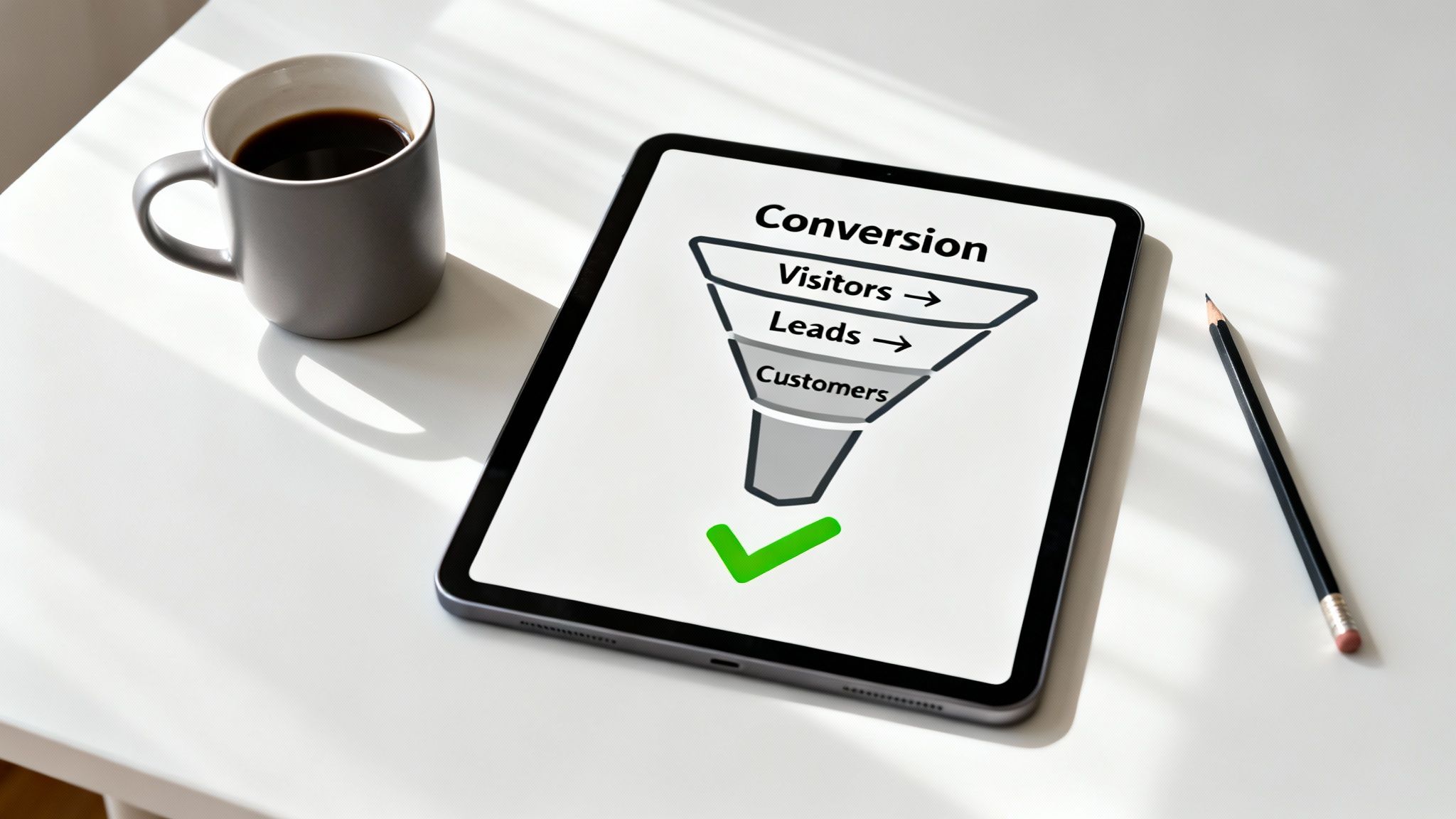
For B2B service providers and SaaS companies, this metric directly translates marketing efforts into tangible business outcomes like leads or trials. A high conversion rate indicates compelling messaging, a seamless user experience, and a strong value proposition, while a low rate signals friction that needs to be addressed. It's the ultimate measure of your ability to persuade visitors to act.
Strategic Analysis & Application
A high-level conversion rate provides a good health check, but its true power is unlocked through segmentation. Analyzing conversion rates by traffic source (e.g., Organic Search vs. Paid Social), device type (Desktop vs. Mobile), and user demographic reveals your most valuable audiences and underperforming channels.
Key Insight: Don't just track your primary "macro-conversion" (e.g., demo request). Monitor "micro-conversions" like downloading a whitepaper or watching a product video. These smaller commitments are leading indicators that show audience engagement and often precede the final conversion.
For instance, you might find that while your overall landing page converts at 3%, traffic from LinkedIn converts at 8%. This insight allows you to confidently reallocate ad spend and tailor messaging to the high-performing channel, directly improving your return on investment.
Actionable Takeaways
- Formula:
(Number of Conversions / Total Number of Visitors) * 100 - When to Use: Use this KPI to assess landing page performance, evaluate A/B test results, measure campaign effectiveness, and identify friction points in your user journey on a weekly or monthly basis.
- Benchmark Guidance: B2B lead generation forms often average a 2-5% conversion rate, while SaaS free trial signups can range from 5-15% on a dedicated landing page. While industry benchmarks are useful, focus on improving your own baseline month-over-month.
- Tracking Tip: Use tools like Google Analytics or your CRM to set up conversion goals for every key action. To get started with a strategic approach, discover key techniques for how to improve website conversion rates.
5. Customer Retention Rate
Customer Retention Rate (CRR) measures the percentage of customers who continue doing business with your company over a specific period. It is a direct reflection of customer satisfaction, loyalty, and the long-term viability of your business model. For service-based businesses like MSPs and professional services firms, a high retention rate is the bedrock of predictable revenue and sustainable growth.

This metric highlights how well your product or service delights customers after the initial sale. It's often far more cost-effective to retain an existing customer than to acquire a new one. Tracking CRR provides critical feedback on your customer success, support, and product development efforts, making it one of the most important marketing KPI examples for any recurring revenue business.
Strategic Analysis & Application
Retention is not just about preventing churn; it's about maximizing value from your existing customer base. Analyzing CRR by customer cohort, which groups customers by their sign-up date, can reveal how changes to your onboarding or product affect loyalty over time.
Key Insight: In B2B SaaS, a 5% increase in customer retention can increase profitability by 25% to 95%. This is because retained customers are more likely to upgrade, expand their usage, and refer new business, creating a powerful compounding growth effect.
For a deeper analysis, B2B companies should track both Gross Revenue Retention (GRR) and Net Revenue Retention (NRR). GRR measures retention from the existing customer base, while NRR includes revenue from upsells and expansion. An NRR over 100% indicates that revenue growth from existing customers is outpacing any revenue lost from churn.
Actionable Takeaways
- Formula:
((Number of Customers at End of Period - Number of New Customers Acquired) / Number of Customers at Start of Period)) x 100 - When to Use: Monitor CRR on a monthly and quarterly basis to gauge customer health. Use cohort analysis to evaluate the long-term impact of your onboarding, customer success, and product updates.
- Benchmark Guidance: Top-tier B2B SaaS companies aim for an annual retention rate of 90% or higher. For membership organizations, the median annual renewal rate is about 84%, with a 75-90% range considered a strong target.
- Tracking Tip: Implement an early warning system in your CRM to flag at-risk accounts based on product usage, support tickets, or low engagement. Surveying churned customers is also essential to pinpoint specific pain points and improve your processes. To dive deeper into this topic, you can discover actionable strategies for increasing customer retention.
6. Click-Through Rate (CTR)
Click-Through Rate (CTR) is a fundamental marketing KPI that measures the percentage of people who click on a specific link, advertisement, or call-to-action (CTA) relative to the total number of times it was viewed (impressions). It is a primary indicator of how compelling and relevant your messaging is to your target audience. A strong CTR signals that your creative, copy, and offer are resonating effectively.
For B2B service providers and SaaS companies, CTR is a crucial top-of-funnel metric for gauging the performance of digital advertising, email campaigns, and organic content. A low CTR suggests a disconnect between your message and your audience's needs, while a high CTR indicates strong initial engagement that can lead to qualified traffic and conversions down the line. It's one of the most direct feedback mechanisms on your creative effectiveness.
Strategic Analysis & Application
CTR should never be evaluated in a vacuum. A high CTR is only valuable if it leads to meaningful business outcomes like conversions or qualified leads. Analyzing CTR alongside conversion rate provides a more complete picture of campaign performance.
Key Insight: A high CTR paired with a low conversion rate often points to a "messaging mismatch." This means your ad or email successfully captured attention, but the landing page failed to deliver on the promise or provide a clear next step. This insight directs you to optimize the post-click experience rather than the ad itself.
Segmenting CTR by campaign, ad group, keyword, or audience is essential for optimization. This allows you to identify which specific elements are driving engagement. For instance, you might find that ads mentioning "24/7 Support" have a higher CTR for MSPs, indicating a key value proposition for that audience.
Actionable Takeaways
- Formula:
(Total Clicks / Total Impressions) x 100 - When to Use: Use CTR to A/B test ad copy, headlines, and imagery in real-time. Monitor it to assess the relevance of your content in paid search, social media, and email marketing. It is a leading indicator of ad fatigue.
- Benchmark Guidance: Benchmarks vary wildly by channel. A "good" search ad CTR might be 3-5%, while a display ad CTR of 0.5% could be excellent. Always compare your performance against industry-specific and channel-specific benchmarks, not a universal number.
- Tracking Tip: Use UTM parameters consistently across all campaigns to track CTR accurately within your analytics platform (like Google Analytics). This allows you to attribute clicks back to the specific source, medium, and campaign, providing granular data for optimizing budget allocation.
7. Cost Per Click (CPC)
Cost Per Click (CPC) is a foundational paid advertising KPI that measures the average price you pay each time someone clicks on one of your online ads. This metric is central to managing pay-per-click (PPC) campaigns on platforms like Google Ads, LinkedIn, or Facebook. Understanding your CPC is essential for controlling ad spend and gauging the cost-efficiency of your digital advertising efforts.
This metric directly reflects the cost of driving traffic to your website or landing pages through paid channels. For B2B companies using Google Ads to capture high-intent search traffic, a low CPC on relevant keywords can signify a high-performing campaign. Conversely, a rapidly increasing CPC might indicate rising competition or a decrease in ad relevance, requiring immediate attention to protect your budget.
Strategic Analysis & Application
CPC should never be evaluated in isolation. Its true value is revealed when analyzed alongside conversion rates, click-through rates (CTR), and ultimately, the revenue generated from those clicks. A low CPC is meaningless if the traffic it generates doesn't convert into leads or sales.
Key Insight: A higher CPC is not always bad. Paying a premium CPC of $8 for a click on LinkedIn might be highly profitable if that click consistently generates a high-value B2B lead that converts into a $10,000 contract. The goal isn't the lowest CPC, but the most profitable one.
Analyzing CPC by campaign, ad group, keyword, and audience segment is crucial. This detailed breakdown allows you to identify which specific elements of your strategy are driving cost-effective traffic and which are draining your budget. For instance, you might find that certain long-tail keywords have a lower CPC and a higher conversion rate than broad, competitive terms.
Actionable Takeaways
- Formula:
(Total Ad Spend) / (Total Number of Clicks) - When to Use: Use CPC daily or weekly to monitor and optimize PPC campaign performance, evaluate the cost of traffic from different ad platforms, and inform budget allocation decisions.
- Benchmark Guidance: Benchmarks vary wildly by industry and platform. B2B service keywords on Google Ads can range from $3 to over $50, while LinkedIn ads often average $5-$10 per click. The key is to benchmark against your own conversion value.
- Tracking Tip: In Google Ads, focus on improving your Quality Score. A higher Quality Score, which measures the relevance of your ad, keyword, and landing page, directly leads to a lower CPC and better ad placements. To learn more about optimizing your paid campaigns, you can explore strategies for maximizing your B2B advertising ROI.
8. Marketing Qualified Lead (MQL) to Sales Qualified Lead (SQL) Conversion Rate
The MQL to SQL Conversion Rate is a pivotal marketing KPI that measures the percentage of marketing-generated leads (MQLs) that the sales team accepts as viable prospects (SQLs). This metric is a direct indicator of lead quality and the alignment between your marketing and sales departments. It highlights how effectively your marketing efforts are not just generating interest, but generating interest from the right audience.
For B2B SaaS, professional services, and MSPs, this KPI is the ultimate test of the marketing-to-sales handoff. A low conversion rate often signals a disconnect in lead definitions or a failure in nurturing, while a high rate indicates that marketing is successfully teeing up high-potential opportunities for the sales team. Tracking this is essential for building an efficient and predictable revenue pipeline.
Strategic Analysis & Application
This KPI's true value lies in its ability to diagnose friction in your funnel. It acts as a bridge metric, forcing marketing and sales to collaborate on shared definitions of what constitutes a "good lead." Analyzing this conversion rate helps pinpoint issues in lead scoring models, nurturing sequences, or campaign targeting.
Key Insight: A healthy MQL to SQL conversion rate is a leading indicator of future revenue. If this rate drops, it often precedes a drop in sales pipeline and closed-won deals, giving you an early warning to diagnose and fix the problem before it impacts the bottom line.
Segmenting this rate by lead source (e.g., webinar, ebook download, demo request) reveals which marketing channels deliver the most sales-ready leads. This allows you to reallocate budget toward high-performing campaigns and refine targeting on underperforming ones. For instance, you might find that leads from a specific webinar convert to SQLs at 40%, while those from a general whitepaper only convert at 5%.
Actionable Takeaways
- Formula:
(Total Sales Qualified Leads) / (Total Marketing Qualified Leads) * 100 - When to Use: Use this KPI on a monthly and quarterly basis to evaluate the effectiveness of your lead generation and nurturing strategies, and to foster alignment between marketing and sales.
- Benchmark Guidance: Rates vary widely by industry and sales cycle length. B2B SaaS companies often see rates between 15-30%, while more complex enterprise sales might be lower at 5-10%. Strong lead nurturing can push this rate higher.
- Tracking Tip: Establish a clear and mutually agreed-upon Service Level Agreement (SLA) that defines the specific criteria for MQLs and SQLs. This shared definition, often managed in a CRM like HubSpot or Salesforce, is the foundation for accurately tracking this critical conversion point.
9. Email Marketing Engagement Rate (Open Rate & Click-Through Rate)
Email Marketing Engagement Rate is a foundational KPI that measures how your audience interacts with your email campaigns. It is typically broken into two core metrics: Open Rate, the percentage of recipients who opened your email, and Click-Through Rate (CTR), the percentage who clicked on a link within it. These metrics reveal the health of your email list and the resonance of your messaging.
For B2B service providers and SaaS companies, strong email engagement is a direct indicator of a nurtured, interested audience. It shows that your subject lines are compelling enough to earn an open, and your content is valuable enough to inspire a click. Low engagement signals list fatigue, poor segmentation, or a mismatch between your content and subscriber expectations.
Strategic Analysis & Application
Analyzing Open Rate and CTR together tells a complete story. A high open rate with a low CTR suggests your subject line was effective, but the email body or call-to-action failed to convert that interest into action. Conversely, a low open rate but a high CTR among those who did open indicates a highly engaged niche audience that you could potentially expand.
Key Insight: Segmenting your audience is the most effective way to improve engagement. A well-targeted promotional email sent to a small, engaged segment of your list will almost always outperform a generic blast sent to everyone. Personalization and relevance are paramount.
Beyond standard CTR, savvy marketers also track Click-to-Open Rate (CTOR), which measures clicks only among those who opened the email. This provides a clearer picture of your content's effectiveness, removing non-openers from the equation. For example, a 20% open rate and a 2% CTR results in a 10% CTOR, indicating strong content performance among the engaged audience.
Actionable Takeaways
Open Rate = (Unique Opens / Emails Delivered) * 100CTR = (Unique Clicks / Emails Delivered) * 100
10. Brand Awareness and Reach Metrics
Brand Awareness and Reach are foundational marketing KPI examples that measure the extent to which your target audience recognizes and is familiar with your brand. Unlike direct-response metrics, these KPIs focus on the top of the funnel, tracking the visibility and recall of your brand within its market. This includes metrics like reach (the total number of unique people who see your content) and share of voice (your brand's conversation volume compared to competitors).

For B2B SaaS and professional services firms, brand awareness is not a vanity metric; it's a long-term investment in building trust and credibility. Strong brand awareness warms up cold audiences, shortens sales cycles, and creates a competitive moat that is difficult for others to replicate. It ensures that when a prospect is ready to buy, your brand is the first one they think of.
Strategic Analysis & Application
Brand awareness is most effective when measured directionally over time and connected to business outcomes. A common mistake is treating impressions as the sole indicator of success. A more strategic approach involves tracking how awareness translates into higher-quality inbound leads, increased direct traffic to your website, and a better close rate for your sales team.
Key Insight: Segmenting awareness metrics provides tactical advantages. Analyze brand recognition within specific target audience segments or geographic regions. If a key market shows low unaided awareness (where consumers recall your brand without prompting), you can launch a targeted campaign to boost visibility and measure the uplift directly.
Another critical analysis is tracking your "Share of Voice." This KPI contextualizes your brand's presence by measuring it against your direct competitors. If your brand mentions are growing but your share of voice is shrinking, it means competitors are accelerating their marketing efforts even faster, requiring a strategic response.
Actionable Takeaways
- Formula: While there's no single formula, key metrics include
(Impressions),(Reach), and(Brand Mentions / Total Market Mentions) x 100for Share of Voice. - When to Use: Use these KPIs to measure the long-term impact of branding campaigns, PR efforts, and content marketing. Track quarterly or semi-annually to assess brand health and market position.
- Benchmark Guidance: For established brands, a 40-60% aided brand awareness in a target market is a strong benchmark. For share of voice, aim to be a market leader or a strong challenger within your niche.
- Tracking Tip: Use a combination of tools. Google Search Console can track branded search volume, while social listening tools like Brand24 or Meltwater can monitor brand mentions and share of voice. For direct measurement, conduct regular brand health surveys to establish a baseline and track progress.
Top 10 Marketing KPI Comparison
From Data to Decisions: Integrating KPIs for a Holistic Marketing Strategy
We've explored a comprehensive list of marketing KPI examples, from foundational metrics like Customer Acquisition Cost (CAC) and Conversion Rate to more nuanced indicators like MQL to SQL conversion and brand reach. Understanding the definition and formula for each is the necessary first step. However, the true path to sustainable growth for professional services, B2B SaaS, and MSPs lies not in tracking these metrics in isolation, but in integrating them into a unified, strategic framework.
Individual KPIs are like single instruments in an orchestra; powerful on their own, but truly transformative when played in harmony. A myopic focus on one metric can lead to skewed priorities. For example, chasing a low Cost Per Click (CPC) without monitoring lead quality can tank your MQL to SQL conversion rate, wasting your sales team's valuable time.
The Power of Interconnected Metrics
The real magic happens when you start connecting the dots between these data points. This interconnected view transforms raw data into actionable business intelligence, allowing you to build a resilient and highly effective marketing engine.
A high Customer Acquisition Cost isn't necessarily a problem if your Customer Lifetime Value (LTV) is three, five, or even ten times greater. Similarly, a low website conversion rate might be a symptom of poor ad targeting, not a flaw in your landing page design.
Seeing these relationships is what separates reactive marketing from strategic, predictive growth. It allows you to ask smarter questions and get more meaningful answers. Instead of just asking, "How can we lower our CAC?" you can start asking, "Which channels deliver the highest LTV:CAC ratio, even if the upfront CAC is higher?"
Building Your Centralized Data Hub
To achieve this holistic view, a centralized data hub is non-negotiable. Manually exporting spreadsheets from Google Analytics, your ad platforms, and your CRM is inefficient and prone to error. The goal is to create a single source of truth where data flows seamlessly, providing a clear view of the entire customer journey.
Actionable Next Steps to Build Your System:
- Start Small, Then Scale: Don't try to track all 20+ KPIs from day one. Master 3-5 core metrics that align directly with your most critical business objective, such as CAC, LTV, and MQL to SQL Conversion Rate.
- Integrate Your Core Tools: Connect your primary analytics platform (e.g., Google Analytics 4) with your CRM (e.g., Salesforce, Dynamics 365, HubSpot). This is the foundational link that connects marketing activity to revenue.
- Create a Performance Dashboard: Use your CRM's reporting features or a dedicated BI tool to build a dashboard that visualizes your chosen KPIs. This makes trends immediately visible and simplifies reporting for stakeholders.
- Establish a Review Cadence: Set a weekly or bi-weekly meeting to review your KPI dashboard. This consistent rhythm ensures that data isn't just collected; it's actively used to inform decisions, adjust campaign budgets, and refine your strategy.
Mastering the marketing KPI examples discussed in this article is more than a technical exercise; it's a strategic imperative. It's about shifting your organization's mindset from simply doing marketing to proving its value and steering the business toward predictable revenue growth. By building a feedback loop where insights from one KPI inform tactics that improve another, you create a system of continuous, compounding improvement that becomes your ultimate competitive advantage.
Ready to transform your data into a clear roadmap for growth? The team at Twelverays specializes in integrating analytics, CRM, and marketing platforms to build the exact kind of holistic KPI dashboards discussed here. Contact Twelverays today to see how we can help you move beyond siloed metrics and unlock a truly data-driven marketing strategy.
Related service: Revenue operations dashboards.
Sources checked: growthspreeofficial.com, gripped.io, uprawmedia.com.


