Using videos for social media marketing is no longer a creative add-on, it's a fundamental tool for business development. In a world where trust is the ultimate currency, video serves as a digital handshake. It enables B2B and professional services firms to forge genuine human connections long before anyone steps into a meeting.
Why Video Is Your Most Powerful Business Development Tool
Let's move beyond the obvious. Video isn't just "important"; it's a strategic investment in your sales pipeline. For B2B firms, the objective isn't merely to be seen, it's to be understood and trusted. Video achieves this by breaking down complex concepts into a format that is both easy to digest and hard to forget, cutting through the noise where key decision-makers spend their time.
Consider the last time you researched a new software or service. Did you dive into a 20-page whitepaper, or did you watch the two-minute explainer video first? Precisely. Most executives opt for the video, and that preference is a massive signal for how professional services firms must approach their content.
The Digital Handshake in a Crowded Market
Video lets potential clients meet your team, see your process, and understand your expertise without leaving their desks. It transforms abstract services into tangible, real-world solutions. This is absolutely critical for building the confidence a prospect needs before making a significant investment. A well-crafted video strategy is one of the most effective ways to improve brand awareness because it showcases your company’s personality and value in a way text never could.
This shift toward visual communication is supported by compelling data. Sandvine's research puts video at roughly 65% of total internet traffic, the single largest category by volume. With 91% of businesses already leveraging it in their marketing, standing on the sidelines is no longer viable.
Aligning with Modern B2B Buying Habits
Decision-makers are busy. They consume content in short bursts on platforms like LinkedIn, often during a coffee break or commute. While static text and images are easily scrolled past, a sharp, well-produced video can stop them in their tracks. It delivers a multi-sensory experience that forges a much stronger connection than words on a screen.
Video is not just another content format; it’s a direct line to your future clients. It’s your best salesperson, working 24/7 to articulate your value, build rapport, and warm up leads before your team even makes the first call.
By integrating videos for social media marketing, you’re not just producing content, you’re engineering a scalable business development engine. It's your opportunity to show, not just tell, why your firm is the right choice, turning passive viewers into genuinely engaged prospects.
Building a Video Strategy That Drives Real Results
A powerful video strategy doesn't begin with a camera; it begins with clear business objectives. Creating videos and hoping they resonate is like throwing darts in the dark. A focused plan, however, transforms your video efforts from a creative expense into a strategic investment that moves the needle.
The first step is a mindset shift: stop chasing views and start creating valuable assets. Every video needs a specific job, whether that’s capturing initial attention, nurturing a lead, or helping to close a deal. This goal-oriented approach ensures every piece of content serves a distinct purpose in your marketing and sales funnel.
Mapping Videos to the Buyer’s Journey
For B2B and professional services, the buyer’s journey is rarely a short trip. It’s a considered process built on trust. Your video content must align with each stage, providing prospects with the right information at the right time to guide them forward. Think of it as a conversation that deepens as the relationship develops.
This diagram illustrates how video acts as the crucial bridge between general internet traffic and your specific business strategy.
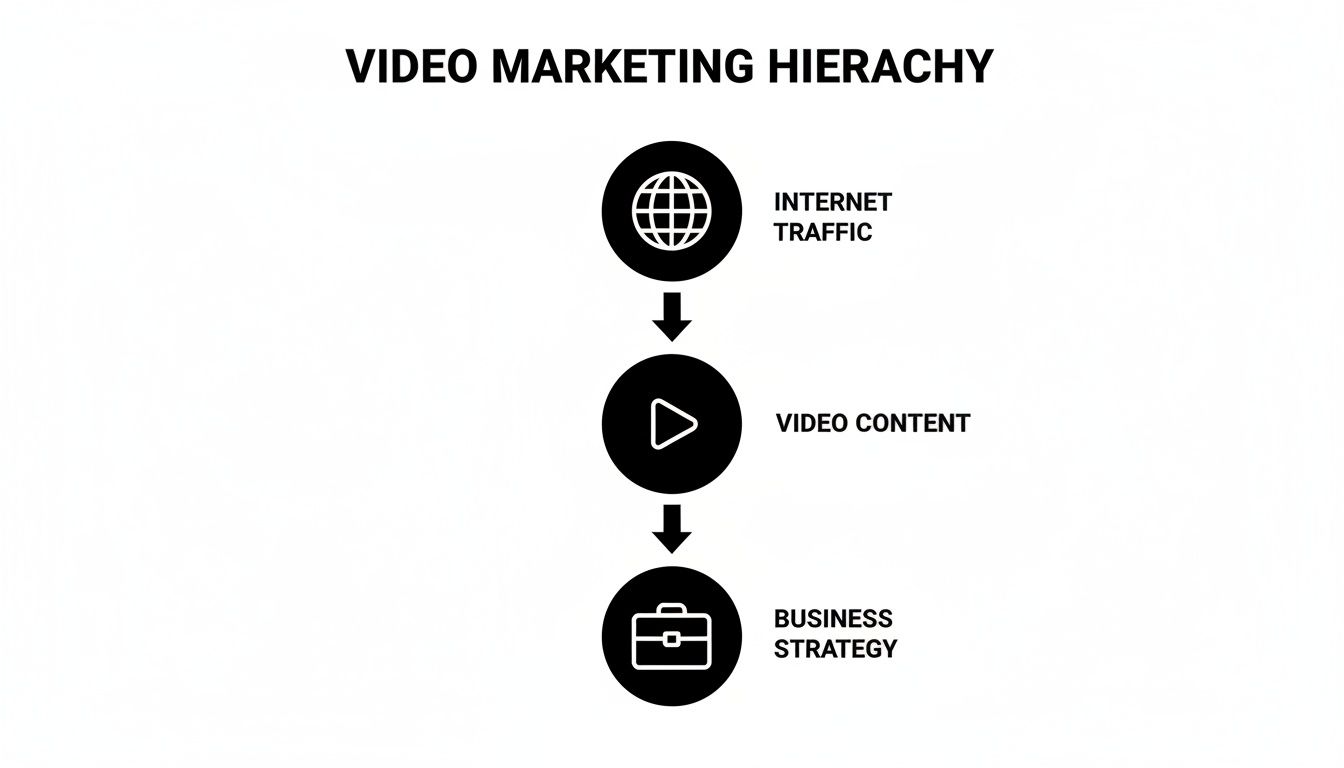
This visual clarifies that video isn't just "content." It's the engine that converts broad audience attention into focused business outcomes.
To map your videos effectively, you must first understand your ideal viewer. Who are they? What are their biggest professional challenges? Where do they spend their time online? Answering these questions allows you to create messages that resonate, speaking directly to their pain points and positioning your firm as the clear solution.
Your goal is not to talk at your audience, but to speak with them. A successful video strategy anticipates their questions and provides answers before they even ask, building authority and trust with every view.
Creating a Sustainable Content Plan
Once you know who you’re talking to and what you want to achieve, it's time to build a sustainable content plan. Consistency is vital on social media, and a content calendar prevents the last-minute scramble for posts. This is where you map out not just what you'll create, but when and where it will be published.
A solid calendar helps you organize themes, manage production schedules, and guarantee a steady stream of valuable content. Planning ahead also creates opportunities to repurpose larger video assets into smaller clips, maximizing the return on your investment. To get started, you can learn more about how to create a content calendar that keeps your team organized and your strategy on track.
To bring this to life, let’s examine how different video formats fit into each stage of the B2B funnel.
Matching Video Formats to Your B2B Funnel
Choosing the right video for the right moment is critical. A high-level brand video won't close a deal, and a detailed demo won't capture a cold audience's attention. The table below outlines which video types are most effective at each stage of the funnel, from first impression to final decision.
This framework isn't just a list of ideas; it's a strategic roadmap. By intentionally planning your videos for social media marketing around these stages, you create a seamless journey that guides leads from initial curiosity to a signed contract. Every video you produce will have a clear purpose, contributing directly to your bottom line.
Creating Professional Videos Without a Hollywood Budget
Let's bust a common myth: you do not need a massive budget or a large creative team to produce high-quality videos for social media marketing. With a smart workflow and a few strategic investments, any team can create polished, professional content in-house. It comes down to focusing on what your audience actually values, clear audio, good lighting, and a coherent message.
Consider this: a video with slightly grainy visuals but crystal-clear audio is perfectly watchable. But a video with stunning 4K visuals and muffled audio? Your audience will scroll past instantly. This insight is key to producing effective videos without overspending. Prioritize the viewer's experience, not expensive equipment.

This entire approach can be broken down into a simple, three-stage process that demystifies production and keeps your team efficient.
The Foundation: Pre-Production Planning
Before you even think about pressing record, a solid pre-production plan will save you countless hours and headaches. This phase isn’t about writing a complex screenplay; it's about establishing clear direction. A simple script or a bullet-point outline ensures your message remains concise and hits all key points.
Next, sketch out a basic storyboard. You don't need to be an artist, stick figures on a whiteboard are perfect. The goal is to visualize the video's flow, plan your shots, and ensure the final product tells a cohesive story. This quick step prevents the awkward cuts and rambling narratives that make content feel amateurish.
A well-planned, 30-second video shot on a smartphone will always outperform a disorganized, rambling video shot on an expensive cinema camera. Your strategy and message are your most valuable production tools.
Production: Smart and Simple Execution
When it's time to film, focus your energy on the two elements that deliver the biggest impact for the lowest cost: lighting and audio. A full studio setup isn't necessary to achieve fantastic results.
- Lighting: Natural light is your best friend. Position your subject facing a window for soft, flattering light. If that’s not an option, an affordable ring light or LED panel can eliminate harsh shadows and instantly boost video quality.
- Audio: This is non-negotiable. Invest in a quality external microphone. A clip-on lavalier or a decent USB microphone costs very little but will make your audio sound infinitely better than your camera’s built-in mic. Clean audio conveys credibility.
These two small investments will elevate your videos far more than any fancy camera upgrade. Your smartphone is already a powerful video tool; pairing it with great light and sound is the secret to a professional look and feel.
Post-Production: Polishing with the Right Tools
The final stage, post-production, is where you assemble the pieces. Modern editing software has made this process more accessible than ever, with many tools designed for collaboration and ease of use. This is where you trim clips, add background music, and incorporate simple graphics to reinforce your branding.
Many platforms now offer features that streamline editing. For instance, various AI-powered tools can automate tedious tasks like generating subtitles, cleaning up background noise, or even suggesting edits. These resources can be a huge time-saver. You can explore some of the best AI tools for digital marketing to see how they might fit into your workflow.
By establishing a repeatable system, Plan, Film, Edit, your team can consistently create polished videos for social media marketing without wasting time or money. It’s not about having a Hollywood budget; it’s about having a smart, scalable process that prioritizes what truly matters to your audience.
Tailoring Your Videos for Maximum Platform Impact
One of the most common mistakes in social media marketing is creating one great video and broadcasting it across every channel. This approach is a guaranteed way to waste time and budget.
Think of social media platforms as different rooms at a conference. You wouldn’t give the same formal, data-heavy presentation in a casual networking lounge as you would in the main auditorium. Similarly, your video content must adapt its style, length, and format to fit the culture of each platform.
This isn’t just about pleasing algorithms; it’s about respecting the user. People use LinkedIn, YouTube, and Instagram for entirely different reasons and expect content that matches that mindset. When you tailor your videos for social media marketing, your message doesn't just get seen, it connects.

LinkedIn: The Professional's Platform
LinkedIn is the digital boardroom. Users are there to network, learn, and advance their careers. Your videos must align with this professional, value-driven environment.
- Ideal Formats: Polished expert interviews, concise case study summaries, thought leadership clips, and company culture videos perform exceptionally well.
- Best Practices: Always use a 1:1 square or 4:5 vertical aspect ratio. This occupies more real estate on the mobile feed, grabbing attention instantly. Keep videos concise, ideally between 30 seconds and 2 minutes: to hold the focus of busy professionals.
One more thing: most social video is watched on mute. The widely cited 85% sound-off figure traces to Facebook's own data, and on LinkedIn the share is likely higher. This makes burned-in captions an absolute, non-negotiable requirement.
YouTube: The Search and Discovery Engine
Don't view YouTube as just a video-sharing site. It's the world's second-largest search engine. Users come here with a specific goal: to learn how to do something, research a topic, or dive deep into a subject. This is where your long-form, evergreen content can shine, delivering value for months or even years.
Your strategy should be built around answering questions and providing deep, searchable value. Think polished tutorials, detailed product demos, webinar recordings, and episodic brand series. Because viewers are actively seeking solutions, they are more willing to watch longer content, with videos in the 5-15 minute range often performing best. To succeed, you must treat the platform like a search engine. Mastering this can massively boost viewership; learn how in our guide to YouTube SEO and how to skyrocket your views.
Instagram and Facebook: The Visual Storytelling Hubs
While distinct platforms, Instagram and Facebook (especially Reels) are hubs for fast-paced, visually arresting, vertical video. This is the place to let your brand’s personality shine with more casual and creative content. Use these channels to build community and put a human face on your business.
A polished corporate video that excels on LinkedIn will feel out of place on Instagram. Instead, lean into formats that feel native and authentic to the feed:
- Quick behind-the-scenes glimpses of your team or office life.
- Relatable, trend-driven clips that use popular audio or memes.
- Quick tips or "hacks" presented in a punchy, visually engaging style.
The core principle is adaptation. A single piece of pillar content, like a 10-minute expert interview, can be strategically repurposed. The full interview lives on YouTube. A powerful 90-second clip gets optimized for LinkedIn. A 15-second "hot take" from the same interview becomes a viral-ready Instagram Reel.
This isn’t about creating more work; it’s about working smarter. This approach allows you to meet your audience where they are, in the format they prefer, maximizing the impact of every video you produce. When you tailor your content, you transform your videos for social media marketing from a generic broadcast into a series of targeted, high-impact conversations.
Using Paid Ads to Amplify Your Video Reach

Creating high-quality videos for social media marketing is a significant achievement, but in today’s crowded feeds, organic reach alone is often insufficient. The best video is useless if the right people never see it. This is where a strategic paid ad budget transforms your video content from a creative project into a predictable lead-generation machine.
Allocating funds to your best-performing videos ensures they cut through the noise and land in front of your ideal clients. It's the difference between hoping for engagement and engineering it with precision. Platforms like LinkedIn and Facebook provide the tools to make every dollar spent contribute to business growth.
This is how you turn views into valuable business conversations.
Advanced Targeting for B2B Success
The true power of paid video ads lies not just in reach, but in sophisticated targeting. You can move beyond basic demographics to get your content in front of the exact decision-makers you need to influence. Think of it less like casting a wide net and more like using a precision tool.
Here are a few advanced targeting methods that are game-changers for B2B firms:
- Website Retargeting: This is your lowest-hanging fruit. Build audiences of people who have already visited specific pages on your site, such as your pricing or services pages. Then, serve them relevant video case studies or testimonials to nudge them closer to a decision.
- CRM Data Integration: Upload a list of contacts from your CRM to create a custom audience. This allows you to target existing leads with nurturing videos or, just as importantly, exclude current clients from top-of-funnel campaigns, making your ad spend incredibly efficient.
- Lookalike Audiences: Once you have a strong custom audience (like a list of your best clients), you can ask platforms like LinkedIn or Facebook to build a "lookalike" audience. Their algorithms find new people who share similar traits, job titles, and online behaviors, dramatically expanding your reach to highly qualified prospects.
By layering these methods, you create a targeting strategy that ensures your video message is not only seen but seen by people with genuine potential to become clients. It’s the difference between shouting into a crowd and having a direct conversation with a warm lead.
A/B Testing Your Way to a Higher ROAS
Once your targeting is dialed in, the next step is to relentlessly optimize your creative to maximize your return on ad spend (ROAS). Never assume you know what will work best. A/B testing: running two slightly different versions of an ad to see which performs better, is non-negotiable for video success.
The key is to test one variable at a time for clear, understandable results. For example:
- Video Creative: Pit a polished, professionally shot video against a more authentic, "lo-fi" clip filmed on a smartphone. The winner might surprise you.
- Thumbnail Image: Test whether a thumbnail with a person’s face gets more clicks than one with bold text.
- Call-to-Action (CTA): Compare the performance of "Learn More," "Download the Guide," and "Request a Demo" to see which drives the actions that matter most.
- Ad Copy: Test a short, punchy headline against a longer, more descriptive one.
This constant cycle of testing, learning, and iterating separates high-performing ad campaigns from those that burn cash. The insights you gather will not only improve ad performance but also provide invaluable data about what messaging truly resonates with your audience.
For specific formats, like Instagram Reels, find detailed advice on how to supercharge your campaign with Reels ads and nail optimization for that platform's unique environment.
Measuring Video ROI and Proving Its Value
Producing great videos for social media marketing is only half the battle. If you can't connect your video efforts to actual business results, you're operating on hope. The real win isn't just accumulating views; it's drawing a clear line from those views to tangible outcomes like new leads and closed deals. This is how you speak the language of the C-suite.
Think of it this way: a high view count is like a crowd walking past your storefront. It shows interest, but it doesn't tell you who came inside, what they bought, or what caught their eye. To prove your video’s true worth, you need to track the entire journey, from the first click to the final sale.
Moving Beyond Surface-Level Metrics
Likes and shares are positive signals, but they don't directly impact revenue. The metrics that truly matter are those that indicate intent and drive action. To get a complete picture of your video’s performance, shift your focus from broad engagement numbers to specific, conversion-focused data points.
These metrics offer a much clearer understanding of how your videos influence your audience and feed your sales pipeline:
- Watch Time and Audience Retention: This reveals how much of your video people are actually watching. A high retention rate is a strong indicator that your content is engaging and relevant.
- Click-Through Rate (CTR): This is the percentage of viewers who clicked on your call-to-action. A solid CTR shows your video successfully prompted the viewer to take the next step.
- Cost Per Lead (CPL): For any paid campaign, this is a crucial bottom-line metric. It tells you exactly how much you're spending to acquire each new lead, which is vital for measuring efficiency and optimizing your budget.
Creating a Closed-Loop Reporting System
The key to proving ROI is building a system that ties your video marketing directly to your sales data. This is achieved by creating a "closed loop," where you can trace a customer's path from a social media video to a closed deal in your CRM. Your most valuable tool in this process is the UTM parameter.
UTM parameters are simple tags added to the end of a URL. They don't change the link's destination, but they feed critical tracking information into your analytics and CRM platforms.
Think of a UTM parameter as a digital name tag for every visitor your video sends to your website. It tells your CRM exactly which campaign, social platform, and specific video ad brought them to you, making every lead's origin story crystal clear.
For example, when a prospect clicks a link in your LinkedIn video ad, UTM codes tell your system they came from LinkedIn, specifically from your "Q3 Explainer Video" campaign. When that person fills out a contact form, the source data is automatically captured in their CRM profile. Months later, when a deal closes, you can run a report and see that the very first touchpoint was that specific video.
This creates an unbreakable chain of data, providing the hard evidence you need to show the direct impact of your videos for social media marketing on the sales pipeline. With a closed-loop system, you can confidently justify your budget, double down on what’s working, and prove that your video strategy is a powerful engine for business growth.
Answering Your Top Video Marketing Questions
Diving into social media video often raises many questions. We consistently see the same concerns from B2B marketers. It's normal to encounter roadblocks, but the most common hurdles are easier to overcome than you might think.
We’ve compiled the top questions we hear and provided clear, no-nonsense answers. Consider this your guide to getting unstuck and starting to create.
How Long Should My Social Media Videos Be?
This is the classic "it depends" question, but we can offer specific guidance. The ideal video length depends on the platform and your objective. While there's no single magic number, clear best practices exist based on user behavior on each network.
- LinkedIn & Instagram Reels: Aim for 30 to 90 seconds. This is the sweet spot for sharing a valuable tip or a quick case study without losing the attention of a busy professional.
- YouTube: This is where you can go more in-depth. For detailed tutorials or deep dives, anywhere from 5 to 15 minutes works well, as users are there specifically to learn.
- TikTok: Punchy and fast win, with 15 to 30 seconds driving the highest completion rates. TikTok now supports uploads up to 60 minutes, and longer videos over a minute can earn more reach, so test longer cuts once a topic justifies the runtime.
The real secret isn't hitting a specific timestamp; it's about efficiency. Your video should be exactly as long as it needs to be to make its point, and not one second longer. Always respect your audience's time.
Do I Really Need Professional Equipment to Start?
Absolutely not. This is perhaps the biggest myth holding marketers back. You don’t need a massive budget or a full studio. The smartphone in your pocket is an incredibly powerful camera.
The key is to focus on two elements that have a much bigger impact than the camera itself: clear audio and good lighting.
You can elevate your video quality immensely by investing in an affordable lavalier microphone and a simple ring light. Viewers are surprisingly forgiving of video that isn't perfectly crisp, but they will click away instantly if they can't hear you clearly. Start with what you have, master the sound and light, and you can always upgrade your equipment once your video strategy starts showing a tangible return.
Ready to turn these insights into a powerful, data-driven strategy for your business? Twelverays is a B2B digital marketing agency that helps firms create and measure video campaigns that drive real growth. Learn how we can help you build a video strategy that delivers results.