

Simply put, what is cross channel marketing? It's a strategy that creates a single, continuous conversation with a customer, intelligently moving from one platform to another. Instead of broadcasting isolated messages, each channel collaborates to guide the customer along a seamless and logical path.
The Core Idea Behind Cross Channel Marketing
Imagine guiding a client through a complex project. You wouldn't restart the conversation every time you switched from email to a phone call. You’d pick up where you left off, referencing previous discussions to create a smooth, coherent experience.
That’s the essence of cross-channel marketing.
It recognizes that a customer's journey is rarely a straight line and certainly isn't confined to a single channel. A potential client might discover your professional services firm through a LinkedIn ad, download a whitepaper from your website, and then receive a follow-up email. A cross-channel approach ensures these touchpoints are connected. The email acknowledges the whitepaper download, transforming a generic message into a smart, persuasive dialogue.
Connecting the Dots for a Better Experience
The goal is to make your marketing feel less like a series of disconnected ads and more like a helpful, ongoing conversation. This requires a deep understanding of customer behavior and the technology to act on that knowledge. To achieve this, businesses focus on three key areas:
- Unified Customer View: All data from different channels is pooled to create a single, comprehensive profile for each customer.
- Journey Orchestration: You actively design and automate the customer's path across your channels, rather than just reacting to their actions.
- Consistent Messaging: The core message remains the same, but its delivery is tailored to fit the specific platform it’s on.
This strategy has become essential as the number of digital touchpoints has exploded. As of 2025, marketers used at least five channels on average for customer engagement, from email and social media to mobile apps. The reason is simple: integrated cross-channel strategies deliver 166% more engagement than single-channel efforts, a figure measured by real interactions like clicks and opens. You can explore more data on the power of connected campaigns in recent research on omnichannel marketing statistics from MoEngage.
A successful cross-channel strategy treats each channel not as a silo, but as a different chapter in the same story. The plot must be consistent, and each chapter must logically follow the one before it.
Ultimately, this entire approach is powered by effective data management. The engine that makes a connected experience possible is your ability to collect, unify, and activate customer information. This is where centralizing your data becomes critical, often with tools designed for this purpose. Learn more about managing this foundational layer in our guide on what is a customer data platform. By connecting these systems, you can turn fragmented interactions into a single, intelligent customer journey.
Cross Channel Vs Multichannel Vs Omnichannel
In marketing, you'll often hear the terms multichannel, cross-channel, and omnichannel used, sometimes interchangeably. While all involve using more than one channel, their strategies, and the customer experiences they create, are fundamentally different. Understanding these distinctions is the first step toward building a marketing engine that genuinely connects with your audience.
Let's break it down with a simple analogy: think of your marketing channels as different rooms in a house.
Multichannel: The Siloed Approach
Multichannel marketing is like having different people shouting separate messages from separate rooms, hoping someone in the hallway hears them. You might have one team managing the "email room" and another in the "social media room," but they aren't coordinating. Each channel operates in its own silo with its own strategy and goals.
From the customer's perspective, this can feel disjointed. A prospect might see a generic ad on LinkedIn and, on the same day, receive a completely unrelated promotional email. Your brand is present on multiple platforms, but the channels aren't communicating. It’s better than being confined to one room, but it lacks the cohesive flow modern B2B buyers expect. You can explore foundational channel strategies in our guide to multi-channel marketing strategies.
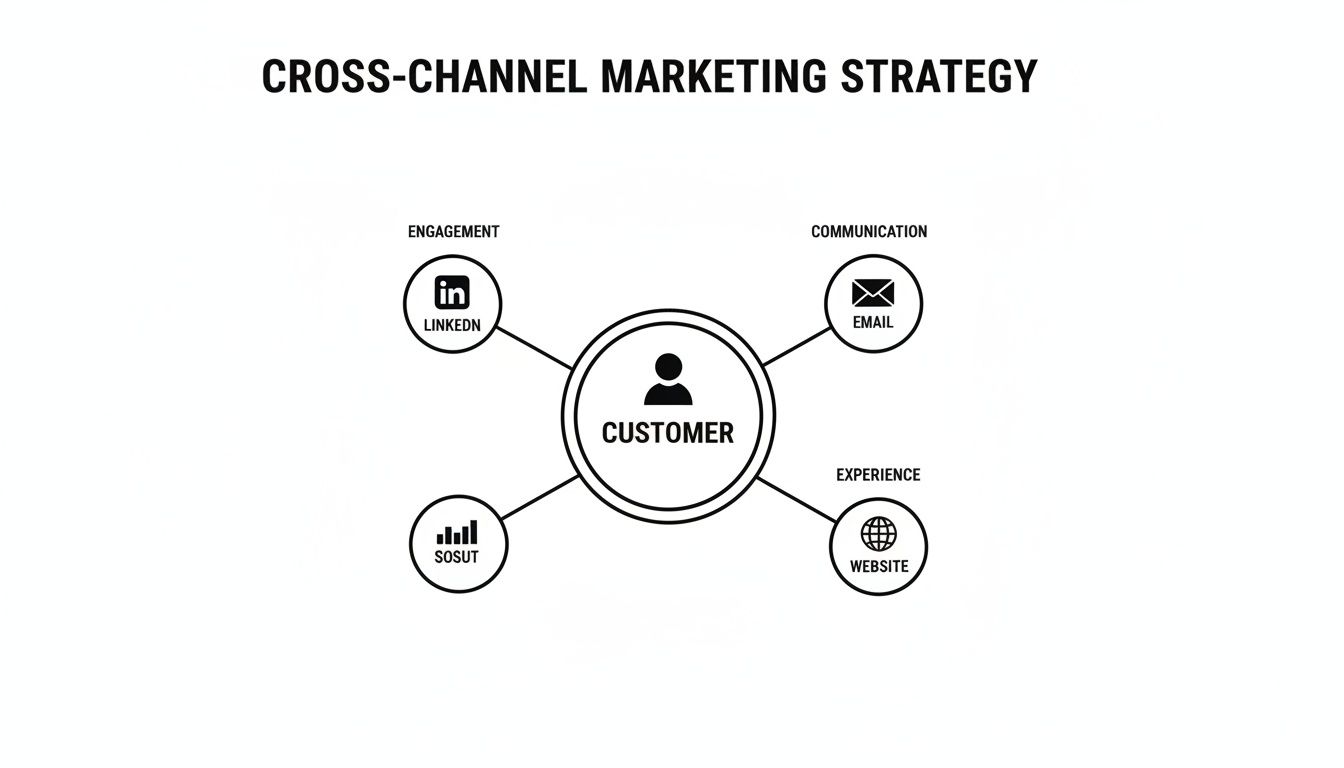
This visual illustrates a better approach: placing the customer at the center and ensuring every touchpoint, from LinkedIn to email to your website, is part of one unified journey, not just an isolated endpoint.
Cross-Channel: The Connected Conversation
This is where a coordinated strategy begins to shine. Cross-channel marketing is like personally guiding someone from one room to the next while continuing a single, fluid conversation. The channels don't just exist; they are connected and aware of each other's roles.
For example, if a prospect clicks your LinkedIn ad for a whitepaper (Room 1) and downloads it from your website (Room 2), the follow-up email they receive (Room 3) specifically references that action. The message isn't generic, it's the next logical step in their journey, creating an intelligent and personalized experience.
The core purpose of cross-channel marketing is to orchestrate the customer's journey, ensuring each interaction builds on the last to create a seamless narrative that guides them forward.
This requires data integration between your channels to track a user's path and trigger the appropriate next step. It's a significant leap from multichannel because the focus shifts from merely being present everywhere to actively guiding the customer's journey.
Omnichannel: The Unified Experience
Finally, omnichannel marketing takes this concept to its ultimate conclusion. Think of it as creating a fully integrated smart home where the walls between rooms practically disappear. The customer is placed at the absolute center, and every single channel, online or offline, updates in real-time to reflect their latest interaction.
For instance, someone might browse a service on your mobile app, add a consultation to their cart on a desktop, and then receive a push notification with a special offer as they walk past your booth at a trade show. The experience is completely fluid and channel-agnostic. Omnichannel is the most complex to execute, demanding deep technological integration and a truly customer-centric organizational structure.
This table helps visualize the key differences and how the focus shifts from the brand's channels to the customer's experience.
Cross Channel vs Multichannel vs Omnichannel
Understanding where your current efforts fall on this spectrum helps clarify your next steps. While a true omnichannel experience is the gold standard, a well-executed cross-channel strategy is a powerful and achievable goal for most B2B firms looking to create more meaningful connections with their clients.
Why a Cross-Channel Strategy Drives Real Growth
Beyond definitions, the real question is: does a cross-channel strategy actually move the needle? The answer is a definitive yes.
Shifting from siloed campaigns to a connected customer journey delivers measurable business results that impact your bottom line, transforming marketing from a cost center into a powerful engine for predictable growth.
This approach creates consistent, logical experiences that guide prospects from initial awareness to becoming a loyal client. When each touchpoint builds on the last, you eliminate the friction and confusion that often derail complex B2B sales cycles. That cohesion drives tangible gains in engagement, conversions, and long-term customer value.
Boosting Customer Engagement and Interaction
One of the most immediate benefits of a cross-channel strategy is a dramatic lift in customer engagement. When your messaging is coherent across platforms, customers are far more likely to pay attention and interact.
A prospect who sees a targeted LinkedIn ad, receives a relevant follow-up email, and then lands on a personalized web page feels understood, not just marketed to. This continuity keeps your brand top-of-mind and encourages them to lean in. Instead of ignoring repetitive or irrelevant messages, your audience begins to anticipate the next step in the conversation.
This sustained engagement is the bedrock for building the trust required for high-value professional services or B2B software sales.
A well-executed cross-channel strategy ensures you’re not just reaching customers, you’re resonating with them. It’s the difference between being another notification and becoming a trusted guide in their decision-making process.
Driving Higher Conversion Rates
Ultimately, engagement is only valuable if it leads to action. This is where a cross-channel approach truly shines. By orchestrating a seamless journey, you methodically remove barriers to conversion. Each step is designed to move the prospect closer to a decision, whether that's booking a demo, downloading a key resource, or contacting your sales team.
The data confirms this. Cross-channel marketing is a validated driver of revenue. According to an analysis of coordinated email, social, and web campaigns, brands running integrated cross-channel campaigns report 24% higher conversion rates compared to single-channel efforts.
The impact on the bottom line is just as significant. Organizations with mature strategies see 23% higher revenue than those without an integrated approach. You can explore more of these findings on YouAppi.com.
Increasing Customer Lifetime Value
Perhaps the most significant long-term benefit is the impact on Customer Lifetime Value (CLV). Acquiring a new client is expensive; retaining and growing existing relationships is where true profitability lies. A cross-channel strategy extends beyond the initial sale, fostering the loyalty that encourages repeat business.
Here’s how:
- Better Onboarding: A connected journey helps new clients feel supported from day one, with timely tips, resources, and check-ins delivered across the channels they use.
- Proactive Communication: By tracking client interactions across your CRM and marketing platforms, you can anticipate needs and offer relevant solutions before they ask.
- Consistent Brand Experience: Every interaction reinforces your brand's value proposition, building a strong relationship that makes clients less likely to churn.
This focus on the entire customer lifecycle turns one-time projects into long-term partnerships, maximizing the value of every client you win.
How to Build Your Cross Channel Marketing Engine
Let's move from theory to action. Building a cross-channel marketing engine isn't about collecting disconnected tools; it's about architecting a system where tech, data, and messaging work in concert to guide your customers.
Think of it as laying a solid foundation, one piece at a time. By focusing on four key pillars, mapping the journey, unifying your data, selecting the right channels, and creating cohesive messaging, you can build a powerful, repeatable system for growth.
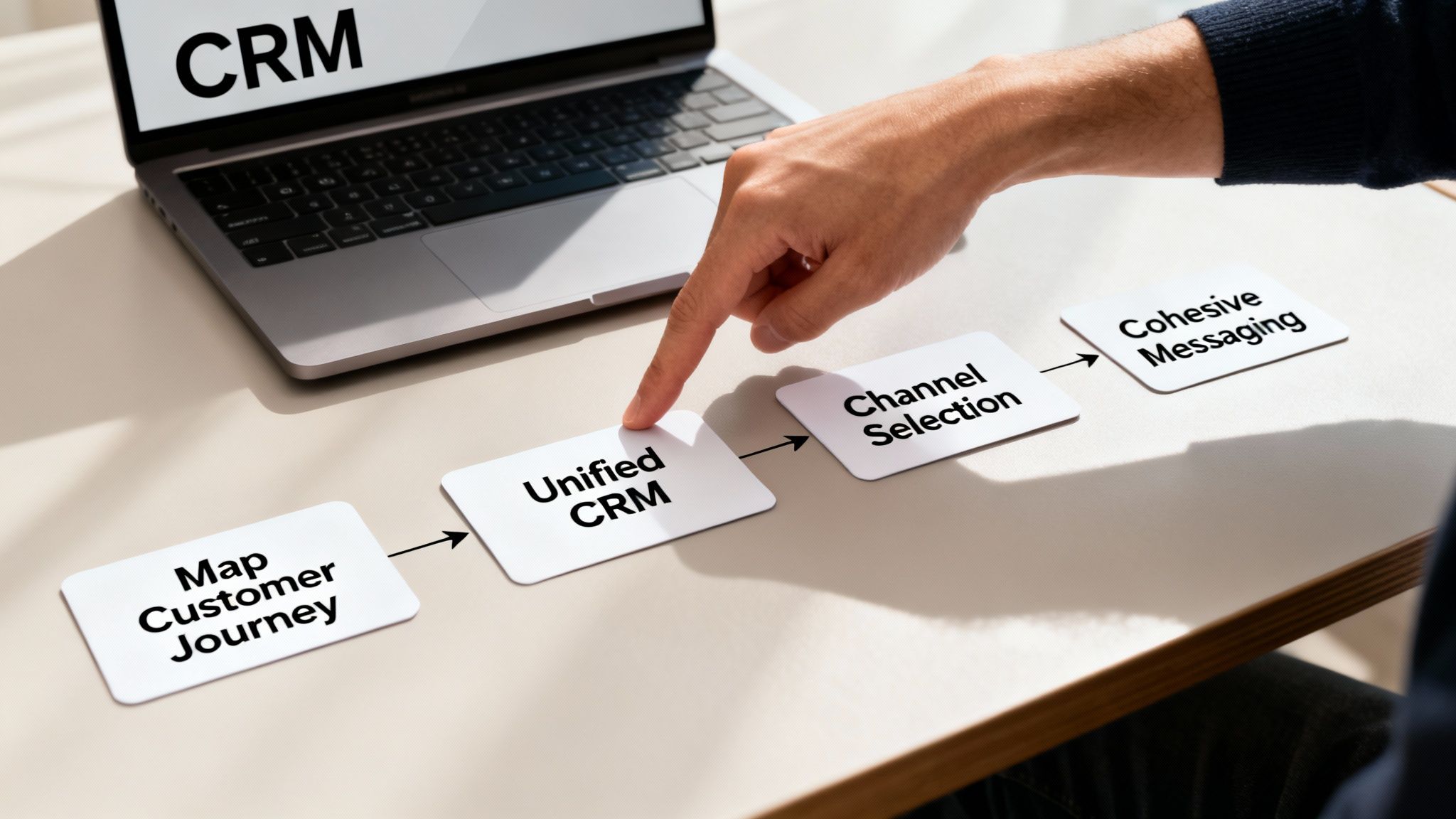
Step 1: Map Your Customer Journey
Before you can connect channels, you must understand the path your customers already take. A customer journey map is your blueprint, a visual walkthrough of every interaction a prospect has with your brand, from initial awareness to becoming a long-term partner.
This exercise forces you to see things from their perspective. Where do they first learn about firms like yours? What information do they need to move forward? And critically, where are the friction points that cause them to hesitate or drop off?
Identifying these moments is crucial, as it shows you exactly where a smooth, cross-channel handoff will have the biggest impact.
Step 2: Unify Your Customer Data
Scattered data is the number one killer of any cross-channel effort. If your email platform, website analytics, and sales records exist on separate islands, a connected experience is impossible. The only way forward is to create a single source of truth for all customer information.
For most businesses, this means placing a robust Customer Relationship Management (CRM) system, like Salesforce or Dynamics 365, at the heart of your operations. When all interaction data flows into one central hub, you gain a complete, 360-degree view of every customer.
A unified CRM doesn't just hold data; it brings it to life. It's the central nervous system of your strategy, letting you see a customer's entire history and trigger the perfect action on the right channel at the right time.
This isn't just a technical step, it's the backbone of your strategy. It allows you to segment your audience based on their actual behavior, not just demographic guesswork. We dive deeper into building this foundation in our guide to data-driven marketing solutions.
Step 3: Select the Right Channels
With a clear journey map and unified data, you can make smart choices about which channels to integrate. The goal isn’t to be everywhere at once. It’s about being in the right places at the right times, where your audience is actively listening.
Analyze your data. Where do your best clients spend their time online? For a B2B professional services firm, this often involves an integrated mix:
- LinkedIn: The go-to platform for targeting key decision-makers and sharing thought leadership.
- Email Marketing: Ideal for nurturing leads who have already shown interest by downloading a guide or joining a webinar.
- Website and SEO: Your central hub for capturing high-intent search traffic and providing in-depth, valuable information.
- Paid Search: A direct line to prospects actively searching for the solutions you offer.
The secret is to choose channels that have natural synergy. A LinkedIn ad can point to a targeted landing page, which triggers a nurturing email sequence, all while your CRM logs every interaction.
Step 4: Craft Cohesive and Adaptive Messaging
The final piece is your messaging. In a cross-channel world, consistency is key, but that doesn't mean copying and pasting the same text everywhere. Your messaging needs to be cohesive yet adaptive.
Your core value proposition should remain consistent, but its delivery must fit the platform. It’s about speaking the native language of each channel:
- Social Media: Messages should be concise, sharp, and visual to cut through the noise.
- Email: You have more space to be detailed, offering deeper insights and a clear call to action.
- Website: This is where you provide comprehensive content that answers every question and builds authority.
Think of it as telling one continuous story, where each channel reveals the next chapter. A prospect who clicks a LinkedIn ad about "improving operational efficiency" should land on a page that continues that exact conversation, and the follow-up email should pick up where the landing page left off. This alignment builds trust and makes the customer’s next step feel natural.
Cross Channel Marketing Examples for B2B
Theory is one thing, but seeing cross-channel marketing in action reveals its true power. For B2B companies with long, complex sales cycles, these connected journeys are far more effective than generic outreach. They are about starting and guiding meaningful conversations.
Let's walk through a few scenarios that demonstrate how to link channels to guide a prospect from initial curiosity to a signed contract, ensuring no one falls through the cracks. The goal is to make every interaction a logical and helpful next step.
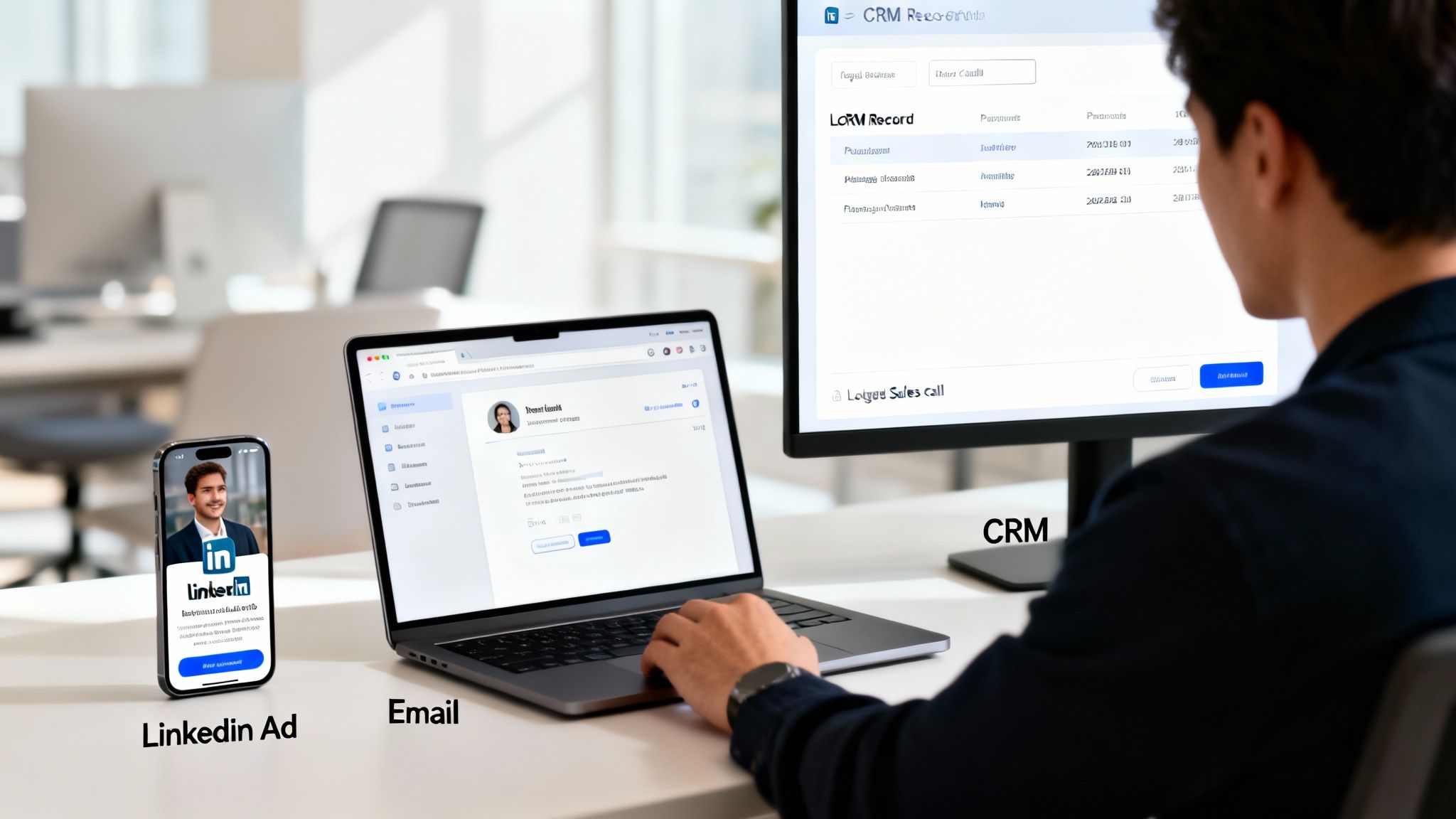
Example 1: The High-Value Lead Generation Journey
Imagine a B2B SaaS company launching new project management software. The old method might involve disconnected ads and a few email blasts. A cross-channel strategy, however, builds an intelligent, connected funnel.
Here’s how that journey plays out:
- Awareness (LinkedIn): It begins with a targeted LinkedIn ad promoting a new whitepaper, "The Future of Agile Project Management." The ad is shown only to users with specific job titles like 'Project Manager' or 'Head of Operations' at companies of a certain size.
- Consideration (Website): A prospect clicks the ad and lands on a dedicated page for the whitepaper. The moment they download it, their information is sent to the CRM, which automatically tags them as a "Warm Lead - Agile Whitepaper."
- Nurture (Email): This tag triggers a three-part email sequence. The first email delivers the whitepaper. Two days later, a second email shares a compelling case study. Four days after that, a third invites them to a live webinar on the same topic.
- Decision (Sales & CRM): If the lead registers for the webinar, the CRM automatically elevates their status to "Marketing Qualified Lead" and creates a task for a sales rep to follow up. The subsequent sales call is no longer cold; it's a warm, relevant conversation built on a foundation of genuine interest.
Example 2: The Account-Based Marketing Play
Now, picture a professional services firm aiming to land a major contract with a specific, high-value enterprise client. This is where an Account-Based Marketing (ABM) approach, executed with cross-channel precision, becomes a game-changer.
An ABM strategy doesn't cast a wide net; it focuses all marketing and sales firepower on a handpicked list of target accounts. Cross-channel marketing is the engine that delivers the personalized, high-touch experience needed to get the attention of key decision-makers at those companies.
Let's walk through this focused approach:
- Initial Engagement (Website & Retargeting): A key decision-maker from a target account visits your "Services" page but leaves without making contact. Your website's tracking pixel identifies them and adds them to a custom retargeting audience.
- Personalized Ads (Paid Social): For the next few weeks, that decision-maker, and their colleagues at the same company, begin seeing personalized LinkedIn and display ads. The ads feature a case study highly relevant to their industry, speaking directly to their biggest pain points.
- Direct Outreach (Sales Navigator & Email): Simultaneously, a sales executive uses LinkedIn Sales Navigator to connect with that decision-maker. Once the connection is accepted, they send a personal message that references the case study from the ads and offers to discuss the specific challenges their company is facing.
This strategy transforms a simple website visit into a coordinated, multi-touch sales offensive. It’s a perfect example of aligning channels to surround a target account with a consistent, valuable message. To execute this effectively, it helps to follow a proven playbook. For a deeper look, check out our guide on account-based marketing best practices.
Measuring And Optimizing Your Performance
A brilliant cross-channel marketing strategy is only as good as your ability to prove it works. To demonstrate its value, you must look beyond surface-level stats like social media likes or email open rates. The real mission is tracking key performance indicators (KPIs) that connect your efforts directly to business growth.
This means focusing on metrics that tell the entire story of a client's journey, not just a single chapter. By linking data from your CRM and analytics platforms, you get a complete picture of performance and see how your coordinated campaigns impact the bottom line. This data-backed confidence allows for smart, continuous improvement.
Key Metrics That Matter
To demonstrate the power of your cross-channel campaigns, zero in on KPIs that reflect both client behavior and financial results. These are the numbers that prove you’re not just creating buzz, you’re driving measurable outcomes.
Here are the essential metrics to monitor:
- Customer Lifetime Value (CLV): This is the ultimate report card for a successful client relationship. A rising CLV is a clear sign that your connected journeys are not only winning new clients but also keeping them happy and growing their accounts over time.
- Conversion Rate by Channel Path: Don't just credit the last touchpoint. Analyze which sequences of channels (e.g., a LinkedIn ad leading to your website, followed by an email nurture series) are most effective at turning prospects into qualified leads.
- Marketing Attributed Revenue: This is the critical metric that draws a straight line from your cross-channel activities to closed deals. It definitively answers the question: "How much revenue did marketing actually generate?"
The most powerful insights come not from looking at channels in isolation, but from seeing how they work together. Knowing that an email campaign boosted webinar attendance, which then led to three high-value sales calls, is infinitely more valuable than just knowing the email's open rate.
Demystifying Marketing Attribution
A central challenge in measuring cross-channel performance is marketing attribution: the science of assigning credit to the various touchpoints that influence a conversion. Without a solid attribution model, it’s easy to overvalue the last channel a client interacted with while ignoring the crucial steps that came before it.
Different models offer different perspectives on the client journey. A Linear model, for example, gives equal credit to every touchpoint. In contrast, a Time-Decay model gives more weight to the interactions that occurred closer to the final conversion.
Choosing the right model helps you see the true contribution of each channel, allowing you to allocate your budget with much greater confidence. For a complete breakdown of this topic, read our guide on what is marketing attribution.
Ultimately, measuring performance is an ongoing cycle of analysis and refinement. By using integrated analytics and CRM reporting, you create a powerful feedback loop. You can see which messages resonate, which paths convert best, and where you might be losing prospects. This constant stream of insights allows you to fine-tune your strategy, making your cross-channel engine smarter and more effective over time.
Frequently Asked Questions
Even with a well-defined strategy, questions often arise when it's time to implement a cross-channel marketing plan. Let's tackle some of the most common ones to help you navigate technology choices, budget discussions, and initial setup.
What Is the First Step in a Cross-Channel Strategy?
The absolute first step is to unify your customer data. Before you can build a connected customer journey, you need a single source of truth that reveals who your customers are and how they’ve interacted with you across all touchpoints.
For most firms, this means integrating your various marketing platforms with a solid CRM like Salesforce or Dynamics 365. Once your data systems are communicating, you can see the full picture, map the actual customer journey, and identify which touchpoints are making a real difference.
How Do I Choose the Right Channels for My Business?
Don't chase every new trend. Your channel selection should be driven directly by your audience's behavior. Analyze your existing data to find out where your best leads and clients are actually coming from. For most B2B and professional services firms, a winning combination often includes:
- LinkedIn: Unbeatable for targeting specific decision-makers and sharing content that builds authority.
- Paid Search: Your net for capturing high-intent prospects who are actively searching for what you offer.
- Content & Email: The workhorses for nurturing leads, delivering value, and building the trust needed to close a deal.
The goal isn't to be everywhere; it's to be exactly where your customers are when they're looking for answers.
A common mistake is stretching yourself thin across too many channels. Real cross-channel success comes from mastering and integrating the handful of channels that matter most to your audience, creating a smooth, logical handoff between them.
Can I Do Cross-Channel Marketing on a Small Budget?
Absolutely. Cross-channel marketing is a strategic mindset, not a shopping list of expensive tools. You can start small by integrating just two or three core channels to prove the concept and demonstrate a tangible return on your effort.
A great starting point is to connect your website's contact forms to an automated email welcome series. From there, you can use engagement data from those emails to create a small, hyper-focused retargeting audience for your social media ads. It's all about ensuring there’s a connected, logical next step for the customer. Once you demonstrate the ROI from these small wins, you'll have a rock-solid case for expanding your budget and your tech stack.
Ready to stop guessing and start building connected customer journeys that drive real growth? At Twelverays, we specialize in integrating your marketing efforts with powerful CRM solutions to deliver measurable results. Schedule a consultation with us today.


