

A Customer Data Platform (CDP) is software designed to centralize all your customer data. It collects first-party data from every available source to create a single, comprehensive profile for each customer. Once unified, this profile is shared with other systems like marketing automation platforms or CRMs, enabling personalized customer experiences and more informed business decisions. In essence, it serves as the central hub for every customer interaction.
Decoding the Customer Data Platform
In many organizations, customer information is fragmented and scattered across various systems, the CRM, analytics tools, email platforms, and support desks. This data chaos makes it nearly impossible to gain a clear understanding of who customers are and what they need. A Customer Data Platform is engineered to solve precisely this problem.
Think of a CDP as the central nervous system for your customer data. It gathers every touchpoint, every click, purchase, and support ticket, from all your systems. It then intelligently merges this information to create a persistent, unified profile for each individual.
This isn't just a technical nicety. Modern consumers expect personalization. A CDP allows you to move beyond generic, one-size-fits-all campaigns and start delivering the right message at the right time, with the right context.
Why Does This Matter for Your Business?
The drive for unified data is a fundamental shift in how successful businesses operate. Market growth tells the story. Data Bridge Market Research valued the global Customer Data Platform market at USD 8.34 billion in 2024 and projects USD 85.18 billion by 2032, a compound annual growth rate (CAGR) of 33.7%. Estimates vary widely by firm, but every credible forecast points the same direction: steep, sustained growth. This expansion highlights the urgent need for businesses to consolidate fragmented customer data from websites, apps, and other touchpoints into a single, actionable profile.
To achieve this, a CDP performs several core functions that empower both marketing and data teams. The table below outlines these primary functions.
CDP Core Functions at a Glance
By mastering these functions, your organization can transition from managing disconnected data points to executing a cohesive, intelligent strategy.
If you're looking to build a strong foundation for this kind of system, you can learn more about the essentials in our detailed guide on customer data integration solutions. This single source of truth becomes the bedrock for smarter marketing, better sales conversations, and genuinely superior customer service.
How a CDP Stitches All Your Customer Data Together
To fully understand what a CDP is, you have to look under the hood. It’s more than a simple database; it's an intelligent engine built to orchestrate every piece of customer information. This engine operates on four core functions that work in concert to create a solid foundation for every customer interaction.
This concept map visually breaks down how scattered data from different sources funnels into the CDP, which then builds a single, unified customer profile.
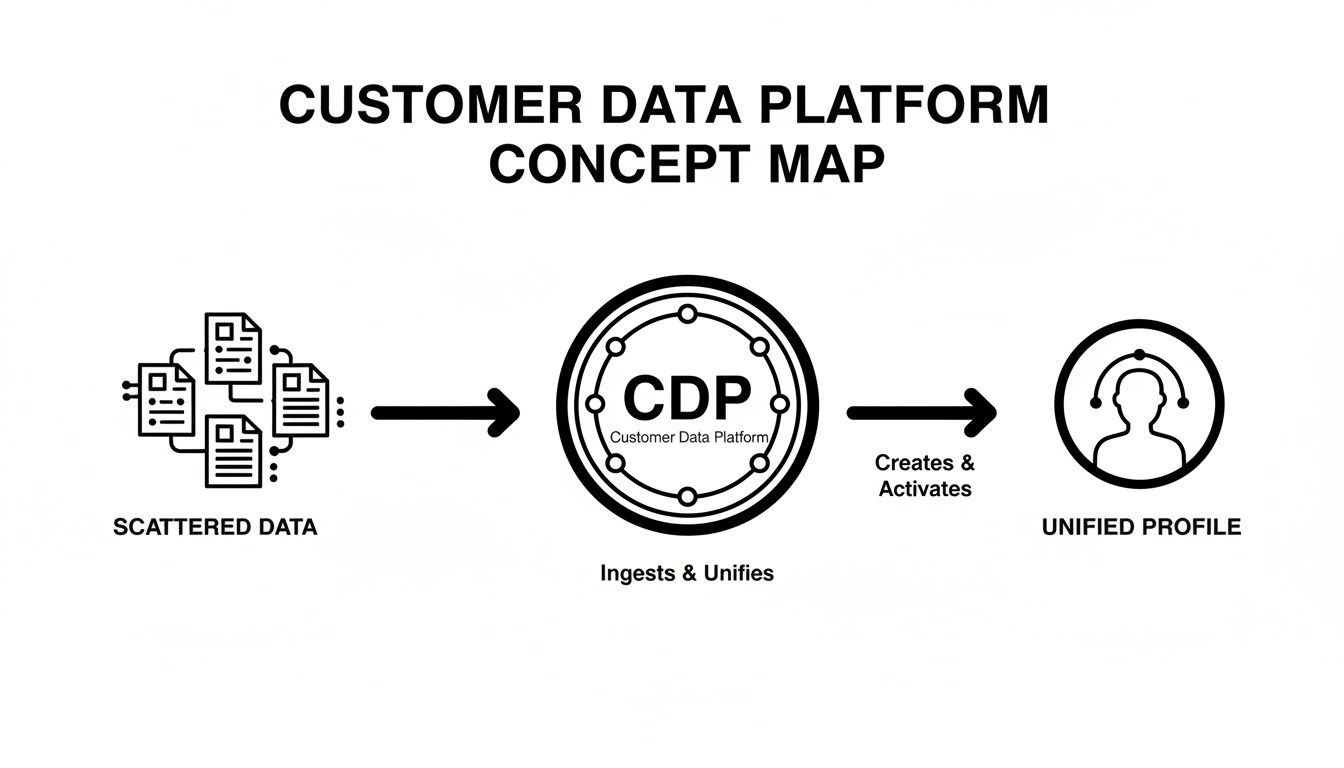
This visual simplifies a complex process, but it highlights the platform's primary job: turning data chaos into clear, actionable insights.
Pillar 1: Data Ingestion
The first step is data ingestion, where the CDP acts as a universal adapter. It pulls information from every conceivable source, including a wide range of touchpoints.
- Online Sources: Website analytics, mobile app interactions, social media engagement, and email campaign responses.
- Offline Sources: In-store purchase records, call center notes, and event attendance lists.
- Existing Systems: Data from your CRM, ERP, and marketing automation tools.
By connecting these disparate sources, the CDP ensures no part of the customer story is lost. This initial collection phase is critical, especially when migrating information from legacy systems. Adhering to best practices for data migration is essential for a smooth transition.
Pillar 2: Identity Resolution
Once the data is collected, the CDP’s most crucial job begins: identity resolution. The platform meticulously examines every piece of data to connect it to the right person.
It stitches together anonymous website visits with known customer emails, links mobile app activity to in-store purchases, and merges duplicate profiles into one persistent, unified view.
The result is a golden record for each customer, a reliable, 360-degree profile that serves as the single source of truth across your entire organization. This solves the chronic problem of fragmented customer identities scattered across different tools.
For instance, a user might browse your site on their laptop, click an ad on their phone, and purchase in your physical store. Without a CDP, these appear as three separate events. A CDP unifies them into one coherent customer journey, providing invaluable context.
Pillar 3: Data Segmentation
With unified profiles in place, the CDP offers powerful data segmentation tools. This goes beyond basic demographic splits to group customers into specific audiences based on nearly any attribute or behavior.
You can create fine-tuned segments like:
- Customers who bought a specific product more than twice in the last six months.
- Users who abandoned their shopping cart in the past 24 hours.
- High-value B2B accounts that recently engaged with your pricing page.
This precision is a game-changer for marketing and sales, enabling them to craft messages that are deeply personal and relevant.
Pillar 4: Data Activation
Finally, the process comes full circle with data activation. A CDP doesn't just store unified data; it pushes the refined profiles and segments back to the tools your teams use daily, unleashing its true power.
The rapid adoption of this technology speaks volumes. Market forecasts project sustained, explosive growth across the sector. This growth is a direct reflection of how vital CDPs have become in connecting data from sources like emails and social media to create profiles that teams can act on.
By activating this data, a personalized email can be triggered by a specific website action, or an ad campaign can be tailored based on recent purchase history. In short, the CDP makes your entire tech stack smarter, ensuring every customer interaction is informed and impactful.
CDP vs CRM vs DMP: Clearing Up the Confusion
The alphabet soup of marketing technology can be confusing. Platforms like Customer Data Platforms (CDPs), Customer Relationship Management (CRMs), and Data Management Platforms (DMPs) all promise a single view of the customer, but the lines between them are often blurry.
While they all handle customer information, they are built for fundamentally different purposes and treat data in distinct ways. Choosing the wrong tool can lead to wasted resources, frustrated teams, and missed opportunities. Let's clarify where each platform shines.
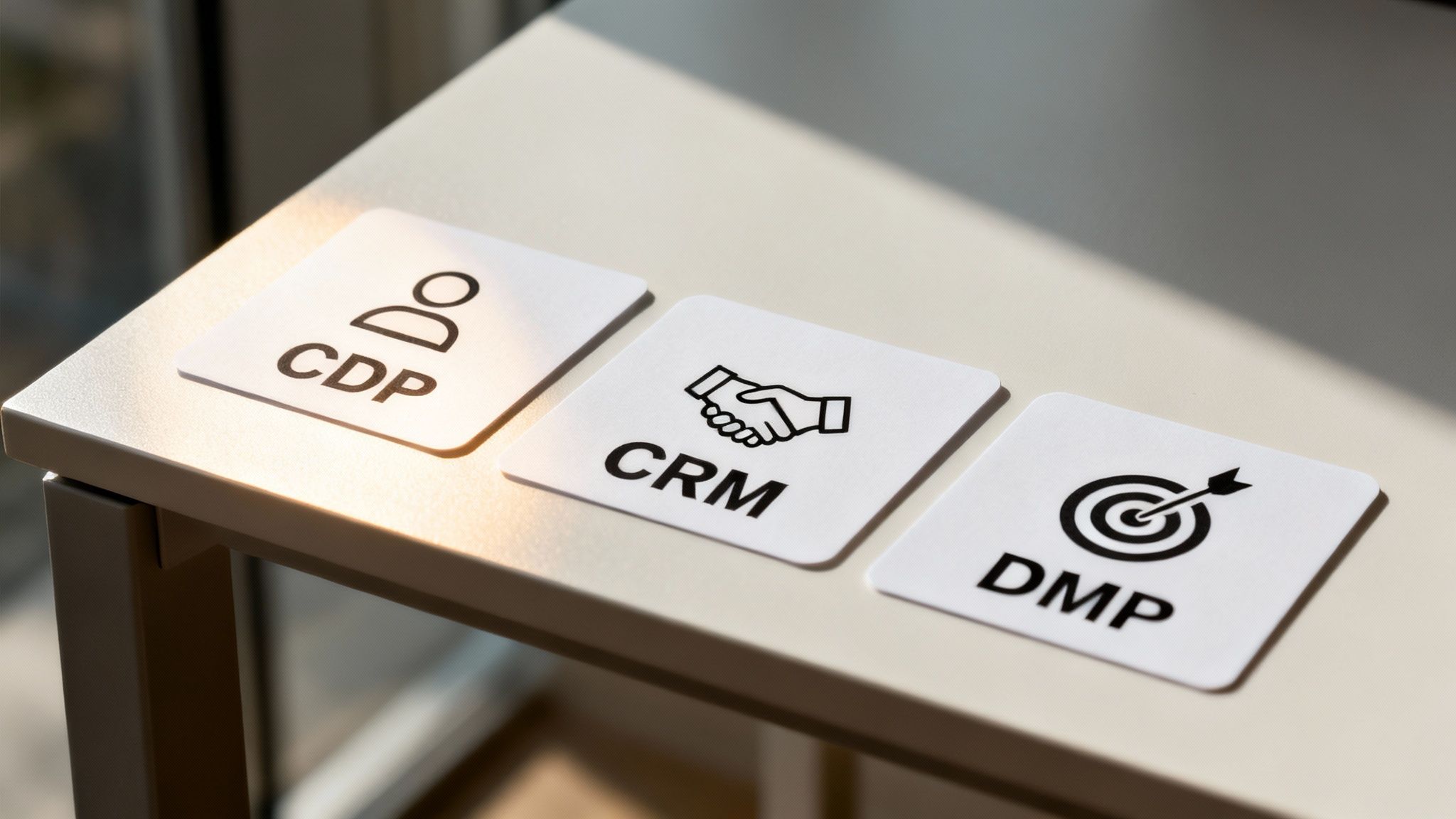
Here's a breakdown of what each platform does, the kind of data it uses, and who on your team would use it.
Customer Relationship Management (CRM): The Sales Hub
A Customer Relationship Management (CRM) system is the operational backbone for sales and customer service teams. It serves as the official record for every direct interaction with known customers and prospects, tracking phone calls, emails, deal stages, and support tickets.
CRMs excel at organizing first-party data: information people provide directly, like their name or email. They are essential for managing relationships but are not designed to ingest large volumes of anonymous behavioral data or unify identities from multiple channels. Our guide on what are CRM systems offers a deeper look.
Data Management Platform (DMP): The Ad Targeting Tool
A Data Management Platform (DMP) operates in the world of programmatic advertising. Its primary function is to collect and segment large volumes of anonymous, third-party data: mostly cookies and device IDs, to target audiences for digital ad campaigns.
The key word here is anonymous. A DMP focuses on creating audience segments for lookalike modeling and ad targeting, not on individual customer profiles. The data is also temporary, as cookie-based profiles expire after about 90 days. DMPs are powerful for broad-reach advertising but are unsuited for building a lasting, unified view of a specific person.
Customer Data Platform (CDP): The Unified View Engine
The Customer Data Platform (CDP) bridges the gap between the CRM and the DMP. It is engineered to ingest data from all sources, first-party, second-party, and third-party, to build a single, durable, and complete profile for each customer.
Unlike a CRM that tracks sales interactions or a DMP that targets anonymous ad audiences, a CDP’s sole mission is to create a unified, persistent customer profile. It resolves identities across every touchpoint, online and off, to become the single source of truth for marketing.
The CDP's core strength is its ability to unify known Personally Identifiable Information (PII) from your CRM with anonymous behavioral data from your website, app, and support channels. It connects a person’s website clicks to their customer record, finally providing a true 360-degree view. This unified profile then fuels deeply personal marketing across all your other tools.
Comparing Data Platforms: CDP vs CRM vs DMP
This side-by-side comparison clarifies the distinctions between these platforms.
Ultimately, these platforms are collaborators, not competitors. A powerful tech stack often features all three, with the CDP acting as the central data hub that enriches the CRM's information while informing the DMP's audience strategy.
Putting Your CDP to Work with Real Use Cases
Understanding a Customer Data Platform's architecture is one thing, but seeing it drive business results is where its value becomes clear. Let's examine concrete applications that show how companies are using CDPs to achieve measurable growth and a clear return on investment.
With a unified data foundation, you can orchestrate sophisticated, multi-channel journeys that were previously impossible. The real power of a CDP is its ability to turn fragmented data into intelligent, real-time actions that directly impact the bottom line.
Hyper-Personalization at Scale
One of the most immediate benefits of a CDP is delivering hyper-personalized marketing. Before a CDP, marketers often rely on static lists and broad segments, leading to generic messaging that fails to connect. A CDP changes the game by enabling personalization based on a complete, real-time view of each individual's behavior.
- Before CDP: A SaaS company sends a generic email about a new feature to its entire user base, resulting in low engagement because the message is irrelevant to many.
- After CDP: The marketing team creates a dynamic segment of users who have actively used a complementary feature in the last 30 days but haven't adopted the new one. A targeted email is triggered, highlighting how the new feature solves a problem relevant to their workflow, resulting in a significantly higher adoption rate.
This level of detail transforms marketing into a one-to-one conversation. For a deeper dive, explore our guide on customer segmentation strategies.
Predictive Churn Reduction
For subscription-based businesses, customer churn is a constant threat. A CDP enables a proactive retention strategy by identifying at-risk customers before they leave.
By analyzing thousands of data points, such as declining product usage or unanswered support tickets, a CDP can build predictive models that flag accounts with a high probability of churning.
This allows customer success teams to intervene at the perfect moment with targeted support or special offers designed to demonstrate value and re-engage the user. It’s about solving problems before the customer is even aware of them.
Orchestrating Seamless Cross-Channel Journeys
The modern buyer journey is rarely linear. A prospect might see a social media ad, visit your website, and then speak to a sales rep over several weeks. Without a CDP, each interaction exists in a separate silo, creating a disjointed experience.
A CDP unifies this journey. If a known prospect from a high-value account visits your pricing page, the CDP can instantly alert the assigned sales rep in the CRM while adding the prospect to a targeted digital ad campaign. This ensures every touchpoint is consistent and contextual.
The market's rapid expansion underscores the value of these applications. Straits Research projects the CDP sector reaching USD 71.94 billion by 2033 at a CAGR of 28.23%, fueled by companies eager to personalize at scale while navigating privacy regulations. Learn more about the trends shaping the CDP market.
Your Practical CDP Implementation Checklist
Adopting a Customer Data Platform is a strategic project that requires careful planning and cross-departmental teamwork. To avoid common pitfalls, you need a structured plan. This checklist serves as a roadmap for a successful implementation, from initial planning to team onboarding.
Think of this as laying a new foundation for your entire customer engagement strategy. Rushing the setup without a solid plan is a surefire way to end up with a powerful tool that goes unused.
Phase 1: Define Your Strategy and Goals
Before evaluating vendors, you must define what success looks like for your business. This critical first step ties the project to real-world outcomes.
Start by answering these core questions:
- Identify Priority Use Cases: What are the most pressing business challenges the CDP needs to solve? Are you trying to reduce churn, improve lead scoring, or deliver hyper-personalized campaigns? Pinpoint 2-3 high-impact use cases to focus on first.
- Define Success Metrics: How will you measure success? Set clear Key Performance Indicators (KPIs), such as a 15% increase in customer lifetime value (CLV), a 10% decrease in customer acquisition cost (CAC), or a 20% lift in conversion rates.
- Assemble a Cross-Functional Team: A CDP implementation is a team effort. Your project team should include representatives from marketing, sales, IT, and data analytics to ensure all perspectives are considered.
Phase 2: Audit Your Data and Technology Stack
With your goals set, it’s time for an honest assessment of your current data landscape. A CDP is only as good as the data you feed it, making a thorough audit non-negotiable.
A common mistake is underestimating the complexity of existing data. A proper audit prevents surprises during integration and ensures you're building on a clean, reliable foundation.
Your audit should cover these key areas:
- Data Source Mapping: Inventory every system that holds customer information, including your CRM (like Salesforce or Dynamics 365), analytics tools, and email platforms.
- Data Quality Assessment: Examine the data in each source for consistency and accuracy. Identify gaps, duplicates, or outdated information that needs to be cleaned before migration.
- Integration Planning: Determine how each source will connect to the CDP, whether through native connectors, APIs, or other methods. Planning this early saves time and money.
Phase 3: Select the Right Vendor and Plan Your Rollout
With your use cases defined and a clear data map, you can begin evaluating vendors based on your specific needs. A phased rollout is key, it helps manage complexity and allows for early wins to build momentum.
When vetting vendors, focus on these critical points:
- Alignment with Use Cases: Does their platform excel at your prioritized functions? If you need real-time identity resolution, ensure they can deliver.
- Integration Capabilities: Confirm they have proven integrations with the most important systems in your tech stack, especially your CRM.
- Scalability and Support: Choose a partner who can grow with you and offers excellent technical support and strategic guidance.
Following this checklist transforms an overwhelming project into a manageable, strategic initiative that delivers measurable value.
How Do You Actually Measure the ROI of a Customer Data Platform?
A Customer Data Platform is a significant investment, so proving its worth with clear financial results is crucial. The true test of success is tracking KPIs that connect unified data to tangible business outcomes.
You need to zero in on the metrics that matter most to the business, showing a direct link between the platform's functions and improved efficiency, revenue growth, and stronger customer relationships.
The KPIs That Really Matter
To build a solid business case, focus on metrics that demonstrate tangible growth and cost savings.
- Customer Lifetime Value (CLV): Richer customer profiles and personalized experiences help you identify and nurture high-value customers. A rising CLV indicates that your CDP-powered retention and cross-selling efforts are working.
- Customer Acquisition Cost (CAC): By creating laser-focused audience segments, you can reduce wasted ad spend and target prospects more likely to convert. A declining CAC is direct proof of more efficient marketing.
- Marketing Campaign Conversion Rates: Shifting from generic to hyper-personalized campaigns based on real-time behavior inevitably boosts conversion rates. Tracking this lift provides immediate evidence of the CDP’s value.
A Simple Way to Calculate ROI
Calculating ROI can be straightforward. The formula gets right to the point: the financial gain relative to the investment.
ROI Formula: (Financial Gain from Investment - Cost of Investment) / Cost of Investment
For example, assume your CDP investment is $150,000 for the year. Through better targeting, you attribute $300,000 in new revenue and $50,000 in efficiency savings.
Here’s the math:
- Total Financial Gain: $300,000 + $50,000 = $350,000
- Calculation: ($350,000 - $150,000) / $150,000 = 1.33
- Your ROI: A 133% return on investment.
This simple calculation translates the platform's benefits into the language of financial results. For a more detailed walkthrough, see our guide on how to measure marketing ROI.
By monitoring these metrics, you can continuously prove that your CDP is an indispensable engine for sustainable growth.
Frequently Asked Questions About Customer Data Platforms
As you explore what a customer data platform is, a few practical questions often arise. Here are straightforward answers to the most common inquiries.
How Long Does It Take to Implement a CDP?
The timeline depends on your data's complexity and the number of sources, but a phased approach is best.
Most businesses can launch a basic implementation focused on one or two high-impact use cases in about 3-6 months, allowing for quick value realization. A full, enterprise-wide rollout may take closer to 9-12 months. The process involves technical setup, data source integration, identity resolution configuration, and team training. The key is to aim for quick wins while building toward your long-term vision.
Can a CDP Help with GDPR and CCPA Compliance?
Yes. A CDP is a powerful tool for managing data privacy. By centralizing all customer data and consent preferences into a single profile, you create a reliable source of truth.
This simplifies managing consent and handling data access or deletion requests under regulations like GDPR and CCPA. Many CDPs include built-in governance features designed to streamline compliance.
Is a CDP Only for Large Enterprise Companies?
Not anymore. While large enterprises were early adopters, the CDP market has matured. Today, many vendors offer solutions tailored for mid-market and even small businesses.
These platforms are often more focused, with flexible pricing and faster implementation paths. The key is to evaluate vendors based on your goals, not just your company's size.
The right platform isn't about the size of your company but the scale of your ambition. If you aim to deliver personalized experiences, a CDP is a strategic asset, regardless of your organization's size.
What Is the Difference Between a Packaged and Composable CDP?
This distinction is important for choosing the right path for your business and depends on your technical maturity and desired level of control.
Packaged CDP: An all-in-one solution from a single vendor, offering a built-in suite of tools for data collection, unification, and activation. It's generally faster to implement and easier for marketing teams to manage.
Composable CDP: A flexible, mix-and-match approach where you build your own platform by integrating best-in-class tools, often on top of an existing data warehouse like Snowflake or Google BigQuery. It offers greater control and is ideal for companies with strong data teams and specific technical requirements.
The choice hinges on your existing tech stack, your team's in-house skills, and your strategic objectives.
At Twelverays, we specialize in implementing data-driven strategies that connect technology to tangible business growth. If you're ready to unify your customer data and unlock its full potential, explore how our CRM and data integration services can help you build a smarter, more effective marketing engine.


