
Retargeting advertising is the practice of serving ads to people who have already visited your website or engaged with your brand. It’s a powerful method for reconnecting with potential customers who showed interest but didn't convert, keeping your brand top-of-mind and guiding them back to complete their purchase or inquiry.
Giving Your Marketing a Second Chance
Imagine a customer walks into your store, examines an item, but leaves without buying it. Now, picture a friendly store assistant later reminding them about that item. That’s what retargeting does in the digital world. It's your brand’s digital assistant.
This strategy re-engages individuals who have visited your website, used your app, or interacted with your social media profiles but didn't take a final step, such as making a purchase or filling out a form. Instead of targeting a "cold" audience of strangers, you focus your efforts on a "warm" audience that already knows your brand. You're not starting a new conversation; you're continuing one.
To provide a clearer picture, here's a breakdown of how the components work together.
Retargeting Advertising at a Glance
This table simplifies the core concept: you focus ad spend on people who have already shown they're interested.
Why Warm Audiences Are So Valuable
The effectiveness of retargeting lies in its efficiency. You’re communicating with a pre-qualified audience that has already demonstrated interest in your offerings. This targeted approach delivers impressive results.
- Higher Engagement: People are more likely to click on your ads because they recognize your brand.
- Increased Conversions: By reminding them of their initial interest, you can overcome hesitation and guide them toward a purchase.
- Improved ROI: Focusing ad spend on a receptive audience reduces waste and yields a much higher return on investment.
The pattern is well documented. Retargeting lifts conversion rates substantially versus cold display, because you re-engage a warm audience instead of strangers. Retargeted ads also earn click-through rates well above standard display. Industry benchmarks have long put retargeting CTR near 0.7% against roughly 0.07% for cold display, an order-of-magnitude gap. Treat that as a directional reference point, not a guaranteed constant, and measure your own.
A Practical Example of Retargeting
Let's make this tangible. Imagine someone visits your e-commerce site and adds shoes to their shopping cart. Then, a distraction occurs, and they leave. This is a classic case of cart abandonment, a topic we cover in our guide on how to reduce cart abandonment.
With a retargeting campaign, that same person might later see an ad for those exact shoes while browsing a news site or scrolling through Instagram.
This gentle, timely reminder serves as a powerful nudge, bringing your product back into their consideration set at the perfect moment. It bridges the gap between initial interest and final purchase, turning a missed opportunity into a successful sale. By strategically re-engaging these high-intent visitors, you significantly increase the likelihood of conversion.
How Retargeting Works Behind the Scenes
Have you ever wondered how an ad for a product you just viewed seems to follow you online? It's not a coincidence; it's a carefully engineered process designed to bring you back, and it all relies on a small piece of code.
This snippet of code is often called a retargeting pixel or tag. When someone lands on your page, this code places a simple, anonymous browser cookie, a small text file, on their device. This cookie acts as a unique, non-identifiable marker, flagging their browser as having visited your site.
Once they leave your site and browse elsewhere, the ad networks you partner with can detect that marker. This signals them to start showing your ads to that person, creating a timely, personalized reminder.
The User Journey Visualized
To make this less abstract, let’s walk through the typical user journey. It's a simple, three-step loop designed to convert initial interest into a conversion.
The visual below breaks down the fundamental flow, from a user's first visit to their re-engagement with your brand.
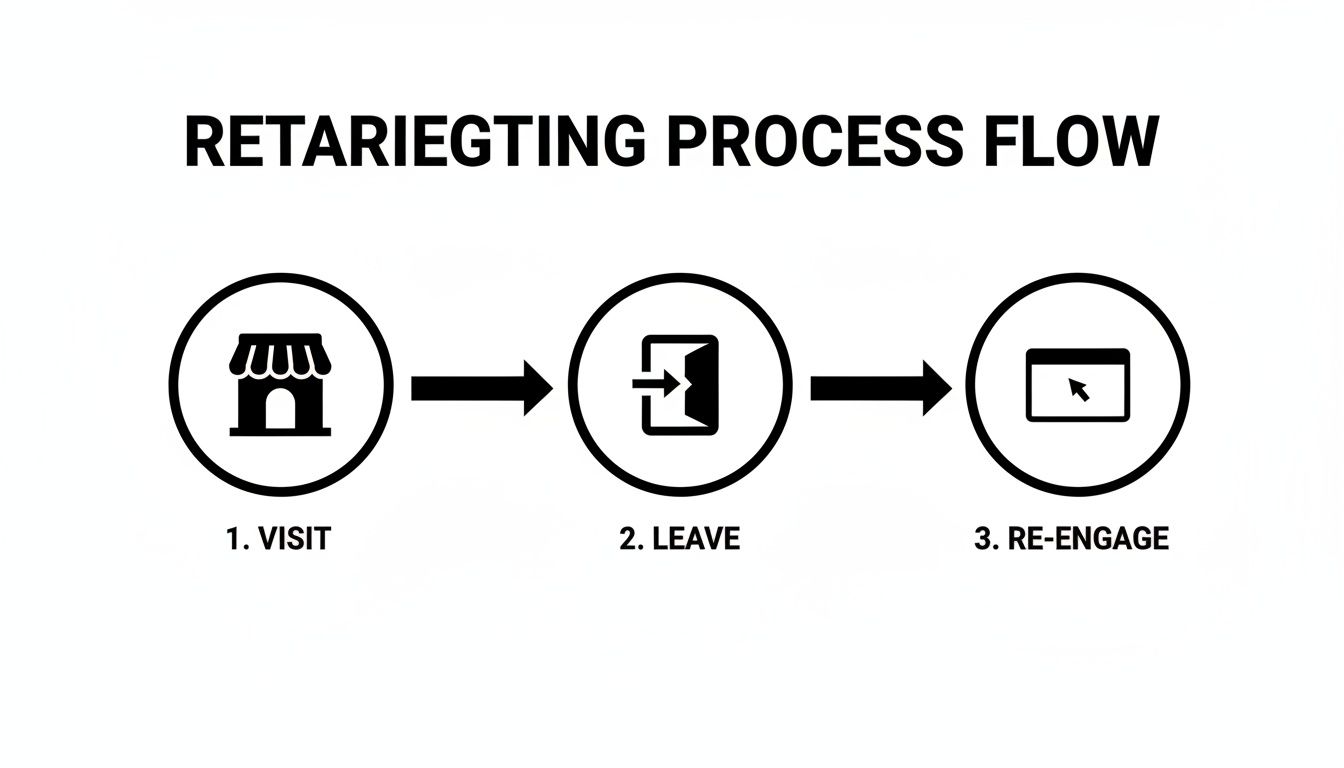
This cycle is straightforward: a user visits, leaves without taking action, and then sees a relevant ad that encourages their return. This process keeps your brand top-of-mind by creating multiple touchpoints after the first interaction.
The Shift from Third-Party to First-Party Data
For years, this system was built on third-party cookies, which tracked users across different websites. That foundation is shrinking. Safari and Firefox already block third-party cookies by default, and signal loss from privacy regulation continues. Google changed course on Chrome: in April 2025 it confirmed it will not deprecate third-party cookies and will keep them under users' existing privacy settings. Cookies are not vanishing in Chrome, but you cannot build a durable retargeting program on a signal that two major browsers already block and that regulators keep constraining.
The future of effective retargeting is centered on first-party data: the information you collect directly from your audience and customers.
First-party data includes information gathered from your own sources, such as website analytics, CRM systems, email lists, and customer purchase histories. It is more accurate, ethically sourced, and powerful because it represents direct interactions with your brand.
By using your own data, you're no longer targeting an anonymous browser ID. You're reaching actual people with a confirmed, direct relationship with your business. This approach is more respectful of user privacy and significantly more effective.
Leveraging First-Party Data in Action
So, what does this look like in practice? It involves building strategies around the information you already possess.
- List-Based Retargeting: You can upload customer email lists directly to ad platforms like Google or Meta. The platform then matches those emails to user accounts and shows your ads exclusively to that group.
- Behavioral Targeting: Track user actions on your site, which pages they visited, if they downloaded a guide, or how far they scrolled. This allows you to serve highly relevant ads based on their demonstrated interests.
- Conversion Tracking: With proper conversion tracking, you can stop showing ads to people who have already converted. This saves money and avoids annoying new customers. To implement this correctly, it’s worth learning more about setting up Google Ads conversion tracking to measure your results accurately.
Pivoting to a first-party data strategy ensures your retargeting remains potent and compliant as the digital landscape evolves. It's about building smarter campaigns powered by the direct signals your audience provides.
Choosing Your Retargeting Strategy

Now that you understand the mechanics of retargeting, it's time to choose the right strategy. Not all retargeting is the same, and the best approach depends on your business, goals, and where your audience spends their time online.
Each retargeting strategy serves a unique purpose, whether you're trying to recover an abandoned e-commerce cart or nurture a long-term B2B relationship.
Site Retargeting: The Classic Approach
This is the foundation of most retargeting strategies. When someone visits a key page on your website, like your services, pricing, or a specific product, a pixel fires and records their visit. Later, as they browse other sites, your ads appear, reminding them of what caught their interest.
Site retargeting is versatile and a solid starting point for almost any business with a website. It’s a workhorse for:
- E-commerce: Nudging shoppers about the products they viewed.
- SaaS: Re-engaging visitors who watched a demo but never signed up.
- Professional Services: Keeping your firm top-of-mind for potential clients researching your expertise.
Social Media Retargeting: Meeting Users Where They Are
Platforms like Meta (Facebook and Instagram) and LinkedIn are prime locations for retargeting. This strategy lets you reconnect not only with website visitors but also with users who've engaged with your social profiles, perhaps they liked a post, shared a story, or watched a video.
This approach is effective because the ads feel native to the platform. For a deeper dive, our guide on the types of Facebook advertising breaks down the different campaign options. For B2B businesses, LinkedIn retargeting is a goldmine, allowing you to re-engage decision-makers based on job titles and on-site actions.
CRM or List-Based Retargeting: Your Most Valuable Asset
This is where retargeting becomes surgical. Instead of relying on anonymous browser cookies, list-based retargeting uses your own first-party data, such as an email list from your Customer Relationship Management (CRM) system. You upload this list to an ad platform, which matches the emails to user profiles and serves ads exclusively to those individuals.
This strategy is a game-changer for businesses with longer sales cycles or those looking to nurture existing client relationships. It lets you build hyper-segmented campaigns to upsell current customers, awaken dormant leads, or target high-value prospects with messaging made just for them.
Because it runs on your consent-based data, it is resilient to privacy shifts and works regardless of what any single browser does with cookies.
Dynamic Retargeting: Personalized At Scale
For e-commerce brands or any business with a large catalog, dynamic retargeting is a secret weapon. It elevates site retargeting by automatically creating personalized ads based on the exact products a user viewed, added to their cart, or previously purchased.
If someone was looking at a specific pair of blue running shoes, your dynamic ad shows them that same pair, not a generic ad for your store. That product-level personalization outperforms generic retargeting because it feels like a helpful reminder rather than a broad ad.
That makes it one of the strongest tools for driving direct sales.
Comparing Retargeting Campaign Types
Choosing the right retargeting method depends on your goals and available data. The table below breaks down the primary types to help you decide which strategy is the best fit.
The most sophisticated strategies often combine these approaches. You might use site retargeting for broad reach, social retargeting for community engagement, and CRM-based retargeting to target your most valuable leads.
Measuring What Matters in Your Campaigns
Launching a retargeting campaign without clear measurement goals is like flying blind. To understand your ads' performance, you need to track the right metrics. These KPIs tell the story of your campaign’s health and prove its value.
The real benefit of retargeting extends beyond clicks and impressions. It drives tangible business results, from keeping your brand top-of-mind to shortening the sales cycle. By focusing on specific Key Performance Indicators (KPIs), you can turn abstract benefits into solid data that justifies your budget and refines your strategy.
Core Metrics Every Campaign Needs
While every business has unique goals, a few core metrics are fundamental to any retargeting analysis. These KPIs provide a clear, high-level view of how your ads are performing and whether they’re driving the right actions.
Click-Through Rate (CTR): This is the percentage of people who saw your ad and clicked it. A strong CTR indicates that your creative and messaging are compelling. Retargeting CTR runs well above standard display because you reach a warm audience.
Conversion Rate: This metric tracks the percentage of users who clicked your ad and completed a desired action, like making a purchase. It’s a crucial measure of success because it directly links ad spend to business outcomes.
View-Through Conversions (VTCs): Not all conversions begin with a click. VTCs track users who saw your ad, didn't click, but later returned to your site to convert. This metric provides a more complete picture of your ads' influence on brand recall.
Moving Beyond Clicks to Calculate True ROI
Clicks and conversions are important, but to make smart business decisions, you must connect ad performance to your investment. That’s where Cost Per Acquisition (CPA) and Return On Ad Spend (ROAS) become essential.
Understanding your CPA and ROAS is the difference between just spending money on ads and strategically investing in growth. These metrics shift the conversation from, "How many clicks did we get?" to "How much revenue did our campaign generate for every dollar we spent?"
Cost Per Acquisition (CPA) tells you exactly how much you’re paying to acquire a new customer from your campaign. The formula is simple: Total Ad Spend ÷ Total Conversions. A lower CPA indicates a more efficient campaign.
Return On Ad Spend (ROAS) is the ultimate measure of profitability. It shows the total revenue generated for every dollar spent on ads. The formula is: Total Revenue from Ad Campaign ÷ Total Ad Spend. For example, a ROAS of 4:1 means you're earning $4 for every $1 invested.
By focusing on these financial KPIs, you can move past vanity metrics and have a clear, data-driven conversation about what’s working. For a deeper look at this topic, our guide on measuring marketing effectiveness provides a comprehensive framework.
Designing Ads That Re-Engage, Not Annoy

There’s a fine line between a helpful reminder and being intrusive. Effective retargeting stays on the right side of that line, and the difference often comes down to the quality of your ad creative and the strategy behind it.
The technology gets your ad in front of the right person, but it’s the creative that compels them to click.
Crafting Compelling Creative
Think of your retargeting ad as a second chance to make an impression. Your goal is to reignite the interest that brought them to your site, and that means grabbing their attention immediately.
- High-Impact Visuals: Use clean, professional images or short, engaging videos. Showcase your product or service in action and ensure your branding is clear.
- Persuasive Copy: Keep your message concise. Remind them of the problem you solve or the value you deliver.
- Clear Call-to-Action (CTA): Your CTA button should be prominent. Use action-oriented language like “Get Your Demo,” “Download the Guide,” or “Shop Now.”
Mastering these fundamentals is the first step toward creating ads that feel like helpful solutions, not interruptions. For social media campaigns, you can find more tips in our guide to Facebook Ads best practices.
The Power of Ad Sequencing
Instead of showing someone the same ad repeatedly, a smarter approach is ad sequencing. This technique tells a story over time, guiding a user along a path where each ad builds on the previous one. It’s a sophisticated way to nurture interest without causing ad fatigue.
A simple sequence might look like this:
- Ad 1 (Days 1-3): Start with a brand awareness ad as a friendly reminder.
- Ad 2 (Days 4-7): Follow up with social proof, such as a customer testimonial or a case study.
- Ad 3 (Days 8-14): Present a direct offer, like a special discount or a free trial.
This approach respects the user’s journey by delivering the right message at the right time.
Navigating Privacy and Building Trust
The biggest challenge, and opportunity, in retargeting today is privacy. With regulations like GDPR and CCPA, and with browsers tightening tracking, the old rules no longer apply. A successful campaign must be both effective and ethical.
The future of what is retargeting advertising lies in transparency and consent. Marketers who prioritize user trust and build strategies around first-party data will not only comply with regulations but will also build stronger, more loyal customer relationships.
This means being upfront about how you use data and making it easy for people to control their preferences. Instead of viewing privacy as a roadblock, see it as a filter that ensures you're focusing your budget on people who want to hear from you.
This shift makes your first-party data, like email lists and website analytics, more valuable than ever. By focusing on consent-based strategies, you build a more sustainable and respectful advertising model.
Setting Up Your Strategy for Success
Launching a powerful retargeting campaign requires a solid technical foundation and a clear plan. This playbook will help you build a program that delivers consistent results, starting with the right technology and finishing with smart, sustainable practices.
A great retargeting strategy is built on a well-integrated tech stack. This is a connected system where data flows smoothly between platforms, creating a single source of truth about your audience.
Your tech stack should connect your core systems, including your Customer Relationship Management (CRM) platform, website analytics tools, and ad networks like Google and Meta. This integration allows a user's action on your site to instantly influence the ads they see online.
Avoiding Common Retargeting Pitfalls
Even with the best technology, simple strategic errors can undermine your efforts. By anticipating common traps, you can avoid them.
The most common failure in retargeting advertising is treating all visitors the same. A successful strategy requires thoughtful segmentation, careful frequency management, and vigilant technical monitoring to ensure your ads are helpful, not harassing.
Here are the critical mistakes to avoid:
- Ignoring Ad Fatigue: Showing the same person the same ad many times a day is the fastest way to annoy a potential customer. Use frequency capping to limit ad exposure within a specific timeframe.
- Using a Single Message: A visitor who glanced at your homepage needs a different message than someone who abandoned a full shopping cart. Segment your audiences based on their on-site behavior and create tailored ads for each stage of their journey.
- Failing to Exclude Converters: Nothing is more frustrating for a new customer than being targeted with ads for a product they just purchased. Set up exclusion lists to remove recent buyers from your campaigns.
Your Pre-Flight Checklist
Before launching your campaign, run through this final check to ensure everything is ready for a smooth start.
- Verify Your Pixel: An improperly installed retargeting pixel is a common issue. Use your ad platform's diagnostic tools to confirm it’s firing correctly on all key pages.
- Define Your Audiences: Double-check your audience segmentation rules. Ensure you are correctly sorting cart abandoners, specific product viewers, and blog readers into separate lists.
- Set Your Frequency Caps: Decide on a reasonable number of impressions per person, per day or week. A good starting point is usually 5-10 impressions.
- Create Exclusion Lists: Make sure your "recent purchasers" list is properly configured and applied to your campaigns to stop showing them ads post-conversion.
By building a connected tech stack and avoiding these common mistakes, you'll be set to launch a high-performing what is retargeting advertising program that drives conversions and builds trust.
Got Questions About Retargeting? We've Got Answers.
Even experienced marketers have questions about retargeting. Here are straightforward answers to the most common inquiries.
What's the Real Difference Between Retargeting and Remarketing?
In modern marketing, the terms are often used interchangeably. Historically, retargeting referred to serving display ads to anonymous website visitors based on browser cookies, while remarketing focused on re-engaging known contacts, such as through email campaigns.
However, platforms like Google Ads began using "remarketing" for their cookie-based ad features, blurring the lines. Today, both terms describe the same goal: reconnecting with an audience that has already shown interest in your brand.
How Long Should a Retargeting Campaign Actually Run?
The ideal duration depends on your sales cycle. An e-commerce brand might run a 30 to 60-day campaign, while a B2B company with a six-month sales process could extend that to 90 or 180 days.
More important than the campaign's length is the frequency of ad exposure.
The goal is to stay top-of-mind without becoming annoying. Capping the number of times someone sees your ad is absolutely critical. It prevents ad fatigue and protects your brand from looking spammy.
A good starting point is to limit ads to 5-10 impressions per person each week. Monitor the data and adjust as needed to maintain a gentle, not aggressive, presence.
Is Retargeting Dead Now That Browsers Are Restricting Cookies?
No. It is evolving. Safari and Firefox block third-party cookies by default, and signal loss from privacy regulation continues, even though Google chose to keep cookies in Chrome. The old method of anonymously tracking users across the internet is fading regardless, which makes your first-party data your most valuable marketing asset.
Modern retargeting now relies on:
- List-Based Retargeting: Using your CRM data and email lists to find customers on other platforms.
- Platform-Native Audiences: Leveraging logged-in user data within walled gardens like Google and Meta.
- Consent-Based First-Party Data: Building on the direct relationships you already have.
This shift centers your what is retargeting advertising strategy on the direct relationships you've built with your audience.
How Much Should I Actually Budget for Retargeting?
There's no magic number. It's best to start small, analyze the results, and scale up. A small business could begin with a budget of $10-$20 per day, which is enough to gather initial data and test different ad creatives and audience segments.
The most important metric to watch is your Return On Ad Spend (ROAS). As long as your campaigns are profitable, you can confidently increase your investment. Focus on profitability, not just total spending.
Ready to build a retargeting strategy that drives real business growth? Twelverays is a data-driven digital marketing agency that crafts campaigns to re-engage your most valuable prospects and customers. We move beyond vanity metrics to deliver measurable results. Learn how we can help you turn missed opportunities into loyal customers.