

At its core, automated lead nurturing is about leveraging technology to have personalized, relevant conversations with your prospects at scale. It’s a strategic system designed to build relationships and guide potential customers through their buying journey without anyone on your team having to manually hit "send."
Building Your Foundation for Automated Lead Nurturing

Before diving into your first workflow, let's establish a key principle: a successful automated lead nurturing program is far more than just a sequence of scheduled emails. It's a strategic framework that creates a scalable system for building trust and transforming mild interest into genuine sales-readiness.
This approach elevates your marketing from sporadic outreach to a consistent, relationship-building engine that operates 24/7.
The primary objective is to deliver the right message to the right person at the right time. To achieve this, you need a solid foundation built on clear, impactful goals. Without them, you're merely launching campaigns that create noise instead of driving meaningful results.
Moving Beyond Vanity Metrics
Many marketing teams fall into the trap of chasing vanity metrics like open rates and clicks. While these numbers can serve as useful health checks, they don't provide the complete picture. A truly effective lead nurturing strategy focuses on metrics that directly impact revenue and streamline the sales process.
Instead of just aiming for high "engagement," tie your goals to tangible business outcomes. Consider objectives such as:
Improving MQL-to-SQL Conversion Rates: How effectively are we preparing marketing-qualified leads for a sales conversation?
Shortening the Sales Cycle Length: A well-nurtured lead is educated and poised to make a decision more quickly.
Increasing Customer Lifetime Value (CLV): Nurturing shouldn't cease after the initial sale. It's ideal for driving upsells and renewals.
Reactivating Dormant Leads: Do you have a list of inactive contacts? Automated workflows are excellent for re-engaging them and uncovering new opportunities.
Setting these specific, measurable goals is the crucial first step. It transforms your program from a series of tasks into a system that actively contributes to the company's bottom line. This provides a clear definition of success and a benchmark for future optimization.
Before building anything, you must define your objectives. Clear goals and the right KPIs will guide every decision, from content creation to workflow logic, ensuring your program delivers real business value.
Key Goals for Your Automated Nurturing Program
Strategic Goal | Primary KPI | Why It Matters for B2B |
|---|---|---|
Increase MQL-to-SQL Conversion | Conversion Rate (%) | This demonstrates that your nurturing is effectively qualifying leads and enhancing sales efficiency. |
Shorten the Sales Cycle | Average Days to Close | Providing educated, warm leads to sales enables them to close deals faster. |
Reactivate Dormant Leads | Number of Re-engaged Leads | This taps into a valuable asset, converting old contacts into fresh revenue opportunities. |
Boost Customer Lifetime Value | Repeat Purchase Rate / Upsell Revenue | Post-sale nurturing builds loyalty and identifies growth opportunities. |
Establishing these objectives from the outset ensures every component of your program is built with purpose.
The impact of this approach is significant. The Annuitas Group's widely cited benchmark found that businesses using marketing automation to nurture prospects saw a 451% increase in qualified leads. That figure is an older industry number, but the direction holds: systematic nurturing beats manual follow-up. Nearly every B2B marketing team now treats automation as core infrastructure rather than a nice-to-have.
Ultimately, this goal-setting phase serves as the blueprint for your entire strategy. Every blog post, webinar, and email in your sequences should align with these core business objectives. For a deeper understanding of how these elements connect, explore the benefits of marketing automation for business growth. This ensures your efforts are purposeful, efficient, and directly tied to revenue.
Segmenting Your Audience for Maximum Impact
The single greatest mistake in automated lead nurturing is sending the same message to everyone. This is a fast track to the spam folder. A generic, one-size-fits-all approach misses the entire point.
The true power of automation is unlocked through smart segmentation, which makes your outreach feel personal and hyper-relevant. It involves grouping leads based on meaningful data, enabling you to tailor your messaging with incredible precision.
Without segmentation, your automation is just a louder, faster method of annoying prospects. With it, you build a system that anticipates needs and delivers genuine value at every interaction.
Beyond Demographics: The Core Pillars of Segmentation
To execute this effectively, you must move beyond basic demographics. While a lead's job title or location is a starting point, the data that drives conversions runs much deeper. You need to organize contacts based on who they are, what they care about, and how they interact with your brand.
Think of it less as sorting a pile of business cards and more as creating a dynamic map of your audience.
Here are the critical categories to focus on:
Firmographics: This is essential for B2B. It includes company size, industry, annual revenue, and even their technology stack. This data provides the business context needed to address their specific industry pain points.
Behavioral Data: This is where the real magic happens. Behavioral segments group leads based on their actions, the pages they visited, the whitepapers they downloaded, or the webinars they attended. These actions are powerful indicators of intent.
Buying Journey Stage: Is this a new lead who just subscribed to your blog (Awareness)? Or have they been exploring your pricing page (Consideration)? Segmenting by funnel stage ensures you send the right message at the right time, educational content for newcomers and product-focused information for those closer to a decision.
By layering these data points, you can create highly specific audience segments that allow for deeply personalized nurturing sequences. For a deeper dive, check out our guide on effective customer segmentation strategies.
Real-World Segmentation Examples
Let's make this practical. While the application of segmentation will vary based on your business, the key is to focus on data that signals a genuine need for your offerings.
A B2B SaaS company, for instance, might create a segment for "Trial users from enterprise financial companies who haven't integrated with Salesforce." This hyper-specific group could receive a targeted sequence with a case study on a similar finance company, followed by an offer for a personalized demo focused specifically on that integration.
Conversely, a professional services firm might build a list of "VPs of Operations at manufacturing companies with over 500 employees who downloaded our supply chain whitepaper." This segment is primed for a workflow that invites them to a webinar on logistics optimization and shares an article on common industry pitfalls.
The goal is always the same: use data to make your automated outreach feel like a one-on-one conversation. When your message speaks directly to a lead's industry, challenges, and interests, your engagement and conversion rates will naturally improve.
This level of detail transforms your CRM from a simple address book into the strategic engine of your lead nurturing program. It allows you to build dynamic lists that update automatically as leads engage with you, ensuring your messaging is always timely and relevant. This is the foundation you need to build nurture sequences that don't just send emails, but actually build relationships.
Crafting Nurture Sequences That Actually Convert
Now that you’ve organized your audience into smart segments, it’s time to map out the actual conversations. This is where the real art of automated lead nurturing comes into play, it's less about the technology and more about the human touch. We're not just scheduling emails; we're designing a thoughtful journey that guides prospects from initial curiosity to genuine interest by delivering value at every step.
An effective nurture sequence doesn't feel like a marketing campaign; it feels like a helpful, one-on-one conversation. It anticipates questions, speaks directly to pain points, and delivers the right information at the exact moment it's needed most. The objective is to build trust and establish your expertise long before you ask for the sale.
This requires a shift from pushing your product to educating your audience. When executed correctly, every interaction feels personal, relevant, and timely. Your automation software transforms from a simple tool into a powerful engine for building real business relationships.
Mapping the Content to the Journey
Every great nurture sequence begins with a solid content map. Don't simply line up your last five blog posts and call it a day. This is about strategically pairing specific content pieces with different stages of the buyer's journey. Someone who just downloaded an introductory guide needs something entirely different from a person who has been watching your case study videos.
Your sequence must reflect this reality. For instance, a lead at the beginning of their journey might receive:
An email with a link to a high-level blog post that helps them define their problem.
A few days later, an invitation to a webinar exploring potential solutions.
Another message sharing a simple checklist or tool to help them assess their needs.
Conversely, a lead much further along, perhaps one who has visited your pricing page, would receive a different sequence, such as detailed case studies, a product comparison guide, or a direct invitation for a personalized demo. You can find excellent ideas by reviewing various email marketing campaign examples to see what is effective for others.
The goal is to make each step feel like a natural progression in a conversation. You're guiding them, not shouting at them. Every email should answer the question, "What is the next logical piece of information this person needs?"
Essential Nurture Workflows Every Business Should Have
While your sequences will be unique to your audience, a few foundational workflows are non-negotiable for nearly any lead nurturing strategy. Consider these the backbone of your program.
1. The Welcome Sequence
This is your first impression, and you only get one. When someone signs up or downloads a resource, this sequence sets the stage for all future interactions. It needs to:
Instantly deliver the requested resource.
Provide a brief introduction to your brand and its purpose.
Set expectations for future communications.
Offer another piece of high-value content immediately to maintain momentum.
2. The Re-Engagement Campaign
What about leads who have gone silent? A re-engagement workflow is your secret weapon for reactivating dormant contacts in your database. You might trigger this for anyone who hasn't opened an email or clicked a link in, for example, 90 days.
This sequence could feature a "break-up" email, a special offer to entice them back, or a quick survey asking about their current challenges. The goal is simple: either bring them back into the conversation or confirm they are no longer interested so you can maintain a clean list.
3. The Topic-Specific Nurture
This is where the strategy becomes truly powerful. This workflow activates when a lead shows clear interest in a particular topic, such as downloading a whitepaper on a specific subject. The subsequent emails should be laser-focused on that topic, providing deeper insights with each message.
For instance, if someone downloads your e-book on "Improving Sales Team Efficiency," the sequence could be:
Email 1: A blog post on the most common efficiency killers in sales teams.
Email 2: A case study showing how a similar company overcame that exact problem.
Email 3: An invitation to a demo of your platform's efficiency-boosting features.
This targeted approach demonstrates that you are listening. It shows you understand their specific needs and can provide genuine expertise, making your messages far more effective than a generic newsletter.
Building Your Nurturing Workflows and Triggers
You've defined your segments and mapped out your content. Now, it's time to bring it all to life. This is where we delve into the mechanics of your automated lead nurturing program, translating strategy into a living, responsive system. We're moving from the "what" and "who" to the "how", building the workflows and triggers that make your automation intelligent.
This phase can sound technical, but at its core, you're simply creating logical rules for your marketing automation platform. Think of it as programming a series of "if this, then that" commands that guide each lead down the appropriate path based on their actions.
Defining Your Triggers
A trigger is the action that initiates a workflow. It's the digital tripwire that signals to your system, "This person just did something important, it's time to engage." Without effective triggers, your well-designed nurture sequences remain inactive.
Your triggers should directly correlate with the buying signals identified during audience segmentation. Some of the most effective triggers include:
Form Submissions: A classic for a reason. When someone downloads a whitepaper, signs up for a webinar, or requests a demo, they should instantly enter a relevant nurture sequence.
Specific Page Visits: If a lead is spending time on your pricing page or a specific feature page, it's a strong buying signal. This can trigger a workflow that sends more product-focused content.
Content Engagement: Did a lead click a link in an email or watch 75% of a video? These micro-engagements are perfect opportunities to start a follow-up sequence that dives deeper into that topic.
Time-Based Triggers: Sometimes, inaction is the trigger. If a lead has been inactive for 90 days, they can be automatically enrolled in a re-engagement campaign designed to bring them back.
This diagram illustrates the flow of a typical high-converting nurture sequence, from the initial touchpoint to ongoing engagement.
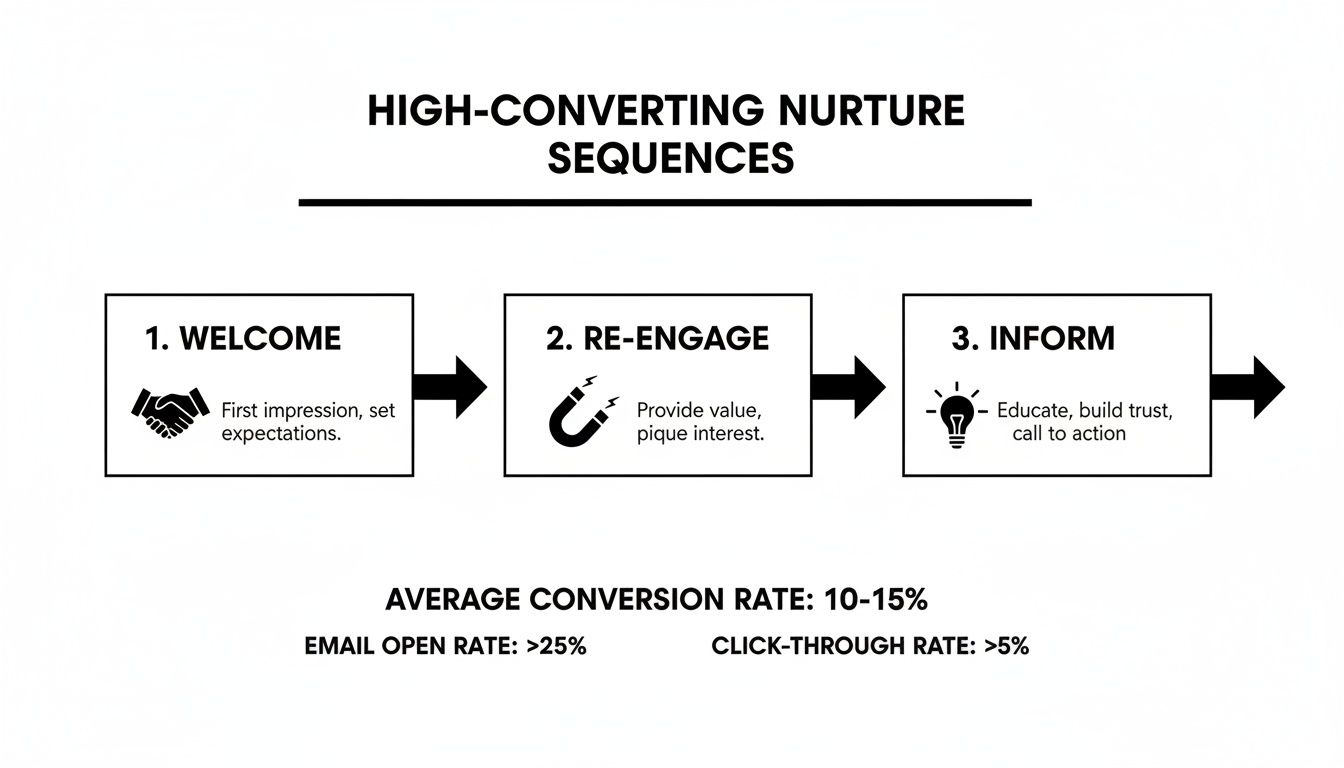
As you can see, a great sequence is a journey, not a dead end. It guides leads with relevant content at each stage.
Constructing Logical Workflows
Once a trigger fires, the lead enters a workflow. A workflow is more than a series of timed emails; it's a decision tree with branches, delays, and various actions that create a dynamic experience. Most modern marketing automation platforms feature visual builders that make this process surprisingly intuitive.
Your workflows should incorporate several key elements:
Time Delays: Avoid overwhelming new leads. A strategic delay of a day or two between emails feels more natural and less robotic.
Conditional Branches: This is where the true intelligence lies. "If a lead opens Email #2 but doesn't click the link, wait two days and send a follow-up with a new subject line. If they do click, advance them to the next stage." This branching logic ensures the path adapts to individual behavior.
Action Steps: Workflows can do more than just send emails. They can add tags to a contact, update their lifecycle stage in your CRM, or notify a sales rep when a lead takes a high-value action. For more on this, see our guide on marketing workflow automation.
Implementing a Lead Scoring Model
Not all leads are created equal. A CEO who downloads your pricing guide is fundamentally different from an intern who subscribes to your blog. Lead scoring assigns points to leads based on their demographic profile and their behaviors, allowing your system to automatically identify who is ready for a sales conversation.
A well-implemented lead scoring model bridges the gap between marketing and sales. It ensures that sales reps focus their time on the most promising opportunities, dramatically increasing their efficiency and close rates.
Think of your scoring model as a point system:
+10 points for visiting the pricing page.
+5 points for opening an email.
+15 points for downloading a case study.
+25 points if their job title is "Director" or higher.
-10 points for 60 days of inactivity.
Once a lead reaches a predefined threshold, say, 100 points: the workflow can automatically create a task for a sales rep to follow up. This system ensures no high-potential lead falls through the cracks, transforming your database from a passive list into an active, prioritized queue.
Optimizing Performance with Analytics and A/B Testing
Launching your automated lead nurturing program is a significant accomplishment, but the work doesn't end there. The most successful nurturing programs are not "set it and forget it" machines; they are living systems that require constant refinement. This is where data becomes your most valuable asset, transforming a good nurturing engine into a great one.
Without solid data, you're merely guessing what your audience wants. Analytics and A/B testing allow you to move beyond assumptions and gather real proof of what works. This process helps you identify weak spots in your funnel, determine which content drives action, and ultimately ensure a real return on your efforts.
Key Metrics to Monitor in Your Nurturing Program
To gain a true understanding of your program's performance, you must look beyond surface-level statistics. While email open rates are informative, the real insights come from connecting your nurturing activities to actual sales outcomes.
Focus on a handful of KPIs that, together, tell the complete story:
Email Engagement Rates: This includes the classic trio: open rates, click-through rates (CTR), and unsubscribe rates. A high CTR on one email may indicate a compelling call-to-action, while a spike in unsubscribes can signal that a message missed the mark.
Content Asset Performance: Are people downloading your resources? Tracking which whitepapers, case studies, or guides receive the most engagement reveals what topics your leads find valuable at each stage.
Conversion Rate per Stage: This is a critical metric. It measures the percentage of leads moving from one stage to the next, such as from a marketing-qualified lead (MQL) to a sales-qualified lead (SQL). A significant drop-off at any point identifies a weak link in your sequence.
Sales Cycle Length: A primary goal of nurturing is to accelerate the sales process. Comparing the average time it takes a nurtured lead to become a customer versus a non-nurtured lead provides a quantifiable measure of your program's impact.
Tracking these metrics is about more than just reporting; it's about diagnosing the health of your lead nurturing strategy. When you spot a dip in engagement or a bottleneck, you know exactly where to focus your optimization efforts.
Speed is a decisive factor. The 2007 MIT and InsideSales.com Lead Response Management study found the odds of contacting a lead are roughly 100 times greater when you respond within five minutes rather than thirty. The odds of qualifying that lead drop about 21 times between the five-minute and thirty-minute marks. That is the case for fast, automated routing. Most marketing leads never convert without consistent follow-up, which is exactly the gap a nurturing program closes.
Running Effective A/B Tests
Once you have established your baseline metrics, you can begin improving performance with A/B testing (or split testing). The concept is straightforward: you create two versions of an element, an "A" and a "B", and test them against each other to see which one yields better results.
The key is to start with small but meaningful changes to isolate what is making a difference.
What to Test in Your Nurturing Emails
Subject Lines: Test a direct, benefit-focused subject line ("New Guide to Improving ROI") against a more intriguing, question-based one ("Are You Missing These ROI Opportunities?").
Calls-to-Action (CTAs): Experiment with the text, color, and placement of your buttons. The difference between "Learn More" and "Get Your Free Template" can be surprisingly significant.
Content Offers: If a case study isn't performing well, try swapping it with a webinar invitation or a different asset. Perhaps that segment isn't ready for a case study yet.
Email Copy and Tone: Test a direct, data-heavy tone against a more conversational, story-driven approach. You may find that different segments respond to vastly different styles.
A disciplined approach to A/B testing removes guesswork and provides hard data to support your decisions. By constantly testing, measuring, and iterating, you can build a nurturing program that not only runs on its own but also becomes smarter and more effective over time. For a deeper look at the analytics behind these efforts, check out our guide on measuring digital marketing performance.
Common Questions About Automated Lead Nurturing
As you assemble your own program, several common questions and potential roadblocks are likely to arise. Addressing these from the outset will save you considerable time and help you maximize your automated lead nurturing efforts.
Let's break down some of the most frequent challenges teams face when translating their strategy into action.
How Much Is Too Much Automation?
One of the biggest concerns is that automation will make a brand feel robotic and impersonal. This is a valid fear. If implemented poorly, automation can alienate your audience.
The key is to remember that automation is a tool to enable conversations, not replace them. The goal is not to automate every single interaction, but to automate the right ones.
Use automation for predictable, repeatable tasks:
Sending the initial welcome email after a download.
Delivering a pre-planned educational email series.
Updating a lead’s status in your CRM based on their behavior.
However, you must reserve the human touch for high-impact moments. When a lead reaches a high score or replies with a direct question, that's the cue for a real person to engage. Automation should handle the heavy lifting of education and qualification, freeing up your sales team for the meaningful, one-on-one conversations that close deals.
Can This Work for a Small Business?
Absolutely. It's a common misconception that automated lead nurturing is reserved for enterprise companies with large teams and complex systems. The principles scale down perfectly for smaller businesses.
In fact, for a small team with limited resources, automation is even more critical. It acts as a force multiplier, allowing you to compete with larger players without overextending your team.
You don't need a massive, expensive platform to get started. Many modern CRMs and email marketing tools offer powerful, user-friendly automation features at an accessible price point. The strategy is what matters most. A good starting point is to focus on one or two key segments and build a simple, effective welcome or re-engagement sequence.
The single biggest mistake is waiting for a "perfect" system. Start small, learn from your data, and gradually build more sophisticated workflows as your business grows. Even a basic automated follow-up sequence is infinitely better than letting new leads go cold.
How Do I Know If It’s Actually Working?
This is the ultimate question. Measuring success goes far beyond just looking at email open rates. To truly understand the impact of your automated lead nurturing, you must connect your marketing activities to tangible business outcomes. The metrics that truly matter are those that show a direct link to revenue and sales efficiency.
To prove the value of your program, track these key performance indicators (KPIs):
MQL to SQL Conversion Rate: Are your nurtured leads more likely to become sales-qualified than non-nurtured leads? This is a direct measure of lead quality.
Sales Cycle Length: Compare the time it takes for a nurtured lead to close versus an untouched one. A shorter cycle clearly indicates that your nurturing is effectively preparing prospects for sales conversations.
Pipeline Contribution: What percentage of your sales pipeline was sourced from or influenced by a nurturing workflow? This demonstrates direct revenue impact.
When you focus on these bottom-line metrics, you can confidently show how your nurturing program is not just another marketing activity, it's a core driver of business growth.
At Twelverays, we specialize in building data-driven marketing and CRM strategies that turn automation into your most powerful growth engine. If you're ready to move beyond guesswork and implement a lead nurturing program that delivers real results, let's talk. Learn how we can help you grow.


