It’s a familiar story. A company invests in a powerful new CRM, expecting it to be a silver bullet for growth. Yet, a year later, the system is barely used, and the team is back to their old spreadsheets. It’s no surprise that studies put CRM implementation failure rates anywhere from roughly 20% to 70%, depending on how failure is defined.
The problem is rarely the software itself. The real issue is the huge gap between buying a sophisticated tool and weaving it into the daily fabric of your business. This is where the most common CRM implementation challenges emerge, turning a potential growth engine into an expensive digital paperweight.
Why CRM Projects Falter Before They Even Begin
Introducing a new CRM isn't just an IT project; it's a commitment to fundamentally change how your business operates, how you engage with customers, track opportunities, and drive growth. Too many firms treat it like a simple software installation, which is their first mistake.
This mindset leads to a reactive approach, where problems are patched up as they appear instead of being strategically anticipated. A CRM touches every customer-facing team, from sales and marketing to client services and operations. A successful rollout demands a proactive strategy that accounts for the entire business. Without a clear roadmap, even the best CRM can be derailed by predictable hurdles.
The Seven Core Implementation Hurdles
To succeed, you must understand the challenges you're up against. These aren't minor technical glitches; they're deep-rooted business problems that require strategic solutions. Let's break down the seven biggest challenges you’re likely to face.
- Data Quality and Migration: Imagine moving your office into a new building without sorting or labeling any boxes. That's what migrating years of messy, siloed data into a structured CRM feels like without a solid clean-up plan.
- User Adoption and Change Management: People are creatures of habit. The greatest hurdle is often overcoming resistance to new ways of working and helping the team see the CRM as a valuable tool, not just more administrative work.
- System Integration: Your CRM cannot exist in a vacuum. It must connect with your accounting software, marketing automation platform, and help desk to create a single, reliable source of truth.
- Customization vs. Configuration: It’s tempting to tweak every feature to match your exact processes. The key is finding the right balance between tailoring the system and over-engineering it into something complex and unmanageable.
- Governance and Security: You need clear rules of engagement. Who can see what? How is data entered? This protects sensitive customer information and keeps your data clean and reliable.
- KPI Measurement and ROI: How will you know if this massive investment was worthwhile? You need to define clear, measurable goals from day one to prove the CRM's value to all stakeholders.
- Vendor and Partner Selection: Choosing the right software is only half the battle. You need an implementation partner who genuinely understands your industry and is invested in your long-term success.
A CRM is more than software, it's a business philosophy. The most common failures of CRM projects stem from treating the implementation as a technology installation rather than a strategic change initiative.
Understanding these pitfalls is the first step toward avoiding them. When you know what to look for, you can build a resilient strategy that turns your CRM into a true cornerstone of your company's growth.
Challenge 1: Mastering Data Migration and Quality

The old saying "garbage in, garbage out" is the hard truth of any CRM project. Before you can dream about slick reports or automated workflows, you have to face one of the most critical CRM implementation challenges: migrating years of data from scattered systems into your new platform without creating a mess.
Think of it like moving into a brand-new, custom-built house. You wouldn't just toss boxes of unsorted junk into the living room. You'd sort, label, and discard what you no longer need. Your customer data requires the same level of care. If you skip this step, your team will never trust the new system, and adoption will stall before it even begins.
This challenge is persistent because business data is rarely clean. It's often spread across outdated spreadsheets, old email clients, and siloed apps, each with its own unique formatting and missing fields. The moment you try to consolidate it, you get a brutally honest look at the state of your data hygiene.
Uncovering the Roots of Poor Data Quality
Bad data isn't just a technical headache; it's a business problem that slowly poisons your sales and marketing efforts. The issues typically fall into a few common categories that worsen over time, turning your data migration into a complex puzzle.
- Duplicate Records: Multiple salespeople enter the same lead, creating fragmented and confusing customer histories.
- Inconsistent Formatting: One record lists a state as "CA," another as "California," and a third as "C.A." This makes accurate reporting and segmentation impossible.
- Incomplete Information: Contact records are missing essentials like an email address, phone number, or job title, rendering them useless for outreach.
- Outdated Data: Contact information, job titles, and company names haven't been updated in years, leading to bounced emails and wasted sales cycles.
A CRM filled with unreliable information isn't a single source of truth; it's a single source of frustration. When a sales rep pulls up a contact record they can't trust, they stop using the system, and user adoption plummets.
The only way to resolve this is with a structured, disciplined approach. This isn't a one-time task, it's the first step toward a real commitment to data governance.
A Practical Strategy for Data Integrity
A successful data migration requires a methodical plan. This process ensures the data fueling your new CRM is accurate, consistent, and ready to drive smart decisions from day one. It breaks down into distinct phases, none of which can be skipped.
- Audit and Assess: Before moving a single byte, conduct a full audit of your existing data sources. Identify where all your customer information resides, gauge its quality, and decide what is essential to migrate.
- Cleanse and De-duplicate: This is the heavy lifting. Use a combination of tools and manual effort to fix formatting issues, merge duplicate records, and fill in missing information. This step alone will massively increase your data's value.
- Map and Validate: Carefully map the fields from your old systems to the correct locations in the new CRM. Run a small test migration with a sample of your data to ensure everything transfers correctly before executing the full migration.
- Execute and Verify: Perform the full migration, preferably during off-peak hours to minimize business disruption. Afterward, have key team members from different departments verify that the data is accurate and complete.
Mastering your data migration lays the foundation for everything that follows. It's what transforms your CRM from empty software into a powerful, trusted business asset.
Challenge 2: Driving User Adoption and Managing Change

You can invest a fortune in the most powerful CRM on the market, but if your team doesn't use it, its value is zero. This brings us to the single biggest reason CRM projects fail: poor user adoption. It’s a deeply human problem that technology alone cannot solve, making it one of the most stubborn CRM implementation challenges.
The resistance isn't necessarily about the software; it's about disrupting the status quo. Your team has established routines and trusted tools, even if it’s just a chaotic mix of spreadsheets and sticky notes. A new CRM disrupts that comfort zone, sparking fears of micromanagement or frustration with unfamiliar workflows.
Without a robust change management strategy, this resistance will quietly sabotage your entire investment. The goal isn’t to force people to log in. It’s to genuinely demonstrate to each team member how this new system makes their specific job easier, more effective, and ultimately, more rewarding.
The Psychology Behind CRM Resistance
To get your team on board, you must first understand the reasons for their pushback. It’s rarely about laziness. More often, it stems from legitimate concerns that, if ignored, will solidify into opposition.
Common sources of resistance include:
- Fear of Micromanagement: Sales teams, in particular, may view detailed activity logging not as a helpful tool, but as a way for management to monitor their every move.
- Perceived Inefficiency: If the CRM adds three extra steps to a process that used to take one, users will see it as a burden and revert to old habits.
- Lack of "WIIFM" (What's in It for Me?): Leaders often highlight the CRM’s benefits for the company but fail to articulate what it does for the individual user.
- Inadequate Training: A single, generic training session is a recipe for failure. Without ongoing, role-specific support, users will feel overwhelmed and give up.
The high failure rate of CRM projects is a testament to these human factors. Grand View Research finds that 91% of companies with more than 10 employees use a CRM, yet studies still put project failure rates anywhere from 20% to 70%. High adoption does not guarantee success. Poor change management is almost always the root cause.
Building a User-Centric Adoption Strategy
Encouraging user adoption isn't something you do after launch; it must be integrated into your implementation plan from the beginning. A user-centric approach shifts the dynamic from a top-down mandate to a collaborative effort where your team feels heard and valued.
A CRM is only as good as the people who use it. The core of any successful implementation is a change management plan that prioritizes empathy, communication, and clear value demonstration for every single user.
Start by involving end-users from key departments early. Ask them about their current pain points and what they genuinely need from a new system. This provides priceless insights for configuration and gives them a sense of ownership over the outcome.
Next, identify and empower your internal CRM champions. These are enthusiastic, tech-savvy individuals on different teams who can act as peer mentors, answer questions, and build excitement from the ground up. Their advocacy is often far more effective than any directive from the C-suite. For more actionable strategies, check out our guide on the top tips to increase CRM user adoptions. This will help you turn your biggest skeptics into your most vocal supporters, ensuring the CRM becomes an indispensable part of your team's daily toolkit.
Challenge 3: Taming System Integrations and Technical Debt

No modern business runs on a single piece of software. It’s an ecosystem of interconnected tools, marketing automation, ERPs, and help desks. A CRM that can’t communicate with this existing tech stack isn't a central hub; it’s just another data silo. This disconnect is one of the most disruptive CRM implementation challenges you will face.
Without solid integrations, the core promise of a CRM, a single, reliable source of customer truth, falls apart. Teams get stuck in a frustrating loop of manual data entry, copying and pasting information between systems. This isn't just a waste of time; it guarantees your data will become inconsistent and outdated, creating confusion across departments.
For B2B firms, this breakdown makes it impossible to achieve a true 360-degree view of the client. Marketing can't see sales activities, and sales has no visibility into recent support tickets. The result is a disjointed customer experience filled with missed opportunities.
The Hidden Cost of Technical Debt
When facing integration hurdles, the temptation is to use quick fixes and custom scripts. While these workarounds might solve an immediate problem, they create a larger issue down the road: technical debt. Think of it as using duct tape to patch a leaky pipe, a temporary fix guaranteed to fail under pressure.
These makeshift connections are rarely documented, are a nightmare to maintain, and tend to break the moment a connected system is updated. Over time, your tech stack becomes a tangled mess of brittle connections, making future upgrades incredibly costly and complex.
Technical debt is the silent project killer. Each quick fix accumulates "interest," making your system progressively harder to scale and adapt. A proactive integration strategy is the only way to avoid this trap.
Building a Scalable Integration Roadmap
A successful integration doesn't happen by accident; it's the result of careful planning. You need a clear roadmap that outlines how your CRM will communicate with other critical business systems, both now and in the future. This strategic approach ensures your technology serves your business goals, not the other way around.
- Prioritize Critical Connections: First, identify the non-negotiable integrations. For most B2B companies, this means linking the CRM to marketing automation, email platforms, and accounting software to automate the entire lead-to-revenue cycle.
- Choose the Right Tools: Decide whether to use native APIs for direct connections or middleware platforms (iPaaS) that act as a central hub for multiple integrations. For complex environments, middleware is often the more scalable choice.
- Plan for the Future: Don’t just build for today. Consider your company’s growth trajectory and choose integration methods that can scale as you add new tools and your data volume increases.
By treating system connections as a core part of your strategy, you can overcome one of the biggest CRM implementation challenges. If you're looking to understand the fundamentals, our guide explains in detail what CRM integration is and why it's so critical for growth. A well-integrated CRM transforms from a simple database into the true operational heart of your company.
Challenge 4: Defining Clear Goals and Proving ROI
Without a clear destination, any road will get you nowhere. This truth highlights one of the most strategic CRM implementation challenges businesses face: failing to set specific, measurable goals from the start. Too often, companies adopt a new CRM with vague objectives like “improve customer relationships” or “boost sales,” without translating those ideas into concrete numbers.
This lack of clarity is a recipe for disaster. It leads to misaligned expectations, a project that lacks direction, and makes it virtually impossible to prove the CRM's return on investment (ROI). When leadership asks you to justify the six-figure expense, you’re left with anecdotes instead of hard data, a dangerous position for any project leader.
This isn't a rare problem. It's a major reason for the gap between what companies expect from a CRM and what they actually get. Even when a CRM is widely adopted, satisfaction can remain low. Adoption and impact are not the same thing. The disconnect is rarely the software. It comes from launching the system without tying it to specific business outcomes.
From Vague Ideas to SMART Goals
To avoid this common pitfall, you must transform high-level ambitions into SMART goals, Specific, Measurable, Achievable, Relevant, and Time-bound. This framework forces you to define what success looks like and anchors your project to tangible business outcomes. It’s what turns a CRM from an expense into a proven revenue-driver.
For example, instead of aiming to "improve sales," a SMART goal would be: "Reduce the average sales cycle length by 15% within the first six months after implementation." Now that's a target you can measure and track.
This process is about translating broad business objectives into metrics you can see and influence within your CRM.
From Vague Goals to Measurable KPIs
The table below shows how to reframe common, ambiguous objectives into specific KPIs that let you measure your CRM's true impact.
By making this shift, you move from wishful thinking to a concrete, data-backed plan for success. It’s the only way to definitively prove your CRM is pulling its weight.
Building a Framework for Tracking ROI
Once your SMART goals are locked in, the next step is to build a system for tracking them directly within your CRM. This isn't something to figure out after you go live; it must be integrated into the system during the configuration phase.
Your CRM dashboards and reports should be a direct reflection of your business goals. If a metric doesn't help you measure progress toward a defined objective, it’s just noise.
Work with your implementation partner to build custom reports and dashboards that put your most important metrics front and center. This keeps everyone, from reps to the C-suite, focused on what matters.
- For Sales Leaders: Dashboards can track metrics like deal velocity, win rates per salesperson, and pipeline value.
- For Marketing Directors: Reports can focus on lead source effectiveness, campaign ROI, and customer lifetime value.
- For C-Suite Executives: High-level dashboards can provide a snapshot of overall revenue growth, customer acquisition cost, and retention figures.
By establishing this framework from day one, you build a culture of accountability and data-driven decision-making. You'll have a clear, undeniable answer when someone asks, "Was this investment worth it?" You can prove the CRM's value with every report you run.
Your CRM Implementation Success Checklist
Navigating a CRM rollout is complex, but you don't have to do it blind. A structured plan is what separates smooth launches from those that go off the rails. To help you sidestep the common CRM implementation challenges we've discussed, here’s a chronological checklist to keep your project on track.
Think of this as a practical, step-by-step game plan. It boils down the core strategies into a simple reference guide to walk your team through each phase, turning a potentially chaotic process into a manageable one.
Phase 1: Pre-Implementation and Planning
This first phase is about laying a rock-solid foundation. It’s tempting to rush this part, but that’s where most projects fail. Skipping these steps leads to misaligned goals and a project that spirals out of control.
- Secure Executive Sponsorship: You need more than just approval. Get active, visible support from leadership who will champion the project and rally the organization.
- Form a Cross-Functional Project Team: Assemble a dedicated team with representatives from sales, marketing, IT, and customer service. This ensures every department's perspective is included from day one.
- Define SMART Business Goals: Vague goals like "improve sales" are insufficient. Get specific and measurable, such as, "reduce the average sales cycle by 15% in nine months."
This is how you move from a fuzzy idea to a real, measurable business impact.
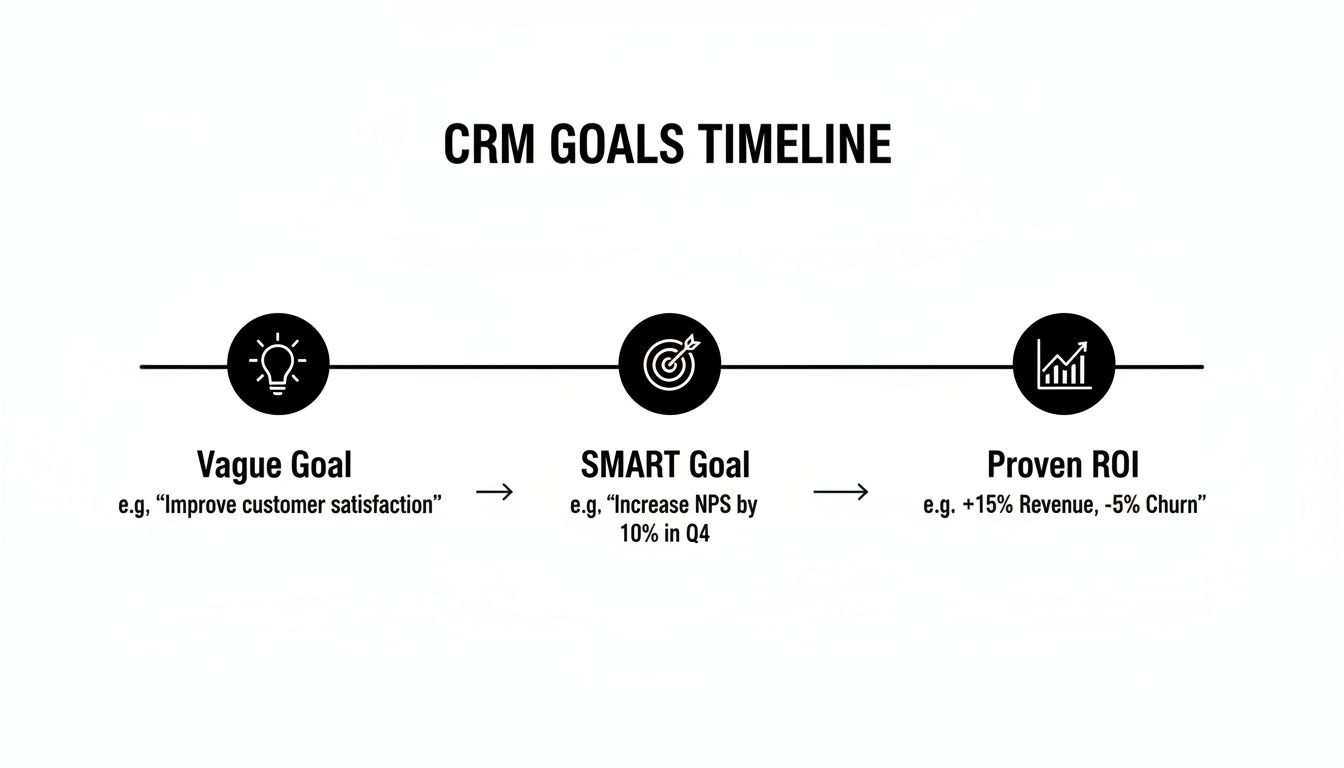
As you can see, the real value emerges when you move past wishful thinking and establish concrete objectives that directly tie your CRM investment to a tangible return.
Phase 2: Execution and Deployment
With a solid plan in place, the focus now shifts to the technical aspects and, more importantly, the people who will use the system. This is where meticulous attention to data and users pays off.
- Conduct a Full Data Audit and Cleansing: Before migration, analyze all existing data sources. Find and merge duplicates, correct errors, and standardize formats.
- Map Business Processes to CRM Workflows: Configure the CRM to support how you actually work, not the other way around. Resist the urge to over-customize, as it adds unnecessary complexity.
- Develop a Role-Specific Training Program: Create training that addresses each user group's needs. The key is to answer, "What's in it for me?" by showing them how the CRM will make their specific job easier.
A successful CRM launch is not the finish line, it's the starting point. The goal isn't just to go live; it's to create a system that evolves with your business and delivers increasing value over time.
Phase 3: Post-Launch and Optimization
The work isn't over just because the system is live. This final phase is about monitoring, listening to your team, and making continuous improvements to maximize your investment. To see this entire process laid out in more detail, you can learn more about how to implement a CRM system in our complete guide.
- Establish a Feedback Loop: Make it easy for users to report issues, ask for help, or suggest improvements. A clear channel for feedback is essential.
- Monitor Key Metrics and Report on ROI: Keep a close eye on the KPIs you defined in Phase 1. Regularly share progress with stakeholders to demonstrate the CRM's value.
- Plan for Ongoing Enhancements: Treat your CRM as a living system, not a static tool. Schedule regular reviews to tweak workflows, add new features, and ensure it continues to meet your business's evolving needs.
Common Questions We Hear About CRM Challenges
Even with a rock-solid plan, questions will arise during a major tech rollout. Getting ahead of common concerns is the best way to maintain momentum and ensure everyone feels confident. Here are some straight answers to the questions we hear most often about CRM implementation challenges.
How Long Does a Typical CRM Implementation Take?
There’s no magic number. The timeline can vary widely depending on your company's size, the complexity of your data, and the number of system integrations required. A small business with clean data might get the basics running in a few weeks. In contrast, a large enterprise project with custom workflows and multiple integrations can easily take 6-12 months or longer.
A realistic timeline can only be established after a thorough discovery phase where all requirements are defined.
What Is the Biggest Hidden Cost in a CRM Project?
It’s almost never the software license that catches companies by surprise. The real budget-busters are the elements that are easy to overlook in initial planning.
- Data Cleanup: The sheer volume of manual work needed to scrub, merge, and reformat years of inconsistent data is almost always underestimated.
- Custom Code: If you require a unique workflow or a special integration that isn't standard, you'll need developers, and those hours add up quickly.
- Ongoing Training: A single launch-day training session is not enough. You must factor in the cost of continuous, role-specific coaching to ensure the change sticks.
Underestimating the human side of the equation, the time and effort required for genuine change management, is a common pitfall.
The most expensive part of a CRM implementation is rarely the software itself. It's the time and resources required to untangle old processes, clean up legacy data, and genuinely guide your team through a new way of working.
How Do We Choose the Right CRM Implementation Partner?
Choosing the right partner is as critical as selecting the right software. You want a team with verifiable experience in your industry. Don’t just take their word for it, ask for detailed case studies and speak directly with their past clients.
A great partner is more than just a technician. They should be a strategic advisor who challenges your assumptions, keeps the focus on business results, and helps you avoid common traps. Their job is to ensure you get real value, not just new features.
Can We Implement a CRM in Phases?
Absolutely. In fact, for many organizations, it’s the smartest approach. A phased rollout is an excellent strategy for managing risk and achieving early wins, which makes the project feel less overwhelming.
For example, you could launch the CRM for one motivated team first, like your core sales group. By proving its value on a smaller scale, you can iron out kinks, gather user feedback, and build momentum. This initial success makes it much easier to get buy-in when you roll it out to the rest of the company.
Navigating the complexities of a CRM implementation requires a partner who understands both the technology and your business goals. Twelverays specializes in deploying and integrating CRM solutions like Salesforce and Dynamics 365, ensuring your project avoids common pitfalls and delivers measurable ROI. Start building a CRM strategy that drives growth.