
A data-driven digital marketing agency is more than just a service provider; they are a strategic partner who uses analytics, customer behavior, and hard performance metrics to make smart decisions that generate predictable revenue. This approach moves beyond guesswork and focuses on measurable business outcomes, not surface-level stats like likes and impressions.
Moving Beyond Guesswork in Digital Marketing

In a crowded market, traditional marketing often feels like flying blind. Campaigns are launched based on gut feelings or what worked last year, with fingers crossed for engagement and sales. This unreliable approach leaves businesses wondering which of their efforts are actually paying off.
The modern solution isn’t just a minor adjustment, it’s a fundamental shift from hopeful campaigns to predictable revenue engines. This is the core philosophy of a data-driven digital marketing agency. It's not just another service; it's a systematic approach to growth that replaces assumptions with solid evidence.
The Formula 1 Approach to Marketing
Think of it like a Formula 1 racing team. A win isn't just about a driver's instinct. It’s the result of analyzing thousands of data points every second, tire pressure, fuel consumption, and engine performance. Engineers use that constant stream of information to make real-time adjustments that squeeze every ounce of performance out of the car and secure a spot on the podium.
A data-driven agency applies that same precision to your marketing. They transform raw information from all your channels into a clear roadmap for growth. This involves integrating and making sense of data from:
- Website Analytics: Understanding how people use your site, which pages they visit, and where they lose interest.
- User Behavior Tools: Watching heatmaps, session recordings, and click patterns to see your website through your customers' eyes.
- CRM Data: Tying marketing activities directly to sales outcomes, qualified leads, and real customer interactions.
- Campaign Metrics: Analyzing performance across SEO, PPC, and social media to pinpoint what resonates with your audience.
This strategic shift allows businesses to stop chasing vanity metrics, like likes and impressions, and start focusing on what truly matters: business outcomes like customer acquisition cost (CAC), conversion rates, and lifetime value (LTV).
From Vanity Metrics to Valuable Outcomes
Focusing on business-oriented KPIs is what separates successful campaigns from expensive experiments. While high engagement on a post feels good, it doesn't directly contribute to revenue. An expert agency helps connect every marketing action to a tangible result.
Making this switch is crucial for long-term, sustainable success. You can dive deeper into the core benefits of data-driven marketing in our detailed guide.
The global digital marketing agency market is expanding rapidly, fueled by AI, interactive content, and mobile-first strategies that are reshaping brand-audience connections. This growth highlights the industry-wide shift from guesswork to precision, a trend especially critical for professional services firms and B2B SaaS companies striving to maximize their return on investment.
The Blueprint of a Data-Driven Strategy
An effective strategy from a data-driven digital marketing agency isn't about throwing tactics at a wall to see what sticks. It's a deliberate, methodical process of building a high-performance marketing machine, piece by piece, using core pillars that turn raw numbers into real results. The entire process begins by fundamentally changing how you measure success.
Instead of chasing vanity metrics like website traffic or social media followers, the first step is to define Key Performance Indicators (KPIs) linked directly to your bottom line. These are the metrics that matter to the C-suite, such as Customer Acquisition Cost (CAC), Marketing Qualified Leads (MQLs), and Return on Ad Spend (ROAS). This focus ensures every action is accountable to business growth.
Uncovering Your Ideal Audience with Data
With the right goals set, the next pillar is deep audience segmentation. Traditional marketing often relies on broad, demographic-based personas. A data-driven approach, however, digs much deeper. It moves beyond who your customers are to uncover the far more valuable why behind their actions.
By analyzing user behavior, purchase history, and engagement patterns, an agency can identify distinct customer segments with unique motivations. For example, data might reveal that one group values efficiency and quick solutions, while another prioritizes in-depth content and long-term support. This level of insight allows for hyper-relevant messaging that resonates with each specific group.
Creating an Integrated Marketing Ecosystem
The third and most powerful pillar is creating an integrated ecosystem where marketing channels work together, not in silos. SEO, PPC, content marketing, and social media cease to be separate efforts. Instead, they become parts of a unified system that constantly feeds insights back into itself, creating a powerful feedback loop that accelerates results.
Here’s how this integration works in practice:
- PPC Informs SEO: Keyword and ad copy data from paid search campaigns provide immediate feedback, revealing high-converting terms that can sharpen your long-term organic SEO strategy. This focuses your efforts where they will have the most impact.
- Content Drives Lead Nurturing: Engagement data from blog posts and whitepapers, tracked through analytics, pinpoints which topics your audience finds most compelling. This intelligence then informs your email marketing and automation sequences, enabling you to deliver content that nurtures leads more effectively down the sales funnel.
- Social Insights Refine Targeting: By analyzing which audience segments on social media respond best to certain offers, you can refine your paid ad targeting across platforms like Google and LinkedIn, ensuring your budget is spent reaching the most receptive prospects.
This continuous cycle of collecting data, analyzing multi-channel performance, and refining targeting is what separates predictable, scalable growth from a series of random successes. It turns marketing from a cost center into a reliable revenue engine.
This approach isn't just theoretical; it's a practical framework for achieving measurable outcomes. To see how this works in more detail, check out our guide on powerful data-driven marketing strategies you can apply to your business.
By building a blueprint based on real-world evidence rather than assumptions, a data driven digital marketing agency provides a clear and reliable path to achieving your most ambitious business goals. It's about making smarter decisions at every turn, backed by undeniable proof.
The Technology Stack Powering Your Growth
Behind every successful data-driven marketing strategy is a carefully selected technology stack working in unison. Think of it as the mission control for your entire marketing operation. It's not a random collection of software but a fully integrated system where every component has a critical job, from tracking a user's first click to proving the final ROI of a campaign.
A data driven digital marketing agency doesn't just use tools, it architects this stack. The goal is to ensure every piece of data is collected, properly analyzed, and then actioned to fuel growth. This is what transforms marketing from a series of disconnected activities into a cohesive, intelligent engine.
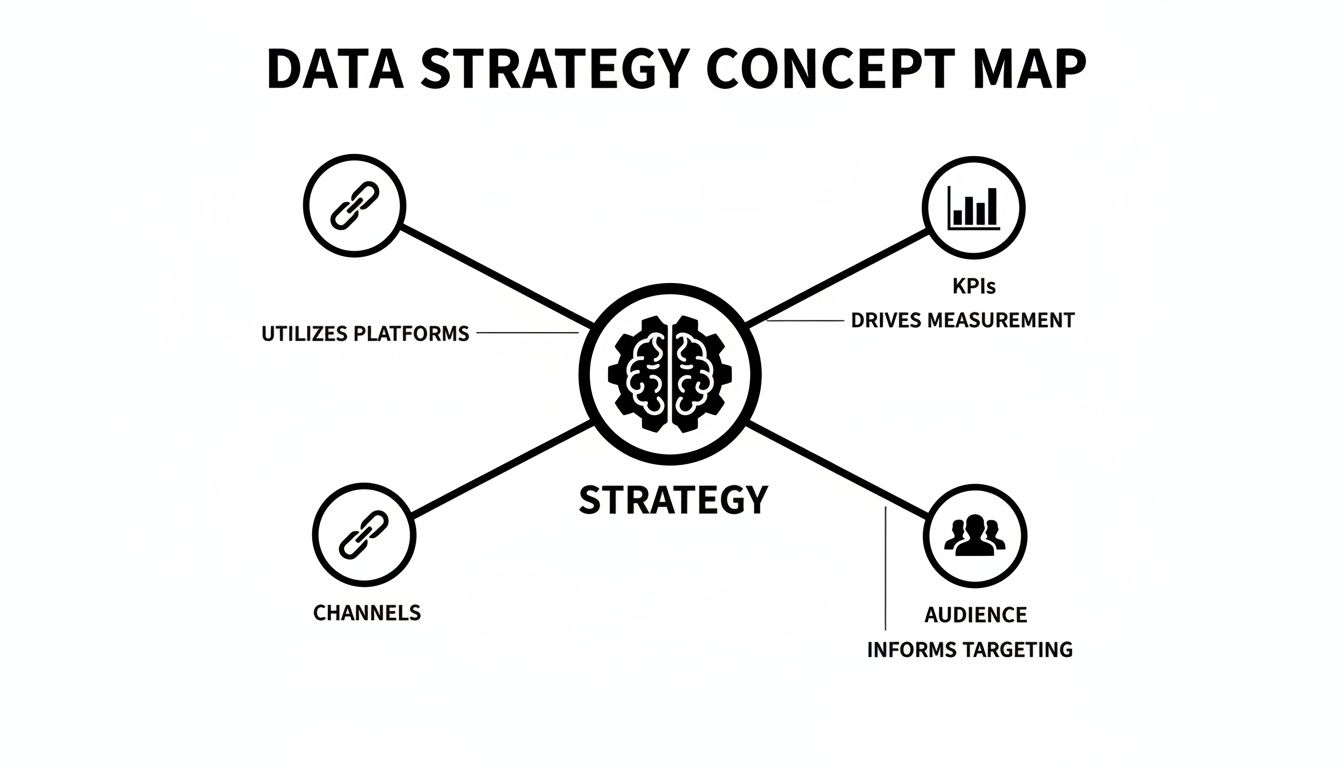
As you can see, a clear strategy is the glue that connects your goals (KPIs), your audience, and your channels into one unified plan. The right tech stack makes this synergy possible, turning abstract data points into tangible business growth.
Core Engines of Insight and Action
The foundation of any modern tech stack is built on a few key types of tools. Analytics platforms are the starting point, acting as the eyes and ears of your digital presence. They go beyond simple traffic counts to show exactly how people interact with your brand across every touchpoint.
Next, data visualization tools translate raw information into something understandable. Instead of getting lost in spreadsheets, you get clear dashboards and reports that tell a story, making it easy to spot trends and seize opportunities.
Finally, marketing automation platforms are the hands of the operation. They take the intelligence gathered from analytics and execute personalized communications at scale.
Here’s a breakdown of the essential technologies that form a complete data-driven marketing stack.
Core Components of a Data Driven Tech Stack
Each of these tools is powerful on its own, but their true value is unlocked when they are integrated to work together seamlessly.
The Central Nervous System: CRM Integration
The full power of a tech stack is only realized when every component feeds into a central hub. For any B2B or professional services firm, that hub is the Customer Relationship Management (CRM) system. Integrating platforms like Salesforce or HubSpot with your marketing campaigns is the single most important step toward getting a complete, 360-degree view of your customer’s journey.
This connection finally bridges the gap between marketing spend and sales outcomes. It allows an agency to follow a lead from their first ad click, through every website visit and email opened, all the way to becoming a paying customer. You can learn more about building these crucial connections in our guide on customer data integration solutions.
By linking marketing data directly to sales revenue inside your CRM, you eliminate the guesswork. You can finally attribute success with precision and prove exactly which campaigns are delivering real, measurable ROI.
The explosive growth in the digital marketing software market proves how critical these tools have become. This trend allows specialized agencies to build custom-fit solutions for B2B SaaS and professional services firms, where accurate customer data is the key to both winning new business and retaining existing clients.
Turning Raw Data into Actionable Insights

Collecting data is just the beginning. The real value is unlocked when you understand what it all means. A spreadsheet packed with numbers is just noise until a skilled analyst can connect the dots and tell a clear story about your customers and your business.
This is where a data driven digital marketing agency excels. They are experts at translating raw information into smart, strategic decisions that drive growth.
It’s about graduating from basic reports that tell you what happened to deep analysis that explains why it happened, and, more importantly, what to do about it next. This is the difference between simply having data and having true business intelligence.
Moving Beyond Last-Click Attribution
A major analytical shift involves understanding the full customer journey. For years, marketers relied on last-click attribution, a model that gives 100% of the credit for a sale to the very last interaction a customer had before converting.
This is like giving all the credit for a championship win to the player who scored the final point, completely ignoring the assists, defense, and coaching that made it possible.
Modern attribution modeling paints a much more complete and honest picture. It helps you see every touchpoint that influenced a customer, from the first blog post they read to the final ad that sealed the deal.
Different models distribute credit in smarter ways:
- Linear Attribution: Every touchpoint gets an equal share of the credit, acknowledging that every interaction played a role.
- Time-Decay Attribution: This model gives more weight to interactions that happened closer to the conversion. The first touch gets some credit, but the final ones get the most.
- U-Shaped (Position-Based) Attribution: This popular model assigns the most credit to the first touch (for awareness) and the last touch (for closing), typically 40% each. The remaining 20% is spread across all interactions in between.
By using these sophisticated models, a data driven digital marketing agency can identify which channels are your best "introducers" versus your best "closers," leading to a much smarter allocation of your marketing budget.
The goal is to get a complete, 360-degree view of your marketing performance. This clarity prevents you from mistakenly cutting budget from a channel that plays a vital role early in the sales cycle, even if it doesn't deliver the final click.
Uncovering Hidden Opportunities with Cohort Analysis
Another powerful technique is cohort analysis. Instead of lumping all users into one anonymous bucket, this method groups them into "cohorts" based on a shared experience during a specific time. For example, a cohort could be "all new customers who signed up in January."
You can then track their behavior over time. You might discover that your January cohort had a 15% higher retention rate after three months than your February cohort. That single insight immediately sparks a crucial question: What did we do differently in January?
This detailed analysis helps you:
- Identify what keeps specific customer groups engaged to improve retention.
- Understand the true long-term impact of a marketing campaign.
- Optimize the user onboarding experience to prevent churn.
- Pinpoint the features or content that deliver long-term value.
From Engagement Data to a New Service Offering
Consider a common scenario. A B2B consulting firm was tracking content engagement, but metrics like page views and downloads weren't providing actionable direction. They hired an agency to dig deeper.
The analysis revealed that a series of articles on regulatory compliance in a niche industry was attracting significant attention from C-level executives. These weren't just quick visits; these executives were spending more time on these pages and were far more likely to download related whitepapers.
The firm had always viewed this content as a minor part of its strategy. But the data was clearly indicating an underserved need among a high-value audience.
Acting on this insight, the firm developed and launched a new consulting service focused entirely on that specific compliance issue.
The result was a steady rise in qualified leads from their target executive audience. This is the pattern we see again and again: turning raw data into actionable intelligence opens entirely new revenue streams. Visualizing this process is key, and you can see some great marketing dashboard examples that show how this kind of information can be brought to life.
How to Choose the Right Data Driven Partner
Selecting a data driven digital marketing agency is a critical decision that will shape your company’s future. The right partner acts as an extension of your team, bringing the strategic and technical expertise to turn your marketing into a predictable revenue machine. The wrong one can lead to wasted budgets and missed opportunities.
Making the right choice means shifting your mindset. Look beyond flashy creative portfolios and seek analytical rigor. You need a partner who can prove ROI and speaks the language of business outcomes, leads, sales, and customer lifetime value, not just fluffy marketing metrics.
Vetting Potential Agency Partners
To find a partner who truly understands data, you must ask questions that cut through the marketing fluff. Generic questions yield generic answers. Challenge them to prove their expertise with questions that demand real evidence.
Your goal is to understand how they think, handle data, and tie their work directly to your bottom line. Go beyond “What services do you offer?” and dig into the "how" and "why" behind their strategies.
Here are a few sharp questions to get you started:
- “Can you show me an example of a report that led to a major strategic pivot for a client?” This question reveals if they can turn numbers into action or if they just present data.
- “How do you plan to integrate with our existing CRM and sales data?” This tests their technical capabilities and shows whether they focus on connecting marketing spend to revenue.
- “Walk me through your process for attribution modeling. How do you decide which model to use?” This reveals their understanding of the full customer journey versus simplistic, last-click thinking.
- “Describe a time a campaign underperformed. What was your analytical process for diagnosing the problem and correcting course?” This question tests their problem-solving skills and commitment to continuous, data-backed improvement.
An expert agency won’t just answer these questions; they will welcome them. They’ll be eager to pull back the curtain on their analytical processes and prove their value with concrete examples. Their confidence will stem from a proven track record of delivering measurable results.
The Old Model vs The New Standard
The gap between a traditional agency and a modern data-driven partner is massive. It’s a fundamental difference in philosophy, process, and ultimately, results. While worldwide ad spending continues to climb, many traditional agencies have seen their revenue stagnate. This highlights the market's clear preference for agile, data-savvy partners over legacy models, a trend noted in recent ad agency trend reports on emarketer.com, especially for B2B companies where specialized digital agencies are seeing major growth.
To help you spot a forward-thinking partner, here’s a look at how the two models compare.
Traditional Agency vs Data Driven Agency Comparison
This table breaks down the critical differences in methodology, focus, and reporting.
Choosing the right agency comes down to finding a partner who operates on this new standard, one who can prove their impact on your bottom line, not just their creative flair.
To learn more about what separates the best from the rest, check out our comprehensive guide on what defines a top-tier data driven marketing agency.
Your Next Steps Toward Predictable Growth
Switching to data-driven marketing is more than a tech upgrade, it's a cultural shift. It’s about moving your entire team toward a mindset of continuous improvement, clear accountability, and predictable results. The journey from hazy campaign outcomes to a sharp, ROI-focused strategy begins with an honest assessment of where you are right now.
That first step is often the easiest. We encourage clients to start with a quick "data audit" of their marketing. This isn't a complex technical deep-dive; it's a strategic gut-check that can immediately spotlight your biggest opportunities for growth.
Conducting Your Initial Data Audit
Start by asking your team a few straightforward questions. The goal is to identify what you're measuring, what crucial information you're missing, and where the disconnects lie between your marketing activities and business goals.
Here’s a simple framework to get you started:
- Current Metrics: What are the top three to five KPIs you review weekly? Are they vanity metrics like traffic and impressions, or do they tie directly to business outcomes like Marketing Qualified Leads (MQLs) or Customer Acquisition Cost (CAC)?
- Data Gaps: What’s the one question you wish you could answer about your customers but can't? Perhaps it's, "Which blog posts actually influence our biggest deals?" or "What's the real lifetime value of a customer acquired from our LinkedIn ads?"
- Tool Integration: Does your marketing automation platform sync with your CRM? A lack of integration is a common reason businesses struggle to prove ROI, as their most important systems aren't communicating.
- Reporting Confidence: On a scale of 1 to 10, how confident are you that your current reports accurately show marketing's contribution to sales revenue? Be honest. Is it a crystal-clear picture or a blurry guess?
This quick audit will instantly illuminate where ambiguity is hiding in your strategy. Think of it as laying the foundation; you must pour it before you can build a marketing engine that doesn't just spend money but reliably generates it.
Moving from guesswork to a data-backed strategy isn't about having all the answers at once. It’s about committing to a process of asking the right questions and systematically finding the answers in your data. This is how marketing evolves from a cost center into a predictable driver of business growth.
Making this transition requires a partner who not only speaks the language of data but is also dedicated to your business outcomes. A data-driven digital marketing agency is that expert guide, bringing the technology, analytical skills, and strategic oversight needed to transform your marketing.
If your data audit left you with more questions than answers, it’s probably time for a conversation. At Twelverays, we specialize in helping B2B and professional services firms build the systems and strategies that deliver measurable, repeatable growth. We're ready to help you finally connect the dots between your marketing spend and your bottom line.
Have Questions? We Have Answers.
Shifting to a more analytical marketing approach often raises questions. It’s smart to get clarity before you commit. Here are some of the most common things B2B leaders ask when considering a partnership with a data driven digital marketing agency.
How Is a Data-Driven Agency Different from a Traditional One?
The key difference lies in the starting point. A traditional agency often leads with a creative idea and measures success against general industry benchmarks. A data driven digital marketing agency, however, starts with your business data and builds the entire strategy from that foundation.
Instead of focusing on broad metrics like website traffic, we concentrate on what moves the needle for your business, things like Customer Acquisition Cost (CAC) and Return on Investment (ROI). Every decision, from budget allocation to campaign tweaks, is backed by performance data, not just a gut feeling.
How Long Does It Take to See Results?
This is a crucial question. While some tactics like paid ads can generate quick initial traction, the true power of a data-driven approach is its cumulative effect. You should expect to see positive leading indicators, like improved engagement and higher-quality leads, within the first 90 days.
The transformative impact, such as a measurable drop in CAC or a significant jump in customer lifetime value, typically becomes clear after about six months. This timeframe allows us to gather clean data, run meaningful tests, and refine the strategy until it becomes a predictable engine for growth.
The goal isn't just a quick win; it's about building a sustainable, long-term system for growth. That first phase is all about pouring a solid data foundation, which is what allows us to accelerate results later on.
What Level of Involvement Is Needed from Our Team?
A great partnership is a two-way street. We'll handle the heavy lifting of data analysis, campaign execution, and reporting, but your team’s expertise is essential to make the strategy effective. You know your business and customers better than anyone.
Here’s what your involvement might look like:
- Initial Onboarding: We'll align on your business goals, define the KPIs that matter, and integrate with your technology, such as your CRM.
- Regular Strategy Meetings: We’ll typically connect monthly or bi-weekly to review performance data, share insights, and agree on the next strategic moves.
- Content and Offer Feedback: Your subject matter expertise is invaluable. We'll rely on you to ensure the messaging and offers we create resonate with your audience.
This is a collaborative partnership, not just a hand-off. The best results occur when an agency acts as a true extension of your team, ensuring the marketing strategy is always perfectly aligned with your sales and business goals.
Can a Data-Driven Approach Work for Our Niche Industry?
Absolutely. In fact, the more specialized your industry, the more a data-driven approach pays off. Niche markets often have longer sales cycles and specific buyer profiles, making generic, broad-stroke marketing an inefficient use of resources.
By digging into engagement data, a skilled agency can pinpoint the exact challenges and motivations of your unique audience. This enables us to build hyper-targeted campaigns that speak their language, leading to higher-quality leads and a smoother sales process. Data cuts through the noise so your message lands with the right people, no matter how specialized your field is.
Ready to move beyond guesswork and build a predictable engine for business growth? Twelverays is a specialized data-driven digital marketing agency that helps B2B and professional services firms connect marketing spend directly to revenue.
Discover how we can transform your marketing strategy today.