

In today's real estate market, a powerful digital presence isn't an option, it's the engine of your business. The goal is to build a lead-generation machine that operates 24/7, methodically turning online visitors into qualified clients. This guide provides a strategic framework for creating that system.
Almost all buyers use the internet during their home search, and 46% start the process by looking at homes online, according to the 2025 NAR Profile of Home Buyers and Sellers. More than half found the home they bought through their own online search. Your digital foundation is the core of your entire operation.
Building Your Digital Foundation
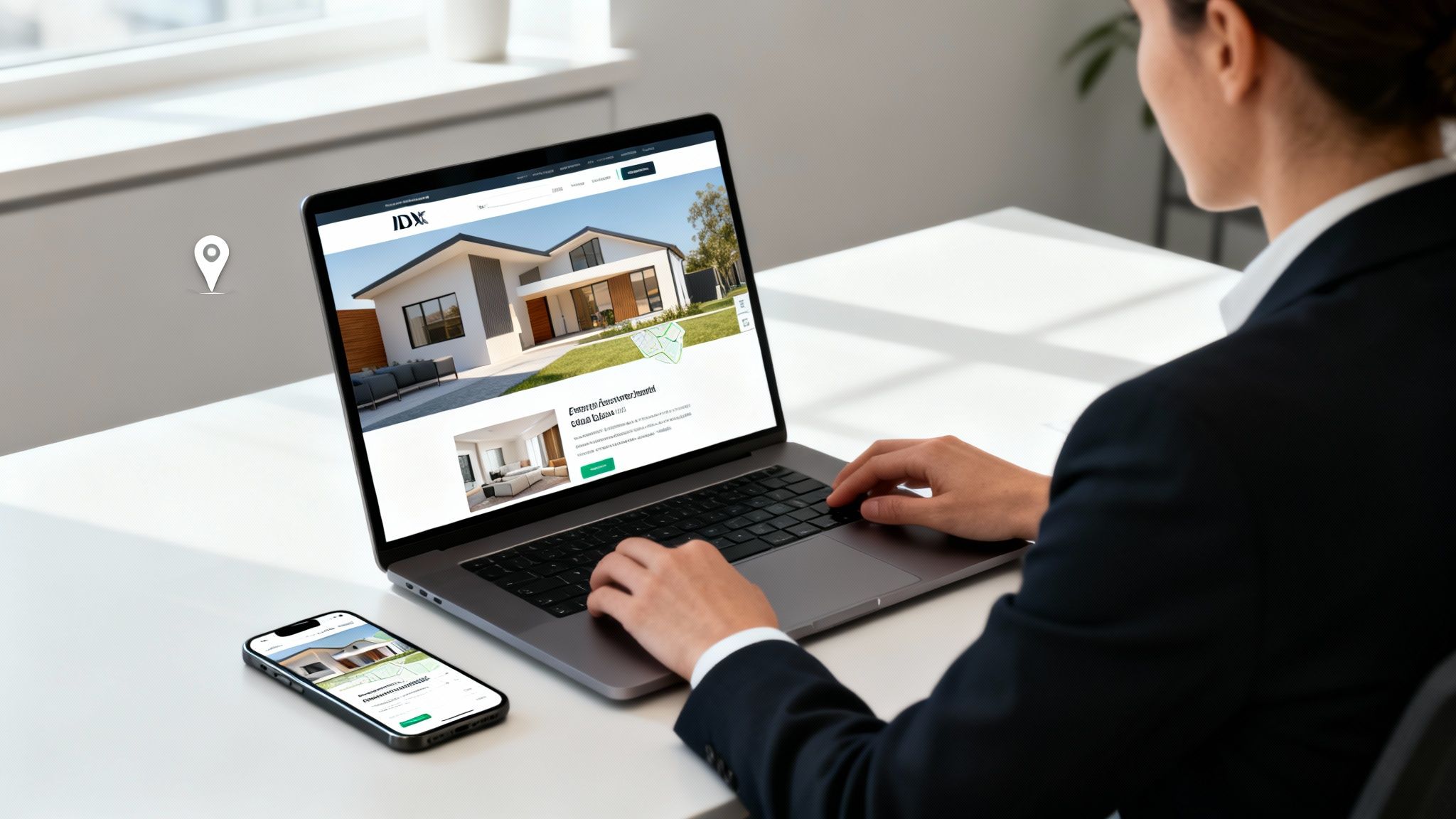
A successful strategy begins with the user experience. Most clients first encounter you on their phone, so your website must deliver a flawless mobile experience. NAR's 2025 data shows 70% of buyers searched on a mobile or tablet device. Mobile-first design, fast load times, and intuitive navigation are non-negotiable.
Defining Your Strategic Goals
Before implementing any tools, you must define what success looks like. Vague objectives like "get more leads" are insufficient. Effective goals are specific, measurable, and tied directly to business outcomes.
Consider these examples of effective goals:
- Increase qualified buyer leads from the website by 20% within six months.
- Generate 15 new seller inquiries per quarter through the home valuation tool.
- Boost organic website traffic from my top three target zip codes by 30% over the next year.
These targets create a clear roadmap and enable you to measure performance, ensuring you can calculate a true return on investment and allocate resources effectively.
Your website should do more than just display listings; it should actively work to capture and convert leads. It's the central hub where all your digital marketing for real estate agents, from paid ads to social media, converges to create a cohesive client acquisition system.
Integrating Core Digital Channels
The most effective digital strategies integrate multiple channels that work in concert. Think of your website as the main stage, supported by other platforms that drive traffic and engagement. No single channel can achieve optimal results in isolation.
Your website requires seamless IDX (Internet Data Exchange) integration to display up-to-date MLS listings, positioning you as the authoritative source for property information in your market. However, your website needs a supporting cast to drive traffic.
This is where other channels become critical. A well-optimized Google Business Profile ensures you appear in local search results when a prospect searches for a "realtor near me." Simultaneously, targeted Facebook ad campaigns can showcase a new listing to a specific demographic, driving them directly to your site. This interconnected system builds credibility and maintains top-of-mind awareness.
As leads flow in, a robust CRM is essential for managing and nurturing relationships. For guidance on selecting the right platform, our in-depth comparison of the best CRM for real estate can help you automate follow-up and streamline your growth.
Make Your Agency the Top Result in Local Search
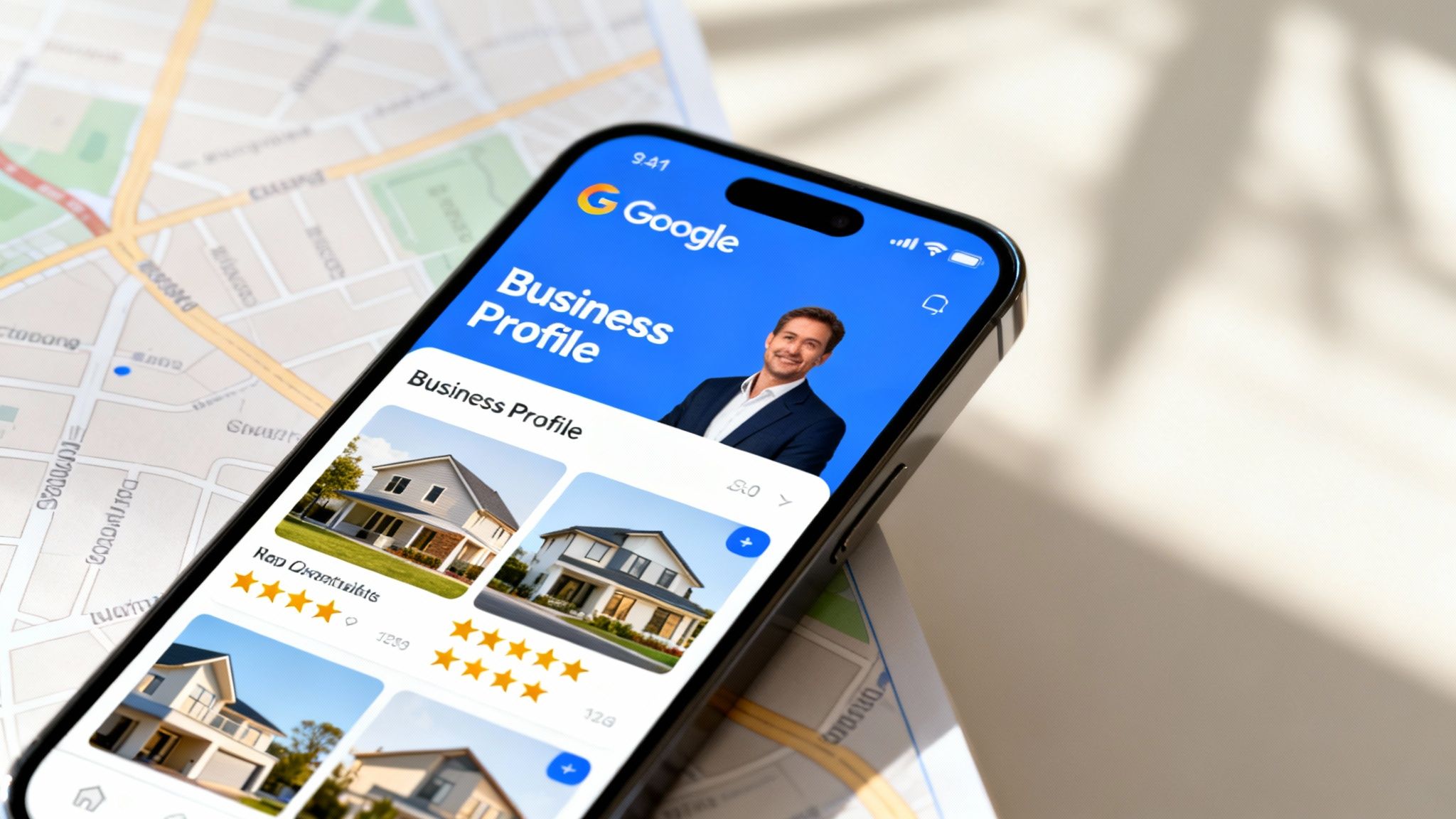
When a potential client searches for "real estate agent near me," your name must be the first one they see. This isn't luck; it's the result of a methodical approach to local search engine optimization (SEO).
The cornerstone of local search is your Google Business Profile (GBP). This free tool is often the first interaction a potential client has with your brand, making it a critical component of your digital marketing. A well-optimized GBP can place you in the coveted "map pack," significantly increasing your visibility.
Dialing In Your Google Business Profile
First, ensure every field in your GBP is complete and accurate, from service areas to business hours. This foundational step should not be overlooked.
Category selection is particularly important. While "Real Estate Agent" is the primary choice, add secondary categories like "Real Estate Consultant" or "Property Management Company" to broaden your reach in relevant searches.
Next, treat your profile as a dynamic portfolio. Regularly upload high-quality media to keep it current and engaging:
- Property Photos: Showcase current and recently sold listings with professional photography.
- Video Tours: Add compelling video walkthroughs of featured properties to capture user interest.
- Headshots & Team Photos: Humanize your brand and build trust with professional imagery.
Client reviews are the lifeblood of your local reputation. Implement a process to request reviews from satisfied clients after each closing. A steady stream of positive reviews provides powerful social proof that boosts your ranking. Equally important is responding to every review, both positive and negative, to demonstrate your engagement and commitment to client satisfaction.
Building Hyperlocal Pages That Convert
While your GBP boosts visibility, your website is where you convert clicks into leads. The key is creating hyperlocal landing pages that address a searcher's specific neighborhood interest. A generic "Homes for Sale" page is no longer sufficient. You need dedicated pages for each neighborhood, subdivision, and community you serve.
These pages should be optimized for long-tail keywords. For example, instead of targeting "homes in Northwood," a more effective approach is a page titled "Ranch Homes for Sale in Northwood, [Your City]." This targets buyers who are further along in their journey and have specific criteria.
Each hyperlocal page should include:
- An insightful overview of the neighborhood's character and amenities.
- Embedded, IDX-powered listings for that specific area.
- Valuable information on local schools, parks, and community hotspots.
This hyperlocal strategy does more than just boost your SEO; it instantly positions you as the undeniable market expert. When a potential client lands on a page that provides deep, specific insights into a community, it builds incredible credibility and trust.
Using Schema Markup to Make Your Listings Pop
To gain a competitive edge in search results, use schema markup. This is a specialized code added to your website that helps search engines understand your content. For real estate, it's a powerful tool.
By implementing RealEstateListing schema, you can provide Google with specific details like price, address, number of bedrooms, and virtual tour links. Google can then use this information to create "rich snippets" in the search results, making your listings more eye-catching than standard text links. This increased visibility can dramatically improve your click-through rate.
A well-structured local SEO approach is essential for agents who want to succeed online. For a deeper dive, explore our complete SEO strategy for real estate. By combining an optimized GBP with targeted hyperlocal content and technical SEO, you can dominate local search and attract a steady stream of qualified clients.
Creating Content That Attracts Homebuyers

To differentiate yourself, you must shift from thinking like an agent to acting like a local publisher. Generic blog posts are no longer effective. Your goal is to transform your website into an indispensable community resource that buyers and sellers consult first.
This requires a sharp focus on hyperlocal content. Move beyond broad topics and answer the specific questions people have about living in a particular neighborhood.
Adopting the Pillar and Cluster Model
One of the most effective ways to structure this strategy is with the pillar page and topic cluster model. This is a core component of a modern digital marketing plan that establishes your authority with search engines.
Here is the breakdown:
- Pillar Page: This is a comprehensive, deep-dive guide to a core community you serve, such as "The Ultimate Guide to Living in Northwood." This page covers everything from school ratings and parks to local coffee shops and commute times.
- Topic Clusters: These are shorter, focused pieces of content that link back to your pillar page. Each cluster post explores a single topic from the pillar page in greater detail.
For a "Northwood" pillar page, your topic clusters could include blog posts or videos such as:
- A detailed review of the top elementary schools in Northwood.
- A video tour of the Northwood community bike trails.
- An analysis of recent home price trends in the Northwood market.
- A guide for first-time homebuyers looking specifically in Northwood.
This structure creates an interconnected web of content. Each cluster reinforces the authority of the pillar page, signaling to Google that you are the definitive expert on Northwood and boosting your rankings for that area.
Building Your Content Calendar
Consistency is the engine of a successful content strategy. Sporadic publishing will not build the necessary momentum. A well-planned content calendar is your most valuable tool for maintaining a steady output.
Your calendar should include a mix of content formats to keep your audience engaged. Avoid relying solely on blog posts. Diversify with formats that are easily consumable and highly shareable.
A great content strategy does more than just attract traffic; it builds a loyal audience that views you as their trusted advisor. When they're ready to transact, you'll be the first person they call.
Incorporate these content types into your schedule:
- In-Depth Neighborhood Guides (Pillar Pages): Aim for one major guide per quarter for a key community.
- Local Market Update Videos: A short, monthly video discussing sales data and local trends establishes you as a data-driven expert.
- Practical "How-To" Guides: Solve client problems with content like "How to Appeal Your Property Taxes in [County]" or "A First-Time Buyer's Checklist for [City]."
- Community Spotlights: Interview local business owners or feature community events to showcase the local lifestyle.
Planning your content ensures a consistent stream of valuable information. To learn more, see our guide on how to create a content calendar that keeps your marketing running smoothly.
Distributing and Repurposing Your Content
Content creation is only half the battle; distribution is equally important. A smart distribution strategy maximizes the reach of every piece you create. Once you publish a new blog post or video, your work has just begun.
Actively promote your content across multiple channels. For example, a single neighborhood guide can be repurposed into numerous smaller pieces of content.
You can break down a pillar page into:
- A series of Instagram Reels highlighting key neighborhood features.
- A Facebook carousel post detailing the top 5 reasons to move to the area.
- A segment in your email newsletter linking back to the full guide.
- Talking points for a short YouTube or TikTok video.
This approach maximizes the value of your efforts and reaches different segments of your audience on their preferred platforms. By consistently creating, distributing, and repurposing hyperlocal content, you build a powerful digital engine that attracts high-quality leads and cements your status as the go-to real estate expert.
Driving Immediate Leads with Paid Ads
While SEO and content marketing are crucial for long-term growth, sometimes you need leads immediately. Paid advertising provides an express lane to the top, allowing you to place your brand directly in front of motivated buyers and sellers at the exact moment they are searching. This is a calculated approach to generating a predictable stream of measurable leads.
Capturing High-Intent Leads with Google Ads
When someone searches "best realtor in Scottsdale," they are actively seeking a professional to hire. Google Ads allows you to be that professional by placing your website at the top of the search results for those critical keywords.
Success hinges on precision. Focus on long-tail keywords that indicate commercial intent rather than broad, expensive terms.
Target specific phrases like:
- "Luxury real estate agent in [Your City]"
- "Realtor specializing in first-time buyers [Your Neighborhood]"
- "How much is my home worth in [Your Zip Code]"
For a target like 'best realtor in Austin,' your ad copy must be direct and compelling. A high-performing ad might read: "Top-Rated Austin Realtor. Proven Results for Buyers & Sellers. Get a Free Home Valuation Today!" This copy directly answers the search query, builds trust, and provides a clear call to action.
To optimize your campaigns, a comprehensive guide on real estate PPC advertising can help you refine your strategy for maximum impact.
Leveraging Social Media Ads for Brand Awareness
While Google Ads captures active searchers, social media platforms like Facebook and Instagram allow you to engage potential clients before they even start their search. This strategy shifts from keywords to demographics, targeting users based on behaviors and life events like "likely to move."
For a new listing, you can run a video tour ad targeting people who live within a 15-mile radius and fit the ideal buyer profile. This level of hyper-targeting is both powerful and cost-effective.
A Pro Tip on Budgeting: Don't spread your ad budget too thin across too many campaigns. A focused campaign targeting a specific niche with a killer offer will always beat a generic ad blasted out to a broad audience. Track your cost-per-lead like a hawk and pour more money into what's actually working.
Paid social media is a workhorse for agents. An industry trend report puts paid-social adoption around 42% of agents, riding the wave of more than 5.79 billion global social media users who consume visual content. Some agents pull back from PPC and SEO because the channels feel technical, which creates an opening: agents who master them gain a competitive edge. You can read more in these real estate marketing trends at Virtuance.com.
This framework provides a starting point for allocating your marketing budget.
Digital Marketing Channel Allocation for Real Estate Agents
This table offers a sample breakdown to guide your strategy, which should be adapted based on performance.
This allocation should remain flexible. If Google Ads are delivering high-quality leads at a favorable cost, shift more budget to that channel. Let data guide your decisions.
Implementing Smart Retargeting Strategies
What happens to users who visit your site but leave without converting? Retargeting ensures you don't lose them.
By placing a small snippet of code (a pixel) on your website, you can "follow" these visitors across the web and social media, showing them relevant ads that bring them back to your site.
For example, a user views a listing at 123 Maple Street on your website. Later, while scrolling through Facebook, they see an ad for that exact property with a caption like, "Still thinking about 123 Maple Street? Schedule your private tour before it's gone!"
This personalized follow-up is highly effective. It keeps you top-of-mind and maximizes the return on your ad spend.
Automating Growth with Your CRM
All your marketing efforts are designed to generate leads. However, a lead is only valuable if it's nurtured into a conversation and, ultimately, a transaction. A Customer Relationship Management (CRM) system is the engine that drives this process.
Your CRM serves as a command center, providing a centralized database to track every client interaction, monitor your sales pipeline, and automate the follow-up that is often missed during busy periods. It is the key to ensuring no opportunity is overlooked.
Designing Your Lead Nurture Workflows
When a new lead enters your system, timely follow-up is critical. A lead nurture workflow, a pre-built sequence of emails or texts triggered automatically, ensures consistent communication every time.
This approach should be tailored to the lead's profile. A potential seller has different needs than a first-time homebuyer.
For example, a new lead from your website's "Contact Us" form could trigger two distinct automated workflows:
- The Buyer Track: This sequence focuses on education and discovery, with emails explaining the homebuying process, links to neighborhood guides, and new listing alerts matching their criteria.
- The Seller Track: This path is designed to build trust and showcase your expertise. It might include an instant home valuation, local market trend reports, and case studies of recent sales in their area.
This turns a generic inquiry into a personalized, high-touch experience without manual effort.
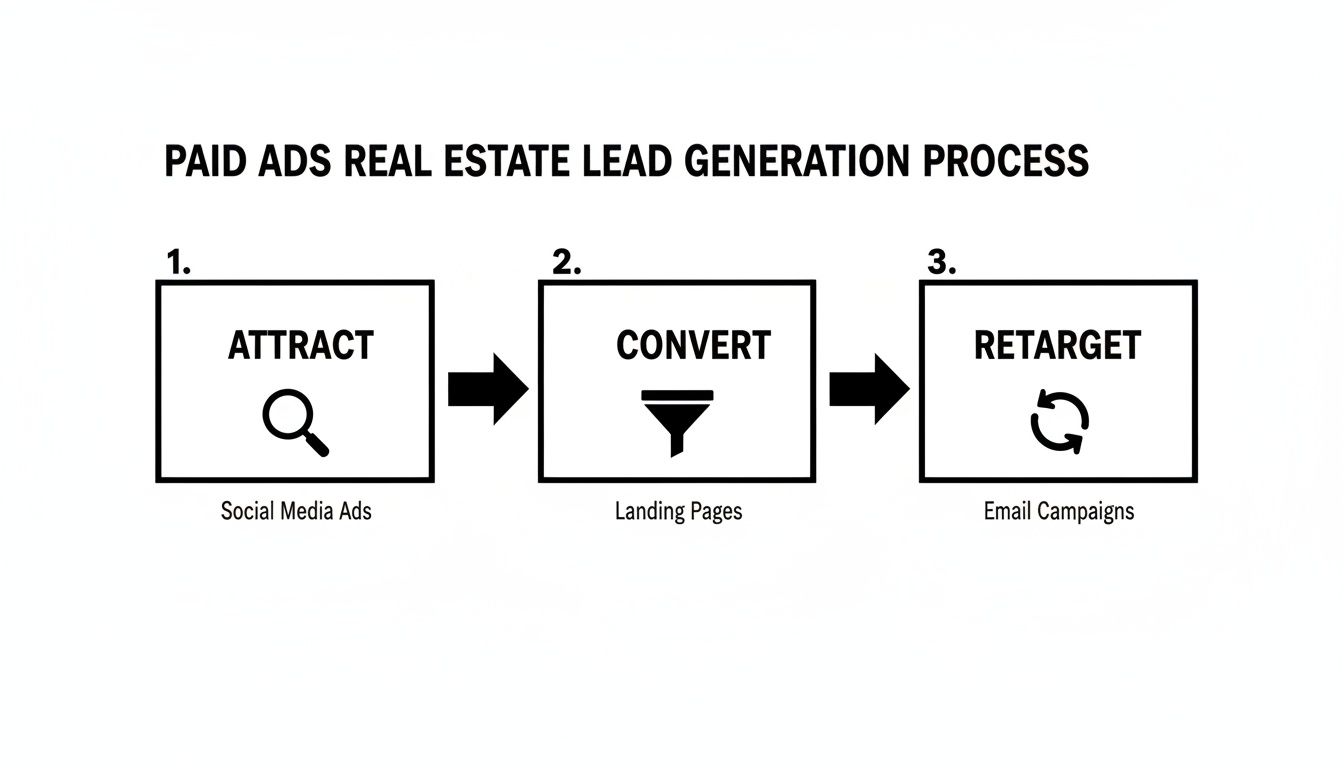
This simple flow shows how paid ads are just the start. The real money is made in the systematic converting and retargeting that happens inside your CRM.
A Sample Email Sequence for New Buyer Leads
Here is a simple but effective five-day email workflow for a new buyer lead, designed to run on autopilot in your CRM.
- Day 1 (Instant): Welcome & Add Value. The first email is sent immediately. Thank them for their interest and provide something of value, such as a link to download your "First-Time Homebuyer's Guide."
- Day 2: Spotlight Your Local Knowledge. This email showcases your local expertise. Link to a hyperlocal blog post or a video tour of a relevant neighborhood.
- Day 3: Build Trust with Social Proof. Send a concise email featuring a powerful client testimonial or a direct link to your latest five-star Google reviews.
- Day 4: Show You're Already Working for Them. Based on the information they provided, send an email highlighting a few listings that match their criteria, demonstrating proactivity.
- Day 5: Go for the Close (the Conversation). The final email in the initial sequence is a direct call to action: "Ready to start looking at some homes? Let's schedule a quick 15-minute call this week to discuss your goals."
This hands-off approach ensures every lead receives prompt, valuable, and strategic communication, preparing them for your personal follow-up.
The Power of Segmentation and Personalization
Beyond initial nurturing, your CRM's true power lies in segmentation. This involves dividing your contact list into smaller, specific groups based on their characteristics, allowing you to send hyper-relevant content.
A CRM isn't just a digital rolodex; it's a strategic tool that turns your database of contacts into a predictable pipeline of future commissions. By automating communication, you stay top-of-mind and build relationships at scale.
You can create segments for nearly anything:
- Lead Status: Active buyers, past clients, or cold leads needing re-engagement.
- Property Interest: Condos, luxury homes, or investment properties.
- Geography: Specific zip codes or school districts.
With these segments, your marketing becomes highly precise. You can send monthly market reports only to past clients to generate referrals or new listing alerts only to active buyers looking in a specific neighborhood. The goal is to send the right message to the right person at the right time.
Properly setting up these systems is what separates agents who struggle from those who scale. For a comprehensive walkthrough, see our guide on how to implement a CRM system.
Got Questions? Let's Talk Brass Tacks.
Implementing a full-funnel digital marketing plan can seem daunting when you're also managing listings, clients, and closings. It is natural to have questions about the required time, money, and effort, as well as the expected results.
Here are straightforward answers to the most common questions agents face when committing to their online presence.
How Much Should a Real Estate Agent Spend on Digital Marketing?
While there is no single answer, a reasonable starting point for a solo agent is 5-10% of your gross commission income (GCI). For example, if your annual GCI is $150,000, your marketing budget would be between $7,500 and $15,000 for the year.
The key is not the total amount but how you allocate it. A balanced approach that delivers quick wins while building long-term assets is most effective.
Consider this practical budget allocation:
- 40% for High-Intent Channels: This is your "right now" budget. Allocate a significant portion to platforms like Google Ads, where you can capture leads actively searching for an agent. This drives immediate lead flow.
- 30% for Brand Building: Use this for social media ads and content promotion to build awareness, establish yourself as a local expert, and stay top-of-mind with prospects who are not yet ready to transact.
- 30% for Long-Term Assets: Invest the remainder in foundational elements like SEO and hyperlocal content. While these do not provide immediate returns, they build an organic lead generation machine that works for you 24/7.
Most importantly, track every dollar. Start with a comfortable budget, measure what works, and double down on the channels that deliver the best leads at the lowest cost.
Which Social Media Platform Is Best for Real Estate Agents?
It is far better to dominate one or two platforms than to spread yourself thin across five. For most real estate agents, the powerhouse duo is Facebook and Instagram.
Instagram is ideal for real estate. As a visual-first platform, it is perfect for showcasing stunning property photos, walk-through video tours, and behind-the-scenes Reels that highlight your personality. It is where you sell a lifestyle, not just a property.
Facebook, on the other hand, excels at community building and hyper-targeted advertising. It is the perfect place to run ads for a new listing to users in a specific zip code, share client testimonials, and engage in local groups to position yourself as the neighborhood expert.
Quick tip: While platforms like TikTok are fun and buzzy, focus your energy where your target clients are actually spending their time. If you're in the luxury market or handle corporate relocations, don't sleep on LinkedIn. It can be an untapped goldmine for connecting with high-net-worth professionals.
Research your local market's demographics, choose the one or two platforms that make the most sense, and commit to mastering them.
What Are the Most Important Metrics to Track?
It is easy to get lost in data. "Likes" and "followers" are vanity metrics that do not directly contribute to your bottom line. To determine if your digital marketing is working, you must focus on Key Performance Indicators (KPIs) tied to revenue.
These are the metrics that truly matter:
- Cost Per Lead (CPL): This is your north star metric. It tells you exactly how much you spend to acquire one new contact. A low CPL indicates efficient marketing.
- Lead-to-Appointment Ratio: This metric measures lead quality. What percentage of your leads convert into a meeting or property showing? This reveals if you are attracting the right audience.
- Website Traffic Sources: Understand where your visitors are coming from, organic search, paid ads, social media, or other channels. This identifies which channels are driving the most interest.
- Conversion Rate: This is the ultimate bottom-line number. What percentage of your appointments become signed clients? Improving this metric has a direct and significant impact on your revenue.
By closely monitoring these four metrics, you can move from guessing to making data-driven decisions that propel your business forward.
Ready to stop guessing and start growing? At Twelverays, we build data-driven digital marketing and CRM systems that deliver measurable results for real estate professionals. Let us help you create a predictable pipeline of high-quality leads. Schedule a consultation with us today.


