

In a crowded market, a sophisticated digital marketing strategy isn't just a "nice-to-have" for a SaaS company, it's the engine that builds a predictable revenue pipeline. This guide moves beyond theory to offer a surgical, integrated approach that turns every marketing dollar into measurable growth. A robust digital marketing plan is what separates SaaS companies that achieve escape velocity from those that never get off the ground.
The New Growth Engine for Modern SaaS Companies

Unlike traditional marketing focused on one-off sales, a SaaS digital marketing plan is built around the entire customer lifecycle. The goal isn't just to acquire new customers but to activate them, ensure their success, and ultimately turn them into advocates.
The global SaaS market sits in the $375 to $465 billion range in 2026, and it keeps growing. With over 30,800 SaaS companies competing for attention as of 2025, a data-backed plan that connects with the right audience at the right moment is essential.
Why a Specialized Approach Matters
A generic marketing playbook is insufficient. The SaaS business model hinges on recurring revenue, making customer retention as critical as acquisition. Every marketing touchpoint must contribute to long-term value.
What sets SaaS marketing apart?
- It’s a Full-Funnel Game: Your strategy must cover the entire journey, from awareness and acquisition to activation and retention. This is how you build a sustainable growth loop.
- Data Is Non-Negotiable: Connecting marketing efforts to a CRM is mandatory. You must track the complete customer journey to understand what's working and prove ROI.
- It’s All About Relationships: The objective is to create a seamless experience that reduces churn and increases customer lifetime value (LTV).
This guide provides the framework for building that system. We will break down the core SaaS marketing funnel and explore specific channels and tactics that deliver consistent, predictable growth for tech companies.
A powerful plan isn't about using a multitude of tools; it's about building an integrated engine that fuels growth at every stage of the customer lifecycle. For a broader perspective, our guide on marketing for technology companies is a valuable resource.
Defining Your Ideal Customer and Market Position
Before investing in digital marketing for your SaaS, you must clarify two things: Who are you selling to? And why should they choose your solution over any other?
Skipping this foundational step is like building a house without a blueprint, it's inefficient, expensive, and destined to fail. The core of a winning strategy isn't flashy ads; it's absolute clarity on your target audience and unique value proposition.
This clarity begins with a meticulously defined Ideal Customer Profile (ICP). A vague ICP is like a blurry photo, lacking the essential details. A well-defined ICP, however, is a high-resolution image of your perfect customer, guiding every piece of content, ad campaign, and product decision.
Bringing Your ICP into Focus
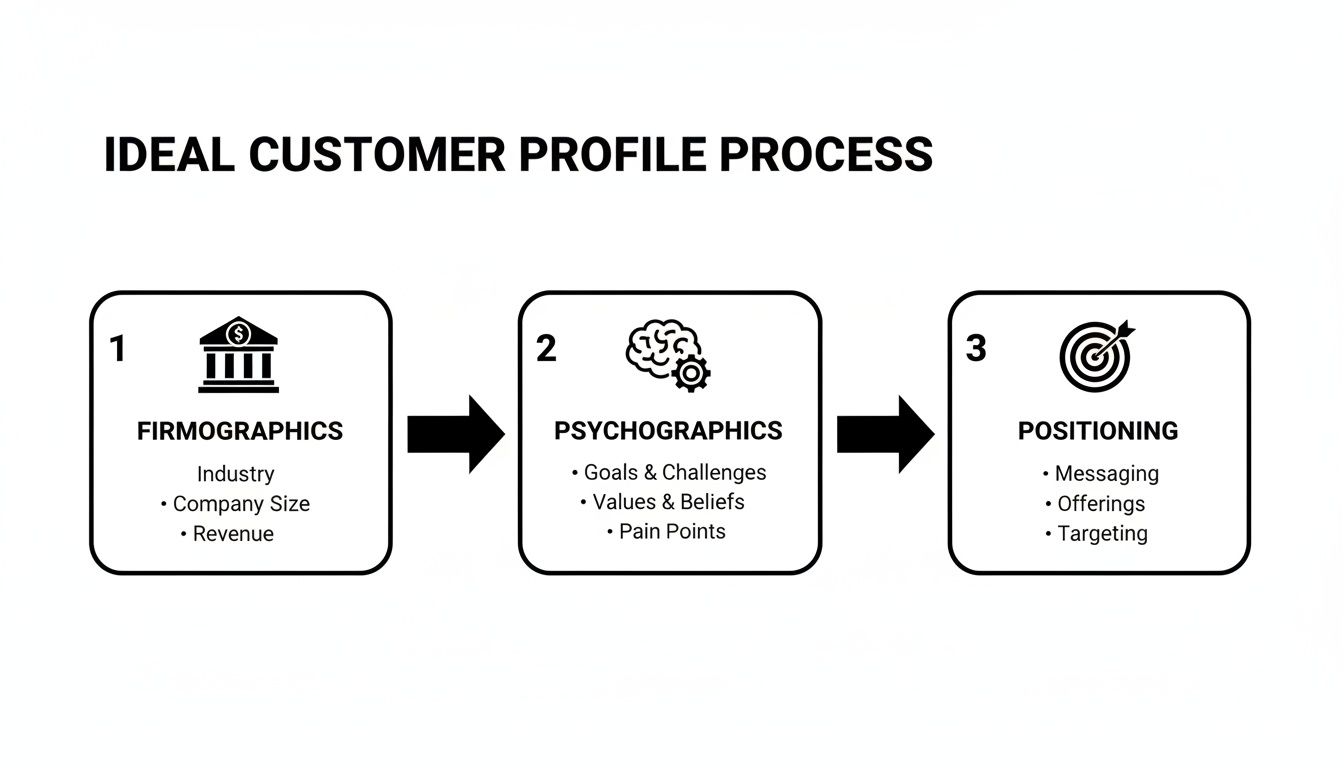
An effective ICP combines quantitative data with a deep understanding of your customer's professional world. This involves analyzing both firmographics (the "what") and psychographics (the "why").
Here’s a practical breakdown:
- Firmographic Data: These are the quantifiable facts about your target companies. Consider their size (employee count or revenue), specific industries, geographic location, and even the tech stack they currently use.
- Psychographic Details: This is where you uncover the human element. What are their most significant pain points? What are their overarching strategic goals? Understanding this allows you to position your SaaS not just as a tool, but as the definitive solution to a costly problem.
A strong ICP avoids vague terms like "small businesses." It gets granular: "B2B tech startups in North America with 50-200 employees struggling to scale content marketing and lacking an integrated analytics platform." This level of detail is a game-changer. To dive deeper, our guide on how to create buyer personas offers more structure.
From Profile to Positioning
Once you know exactly who you're targeting, you can define your market position. This is the unique space your SaaS product occupies in the minds of your ideal customers. It's the compelling, undeniable reason they should choose you.
Your positioning statement is your anchor. It answers the question: "For [our ICP], our product is the only one that [solves this specific pain point] by [delivering this key benefit]."
This statement becomes your north star, ensuring your ad copy resonates with your audience's needs, your blog posts address their real-world challenges, and your marketing channels are the ones they actively use.
With a strong ICP and clear positioning, your digital marketing for SaaS evolves from a guessing game into a predictable, powerful engine for attracting high-value customers who stay for the long term.
Building Your High-Performance SaaS Marketing Funnel
A successful digital marketing strategy for a SaaS company is not a random assortment of tactics. It's a cohesive system designed to guide prospects on a specific journey, a marketing funnel that turns strangers into loyal, paying customers.
The SaaS funnel is unique because the journey extends beyond the sale, forming a continuous loop focused on delivering long-term value. We break this down into four critical stages: Awareness, Acquisition, Activation, and Retention. Each stage has a distinct goal and requires specific strategies. Mastering this flow is key to building a predictable revenue machine.
Awareness: Attracting Your Ideal Customer
The Awareness stage is about getting on your Ideal Customer Profile's radar. At this point, prospects are aware of a problem but may not know your solution exists. They are actively searching for information and insights related to a pain point your SaaS addresses. Your objective is to be the helpful resource they discover.
Content and SEO are your primary tools here. Create valuable, educational content, such as blog posts, guides, and webinars, that answers their questions without a hard sales pitch. The goal is to establish authority and build initial trust by providing genuine help.
Effective tactics for the Awareness stage include:
- SEO-Driven Blog Content: Develop in-depth articles optimized for keywords your ICP uses. Think "how to solve [problem]" or "best ways to improve [metric]."
- Top-of-Funnel (ToFu) Content: Create ebooks, whitepapers, or original research that delivers significant value and positions your brand as a thought leader.
- Social Media Engagement: Share your best content on platforms where your audience is active, like LinkedIn, to drive traffic and start conversations.
Content and SEO are powerhouses for SaaS growth. Content marketing generates three times more leads than outbound marketing, at a lower cost. Organic search is one of the largest pipeline sources for most B2B SaaS companies. That edge matters as acquisition costs climb. A smooth, product-led onboarding process lowers acquisition cost by letting the product carry more of the conversion.
Acquisition: Turning Visitors Into Leads
Once you have their attention, the Acquisition stage focuses on converting anonymous website visitors into known leads. This is where you request a small commitment, usually an email address, in exchange for a high-value asset. This marks the beginning of a direct relationship with a potential customer.
This value exchange is a critical first step, granting you permission to continue the conversation on a more personal channel like email. The key is to offer something so compelling that the visitor feels they are getting exceptional value.
Common Acquisition tactics include:
- Gated Content: Place your most valuable assets (ebooks, templates, webinar recordings) behind a simple form to capture contact information.
- Targeted Paid Campaigns: Use paid search or social ads to promote your gated content directly to your ICP, accelerating lead generation.
- Newsletter Sign-ups: Offer a newsletter that promises ongoing value and unique insights, making it an easy decision for visitors to subscribe.
Activation: Guiding Leads to Value
Activation is the most critical stage in the SaaS funnel. This is where a lead experiences your product's value firsthand, transforming them from a prospect into a paying customer. A failure at this stage means losing a customer you worked hard to acquire. The goal is to deliver on your promise and guide them to their "aha!" moment as quickly as possible.
This process runs through a free trial or a product demo. Your marketing and product teams must be perfectly aligned to create an onboarding experience that directs new users to the features that solve their biggest problems.
Activation isn’t just about getting a sign-up; it’s about ensuring the user successfully performs a key action that proves the product's core value. This is the bridge between showing interest and making an investment.
Effective Activation strategies include:
- Frictionless Free Trials: Offer a self-serve trial that is easy to start. Include guided in-app tours or checklists to help users get started.
- Compelling Product Demos: For more complex products, a personalized demo is highly effective. Focus entirely on the prospect's specific use case and objectives.
- Onboarding Email Sequences: Set up automated email campaigns that welcome new trial users, highlight key features, and offer support.
Retention: Keeping Customers for Life
Finally, Retention is where sustainable, long-term growth is realized. In a subscription business, customer acquisition is just the beginning. Reducing churn and increasing customer lifetime value (LTV) are paramount for profitability. This stage is about keeping customers engaged, successful, and satisfied with your product.
This requires ongoing communication, excellent support, and proactive engagement. Integrating your marketing platform with a CRM is non-negotiable, allowing you to personalize communication based on product usage and customer journey stage.
For a detailed breakdown of the entire process, check out our guide on how to create a sales funnel that works. By implementing this full-funnel system, your digital marketing for SaaS becomes a powerful, self-sustaining growth engine.
Mastering the Essential SaaS Marketing Channels
Once your funnel is mapped, it's time to execute. A winning plan for digital marketing for SaaS is not about being on every channel; it's about mastering the right ones that connect with your Ideal Customer Profile (ICP). Let's examine the core channels that consistently deliver results for B2B SaaS companies.
Content Marketing and SEO: The Foundation of Trust
In the SaaS world, content and SEO are intrinsically linked. Your ICP is not waiting for a sales pitch; they are actively searching for solutions. Your objective is to be the authoritative answer they find.
Create high-value, educational content that addresses their specific pain points. Treat your blog less as a promotional tool and more as a resource library. Develop comprehensive pillar content: long-form guides on major industry topics, and supplement it with shorter, focused posts that answer niche questions. This strategy builds topical authority, signaling to search engines that you are an expert.
The most effective SaaS content marketing answers key customer questions before they are asked. It builds trust by providing value upfront, long before you ever ask for a sale.
Every piece of content must be optimized for search without sacrificing readability. Your primary focus is on solving problems. When you do that effectively, your content naturally aligns with user intent, helping you rank for relevant keywords. For a deeper dive, our guide on SEO for SaaS companies provides a rock-solid foundation.
Paid Media: Precision Targeting for High-Intent Prospects
While SEO builds long-term organic growth, paid media provides immediate, targeted reach. For SaaS businesses, this means focusing ad spend where you can zero in on your ICP and capture high-intent prospects who are actively seeking a solution.
Pay-per-click (PPC) campaigns on search engines are highly effective. Targeting keywords like "[competitor] alternative" or "best software for [a specific job]" allows you to intercept users deep in the evaluation stage.
LinkedIn is another B2B SaaS powerhouse. Its advanced targeting options let you build audiences based on job title, company size, industry, or specific skills, making it the perfect platform to promote gated content directly to decision-makers.
The B2B SaaS advertising landscape is increasingly sophisticated, with a strong emphasis on AI-driven personalization. That makes sense given how much software buyers now juggle. The average company runs more than 300 SaaS apps, and large enterprises run several hundred, sometimes close to 700. SaaS now accounts for a large and growing share of business software, so companies invest heavily in the martech that organizes it.
Account-Based Marketing: Going After High-Value Accounts
Account-Based Marketing (ABM) inverts the traditional marketing funnel. Instead of casting a wide net, ABM identifies a select list of high-value target accounts and treats each as its own market. This hyper-targeted approach is ideal for SaaS companies aiming to secure larger, enterprise-level clients.
The process begins with close alignment between sales and marketing to build the target account list. Marketing then creates highly personalized campaigns to engage key stakeholders within those companies.
- Personalized Content: Develop case studies or landing pages that speak directly to a target account's industry and pain points.
- Targeted Ads: Use platforms like LinkedIn to serve ads exclusively to employees at your target companies.
- Coordinated Outreach: Integrate marketing efforts with direct, personalized outreach from your sales team for a unified experience.
ABM requires more upfront resources, but the payoff can be substantial, resulting in significant contract values and long-lasting customer relationships.
Email Marketing and Automation: Nurturing Relationships at Scale
Email remains one of the most powerful channels in digital marketing for SaaS. It is your primary tool for nurturing leads and engaging customers. The key is to move beyond generic blasts and embrace automation to send personalized, timely messages based on user behavior.
For instance, a prospect who downloads gated content should enter a lead nurturing sequence, an automated series of emails designed to build on their initial interest and guide them toward your solution.
For new customers, an onboarding email sequence is critical for activation and retention. These emails can:
- Welcome new users and reinforce the product's value.
- Highlight key features to guide them toward their "aha!" moment.
- Offer helpful resources like tutorials or direct access to support.
By connecting your email platform to your CRM, you can create sophisticated segments and trigger campaigns based on product usage, subscription level, or inactivity. This level of automation enables you to nurture relationships at every stage of the customer lifecycle.
Measuring Success with CRM and Analytics

Effective digital marketing for SaaS is about driving measurable results that grow the business. Clicks and impressions are insufficient; every marketing activity must be tied directly to the metrics that define the health of a subscription business. This means looking beyond surface-level data to track the key performance indicators (KPIs) that truly matter, drawing a straight line from marketing campaigns to revenue.
The KPIs That Define SaaS Success
In the recurring revenue model, unit economics are paramount. The fundamental question is: for every dollar spent on marketing, how many dollars does that new customer generate over their lifetime? Answering this requires mastering three core metrics.
- Customer Acquisition Cost (CAC): The total sales and marketing spend required to acquire one new customer. Keeping CAC low is essential for profitable growth.
- Lifetime Value (LTV): The total revenue you can reasonably expect from a single customer account over their entire relationship with your company. A high LTV indicates a valuable product and satisfied customers.
- Monthly Recurring Revenue (MRR): The predictable revenue your business generates each month. It is the primary indicator of your company's growth and financial stability.
The golden ratio in the SaaS world is LTV to CAC. A healthy, growing business should aim for an LTV that is at least 3x its CAC. This 3:1 ratio indicates that your marketing engine is acquiring customers profitably. A lower ratio signals overspending, while a significantly higher ratio means you are underinvesting in growth.
Creating a Single Source of Truth
Accurate tracking of these metrics is only possible by integrating your marketing platforms with your Customer Relationship Management (CRM) system. When tools like Google Analytics, your email provider, and ad networks are connected to your CRM (e.g., Salesforce or Dynamics 365), you create a single source of truth.
This connected tech stack allows you to see the full customer journey, from their first interaction, like clicking a LinkedIn ad, to becoming a closed deal in your CRM. This visibility is the foundation of full-funnel attribution. For a deeper analysis, our post on measuring digital marketing performance offers further details.
A disconnected tech stack is like trying to assemble a puzzle with pieces from different boxes. Integrating your CRM and analytics tools ensures every piece fits, giving you a complete and actionable picture of your marketing ROI.
Making Data-Driven Decisions
With full-funnel attribution, you can move from guessing to knowing. You can see exactly which campaigns are attracting your most valuable customers.
Consider this scenario: Campaign A generates 100 trial sign-ups at a low CAC. Campaign B yields only 20 sign-ups at a higher CAC. Superficially, Campaign A appears to be the winner.
However, your integrated CRM data reveals that sign-ups from Campaign B have a 2x higher LTV. They convert to paid plans faster and exhibit lower churn. Armed with this insight, you can confidently reallocate your budget to the channel that drives sustainable growth, not just vanity metrics. This is the power of a data-driven approach to digital marketing for SaaS.
Your Blueprint for Sustainable SaaS Growth
Success in digital marketing for SaaS is not about chasing fleeting trends. It's about building a robust, repeatable system designed to attract and retain your ideal customer. The path from startup to market leader is paved with strategic, connected actions, not random acts of marketing.
It all begins with a solid foundation: a razor-sharp Ideal Customer Profile (ICP) and crystal-clear market positioning. Without this, even the most creative campaigns will fail. Once you know exactly who you're targeting and why you are their best option, you can build the machine.
Building Your Growth Engine
Next, you architect your full-funnel strategy, methodically guiding prospects from initial awareness to loyal customers.
- Awareness: Attract prospects who are problem-aware with high-value, SEO-optimized content that establishes your expertise.
- Acquisition: Convert anonymous visitors into known contacts using targeted campaigns and compelling gated assets.
- Activation: Turn leads into paying customers with frictionless trials, persuasive demos, and intelligent onboarding that highlights your product's "aha!" moment.
- Retention: Reduce churn and increase profitability with personalized communication and proactive customer success initiatives.
The best SaaS marketing strategies aren't just a random assortment of activities; they're a cohesive engine. Each stage seamlessly fuels the next, creating a predictable and scalable pipeline for revenue.
Finally, you must measure what truly matters. Focus relentlessly on Customer Acquisition Cost (CAC), Lifetime Value (LTV), and Monthly Recurring Revenue (MRR). Integrating your marketing tools with a CRM like Salesforce or Dynamics 365 provides full-funnel visibility, enabling you to connect marketing spend directly to business results.
This blueprint provides the framework to implement these strategies with confidence, transforming marketing from a cost center into the primary driver of predictable, sustainable growth.
Got Questions? We've Got Answers.
Even the best blueprint can raise questions during implementation. The world of digital marketing for SaaS is dynamic, with new challenges and opportunities constantly emerging. Here, we address some of the most common questions from SaaS leaders and marketers.
What Are the Most Important KPIs for SaaS Digital Marketing?
It's easy to get lost in vanity metrics. The true health of your marketing is reflected in the numbers that directly impact your business. You must track Customer Acquisition Cost (CAC) to ensure profitable user acquisition, Lifetime Value (LTV) to understand long-term customer worth, and Monthly Recurring Revenue (MRR) as your north-star growth metric.
The ultimate health check? The LTV:CAC ratio. If you're not aiming for a ratio of 3:1 or higher, you don't have a scalable business. Simple as that.
This ratio confirms that for every dollar spent acquiring a customer, you generate at least three dollars in return. It's the clearest indicator of a sustainable growth model.
Should a New SaaS Company Focus on Inbound or Outbound First?
For most new SaaS companies, building a solid inbound marketing foundation from day one is the most strategic choice. SEO and content marketing are long-term assets that compound over time; an article published today can generate qualified leads for years.
While outbound tactics can provide quick wins, they are expensive and cease to be effective once spending stops. A hybrid approach works best:
- Start building your inbound engine immediately. This is a non-negotiable investment in your future.
- Use hyper-targeted paid or outbound campaigns. This can generate initial traction, test messaging, and gather market feedback while your inbound efforts gain momentum.
This balanced strategy builds a pipeline for both today and tomorrow.
How Does Product-Led Growth Change Digital Marketing?
Adopting a Product-Led Growth (PLG) model fundamentally changes marketing's role. The product itself becomes the primary engine for customer acquisition, activation, and retention. The marketing team's primary goal shifts from generating sales-qualified leads (SQLs) to driving free trial or freemium sign-ups.
Marketing's focus pivots to acquiring product-qualified leads (PQLs): users who have already experienced the product's value firsthand. Marketing strategies must integrate seamlessly with the product experience. Content is used to show users how to maximize specific features, while email automation guides them through onboarding toward conversion. It's about letting the product do the heavy lifting.
At Twelverays, we build data-driven digital marketing and CRM solutions that create predictable growth for SaaS companies. If you're ready to stop guessing and start implementing a strategy that delivers real, measurable ROI, we're here to help. Learn more about how we turn marketing into a revenue engine.


