

Deciphering how many keywords to use for SEO can feel like a complex puzzle, but the modern answer is refreshingly straightforward. For any given page, focus on one primary keyword and support it with a cluster of 5-10 related secondary keywords.
This strategy marks a significant evolution from the outdated practice of "keyword stuffing." Today's approach is about demonstrating deep, authentic expertise on a topic, signaling to search engines that your content is a comprehensive and valuable resource.
The Modern Answer to a Timeless SEO Question

The "how many keywords" debate is a classic in SEO. In the past, the prevailing wisdom was simply "more is better," which led to clunky, unreadable content packed with repetitive phrases. Fortunately, search algorithms have become far more sophisticated, and such tactics are now more likely to earn a penalty than a top ranking.
The strategic focus has shifted from sheer quantity to quality and intent. The real question isn't about a specific number; it's about the purpose each keyword serves. A winning strategy today aligns one piece of content with one core user intent, providing absolute clarity for both your audience and Google.
Shifting from Keyword Density to Topical Depth
Forget keyword density, that metric is a relic. Today, savvy marketers build topical authority by creating content that covers a subject from every important angle.
To achieve this, select one primary keyword to act as your North Star. This is the main search query you want the page to rank for, period.
Then, surround it with a supportive cluster of secondary and semantically related keywords. These aren't just synonyms; they are the subtopics, related questions, and concepts your audience is actively searching for. For example, a page targeting "managed IT services" becomes much more powerful when it naturally incorporates terms like:
- "outsourced IT support costs"
- "what does a managed service provider do"
- "benefits of managed IT for small business"
This layered approach signals to Google that your page isn't just touching on a topic, it's a comprehensive resource that deserves a top spot. If this is a new concept for you, understanding what search engine optimization is provides an excellent foundation.
Key Takeaway: Stop counting keyword repetitions. Instead, focus on weaving a rich tapestry of related terms that comprehensively addresses a user's search intent. One primary keyword sets the direction, while 5-10 secondary terms build authority.
To help you put this into practice, here's a quick guide for applying this principle to the kinds of content most businesses create.
Keyword Targeting Quick Reference Guide
This simple breakdown illustrates how the strategy applies to different page types. Use it as a starting point for building out your content plan.
As you can see, the core idea holds true across the board: a tight focus on a primary goal, supported by a healthy mix of related terms to demonstrate depth. It’s a far more effective, and sustainable, way to approach modern SEO.
Why Chasing High Keyword Volume Is a Losing Game
We’ve all been there. You run a keyword report, and a term with tens of thousands of monthly searches jumps off the screen. It's tempting to think, "If I can just rank for that, the floodgates will open." But for most businesses, especially in B2B and professional services, chasing those massive, generic keywords is a surefire way to waste time and money.
Consider "vanity" terms like "IT services" or "marketing agency." The competition is fierce. You aren't just competing with local firms; you're up against national and global giants with staggering budgets and domain authority built over a decade. Trying to win that top spot is like entering a heavyweight fight as a welterweight.
Even if you managed to rank, the traffic would be low quality. A search for "IT services" could come from a student writing a paper, a job seeker, or someone looking for a type of IT help you don't offer. The search intent is simply too broad.
The Real Win Is in Niche Specificity
Here’s the thing: great SEO isn’t about getting all the traffic; it’s about getting the right traffic. This is where long-tail keywords, those longer, more specific phrases, become your secret weapon.
Let’s say you're a managed service provider (MSP). Targeting a generic term like "IT services" is a battle you’re positioned to lose. But what happens when you shift your focus to a high-intent query like "managed IT services for financial firms in Chicago"?
Suddenly, the game changes.
That search comes from a highly qualified lead. They know exactly what they need, where they need it, and are likely much closer to making a buying decision. Shifting your mindset from raw volume to sharp relevance is the cornerstone of an SEO strategy that actually works.
Expert Insight: Your goal should be to match your content to the specific problems your ideal customers are trying to solve. High-volume keywords attract browsers just becoming aware of a problem; high-intent, long-tail keywords attract buyers actively seeking a solution.
The Numbers Don't Lie: Go Long-Tail
The data fully supports this approach. Ahrefs' analysis of billions of keywords found that more than 90% of all keywords get 10 or fewer searches per month, while only a tiny fraction clear 100,000 monthly searches. This massive gap shows why obsessing over volume is a fool's errand. The smarter play is to target a focused cluster of long-tail keywords that perfectly match your offerings. You can review the full long-tail keyword research from Ahrefs to see the distribution for yourself.
One point trips people up. Long-tail does not mean "long." A long-tail keyword is defined by low search volume and specific intent, not word count. Some one-word terms barely get searched. Some five-word phrases pull hundreds of thousands of searches. Long-tail keywords convert better because the searcher's intent is crystal clear, not because they contain a certain number of words.
Dodging the High-Volume Traps
Fixating on high-volume keywords often leads to several classic mistakes. By spotting them early, you can build a smarter, more profitable SEO plan.
- Vague, Useless Content: Trying to create content for a broad term results in generic material that doesn't address anyone's real pain points.
- Wasted Time and Money: The resources spent trying to rank for a vanity term could be used to capture dozens of lower-competition keywords that actually convert.
- Sky-High Bounce Rates: When a user with broad intent lands on your specific service page, they leave quickly. This signals to Google that your page isn’t a good match, hurting your rankings further.
Ultimately, focusing on keyword volume is one of the most common SEO mistakes to avoid. It distracts from the real prize: driving measurable business results like leads, consultations, and new clients. When you prioritize relevance and user intent over raw search numbers, you position your business to attract not just any visitors, but future clients who see you as the perfect solution to their specific problem.
Building Your Keyword Strategy From the Ground Up
A powerful keyword strategy isn't a one-time task; it’s a repeatable framework for every piece of content. The process is about building a clear, intentional roadmap: define a core topic, anchor it with a strong primary keyword, and then expand with a strategic cluster of related terms.
This methodical approach moves you from guesswork to a system that consistently attracts qualified traffic. Using tools like Ahrefs or Semrush, you can gain a clear picture of user intent, uncover valuable question-based queries, and find the semantic variations that Google’s algorithm loves.
Starting With a Pillar Topic
First, zoom out and define a core "pillar topic." This should be a broad subject area central to your business. For a B2B SaaS company selling project management software, a perfect pillar topic might be "agile project management."
This pillar becomes your foundation. Every piece of content created around it will link back to this central theme, sending a powerful signal to search engines that you're an authority on the subject. A well-defined pillar streamlines your entire content plan and ensures every article serves a clear purpose.
Identifying Your Primary Keyword
Once your pillar topic is set, the next step is to select the primary keyword for a specific piece of content within that pillar. This is the main search query you want your page to rank for. It should have a healthy search volume but, more importantly, must perfectly match the user intent you aim to capture.
Continuing with our example, for a blog post under the "agile project management" pillar, a great primary keyword could be "agile project management techniques." This phrase is specific, has clear informational intent, and targets an audience looking for actionable advice.
The diagram below illustrates how this works in practice, moving from broad, high-volume terms to high-quality, targeted long-tail keywords that actually convert.
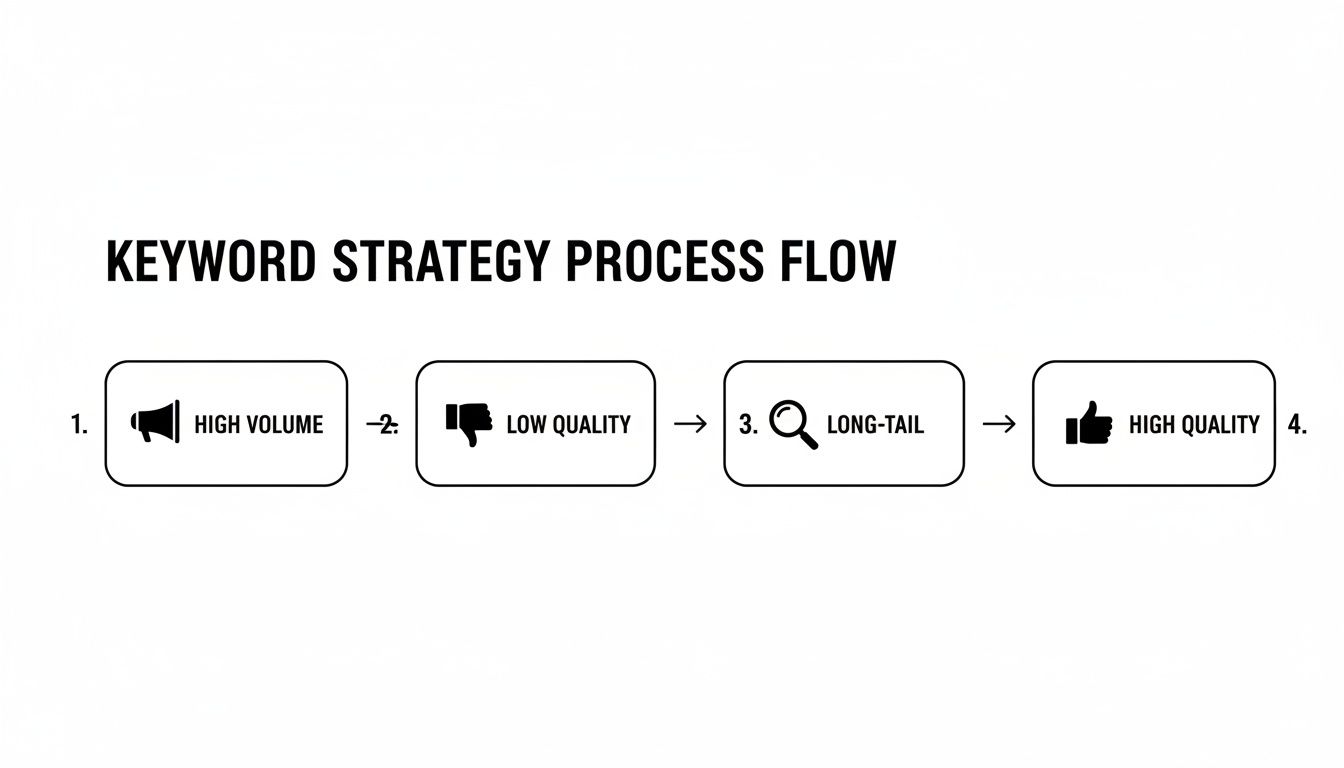
It’s about a strategic shift away from chasing vanity metrics and toward capturing high-intent traffic that is far more likely to become a lead or a customer.
Expanding into Secondary and Long-Tail Keywords
With your primary keyword set, it's time to build out the rest of your cluster by finding secondary and long-tail keywords that support your main topic. These are typically more specific, often question-based queries that your audience is searching for on Google.
For our target of "agile project management techniques," your secondary keywords might look like this:
- "what are the 5 phases of agile project management"
- "scrum vs kanban for software development"
- "how to implement agile methodology"
- "agile project management tools for small teams"
These supporting terms add incredible depth and context, allowing you to answer a host of related questions within a single, comprehensive article. This is a cornerstone of any modern SEO content strategy because it addresses the user's entire journey, not just a single query.
Pro Tip: The "People Also Ask" section in Google's search results for your primary keyword is an absolute goldmine. It offers direct insight into what real users are asking, making it perfect for discovering secondary and long-tail keyword ideas.
Mapping Keywords to a B2B SaaS Service Page
Let’s apply this to a real-world scenario. Imagine our SaaS company is creating a new service page for its "Agile Reporting Dashboard" feature.
By mapping keywords this way, the content team can structure the page to answer every critical question a potential customer might have. The H1 and introduction would target the primary keyword, while H2s and body copy would address the secondary and long-tail queries. This creates a deeply relevant, comprehensive page that satisfies user intent, signals strong authority to search engines, and ultimately drives more qualified leads.
The Art of Keyword Clustering for Topical Authority

This is where a modern SEO strategy truly shines. Move beyond a simple list of keywords and embrace keyword clustering: the practice of building an interconnected web of related concepts. It’s one of the most effective ways to demonstrate deep expertise to Google and build coveted topical authority.
The core idea is to shift from a "one page, one keyword" mindset to "one page, one topic." A single, powerhouse page can and should rank for dozens of related search queries by covering a core subject from every important angle. This is far more powerful than creating ten thin pages that all say essentially the same thing.
Grouping Keywords by User Intent
The first step in building a solid cluster is to understand the user's intent. Every search query falls into one of three main categories, and recognizing the difference is crucial for creating content that connects.
Informational Intent: The user wants to learn something, solve a problem, or understand a concept. Think "what is," "how to," or "benefits of."
Transactional Intent: The user is ready to buy, sign up, or take a specific action. These keywords often include terms like "buy," "pricing," "demo," or specific product names.
Navigational Intent: The user already knows where they want to go and is using Google as a shortcut, like searching for "Twelverays blog."
When you group your keywords by intent, you can create hyper-focused content that meets people exactly where they are. For a deeper look, our guide explains more about how to use keyword clusters to build authority.
The Big Picture: Instead of asking "how many keywords should I use for SEO," the better question is "how many related user questions can I answer with one piece of authoritative content?" This reframe is the key to a successful clustering strategy.
To take this a step further, mapping user intent directly to the right content format is a game-changer for organizing your clusters. This table breaks down how specific intents align with different types of content.
Keyword Intent vs. Content Format
Match keyword intent to the most effective content format to guide your clustering strategy.
Using this framework helps ensure that every piece of content you develop is perfectly tailored to what the searcher is trying to accomplish.
From Pillar Page to Dominant Authority
Let's walk through a real-world B2B example. Imagine your firm offers Salesforce integration services. Your core pillar topic is clearly "Salesforce Integration." This is the broad subject you want to own in the search results.
Your primary keyword for a pillar page might be "Salesforce integration solutions." But a truly dominant page doesn’t stop there. It's supported by a whole cluster of articles and landing pages that tackle related, more specific questions.
Here’s what a simple topic cluster could look like:
- Pillar Page: "The Ultimate Guide to Salesforce Integration Solutions"
- Cluster Content 1 (Comparison): "Dynamics 365 vs Salesforce Integration"
- Cluster Content 2 (How-To): "How to Integrate Salesforce with Outlook"
- Cluster Content 3 (Informational): "Common Salesforce API Integration Challenges"
Each piece of cluster content links back to the main pillar page, creating a tightly-knit hub of expertise. This structure signals to Google that you are a definitive resource on the topic, making you far more likely to rank for a huge array of related terms. The focus shifts from merely deploying keywords to building strategic depth.
Weaving Keywords Naturally Into Your Content

You have your keyword map and a clear cluster strategy. Now comes the part where many well-intentioned SEO plans fail: execution. It’s easy to become so focused on keywords that you force them into sentences where they don't fit, creating awkward, robotic copy that alienates readers.
Let's be clear: write for your audience first, and optimize for search engines second. Modern search algorithms are incredibly sophisticated; they understand context, synonyms, and natural language. Your primary job is to create a genuinely valuable, authoritative piece of content that seamlessly integrates your keywords.
Prioritizing Key On-Page SEO Elements
Think of certain parts of your page as major signposts for Google. While keywords should be present throughout your text, these specific locations carry more weight in telling search engines what your content is about.
Your primary keyword must be in a few critical spots:
- Title Tag: The clickable headline in search results. This is arguably the most important place for your primary keyword.
- Meta Description: Not a ranking factor, but a well-written meta description with your keyword earns clicks and brings the right visitors to your page.
- H1 Heading: The main title on the page itself. It should contain your primary keyword and make the page's purpose clear to both humans and bots.
From there, look for natural opportunities to sprinkle in your secondary and long-tail keywords. Subheadings (H2s and H3s), the first few paragraphs, and the body copy are all excellent places to build thematic relevance.
Beyond Exact-Match Keywords
The days of hammering your exact-match keyword into the page repeatedly are long gone. This practice, known as keyword stuffing, can lead to penalties and creates a terrible reader experience.
Google's algorithm now rewards content that demonstrates a deep, holistic understanding of a topic. This means using a rich vocabulary is essential.
Actively incorporate these elements:
- Synonyms and Variations: If your main keyword is "managed IT services," you should also use phrases like "outsourced IT support," "third-party tech management," and "MSP solutions."
- Contextual Phrases: These aren't direct synonyms but are terms closely related to your topic. For a page on "agile project management," you would naturally mention concepts like "Scrum," "Kanban boards," "sprints," and "user stories."
This approach accomplishes two things. First, it prevents your content from sounding repetitive. Second, and more importantly, it helps you rank for a much wider array of related searches by showing search engines you've covered the topic comprehensively.
Expert Tip: After you finish a draft, read it out loud. If you stumble over a sentence because you tried to force in a keyword, rewrite it. Natural flow always wins.
Optimizing Images and Multimedia
A simple yet often overlooked optimization opportunity is image alt text. This text describes an image for screen readers and helps search engines understand its content.
Every time you add an image, write a descriptive alt text that naturally includes a relevant keyword. Instead of "man at computer," a better, more optimized version would be "IT professional configuring a managed IT services dashboard for a client." This small detail adds another powerful layer of contextual relevance to your page.
A Practical On-Page Optimization Checklist
Let's tie this all together with a practical example. Say you're writing a blog post with the primary keyword "B2B content marketing strategy." Here’s how you’d weave that and its related terms into the page.
By strategically placing your primary keyword and its variations in these high-impact areas, you send clear, consistent signals to search engines about your content's focus. This structured approach shifts the discussion from how many keywords should I use for SEO to a more effective question: how can I best use my keywords to prove my expertise?
Measuring Success and Refining Your Keyword Strategy
A keyword strategy isn't a "set it and forget it" document. Think of it as a living component of your marketing that requires consistent attention and intelligent adjustments. Launching a page perfectly optimized around a keyword cluster is just the beginning. Real growth happens when you analyze what’s working, what isn't, and, most importantly, why.
This means looking beyond simple rank tracking. Hitting the #1 spot is a vanity metric if that ranking doesn't drive tangible business outcomes. The goal is to connect your SEO efforts directly to the bottom line: leads, consultations, and revenue.
Key Metrics to Track for True ROI
To get a real picture of your performance, you need to blend leading and lagging indicators. Google Search Console (GSC) and Google Analytics are your two most valuable tools here, filled with the data you need to guide your next moves.
Focus on the data points that tell the whole story:
- Impressions: This is your visibility. How often does your page appear in search results for your target queries? A steady increase in impressions suggests Google is beginning to recognize your page as an authority.
- Average Position: While it fluctuates, tracking your average position for primary and secondary keywords is a straightforward way to monitor your progress toward page-one visibility.
- Click-Through Rate (CTR): This is critical. High impressions with a low CTR can indicate that your title tag and meta description aren't compelling enough to earn the click, even if your ranking is solid.
- Conversions: This is the ultimate measure of success. Are visitors finding you through your target keywords and then filling out forms, requesting demos, or making a purchase?
Analyzing these metrics together provides a much richer picture. For instance, a page with a great average position but a poor conversion rate might be attracting the wrong audience, signaling a need to refine your keyword targeting.
Setting Up a Performance Review Cadence
Data is useless without action. By establishing a regular review cycle, a quarterly keyword performance review is a great start, you can turn raw numbers into an actionable plan for continuous improvement.
Your quarterly review should answer a few core questions for your most important pages:
- Are we ranking for our target keywords? If not, the content may need a refresh or expansion to better demonstrate your expertise.
- Are we earning clicks? If you're ranking well but the CTR is weak, it's time to A/B test your title tags and meta descriptions.
- Is the traffic converting? If not, the issue could be the on-page experience, a weak call-to-action, or a mismatch between the keyword's intent and your page's content.
This systematic approach removes guesswork from SEO. It changes the conversation from a static question like how many keywords should i use for seo to a dynamic, strategic one: Are the keywords we've chosen delivering measurable business value?
Key Insight: Your keyword strategy must be agile. Be prepared to deprioritize keywords that aren't performing and double down on the terms that are driving conversions and showing a clear path to revenue.
From Data to Actionable Adjustments
Let's consider a real-world scenario. You're reviewing a blog post targeting "salesforce integration challenges." In GSC, you see it’s getting plenty of impressions for that term but very few clicks. However, you notice it has a surprisingly high CTR for a secondary keyword you included: "common salesforce API integration errors."
That's a powerful insight. It tells you the market is responding more strongly to that specific, technical pain point. Your next move is clear: pivot the article to better serve the "API errors" query. You could update the H1, add a new section detailing specific error codes, and tweak the introduction to speak directly to that problem. For a more detailed guide on tracking these changes, you can explore our article on how to measure website traffic effectively.
This cycle of measuring, analyzing, and refining is what separates good SEO from great SEO. It transforms your content from a static page into a dynamic asset that constantly adapts to what your audience and the search engines want, ensuring sustained growth for your business.
At Twelverays, we build data-driven SEO strategies that focus on the metrics that matter most to your bottom line. We move beyond guesswork to deliver measurable growth, helping you attract not just more traffic, but the right traffic that converts. Ready to see real results? Contact us today.


