

An effective SEO content strategy is more than a list of keywords to chase, it’s the architectural blueprint for your entire digital presence. Without a plan, creating content is like building a house one room at a time without a foundation. You might end up with a few strong blog posts, but they won't connect into a cohesive structure that delivers predictable, measurable ROI.
A solid strategy is the difference between publishing content sporadically and publishing with intent. Random acts of content might create a temporary traffic spike, but they won’t build authority or guide potential clients from awareness to action. Search engines reward structure and consistency, not scattered efforts.
Why a Modern SEO Content Strategy Goes Beyond Keywords
Let's move past the outdated idea that an SEO content strategy is just a keyword list. Today, it’s a master plan ensuring every piece of content, from a detailed guide to a quick blog post, serves a specific business purpose.
The Problem with Fragmented Content
When content is created in a vacuum, several problems arise that stunt your growth. A fragmented approach often leads to inconsistent messaging and a confusing user experience. Worse, it fails to establish topical authority, a critical ranking factor for search engines.
Without a unified strategy, your content often:
- Lacks Audience Alignment: It fails to address the specific pain points or questions of your ideal customers.
- Fails to Match Search Intent: The format or depth doesn’t match what users expect to find for their search query.
- Islands Itself: Your articles aren't linked together, stopping the flow of authority and making it hard for visitors to explore related topics on your site.
A great SEO content strategy isn’t about winning a single keyword. It’s about owning the entire conversation around a topic that matters to your customers, turning your website into a trusted resource, not just a collection of pages.
Before diving deeper, let's review the core components that transform scattered content efforts into a predictable growth engine.
Key Pillars of a Revenue-Focused SEO Content Strategy
Each pillar supports the others. Neglecting one weakens the entire structure and undermines your ability to connect content directly to revenue.
From Blueprint to Business Growth
A modern SEO content strategy is a business framework. It begins with a deep understanding of your audience, built through detailed buyer personas. If you're new to this concept, our guide on how to create buyer personas offers a step-by-step process. This understanding allows you to map content directly to the buyer's journey, ensuring you provide the right answers at the right time.
Ultimately, this strategic approach connects marketing directly to revenue. It creates a predictable system for attracting qualified leads, nurturing them with valuable information, and demonstrating how your services solve their biggest problems. This is how you turn content from a cost center into a powerful, sustainable engine for business growth.
Mapping Your Strategy from Audience Insights to Search Intent
A winning SEO content strategy begins with a deep understanding of your audience. It’s about precision, not casting a wide net. Forget generic demographics; you need to build detailed B2B buyer personas that capture the real-world pain points, motivations, and questions of your ideal clients.
These personas are not fictional characters. They are composites built from customer interviews, sales team feedback, and analytics data. They reveal what keeps a VP of Operations up at night or what a Marketing Director searches for after a challenging quarter. These human insights are the bedrock of your strategy.
From Persona Pains to Search Intent
Once you know who you’re trying to reach, the next step is understanding what they’re searching for at each stage of their journey. This is where you translate persona insights into a practical keyword intent map. Search intent is the "why" behind a query, and for most B2B professionals, it falls into three main categories.
This framework shows how modern SEO attracts, engages, and converts your target audience.
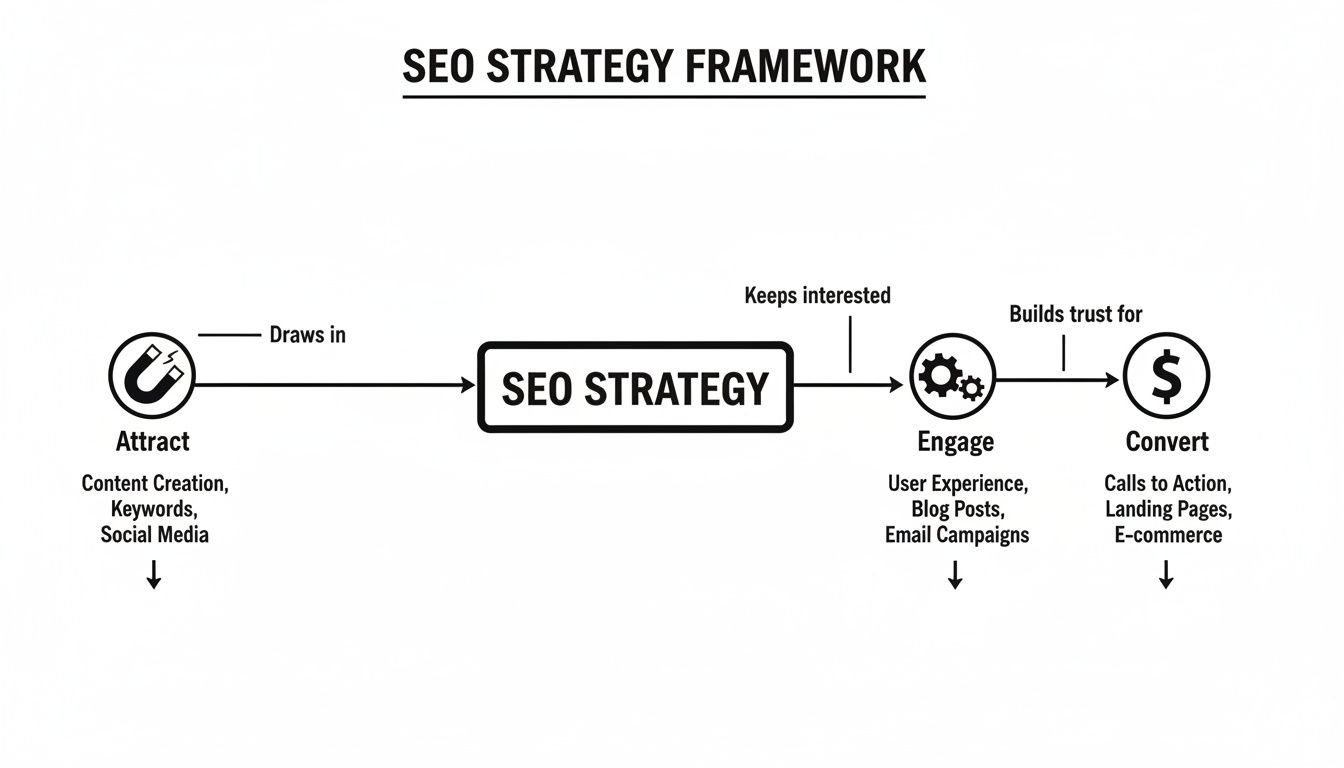
As the visual illustrates, there’s a logical progression. Each stage requires different tactics to guide a prospect smoothly to the next step.
Matching your content to these intent types is non-negotiable. If you create decision-stage content for a user who is just learning, bounce rates will skyrocket, a clear signal to Google that your page isn't a good fit.
The most effective SEO content strategy doesn't just answer questions; it anticipates the next one. It guides the user from a broad problem to a specific solution, building trust with every click.
Understanding the Three Core Search Intents
Let's explore this with a real-world example for a firm selling CRM implementation services. Each stage of intent demands a different type of content.
Informational Intent ("I need to learn")
At the top of the funnel, the prospect has a problem but may not know the solution. Searches are broad and often phrased as questions. Your role is to be a helpful expert, not a salesperson.- Example Searches: "how to improve sales team efficiency," "signs of an outdated CRM," or "what is lead nurturing."
- Content Match: In-depth blog posts, ultimate guides, checklists, and explainer videos that educate them on the problem.
Consideration Intent ("I need to compare options")
In the middle of the funnel, the prospect has defined their problem and is actively researching solutions. They are comparing vendors, products, and different approaches.- Example Searches: "best crm for small professional services," "Salesforce vs HubSpot for B2B," or "crm implementation partner reviews."
- Content Match: Detailed case studies, comparison guides, webinar recordings, and white papers that prove your expertise and showcase results.
Transactional Intent ("I need to buy")
At the bottom of the funnel, the searcher is ready to act. Their queries are specific and often include commercial terms like "pricing" or "quote." They need final details to remove any last-minute barriers.- Example Searches: "Salesforce implementation pricing," "contact Twelverays for a CRM quote," or "hire a CRM consultant."
- Content Match: Service pages, pricing pages, consultation forms, and client testimonials.
- In-Depth Guides and Blog Posts: Perfect for targeting informational keywords like "how to..." or "what is...". A comprehensive guide attracts traffic and builds authority.
- Checklists and Templates: Simple, downloadable resources offer immediate value. A one-page checklist can be more effective than a dense white paper and works well as a lead magnet.
- Explainer Videos: Visuals simplify complex ideas. A short animated video or screen-share can break down an intimidating process, making your brand feel helpful and approachable.
- Case Studies: For B2B audiences, proven success is paramount. Detailed case studies outlining a client's problem, your solution, and measurable results are incredibly persuasive.
- Webinars: Live or on-demand, webinars allow you to dive deep into a topic, showcase your team’s expertise, and answer tough questions directly. They are powerhouses for nurturing qualified leads.
- Comparison Guides: Don't shy away from creating content that compares products, methodologies, or services. An honest, well-researched guide positions you as a transparent, trusted advisor.
- Service or Product Pages: These pages must be crystal clear, detailing what you offer, the tangible benefits, and who it’s for. Optimize them for transactional keywords that include terms like "pricing," "services," or your brand name.
- Client Testimonials and Reviews: Social proof is crucial at this stage. Direct quotes, video testimonials, and positive reviews can overcome last-minute hesitation.
- Free Consultations or Demos: Offering a no-obligation consultation or demo is a low-risk, high-value call-to-action that moves a hot lead into your sales pipeline.
- Site Speed: Page load time is a massive ranking factor. A slow site frustrates visitors, causing them to leave before reading your first sentence.
- Schema Markup: This code helps search engines understand the context of your content. It can unlock "rich snippets" in search results, like star ratings or event details, that significantly boost click-through rates.
- Internal Linking: Strategically linking between related articles on your site helps search engines discover more content and understand its topical authority. It also keeps users on your site longer, guiding them to other helpful resources.
- Lead Scoring: Automatically assign points to leads based on the content they consume. Someone who reads three case studies is a hotter lead than someone who only glanced at the homepage.
- Personalized Follow-ups: Sales teams can see a prospect’s full engagement history, allowing them to tailor outreach by referencing topics the prospect is interested in, leading to warmer conversations.
- Content Gap Analysis: By analyzing the content journeys of your most successful customers, you can pinpoint which assets are most effective at moving deals forward. This data helps you decide where to invest content resources for maximum impact.
- Content Title & Target Keyword: The main search query and the working title.
- Target Persona & Funnel Stage: Who you're talking to and where they are in their journey (e.g., Awareness, Consideration).
- Content Format: Is it a blog post, case study, webinar, or something else?
- Key Dates: Milestones like draft deadlines, review dates, and the final publish date.
- Author & Stakeholders: Clear ownership for creation and sign-off.
- Owned Channels: These are platforms you control completely. Your email newsletter is arguably your most powerful owned channel, delivering content to a receptive audience. You can also promote new pieces across your social media profiles and feature them on high-traffic pages.
- Earned Channels: This is about getting others to talk about your content. It includes strategic outreach for guest posting, building relationships with industry influencers, and participating in online communities where you can share your expertise and a relevant link.
- Paid Channels: When you have a proven piece of content, paid promotion is like pouring gasoline on a fire. This could mean boosting a post on LinkedIn to reach a specific professional audience, running targeted social media ads, or using paid search to drive traffic to a cornerstone guide.
- Organic Lead Generation: How many new contacts entered your CRM after finding and engaging with content that ranks in search? This is your most critical connection.
- Conversion Rates from Search: What percentage of organic visitors took a meaningful action, like downloading a case study, requesting a demo, or filling out a contact form?
- Content-Influenced Revenue: This is the ultimate metric. Using your CRM, can you attribute new sales opportunities or closed deals to specific articles a prospect read during their buying journey?
- Industry Competitiveness: Crowded markets require more time and effort to build authority.
- Website Authority: An established site with a solid backlink profile will gain momentum faster than a brand-new domain.
- Consistency of Execution: A regular publishing and promotion schedule builds momentum over time, much like compounding interest.
Mapping your content this way ensures you have an asset ready for your ideal client at every step. This methodical approach is key to building topical authority. Instead of chasing random keywords, you group them into thematic hubs. Learn more about this powerful tactic in our guide on what keyword clusters are and how to use them. This structured approach transforms your website from a simple brochure into a valuable, problem-solving resource that search engines and potential clients will reward.
Choosing the Right Content Formats for Maximum Impact
Think of your content strategy like a toolkit. You wouldn't use a sledgehammer for a finishing nail, and you shouldn't use a case study to attract someone just realizing they have a problem. Selecting the right content format for each stage of the buyer's journey is crucial for guiding prospects from initial awareness to a final decision.
This is where high-level planning connects to what your team creates. It ensures every blog post and webinar has a specific job, justifying the resources spent by linking each format to outcomes like generating qualified leads and helping sales close deals.

Content for the Awareness Stage
At the top of the funnel, your audience has a problem but may lack the words to describe it. Your goal is to educate, build trust, and answer high-level questions. This is about building the foundation of a relationship by positioning your brand as a credible expert.
Content for the Consideration Stage
Once someone enters the consideration stage, they've named their problem and are actively weighing options. Your content must pivot from general education to demonstrating deep expertise and proving your unique value. It’s time to show why you’re the better choice.
The goal in the consideration phase is to transition from being a helpful resource to being the obvious solution. Your content should build a compelling case for why your approach is the best fit for their specific problem.
At this point, you need content that helps them compare, validate, and feel confident in their choices.
Content for the Decision Stage
In the final stage, your prospect is on the verge of purchase. They have narrowed their options and are looking for final assurance and logistical details. Your content here must be direct, remove friction, and make the next step easy.
This is where your SEO content strategy pivots again to directly support the sales process.
By thoughtfully selecting formats for each step, you create a smooth journey that meets your audience where they are. Video content, for example, is versatile and can be adapted for each stage, a topic we explore in our guide on using video in your social media marketing. This alignment ensures your efforts build momentum, turning search traffic into sustainable business growth.
Integrating Technical SEO and CRM for a Seamless Journey
You can create the most compelling content, but it’s useless if no one finds it. An effective SEO content strategy doesn't end at "publish." It also ensures every asset is discoverable by search engines and that its business impact is measurable.
This is where technical SEO becomes your greatest ally.
Think of technical SEO as the foundation of your digital house and your content as the rooms. Without a solid foundation, even the most beautifully decorated rooms will crumble. Technical elements make your website fast, easy for search engines to crawl, and simple for people to navigate.

Building the Technical Foundation for Content
Many marketers shy away from technical SEO, viewing it as a developer's job. In reality, several key components are directly tied to content performance, and marketing leaders must be familiar with them. These aren't just minor tweaks; they send critical signals to search engines about your content's quality and relevance.
The stakes are high. The majority of online journeys begin with a search engine, and organic search remains a leading discovery channel (per BrightEdge research). For professional services firms, small technical advantages compound. URLs that contain a keyword see roughly 45% higher click-through rates (Backlinko), and a page that loads in one second can convert about three times higher than one taking five seconds (Portent).
Connecting Content Engagement to Revenue with CRM
Getting traffic is just the first step; the real goal is converting it into revenue. Integrating your content efforts with your Customer Relationship Management (CRM) system, like Salesforce or HubSpot, is a game-changer. It’s how you move from marketing as an art to marketing as a science.
By linking your content analytics directly to your CRM, you create a powerful, closed-loop system. You can finally draw a straight line from a specific blog post to a closed deal, providing undeniable proof of your content's ROI.
This integration lets you track a prospect's entire journey, seeing which blog posts they read, white papers they downloaded, and webinars they attended before a salesperson ever speaks with them. Learn more about the mechanics in our guide on what CRM integration is.
This connection creates a feedback loop that sharpens your entire SEO content strategy.
Turning Engagement Data into Actionable Insights
A CRM integration doesn't just measure past performance; it informs your future strategy and empowers your sales team. When marketing and sales data live in the same system, you unlock powerful capabilities.
By combining a strong technical SEO foundation with an integrated CRM, you transform your content from a collection of assets into a predictable, revenue-generating machine. This alignment ensures your hard work gets discovered and its business value is clearly quantified.
Building Your Editorial Calendar and Amplification Plan
An SEO content strategy remains a theory until put into practice. The real work is powered by two critical tools: a dynamic editorial calendar and a smart amplification plan. Together, they turn your goals into a disciplined workflow that builds momentum.
A good editorial calendar is more than a spreadsheet with due dates; it's the command center for your content operation. This living document maps out what you’re creating, who it’s for, and why it matters, ensuring every piece aligns with your marketing campaigns and business objectives. It helps you manage different formats, tackle keyword clusters, and maintain a steady publishing rhythm that search engines reward.
From Static List to Dynamic Workflow
The best editorial calendars are built for action. They bring clarity to your entire team, from writers and designers to subject matter experts, by outlining the full lifecycle of every piece of content.
Your calendar should be the single source of truth for production, preventing your content engine from becoming a series of disconnected, last-minute scrambles. For a deep dive into building one, our guide on how to create a content calendar lays out the complete framework.
An effective calendar tracks:
Creation Is Only Half the Battle
Publishing brilliant content without a promotion plan is like throwing a party and forgetting to send invitations. Content amplification is the work you do after publishing to ensure your investment reaches the largest possible audience. It’s about using multiple channels to kickstart traffic and accelerate the process of earning backlinks and social shares.
A great amplification plan doesn't just push content out; it places it directly in the path of the people who need it most. It's the difference between hoping for an audience and actively building one.
A solid plan utilizes three different types of channels, each playing a unique role in getting your content seen.
A Multi-Channel Amplification Framework
Your distribution strategy deserves as much thought as your creation process. Smart amplification ensures your most valuable content doesn't just sit on your blog.
By pairing a detailed editorial calendar with a multi-channel amplification plan, you create a complete, repeatable system. This workflow ensures every asset is produced with a clear purpose and promoted for maximum impact, turning strategy into measurable business results.
How to Measure Content Success Beyond Vanity Metrics
So, how do you prove your content is delivering business value? An effective SEO content strategy demands looking past surface-level numbers. Page views and social likes feel good, but they don’t justify your budget or show how content impacts the bottom line.
True measurement is about connecting content directly to business outcomes. It means drawing a straight line from a blog post to a new lead, a sales opportunity, and ultimately, a closed deal. This is how you transform content from a line item into a proven revenue engine.
Shifting Focus to Business-Centric KPIs
To get a real picture of your content's ROI, you must track the key performance indicators (KPIs) that your leadership team cares about. Instead of just reporting on traffic, you need to show how your content actively feeds the sales pipeline.
Your measurement framework should be built around these core business goals:
The goal is to shift the conversation from, "How many people saw our content?" to, "How much business did our content generate?" This change in perspective is fundamental to proving the value of your SEO content strategy.
Building Your Measurement Engine
To track these meaningful metrics, you must connect your website analytics and your CRM. This integration unlocks true revenue attribution. You can use tools like Google Analytics alongside your CRM to follow a user's entire journey, from their first organic search to becoming a paying customer.
A great starting point is setting up key events in GA4 for actions like form submissions. Then, use hidden fields in your forms to capture the original traffic source. When that lead data flows into your CRM, you’ll have a permanent record of where the contact came from, giving your sales team valuable context and marketing clear attribution.
This data-driven approach dramatically impacts resource allocation. A strong SEO content strategy can cost about 62% less than traditional marketing while generating roughly 3 times as many leads (Demand Metric), an airtight case for investment. The latest Content Marketing Institute B2B research backs the trend: marketers report content helped create brand awareness (87%), generate demand and leads (74%), and nurture audiences (62%). You can read more in CMI's B2B content marketing research.
By focusing on these business-centric KPIs, you're not just creating reports; you're providing hard evidence that your content is a core contributor to the company’s growth. It's how you prove your strategy isn't just making noise but delivering tangible, measurable results.
Frequently Asked Questions
Even the best-laid plans encounter questions. Let's tackle some common hurdles marketing managers face when implementing an SEO content strategy.
How Long Does It Take to See Results from an SEO Content Strategy?
This is the million-dollar question, and the honest answer is: patience is key. While you might see early positive signals within three months, significant, lasting results take six to twelve months. Think of SEO as a long-term investment, not a quick fix.
The timeline can shift based on several factors:
The best analogy is planting a tree. It takes work upfront, but the growth compounds, eventually yielding something of lasting value.
Should I Delete or Update Old Content?
Almost always choose to update rather than delete. Your existing content is a valuable asset. It's already indexed by search engines and may have earned backlinks over the years. Deleting it throws away that value and forces you to start from scratch.
Your old content isn't dead weight; it's a foundation you can build on. A strategic content refresh can often deliver faster results than creating a brand-new piece from the ground up.
Instead of trashing old posts, conduct a content audit to find underperforming pages. Revitalize them by updating statistics, adding new insights, improving readability, and ensuring they align with current search intent. This signals to Google that your content is fresh and relevant, often resulting in a rankings boost.
What’s the Difference Between SEO and AEO?
This is a great question, and the distinction is becoming increasingly important. SEO (Search Engine Optimization) is the classic practice of ranking web pages in standard search results. AEO (Answer Engine Optimization), on the other hand, focuses on getting your content featured as the direct answer for AI assistants and voice search.
Think of it this way: SEO’s goal is to earn a click to your website. AEO’s goal is to have your content featured as the definitive answer within the search experience itself, like in a Google AI Overview or a response from Siri.
A modern SEO content strategy must now address both. This means using structured data and clear, question-and-answer formatting to make it easy for answer engines to pull from your content. It’s about becoming the source of truth, not just another link in a list.
Ready to build an SEO content strategy that drives real business growth? The experts at Twelverays combine data-driven insights with strategic execution to turn your content into a predictable revenue engine. Get in touch with us today.


