

At its core, pay-on-performance SEO is a model where you compensate an agency only after they deliver specific, agreed-upon results. It’s analogous to a commission-only sales role: the paycheck is directly tied to performance, creating a powerful incentive to deliver.
This approach contrasts sharply with the traditional SEO retainer, where businesses pay a flat monthly fee for ongoing services, regardless of the immediate outcomes.
Demystifying The Pay On Performance SEO Model
The concept of a results-only payment structure is undeniably attractive, particularly for businesses previously let down by significant SEO investments that yielded little return. It presents a seemingly risk-free proposition, if the agency doesn’t perform, you don’t pay. It's no surprise this model resonates with companies seeking tangible business growth from their SEO campaigns.
However, it's crucial to understand the strategic difference. A traditional SEO partnership focuses on building a long-term, sustainable digital asset for your business through a comprehensive strategy. In contrast, a pure pay-on-performance SEO agreement almost invariably narrows the focus to hitting a few specific metrics, often as quickly as possible. For a complete overview, explore our guide on what Search Engine Optimization truly involves.
What Does "Performance" Usually Mean?
In most of these arrangements, "performance" is seldom tied directly to revenue or closed sales. Instead, it's typically defined by more accessible, top-of-funnel metrics. An agency might receive payment when:
- Your website achieves a first-page ranking for a specific keyword.
- Your site reaches a certain organic traffic threshold.
- A specific number of leads, such as form fills or phone calls, are generated.
The critical factor is the quality of these results. A #1 ranking is a hollow victory if it's for a keyword that generates zero qualified leads or sales. This is a common pitfall of simplistic performance models.
Common Pay On Performance SEO Models At A Glance
The structure of these agreements varies significantly, so understanding the landscape is essential before committing. Each model has distinct payment triggers, ideal applications, and inherent risks that could impact your business.
Here’s a concise summary of the most prevalent frameworks.
Understanding these structures is the first step in determining if a performance-based model is a suitable fit, and how to protect your interests if you proceed.
Exploring The Different Performance SEO Models
Beyond the basic concept, pay on performance SEO encompasses a spectrum of models, each with unique mechanics, payment triggers, and use cases. Analyzing these variations is key to finding an approach that aligns with your business goals rather than just chasing vanity metrics.
Every performance-based deal follows the same fundamental flow: client investment and agency risk on one side, measurable results on the other.
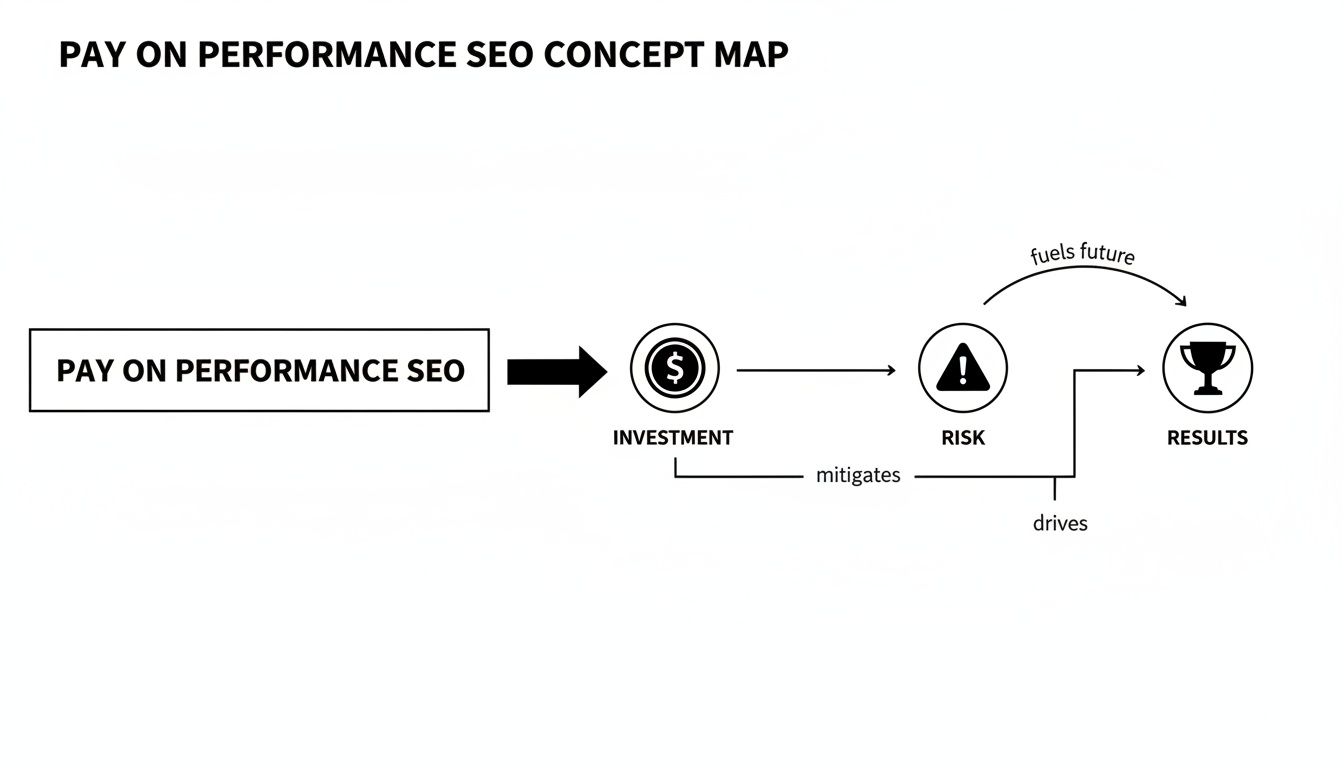
The model is designed to shift initial financial risk from the client to the provider, making tangible results the catalyst for payment.
The Keyword Ranking Model
This is the most traditional, and often most flawed, version of performance SEO. The agreement is simple: you pay the agency upon reaching a specific ranking (e.g., top 3 or top 10) for a pre-agreed list of keywords.
While it sounds straightforward, the danger lies in keyword quality. It's not uncommon for agencies to game this system by targeting low-value, low-competition terms. Some have been known to focus on keywords with global search volumes of just 0-10 monthly searches. They meet their contractual obligations and get paid, but the effort generates virtually no business impact for you.
Cost Per Lead (CPL) Model
The CPL model represents a significant improvement over chasing rankings. Here, payment is tied to a specific action, typically a lead generation event like a submitted contact form, a newsletter sign-up, or a tracked phone call. For service-based businesses, this model is highly appealing as it focuses on bringing potential clients through the digital door.
The primary challenge, however, is defining a "qualified" lead. Without strict, clear criteria, you risk paying for spam, inquiries from outside your service area, or contacts who are not a good fit for your offerings.
A successful CPL agreement requires a crystal-clear definition of a qualified lead, ideally verified by your sales team. For example, a law firm might only pay for form submissions from individuals within their state seeking help for a specific practice area.
Cost Per Acquisition (CPA) Model
The CPA model takes performance a step further, tying payments directly to a new customer or completed sale. This is the ideal for many businesses, as it connects SEO investment directly to revenue. It is most prevalent in eCommerce, where a sale is easily and immediately trackable.
However, it becomes more complex for businesses with longer sales cycles. If an organic lead takes three months of follow-up to become a client, attributing that final sale solely to the initial SEO touchpoint is a significant challenge. This model demands sophisticated tracking and tight integration between website analytics and your CRM.
The Revenue Share Model
As the name suggests, this model involves sharing a percentage of the revenue generated from organic search traffic with your SEO partner. This structure fosters the ultimate partnership, as the agency is incentivized not just to drive traffic but to help convert that traffic into high-value customers.
This is by far the most complex model to execute, due to several factors:
- Total Transparency: It requires you to grant the agency full visibility into your sales data.
- Attribution Complexity: An airtight system is needed to accurately track a customer's journey from their first organic click to the final purchase.
- Profit Margins: It is primarily viable for businesses with high-margin products or services, where sharing revenue is financially sustainable.
Each model offers a unique way to structure a pay on performance SEO agreement. While some are more directly tied to your bottom line, all demand a firm grasp of the mechanics and potential pitfalls. Getting this right is fundamental before you can explore the different types of SEO work and decide which strategy is the best fit for you.
The Hidden Risks and Unspoken Truths
The promise of paying only for results sounds like a dream, a risk-free path to growth. This appeal begs the question: why do so many top-tier SEO agencies avoid pure pay on performance SEO agreements?
The answer lies in the intense pressure to deliver results fast, which can transform a seemingly smart investment into a costly disaster. This environment creates a perfect storm for shortcuts and unethical tactics that can inflict severe, long-term damage on your brand.
When an agency's entire revenue depends on hitting a specific metric, the temptation to use aggressive, "black-hat" tactics can be overwhelming. These are the SEO equivalent of performance-enhancing drugs; they might yield a short-term win, but the consequences will eventually lead to penalties and reputational ruin.
The Lure of Low-Value Keywords
One of the most common pitfalls is the bait-and-switch on keyword targets. A performance contract might stipulate payment for achieving top-five rankings for ten keywords. Sounds great, right?
To get paid quickly, an unscrupulous agency might focus on obscure, long-tail keywords with virtually zero search volume. They'll successfully rank your site for terms like "best industrial widget supplier in north platte nebraska," meet their contractual goal, and promptly issue an invoice.
You receive a report showing "success," but your phone doesn't ring and your inbox remains empty. You’ve paid for a result that provides no business value. While the agency technically fulfilled the agreement, you're left with useless rankings and a wasted budget.
This focus on vanity metrics is a classic shell game. The agency delivers on paper, but the performance you paid for has no connection to your bottom line. True SEO success is about driving profitable customer action, not just rankings.
Black-Hat Tactics and Long-Term Damage
Beyond targeting worthless keywords, the pressure to perform can lead to far more destructive strategies. To secure rankings at any cost, some providers resort to dangerous tactics that can get your website penalized or even de-indexed by Google.
These high-risk methods often include:
- Spammy Link Building: While pages ranking #1 have, on average, 3.8 times more backlinks than positions 2 through 10 (Backlinko, 11.8M results), quality is paramount. Black-hat providers build thousands of low-quality links from spammy comments, private blog networks (PBNs), and even hacked websites to create an illusion of authority.
- Keyword Stuffing: This involves unnaturally cramming keywords into content, sometimes hiding text so it's invisible to users but visible to search engines. This creates a poor user experience and is a major red flag for Google.
Once Google's algorithms detect these manipulations, the penalties are swift and severe. Your website's rankings can plummet, organic traffic can disappear, and your domain's authority, built carefully over years, can be permanently damaged. For a deeper look at what to avoid, review this list of common SEO mistakes to avoid that can cripple your digital presence.
The recovery from a Google penalty is an arduous and expensive process, often costing far more than a standard, ethical SEO investment. You end up paying to fix a problem created by the very model designed to "protect" you. This is the unspoken truth of many pay on performance SEO deals: initial savings are often dwarfed by the long-term cost of cleanup and recovery.
How to Structure a Smarter Performance-Based Deal
A pure pay-on-performance SEO model is often a major red flag. However, this doesn't invalidate the concept of performance incentives. The solution is to move away from high-risk, results-only arrangements toward a smarter, hybrid "performance-tied" agreement. This approach fosters a genuine partnership that protects both parties and keeps everyone focused on sustainable business growth.

Consider it like building a custom home. You wouldn't tell the builder you'll only pay them once the entire house is finished. Instead, you pay for milestones: the foundation, the framing, the electrical work. A smart SEO model operates on the same principle.
A modest base retainer covers the essential groundwork, technical audits, content strategy, and on-page optimization. Then, performance bonuses are triggered when the agency delivers on specific, high-value business outcomes. This structure provides the agency with the resources to do the job correctly while incentivizing them to drive the bottom-line results you truly care about.
Define What Success Actually Looks Like
First, you must move beyond vanity metrics. Rankings and traffic are components of the strategy, not the end goal. Your agreement must be built around Key Performance Indicators (KPIs) that directly correlate with revenue.
Shift your focus from broad, ego-boosting keywords to the high-intent keywords tied to your most profitable services. These are the phrases your ideal customers use when they are ready to make a purchase.
Here’s how that mindset shift looks in practice:
- From: "Rank #1 for 'IT services'"
- To: "Generate 15 Sales Qualified Leads (SQLs) per month from keywords like 'managed IT support for law firms' or 'cybersecurity consulting for healthcare'."
This approach forces a conversation about business goals from day one, ensuring everyone agrees on what a "win" means for your company's finances, not just its search rankings.
Establish Realistic Timelines and Expectations
SEO is a marathon, not a sprint. Any reputable agency will be transparent about this, and setting realistic timelines is a critical part of a performance agreement. Anyone promising page-one rankings in 30 days is likely using questionable tactics that will lead to future penalties.
Sustainable results from ethical SEO work typically take 6 to 12 months to materialize. Your contract should reflect this reality with tiered goals and clear milestones. For instance, the first three months might focus on technical fixes and content development, with lead generation targets beginning in month four and scaling up from there.
A well-structured agreement should outline a clear roadmap with phased objectives. This prevents misunderstandings and holds the agency accountable for steady progress, not just a distant end goal.
Sample SLA Clauses for Your Agreement
Your Service Level Agreement (SLA) is the rulebook for your partnership. It must be crystal clear to avoid misunderstandings. Below are sample clauses you can adapt for a solid, performance-tied contract.
Sample KPI Definition Clause:
"A 'Sales Qualified Lead' (SQL) is defined as a contact form submission or tracked phone call originating from organic search traffic, from a company within our target industry and service area, that has been reviewed and accepted by our sales team as a viable prospect."
Sample Performance Bonus Clause:
"Upon achieving and maintaining a monthly average of twenty (20) verified SQLs for a consecutive three-month period, a performance bonus of [Amount] shall be paid. An additional bonus tier will be triggered if the SQL-to-customer conversion rate exceeds 15% for any given quarter."
Quality, sustainable SEO is an investment in expertise, and retainer pricing varies widely by provider size. SE Ranking's 2025 agency pricing survey of 260 agencies found most charge under $2,000 per month, while a separate Ahrefs survey of 439 providers put the average agency retainer at $3,209 per month, a figure pulled up by larger enterprise engagements. B2B firms with complex strategy, content, and technical needs should expect to land on that higher end. This investment covers the foundational work that makes hitting performance targets possible.
Measuring Success Beyond Ranking Reports
A performance-based partnership lives or dies by its data. To truly know if a pay on performance SEO strategy is working, you must look past simple ranking reports and track the metrics that impact your bottom line. The conversation must shift from "Are we ranking?" to "Are we profitable?"

This requires a connected approach that provides full-funnel visibility, from the first click to the closed deal. Without this connection, you're unable to distinguish between SEO activities that generate real value and those that merely look good on paper.
Integrating SEO Analytics with Your CRM
The key to unlocking this visibility is integrating your SEO analytics (like Google Analytics) with your Customer Relationship Management (CRM) platform, such as Salesforce or HubSpot. This connection allows you to follow a user's entire journey, attributing revenue back to the specific organic search that brought them to you.
Think of it this way: Google Analytics tells you how many people attended your event. Your CRM tells you who they were, what they bought, and how much they spent. Integrating the two reveals exactly which invitations (your SEO efforts) attracted the most valuable guests.
This integration is the foundation for accurately measuring digital marketing performance and calculating the definitive Return on Investment (ROI) of your campaign.
The Metrics That Truly Matter
Once your systems are integrated, you can focus on the KPIs that drive business growth. Instead of getting bogged down in keyword positions, prioritize these bottom-funnel metrics:
- Lead-to-Close Ratio: What percentage of leads from organic search become paying customers? This metric reveals the quality of your traffic, not just the quantity.
- Customer Lifetime Value (CLV) by Source: Are customers from organic search more valuable over time than those from other channels? This helps you understand the long-term impact of your SEO investment.
- Cost Per Acquisition (CPA) from Organic: How much does it cost, on average, to acquire a new customer through SEO? This is the ultimate measure of efficiency.
Shifting your focus to these revenue-centric KPIs ensures your performance-based agreement is aligned with actual business success. It compels the agency to attract visitors who are ready to buy, not just browse.
A Practical Checklist for Robust Tracking
Setting up a data-driven framework doesn't have to be overwhelming. Following a clear process ensures no data is lost between your marketing and sales platforms.
Essential Tracking Setup:
- Configure Goals in Google Analytics: Set up specific conversion goals, like form submissions or phone number clicks, to track key on-site actions.
- Implement UTM Parameters: Use consistent UTM tags to properly segment and track traffic sources within your analytics.
- Ensure CRM Lead Source Attribution: Your CRM must have a field that automatically captures the original source of every lead, connecting them back to their organic search origin.
- Create Custom ROI Dashboards: Build reports in your CRM or a tool like Google Data Studio to visualize the entire funnel, from organic sessions to closed-won revenue.
This meticulous tracking separates legitimate performance SEO from risky alternatives. Globally, the #1 organic position captures around 27.6% of clicks (Backlinko, 4M results), but without tracking, you have no idea if those clicks ever convert. A solid data foundation ensures you pay for outcomes, not just traffic. Explore more about these kinds of SEO benchmarks and their impact to understand why this level of measurement is vital.
Is This SEO Model Right For Your Business?
Deciding on the right SEO model comes down to an honest assessment of your company's goals, resources, and risk tolerance. A pure pay-on-performance SEO deal is almost always a red flag, often suggesting an agency willing to take shortcuts for low-value, short-lived results.
However, performance incentives are not inherently flawed.
The most effective SEO partnerships often blend the stability of a traditional retainer with the motivation of performance bonuses. This hybrid approach provides an agency the resources to perform critical foundational work that builds lasting value. Simultaneously, it ties their ultimate success to the metrics that grow your bottom line. It's a strategic shift from chasing vanity rankings to generating measurable business outcomes.
A Self-Assessment Checklist For Your Business
Before engaging with agencies, conduct an internal review. Answering these questions will provide a framework for deciding if a performance-based model is a good fit.
- What is your true risk tolerance? Are you comfortable with an agency potentially using aggressive tactics to hit a number? Or do you prefer a steady, sustainable strategy that builds domain authority for the long term?
- How long is your sales cycle? If it takes six months to convert a lead, a simple Cost Per Lead (CPL) model will miss the mark. You'll need a more sophisticated method for tracking long-term value.
- Can you accurately track ROI? Is your CRM integrated properly? Can you trace a lead from their first organic click to a closed deal? If not, proving performance becomes a guessing game.
- Do you have internal buy-in? Is your sales team prepared to collaborate with marketing to validate lead quality and provide consistent feedback? This partnership is essential for a performance model to work.
Answering "no" to some of these questions doesn't disqualify you. Instead, it highlights the internal systems you need to strengthen before a performance-based deal can be effective. It reinforces the need for a partner who values transparent, data-driven strategies over risky shortcuts.
Ultimately, choosing an SEO strategy is a major business decision. While the allure of "only paying for results" is strong, understanding the nuances and potential pitfalls is critical. For a deeper analysis of whether an investment in search aligns with your goals, our guide on if SEO is worth it for your business offers valuable context.
The goal is to feel empowered to evaluate agencies and select a path that prioritizes sustainable growth. You're looking for a true partner, not a vendor chasing a quick commission.
Got Questions About Performance SEO?
Even with a clearer understanding of the model, questions are natural before shifting your SEO strategy. Let's address some of the most common inquiries from business leaders considering a pay-on-performance SEO partnership.
What Does a Hybrid Model Typically Cost?
A hybrid or "performance-tied" model isn't about finding the cheapest option; it's about establishing a fair and motivating partnership.
Most credible agencies will start with a base monthly retainer, typically between $2,500 and $7,500+ per month for B2B or professional services firms. This investment covers essential groundwork like technical audits, strategy development, and high-caliber content creation. The "performance" component involves pre-agreed bonuses paid only when specific, revenue-focused goals, like generating a certain number of Sales Qualified Leads (SQLs), are achieved and maintained.
How Long Until I See Meaningful Results?
SEO is a long-term investment. If an agency promises page-one rankings in 30 days, proceed with caution. Legitimate, lasting SEO strategies require time to build authority and earn trust from search engines.
A realistic timeline to see significant business impact, such as a consistent stream of qualified organic leads, is typically 6 to 12 months for most competitive industries. The initial months are dedicated to laying a solid foundation. You'll likely see tangible lead generation momentum build around the four-to-six-month mark.
How Can I Protect My Business From Risky Tactics?
Protecting your brand in any performance-based agreement comes down to clarity and accountability. Your Service Level Agreement (SLA) is your most important tool. It must be highly detailed, leaving no room for interpretation or dangerous shortcuts.
Insist on these clauses in your contract to safeguard your digital assets:
- A "No Black-Hat" Clause: This is non-negotiable. The contract must explicitly prohibit any tactics that violate Google's spam policies, such as paid links, keyword stuffing, or using private blog networks (PBNs).
- KPIs Tied to Quality: Performance is about lead quality, not just quantity. Your contract should specify that a lead only counts toward a performance target after being verified as an "SQL" by your sales team.
- Full Transparency and Reporting: Demand regular, detailed reports on all agency activities, including content created, links built, and technical changes. Vague reporting can be a red flag.
By incorporating these protections into your agreement, you build a partnership focused on sustainable growth. This ensures your pay-on-performance SEO investment becomes a valuable long-term asset, not a short-term liability.
At Twelverays, we build transparent, data-driven SEO strategies that connect directly to your revenue goals. If you're ready to move beyond vanity metrics and focus on measurable growth, let's talk about building a performance-tied partnership that works for you.


