

A marketing funnel is the strategic framework that maps a customer's entire journey with your business, from their first moment of brand awareness to the point they become a loyal advocate. It’s a visual representation of how you guide potential customers through a series of stages, with each step designed to build trust and move them closer to making a purchase.
Think of it as a roadmap for turning strangers into your most valuable customers.
What Is A Marketing Funnel
Ever guided a new acquaintance from a casual conversation to a lasting friendship? A marketing funnel accomplishes something similar for your business. It replaces guesswork with a structured, repeatable system for generating revenue and building customer relationships. Instead of just hoping for sales, you create a clear, intentional path for them to happen.
This isn't a new-age concept; it’s a time-tested model rooted in consumer psychology. By breaking down the customer journey into distinct phases, you can tailor your messaging, content, and offers to what your audience needs at that exact moment. This strategic alignment is the key to moving people smoothly from one stage to the next.
The Foundation of Modern Marketing
The concept of the marketing funnel dates back to 1898 when American advertising pioneer E. St. Elmo Lewis introduced the AIDA model: Awareness, Interest, Desire, and Action. This simple framework mapped the linear path a customer took from first learning about a product to finally buying it. It gave marketers a powerful, straightforward way to structure their campaigns, and its influence remains evident in today's strategies.
This foundational model allows businesses to:
- Pinpoint Customer Mindset: Understand what prospects are thinking and feeling at each step of their journey.
- Align Marketing Activities: Deploy the right tactics at the right time, like using blog posts for awareness and case studies for consideration.
- Measure What Matters: Track how effectively you’re moving people through the funnel and identify bottlenecks.
- Predict Revenue: Develop more reliable sales forecasts by understanding conversion rates between stages.
A well-structured funnel doesn't just attract customers; it builds momentum. Each stage is designed to seamlessly guide a prospect to the next, reducing friction and increasing the likelihood of conversion by consistently delivering value.
From Awareness to Action
At its core, the funnel is wide at the top to capture a large audience of potential leads and gradually narrows as those leads move closer to a decision. The top of the funnel focuses on creating awareness and sparking initial interest, often through tactics that support effective demand generation marketing. As people move down, your communication becomes more targeted, nurturing their interest and building a genuine desire for your solution.
Ultimately, the goal is to drive a specific action, whether that's making a purchase, signing up for a demo, or subscribing to a service. Mastering this framework provides the clarity needed to attract, engage, and convert your ideal customers, even in a crowded market. It’s about becoming the helpful guide your future customers are already searching for.
Exploring The Key Marketing Funnel Stages
To master the modern marketing funnel, you must understand its core stages. Each has distinct goals, tactics, and, most importantly, addresses a different customer mindset. While the classic AIDA model provides a great starting point, today’s funnel extends beyond the sale into crucial post-purchase phases that drive long-term growth.
Let’s walk through this journey, from the moment a potential customer senses a problem to becoming a passionate advocate for your brand. This process is typically segmented into three main phases: Top of Funnel (TOFU), Middle of Funnel (MOFU), and Bottom of Funnel (BOFU).
The diagram below illustrates the traditional AIDA framework, the bedrock for understanding how a customer moves from initial Awareness to final Action.
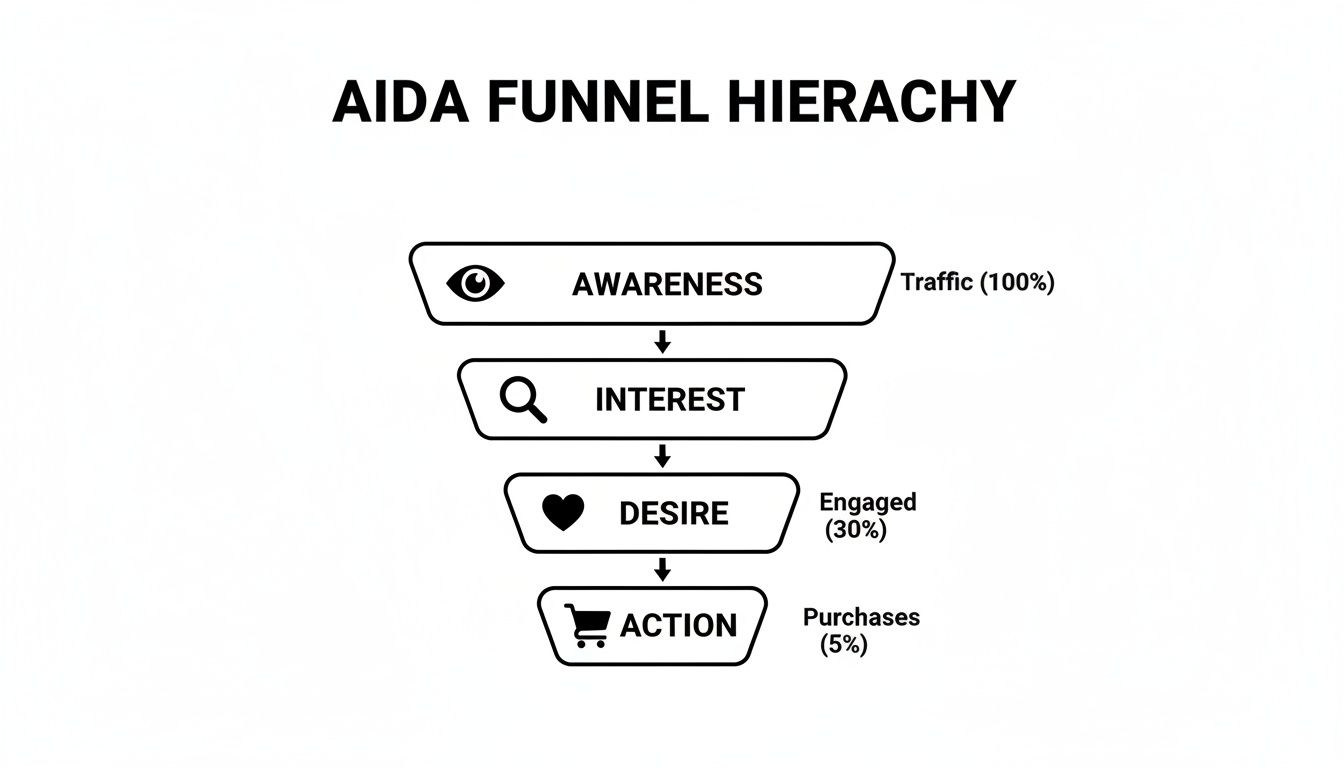
You can see how a wide audience at the top narrows as individuals get closer to a buying decision.
Top of Funnel (TOFU): The Awareness Stage
At the top of the funnel, your audience is aware they have a problem but may not know a solution exists. They're experiencing the symptoms of a pain point but haven't defined it or started searching for a specific fix. Your goal here is not to sell; it's to educate, inform, and get on their radar.
Think of TOFU as the first handshake. The content you create for this stage must be helpful, broad, and easily discoverable.
- Customer Mindset: "I have this issue, but I'm not sure what it is or how to solve it."
- Your Goal: Attract the right audience and position your brand as a helpful, credible expert.
- Effective Channels: SEO-optimized blog posts, social media content, podcasts, and informational videos.
For example, a user might Google "how to improve team productivity" long before they consider project management software. A blog post answering that exact question places your brand in their mind as a trusted guide, building initial trust without sales pressure.
Middle of Funnel (MOFU): The Consideration Stage
Once a prospect enters the middle of the funnel, they have defined their problem and are actively researching different ways to solve it. This is where they begin comparing products, vendors, and approaches. Your marketing must shift from general education to targeted persuasion.
This is your opportunity to showcase your expertise and demonstrate why your solution is the best fit. Your content needs to build their confidence and answer the question: "Why should I choose you?"
The MOFU stage is about building trust. Prospects are evaluating your credibility and expertise. In-depth, valuable content like case studies or webinars can make a significant difference by showing what you can do, not just telling.
Some of the most effective MOFU content includes:
- In-depth guides that compare various solutions.
- Case studies that highlight real-world success stories.
- Webinars that offer a deep dive into a relevant topic.
- Email nurture sequences that deliver targeted, useful information over time.
This type of content helps them envision success with your solution, nudging them closer to a final decision.
Bottom of Funnel (BOFU): The Decision Stage
At the bottom of the funnel, your leads are ready to make a commitment. They’ve done their research, weighed their options, and narrowed the field to a few contenders. The goal is now to convert these highly-qualified leads into customers by removing any final barriers and making it easy to say yes.
Your communication must be direct, value-packed, and compelling. You are making a clear offer and providing the final nudge they need. For a deeper dive into structuring this phase, check out our guide on how to create a sales funnel.
Tactics for this stage are laser-focused on conversion:
- Product Demos: Let them see your solution in action.
- Free Trials: Give them a chance to experience the value firsthand.
- Consultations: Offer personalized advice to solve their specific challenges.
- Customer Testimonials: Use social proof from happy clients to build confidence.
The objective here is to reduce perceived risk and build absolute certainty in your offer.
Beyond The Funnel: Retention And Advocacy
The journey doesn't end with a sale. The most successful businesses understand that retaining an existing customer is far more cost-effective than acquiring a new one. The post-purchase stage is centered on two key outcomes: Retention and Advocacy.
The old, cone-shaped funnel emphasized awareness to capture the widest net of anonymous prospects, funneling them through the AIDA framework. This model was effective in an era with limited advertising channels.
Today, modern funnels are designed to turn happy customers into your most powerful marketers. This involves:
- A seamless onboarding experience: Ensure new customers achieve value quickly.
- Proactive customer support: Provide helpful answers before they even need to ask.
- Loyalty programs: Reward repeat business and maintain engagement.
- Referral campaigns: Make it easy for satisfied customers to spread the word.
When you delight customers after the sale, you initiate a powerful growth loop where your best clients become your most effective marketing asset.
To provide a clearer picture, here’s a breakdown of how these stages connect to goals, tactics, and metrics.
Marketing Funnel Stages And Key Metrics
This table summarizes each stage in the marketing funnel, outlining its primary objective, common marketing activities, and the Key Performance Indicators (KPIs) you should track to measure success.
Using this framework helps ensure you’re deploying the right tactics at the right time and, most importantly, measuring what truly matters at each step of the customer journey.
The Old Marketing Funnel Is Broken. Here's What Replaced It.
The customer journey has evolved, and if your marketing funnel hasn't, you're falling behind. The linear, predictable path that defined marketing for over a century is now obsolete. It has been replaced by a dynamic, customer-led model because today's buyers are in control, armed with research from search engines, social media, and peer reviews.
This means they can enter your funnel at any stage, not just the top. Someone might discover your brand through a detailed case study (MOFU) or a product comparison (BOFU) long before seeing an introductory blog post. Sticking to the old model is like building a highway with only one on-ramp; you're missing most of the traffic.
From A Linear Path To A Cyclical Journey
The traditional funnel excelled at getting a person from Point A (awareness) to Point B (purchase). Its flaw was viewing the customer relationship as a transaction that ended when money changed hands. This short-sighted, linear thinking is a liability when customer retention and advocacy are the true engines of sustainable growth.
This is why cyclical models, like the flywheel, have gained popularity. A flywheel is a self-reinforcing loop where your happiest customers feed new growth back into the business.
Instead of a funnel that constantly leaks energy as prospects drop off, the flywheel gains momentum with every positive customer interaction. It's about turning buyers into active promoters, creating a growth engine fueled by word-of-mouth. After all, your best marketers are your happiest customers.
The core idea is a shift from a "capture and convert" mindset to a "delight and empower" philosophy. When the customer experience becomes your central focus, the funnel stops being a leaky bucket and starts acting more like a perpetual motion machine for your business.
Why The Old Funnel Is Breaking Down
Several major market shifts have pushed the traditional funnel to its breaking point. Signal loss is a major one. Apple's App Tracking Transparency, stricter browser defaults, and privacy regulation have made massive, impersonal awareness campaigns harder to target and measure. Even after Google reversed its plan to remove third-party cookies from Chrome, the broader privacy shift stands. You can no longer just cast a wide net; you must build genuine relationships based on trust and value.
This evolution is reflected in how people begin their buying journey. The funnel has transformed from the rigid AIDA path of 1898 into a dynamic experience that treats people as individuals. Prospects might arrive from a paid search ad, find you on social media, or click a personalized email recommendation. Roughly 75% of B2B buyers use social media to support their buying decisions, according to IDC research. You can find more insights on the history of marketing funnels.
Here’s a breakdown of the old approach versus the new:
Adapting to this new reality isn't just a good idea, it's essential. Businesses clinging to the old, rigid model will find themselves talking to an empty room. Those that embrace a fluid, non-linear, and customer-centric approach will build the authentic relationships that drive lasting success. The modern marketing funnel is less about forcing people down a path and more about being a helpful guide, ready to meet them wherever they are.
Adapting The Funnel For B2B And Service Businesses
The marketing funnel isn't a one-size-fits-all blueprint. While its core concept of guiding customers holds true, applying a consumer model to a B2B or service-based company is ineffective. It’s like navigating a maze with a map for a straight road.
The key differences? B2B sales cycles are longer, price points are higher, and decisions are rarely made by one person.
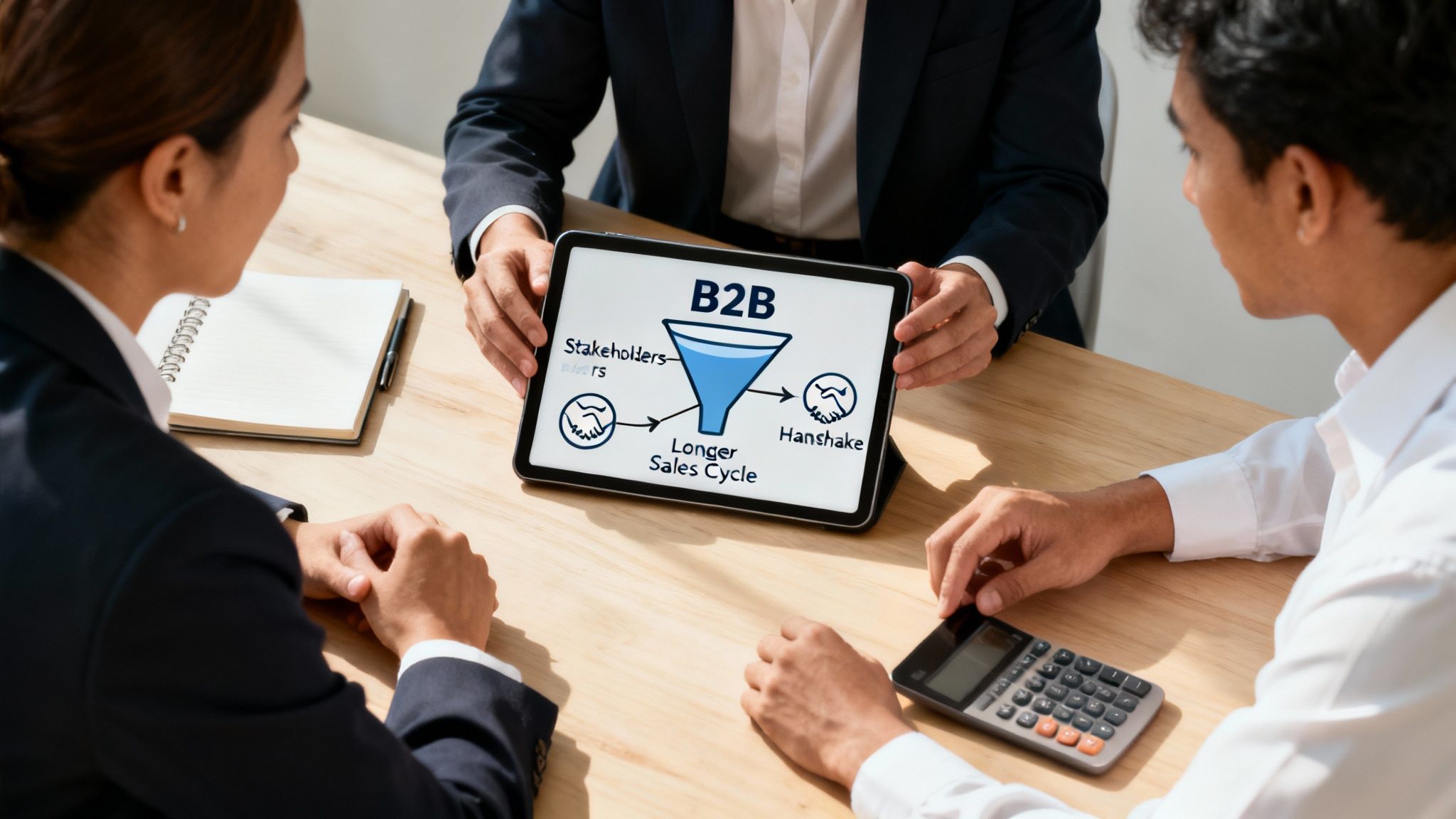
This complexity changes the entire dynamic. You aren't just winning over a single buyer; you're navigating a web of decision-makers, from the department head feeling the pain point to the CFO scrutinizing the budget. Each individual has different concerns and questions that you need to address.
Mapping The Complex B2B Buyer's Journey
The first step is to map this intricate buyer's journey. Most B2B purchases involve a buying committee, which might include an IT manager, a project lead, and a C-level executive. Each of them needs different information to get on board.
For example, a marketing director might be your internal champion, but the CTO will have questions about security and integration, while the CEO is focused on long-term ROI. Your content must speak to all of them.
To achieve this, build specific assets for each stakeholder at every stage. Here’s how a consulting firm might approach this:
- TOFU (Awareness): A webinar on "Industry Trends in Process Optimization" can attract department heads looking for high-level solutions.
- MOFU (Consideration): An interactive ROI calculator helps a finance manager quantify potential savings.
- BOFU (Decision): A personalized consultation with a senior partner directly addresses a CEO's specific operational challenges.
This targeted approach ensures every key player gets the information they need, when they need it.
The Critical Role Of Lead Nurturing And Scoring
In the B2B world, a prospect can spend months in the consideration stage, gathering data and building internal consensus. This is where lead nurturing and lead scoring become indispensable. You can't just present an offer and hope for the best; you must build a relationship over time.
Lead scoring is a system that assigns points to prospects based on their profile (job title, company size) and behavior (downloading a whitepaper, visiting the pricing page). This data-driven method helps your sales team identify the most engaged leads, allowing them to focus their energy where it will have the greatest impact.
A B2B funnel without lead nurturing is like a garden without water. Prospects need consistent, valuable engagement to grow from initial interest into a confident purchase decision. Neglecting this crucial step is the fastest way to lose high-value deals.
Once a lead reaches a certain score, nurturing sequences can be triggered. These are automated email campaigns designed to deliver the right content at the right time, systematically answering questions and overcoming objections. A lead who attended your webinar might receive a follow-up with a related case study, then an email with a customer testimonial a week later. Each touchpoint adds value and moves them closer to a decision.
For a deeper dive, our guide to lead nurturing automation explains how to build these effective sequences.
By adapting the funnel for these complexities, B2B and service-based businesses can transform a generic model into a precise, high-performance engine for winning and retaining high-value clients.
How To Measure And Manage Your Funnel With A CRM
A marketing funnel without data is an expensive guess. To turn your funnel into a predictable, performance-driven machine, you need a central hub to track, measure, and manage every interaction. This is where a Customer Relationship Management (CRM) system becomes your most valuable asset.
Platforms like Salesforce or HubSpot are designed to connect all your marketing and sales activities, giving you a complete view of how leads move from their first click to final purchase. Without a CRM, you're left trying to piece together a story from scattered data in spreadsheets, email platforms, and analytics tools, making it nearly impossible to see the full picture.
Turning Data Into Actionable Insights
A robust CRM pulls every touchpoint, website visits, email opens, content downloads, and sales calls, into a single, unified profile for each lead. This is the critical first step to understanding how your funnel performs in the real world, not just on a whiteboard.
This consolidated view, like the one in the Salesforce example below, integrates data from multiple sources to create a complete picture of your customer.
When you connect these dots, you can finally pinpoint where your funnel is working effectively and, more importantly, where it’s leaking leads.
With this level of clarity, you can answer critical questions:
- Which blog posts are generating qualified leads?
- What is our conversion rate from the consideration (MOFU) to the decision (BOFU) stage?
- How long is our average sales cycle, and which activities shorten it?
A CRM doesn’t just hold data; it provides answers, turning abstract metrics into a clear roadmap for what to do next. To learn more, check out our article on the key benefits of using a CRM for your business.
Automating Nurturing And Spotting Bottlenecks
One of the most powerful features of a modern CRM is marketing automation. You can build automated email nurturing sequences that trigger based on specific user actions, delivering the right message at the perfect time. For example, if a lead downloads a case study, your CRM can automatically enroll them in a follow-up sequence that offers a product demo a few days later.
A CRM doesn’t just store data; it activates it. By automating communications and tracking engagement, it ensures no qualified lead slips through the cracks and empowers you to make strategic adjustments backed by real-time insights.
This automation works hand-in-hand with analytics. By setting up dashboards in your CRM, you can monitor vital metrics like lead velocity, stage-by-stage conversion rates, and customer lifetime value (CLV). If you notice a significant drop-off between your MOFU and BOFU stages, the data might reveal that your sales team's follow-up is too slow or that your messaging fails to address key objections.
For instance, you might discover that leads who watch a webinar convert at a higher rate than those who only download an ebook. That is a game-changing insight. It tells you exactly where to double down, reallocating your budget and effort to the activities that truly move the needle.
Ultimately, a CRM removes the guesswork from your marketing funnel, making it measurable, manageable, and significantly more profitable.
Fixing Common Funnel Problems
Even the most well-planned marketing funnel can develop leaks. Identifying and fixing these issues is what transforms a good strategy into a predictable revenue machine. The key is to treat your funnel not as a static blueprint but as a dynamic system that requires regular monitoring and optimization.
Most problems can be traced to a few common culprits: high drop-off rates, poor lead qualification, or neglecting customers post-purchase. When leads fail to advance, it signals a mismatch between what you're offering and what your audience needs at that point in their journey.
Diagnosing Funnel Leaks
If you're seeing a high drop-off rate at the top of the funnel, your awareness-stage content may not be resonating with the right pain points. If leads are getting stuck in the middle, you might be missing trust-building assets like case studies or in-depth guides that prove your value.
A bottleneck at the bottom of the funnel suggests your final offer isn't compelling enough, or perhaps the checkout process is too complicated. To solve these problems, you must get specific and use data to guide your optimization tactics.
The most common mistake is assuming the funnel ends at the sale. Neglecting post-purchase engagement doesn't just cost you repeat business, it shuts down your most powerful growth engine: customer advocacy.
A great place to start is with A/B testing. This allows you to experiment with different versions of your landing pages, calls-to-action, or email subject lines to see what drives action. Making small, data-backed changes is how you systematically plug leaks and improve performance over time.
Implementing Proven Solutions
Another common issue is a disconnect between marketing and sales teams. Marketing generates leads, but if the sales team doesn't consider them qualified, the entire system breaks down.
This is where a Service Level Agreement (SLA) becomes invaluable. An SLA clearly defines what a "qualified lead" is and sets expectations for how quickly sales will follow up, ensuring both teams are aligned.
For smarter qualification, a robust lead scoring model is essential. This system automatically assigns points to leads based on their profile and actions (like downloading a whitepaper or visiting your pricing page). This helps your sales team focus on prospects who are most likely to buy, dramatically improving their efficiency. You can explore these tips to enhance your lead gen campaigns to build a stronger pipeline.
Finally, never underestimate the power of the post-sale experience. A well-designed loyalty program or a proactive customer success team can transform one-time buyers into loyal advocates, kicking off a self-sustaining growth loop.
Common Funnel Problems And Proven Solutions
To make this more practical, here is a breakdown of frequent issues and the specific tactics you can use to fix them. Think of this as your cheat sheet for diagnosing and solving funnel friction.
By monitoring for these symptoms and applying the right fix, you can keep your funnel healthy and ensure a smooth journey from first touch to loyal customer.
Got Questions About The Marketing Funnel? We've Got Answers.
Even with a detailed guide, questions can arise when you begin putting theory into practice. Here, we address the most common queries marketers have when building and optimizing a high-performance marketing funnel.
Consider this your quick-reference guide for those "wait, what about..." moments.
How Do I Choose The Right Content For Each Stage?
The golden rule is to match your content to the customer's mindset at each stage.
At the top of the funnel (TOFU), people are aware of a problem but not your solution. Your job is to educate, not sell. This is the ideal place for helpful blog posts, infographics, and short videos that answer broad questions.
In the middle (MOFU), they are actively comparing options. Now is the time to build trust and demonstrate your expertise. This is where you deploy case studies, comprehensive guides, and webinars that showcase your authority.
Finally, at the bottom (BOFU), they are on the verge of a decision. Your content must be direct and remove any lingering risk. Think free trials, live demos, and powerful customer testimonials to close the deal.
What's The Difference Between A Marketing Funnel And A Sales Funnel?
This is a common point of confusion, but the distinction is clear. The marketing funnel is focused on generating awareness and capturing leads. Its primary function is to attract a broad audience and nurture them until they are qualified and ready for a sales conversation.
The sales funnel takes over from there. It deals with a smaller, pre-qualified group of leads and is focused on the specific activities that convert those leads into customers, such as demos, proposals, and contract negotiations. For the entire system to function optimally, these two funnels must be perfectly aligned.
While distinct, the most successful companies view the marketing and sales funnels as two halves of a single, continuous customer journey. Misalignment between them is a common cause of poor conversion rates.
How Often Should I Review My Funnel Performance?
There is no single magic number, but establishing a consistent rhythm is crucial.
A monthly review is a great starting point for analyzing key funnel metrics, such as conversion rates between stages and lead velocity. This frequency is usually sufficient to spot important trends without getting lost in daily fluctuations.
However, if you have just launched a new campaign or a major initiative, a weekly check-in is a smarter approach. It allows you to make quick adjustments to ad creative, landing page copy, or email sequences before you exhaust your budget on something that isn't performing.
Ready to build a marketing funnel that delivers predictable growth? The experts at Twelverays specialize in creating data-driven strategies that turn prospects into loyal customers. Learn how we can help your business grow.


