

Marketing mix modeling is a powerful statistical analysis that quantifies how much each of your marketing efforts contributes to sales. It helps you see what's working and what's not, from advertising spend to pricing and promotions, so you can allocate your budget more intelligently and get a true measure of your marketing ROI.
Unlocking Your Strategic Marketing Compass
Think of a master chef crafting a signature dish. They don't just toss ingredients into a bowl and hope for the best. They know precisely how much salt enhances the flavor, how much heat is needed for the perfect texture, and how all the elements work together.
Marketing Mix Modeling (MMM) is that master recipe for your marketing budget. It transforms your strategy from expensive guesswork into a predictable science.
MMM is a "top-down" approach, meaning it looks at the big picture rather than getting lost in the details of individual customer journeys. It analyzes aggregated historical data to see how all your marketing activities, both online and offline, collectively impact the bottom line. This allows you to measure everything from your Google Ads campaigns to your TV commercials and print ads, all within a single, unified model.
From Classic Theory to Modern Science
This idea is far from a new trend; it's built on decades of marketing fundamentals. The roots of MMM trace back to the 1950s, when Neil Borden introduced the "marketing mix" concept, later distilled into the 4Ps of product, price, place, and promotion by E. Jerome McCarthy in 1960.
By the 1970s, this theory had evolved into the first real models. Marketers began using regression analysis to finally quantify how their activities were driving sales, even accounting for factors like the lingering effects of past ads. This history is important because it shows MMM was created to answer the timeless question every executive asks: "Is our marketing actually working, and how can we make it work better?"
By analyzing historical data across all channels, MMM isolates the incremental contribution of each marketing input, helping you understand its true impact on your bottom line. It effectively separates the signal from the noise in a complex market.
Core Components of a Marketing Mix Model
To fully grasp what marketing mix modeling is, you need to understand what goes into it. Think of these variables as the core "ingredients" the model analyzes. Each component is designed to answer a critical business question, giving you the insights needed to optimize your spending and forecast future results. For a deeper look at this, check out our guide on how to measure marketing ROI.
Here’s a breakdown of the key inputs that a typical model examines:
Table: Core Components of a Marketing Mix Model
Component Category | Examples of Variables | Business Question It Answers |
|---|---|---|
Marketing Activities | Ad spend (TV, digital, print), social media impressions, email campaign sends | How much did each channel contribute to sales last quarter? |
Pricing & Promotions | Product price points, discount percentages, BOGO offers, coupon usage | Did our recent price drop generate enough new sales to be profitable? |
Distribution & Place | Number of retail locations, website traffic, sales team presence | How does our distribution network impact regional sales performance? |
External Factors | Seasonality, competitor ad spending, economic indicators, weather events | How much of our summer sales spike was due to seasonality versus our campaign? |
By quantifying these diverse inputs, MMM delivers a clear, evidence-based roadmap for strategic planning. It turns your marketing department from a cost center into a predictable driver of revenue growth.
How Marketing Mix Modeling Actually Works
To really understand what marketing mix modeling is, you have to look under the hood. At its core, MMM uses statistical methods, primarily a technique called multivariate regression analysis: to untangle the complex web of factors driving your sales. But don't worry, you don't need a degree in statistics to grasp the concept.
Imagine a sound engineer at a massive mixing board, trying to find the perfect balance for a hit song. They have dozens of sliders, each controlling a different instrument or vocal. If the bass is too high, it drowns out everything else. If the vocals are too soft, the song's message is lost. The engineer’s job is to tweak each channel to determine its unique contribution to the final mix.
Marketing mix modeling does the same thing, but for your marketing channels. It treats every marketing activity (like Google Ads, TV spots, or content marketing) and external factors (like seasonality or competitor spending) as a separate slider. By analyzing historical data, the model adjusts these sliders to see how a change in one affects the final outcome, your sales. This is how it isolates and measures the real impact of each individual tactic.
This concept map breaks down the flow of an MMM, from the various data you feed it to the strategic decisions that come out the other side.
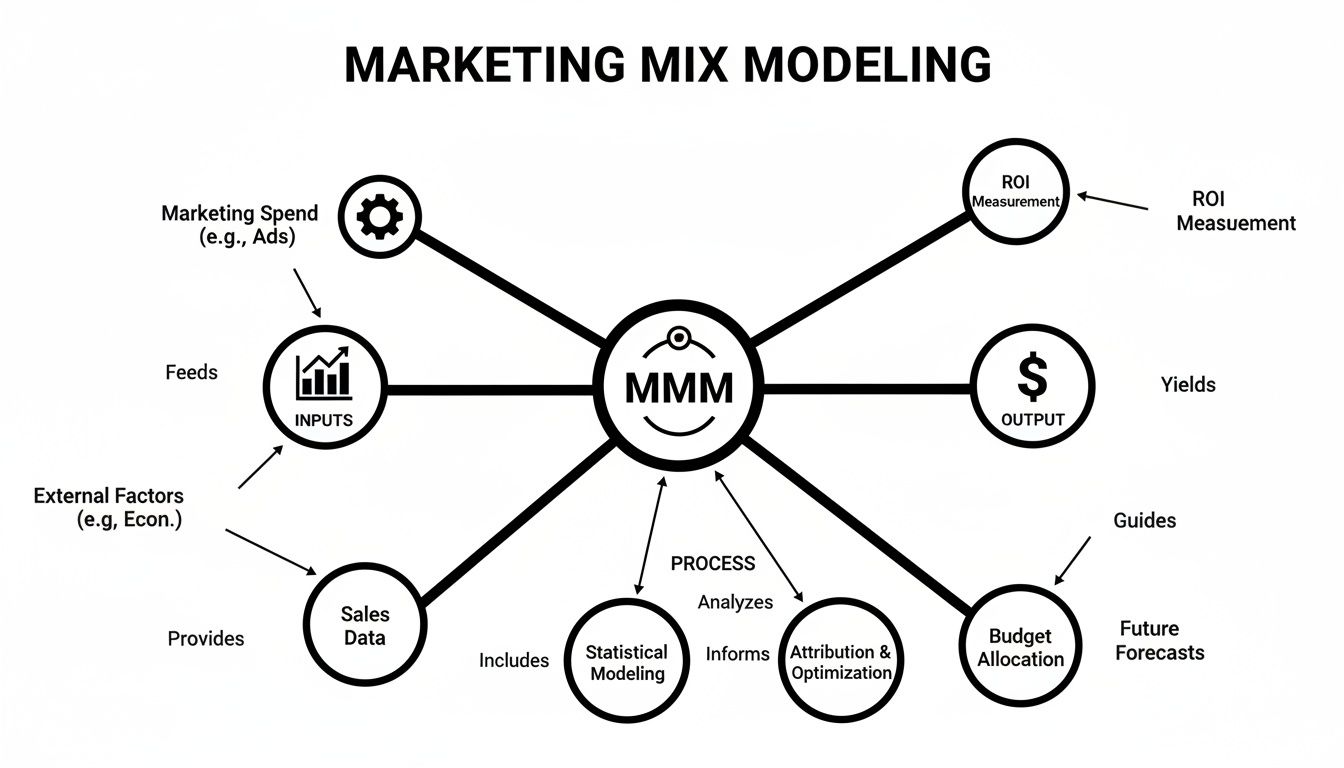
As you can see, a solid model depends on processing diverse inputs to generate a unified output that directly informs your budget allocation and ROI measurement.
Understanding Adstock and the Lingering Effect
One of the reasons MMM is so powerful is that it accounts for factors that simpler measurement tools miss. One of the most important of these is adstock, sometimes called the carryover effect. Think about a great movie trailer you saw last week. You may not have bought a ticket right then, but the ad’s impact stuck with you, nudging you toward the theater this weekend.
Marketing operates in the same way. The effects of a campaign don't vanish the moment it's over.
Awareness Building: A major TV ad or a sponsored event builds brand recognition that can drive sales weeks or even months later.
Memory Decay: The influence of an ad fades over time, but it doesn't drop to zero overnight.
Cumulative Impact: Consistent advertising builds on itself, creating a much stronger brand presence over time.
MMM mathematically models this lingering effect. It understands that last month's social media push might still be generating sales this month. By capturing adstock, the model gives you a far more realistic view of how your marketing creates value over time, preventing you from prematurely cutting campaigns that are still delivering results.
The Law of Diminishing Returns
Another critical concept baked into marketing mix modeling is the law of diminishing returns. This is a fundamental economic principle: at a certain point, investing more money into something yields smaller and smaller gains. In marketing, it means that doubling your ad budget won't necessarily double your sales.
Simply spending more isn't a sustainable strategy. An MMM identifies the saturation point for each channel, the point where additional investment stops delivering a worthwhile return, allowing for smarter, more efficient budget allocation.
For example, your first $10,000 in LinkedIn ads might bring in 100 excellent leads. But the next $10,000 might only secure 70 more, and the $10,000 after that could yield just 30. Eventually, you've reached most of your target audience, and your cost per lead starts to skyrocket.
An MMM maps out this curve for every single channel, showing you exactly where your spend becomes inefficient. This lets you pull back investment at that saturation point and reallocate that budget to another channel with more room for growth. It’s this kind of insight that transforms budget planning from a guessing game into a strategic exercise in optimization.
Gathering the Right Data for Your Model
Any marketing mix model is only as good as the data you feed it. Think of it like baking a gourmet cake, even with the best recipe, if you use subpar ingredients, you'll get a disappointing result. To get clear, actionable insights from your MMM, you must first assemble a clean, comprehensive, and consistent dataset.
This isn’t just about exporting a few spreadsheets. It’s a meticulous process of pulling information from different parts of your business and the wider market. Your goal is to build a detailed historical log that the model can analyze to find the hidden connections between your marketing spend and sales revenue.

The foundation of a reliable model rests on high-quality, granular data covering a significant period. Skimp on this, and your results will be unreliable at best and dangerously misleading at worst.
The Essential Data Ingredients
For a robust analysis, you'll need to pull data from three main categories. Each one provides a different piece of the puzzle, and together, they paint a complete picture of your business performance.
Internal Business Data: This is the core of what you sold and how you sold it. We're talking about key metrics like daily or weekly sales revenue, units sold, and website conversions. You’ll typically find this data in your CRM (like Salesforce or HubSpot), your eCommerce platform, or your financial systems.
Marketing and Media Data: This category covers everything related to your promotional efforts. You'll need channel-specific spending and impression data for every campaign, digital ads, social media, TV, print, and more. The more granular, the better. Daily spend data, for instance, is far more powerful than a monthly total.
External Factors: Your business doesn’t operate in a vacuum. Factors like seasonality, major holidays, competitor ad spending, or broader economic trends can all have a huge impact on your sales. Including this data helps the model separate the impact of your marketing from external market noise.
As a rule of thumb, you'll want to gather at least two to three years of historical data. This gives the model enough runway to spot seasonal patterns and properly measure the impact of marketing activities that deliver results over the long term.
Data Quality and Granularity
Once you know where your data is coming from, the next step is to ensure it's clean and consistent. Data granularity: the level of detail, is especially critical. Daily ad spend figures allow the model to draw a much tighter connection between a marketing push and a corresponding sales spike than a vague monthly total ever could.
To prepare your data for modeling, focus on a few key areas:
Consistency: Ensure your metrics are measured the same way over time. If you changed how you define a "lead" halfway through your historical data, you'll skew the model's calculations.
Accuracy: It’s time for some spring cleaning. Scrub your data to eliminate errors, duplicate entries, and unusual outliers. Garbage in, garbage out.
Completeness: Hunt down and fill in any gaps in your records. Missing data for a month here or a week there can seriously weaken your model's predictive power.
Wrangling these different datasets is often the most time-consuming part of building an MMM. For a deeper dive, you can learn more about customer data integration solutions and how to create a single source of truth. By turning the raw data from systems like Salesforce and Google Analytics into a unified, high-quality asset, you’re setting the stage for a marketing mix model that delivers powerful insights.
MMM vs Multi-Touch Attribution
Marketers often face two different roadmaps: Marketing Mix Modeling (MMM) and Multi-Touch Attribution (MTA). Both are designed to measure what’s working, but they answer different questions and operate on different scales. Understanding this distinction is key to building a comprehensive measurement strategy.
The easiest way to think about it is with an analogy: MMM is your telescope, and MTA is your microscope.
A telescope gives you a breathtaking, panoramic view of the entire galaxy. You see how massive celestial bodies influence each other over vast distances and long periods. A microscope, on the other hand, lets you zoom in on a single cell, revealing every tiny, intricate detail with precision. You need both to understand the universe, and similarly, you often need both MMM and MTA to get the full picture of your marketing performance.
The Strategic View vs. The Tactical View
Marketing Mix Modeling, our telescope, provides the high-level, strategic overview. It looks at aggregated data over long timeframes, usually a few years, to determine how your entire marketing mix drives top-line business metrics like sales or revenue. This includes everything from offline channels to external factors like the economy. Its real power lies in its holistic scope.
MMM is built for strategic budget allocation and long-term planning. It tackles the big-picture questions like, "How much should we invest in TV versus paid search next year?" or "What's the actual ROI of our print advertising?"
Conversely, Multi-Touch Attribution is the microscope. It focuses on individual user journeys, using tracking tools like cookies and pixels to assign credit to specific digital touchpoints that lead to a conversion. If you want to dive deeper into this, our guide on what multi-touch attribution is breaks it down.
MTA is perfect for tactical, real-time campaign optimization. It answers granular, on-the-ground questions like, "Which ad creative is driving the most clicks in our current Facebook campaign?" or "Which keyword in Google Ads has the best conversion rate this week?"
Key Differences at a Glance
The core differences between these two methodologies boil down to their data sources, scope, and primary functions. One isn't "better" than the other; they are different tools for different tasks. The right choice depends on the business question you’re trying to answer.
To make it crystal clear, here’s a head-to-head comparison of how MMM and MTA stack up.
Marketing Mix Modeling (MMM) vs. Multi-Touch Attribution (MTA)
Feature | Marketing Mix Modeling (MMM) | Multi-Touch Attribution (MTA) |
|---|---|---|
Primary Goal | Strategic budget allocation and long-term planning. | Tactical campaign optimization and short-term adjustments. |
Data Source | Aggregated, historical data (e.g., weekly sales, channel spend). | User-level, granular data (e.g., clicks, impressions, conversions). |
Scope of Channels | Holistic view including both online and offline channels. | Primarily focused on trackable digital channels. |
External Factors | Accounts for seasonality, economic trends, and competitor activity. | Does not typically account for external or offline influences. |
Time Horizon | Long-term analysis (typically 2-3 years of historical data). | Short-term to real-time analysis (days or weeks). |
Privacy Impact | Resilient to privacy changes as it uses aggregated, anonymous data. | Depends on user-level tracking, which privacy changes erode. |
This table highlights that while both aim to measure performance, they approach the problem from opposite ends, one top-down and strategic, the other bottom-up and tactical.
The privacy row drives a lot of the current interest in MMM, so it is worth being precise about why. Apple's App Tracking Transparency cut off a large share of user-level mobile signal. Privacy laws like GDPR and CPRA tightened consent. User-level attribution lost fidelity across the board. Google reversed its plan to remove third-party cookies, and Chrome keeps them, so this is not a cookie-removal story. It is a broader shift toward aggregated, privacy-durable measurement, and MMM runs on exactly that kind of data.
Choosing the Right Model for Your Goals
Ultimately, the choice between MMM and MTA, or the decision to use both, comes down to what you need to achieve.
Use MMM when... you're focused on C-suite level strategic planning. It’s the perfect tool for setting annual budgets, understanding the impact of offline media, and forecasting long-term growth.
Use MTA when... your focus is on the day-to-day management of digital campaigns. It excels at providing the rapid feedback needed to optimize creative, bidding, and channel performance on the fly.
The most sophisticated marketing teams don't see this as an either/or choice. They use a hybrid approach where MMM sets the strategic direction for budgets across all channels, and MTA provides the granular data to optimize execution within those digital channels. This blended strategy provides both the telescopic vision for long-range planning and the microscopic precision for daily execution.
Real-World Benefits and Use Cases
Let's move beyond theory. Understanding what marketing mix modeling is on paper is one thing, but seeing it drive real profit is where it truly matters. This is the point where complex data models become a clear, actionable roadmap for smarter spending and predictable growth.
When you move beyond simple last-click metrics, MMM gives you a panoramic view of your entire marketing ecosystem. It’s designed to answer the tough, high-stakes questions that keep CMOs and VPs of Marketing up at night.

The benefits aren't just academic; they directly impact the bottom line. A well-built model sharpens your competitive edge by making every dollar you spend work harder.
Strategic Budget Optimization and ROI Measurement
The most immediate and powerful benefit of MMM is its ability to optimize your budget with surgical precision. It quantifies the true return on investment (ROI) for every channel, both online and offline, showing you what’s actually driving growth versus what’s just draining resources.
Instead of patching together reports from different platforms or relying on gut feelings, MMM provides a single, unified source of truth.
Optimal Spend Allocation: It pinpoints the exact point of diminishing returns for each channel. You’ll know when to stop pouring money into one area and shift it to another with higher potential.
True ROI Clarity: By measuring the incremental impact of each marketing dollar, you can walk into any budget meeting and justify your spend with confidence.
Offline Channel Measurement: Finally, you can put a real number to the impact of notoriously tricky channels like conference sponsorships, print ads, and TV commercials.
This flips budget planning on its head. It’s no longer a reactive chore but a proactive strategy for maximizing every dollar. Grasping the full benefits of data-driven marketing is the foundation for achieving this strategic clarity.
The real power of MMM lies in its predictive ability. You can run "what-if" scenarios to forecast the exact outcome of budget shifts. For example, model the expected revenue lift from moving 20% of your trade show budget into a targeted paid social campaign before you spend a dime.
Use Cases for B2B and Professional Services
While many associate MMM with big consumer brands, it’s a game-changer for B2B and professional services firms. In a world of long sales cycles and complex customer journeys, it provides the clarity you need.
In markets like CPG, retail, and automotive, MMM is already a cornerstone of strategic planning. As user-level tracking erodes, MMM is making a comeback because it runs on aggregated, privacy-durable data. McKinsey finds that companies applying marketing analytics and media-mix modeling can free up 15 to 30% of their marketing budget, redeploying it to higher-return activities or banking it as savings, without growing total spend.
Here’s how this plays out in the real world for B2B companies:
1. A B2B SaaS Company
Imagine a SaaS firm trying to allocate its $500,000 quarterly marketing budget between LinkedIn ads, content marketing (webinars, whitepapers), and industry events. An MMM can analyze historical lead and sales data against the spend in each of these buckets.
The model might reveal that while LinkedIn drives high-quality leads, the ROI craters after the $200,000 spend mark. Simultaneously, it could show that webinars have a powerful delayed effect, influencing massive enterprise deals three to six months later. Armed with that knowledge, the company could cap its LinkedIn spend and invest the extra cash into its webinar program, fueling long-term pipeline growth. These figures are illustrative, not a client result.
2. A Management Consulting Firm
A consulting practice needs to determine if sponsoring a major industry conference for $100,000 is worthwhile. For years, they've struggled to connect that expense directly to new business.
By feeding sponsorship data, subsequent website traffic spikes, branded search volume, and inbound inquiries into an MMM, they can isolate the event's impact. The model might show that the sponsorship lifted branded search and contributed to several major client wins over the following months. Just like that, an expense that was previously invisible now shows a clear, positive ROI. Again, these numbers are illustrative.
How to Get Started with Marketing Mix Modeling
Getting started with marketing mix modeling can feel like an intimidating project. However, by breaking it down into a clear sequence of steps, it becomes a much more manageable, and highly rewarding, process. A structured approach is key to building a model that delivers real, actionable insights instead of just interesting data points.
The journey doesn't start with data. It starts with your business goals.
What are the specific, high-stakes questions you’re trying to answer? Are you trying to optimize the annual budget, prove the ROI of a major conference sponsorship, or get a better handle on your sales forecasts? Defining these goals upfront gives the entire project a clear purpose.
Your Implementation Roadmap
Successfully launching an MMM program is a team sport. It requires a blend of strategic alignment, data discipline, and the right expertise, bringing together people from marketing, finance, and data analytics. Everyone needs to work toward the same goal: maximizing the effectiveness of every dollar spent.
Think of the following steps as a practical checklist to guide you from idea to working model. This roadmap is designed to keep your project on track and ensure the final model is both statistically sound and genuinely useful for your business.
Define Business Objectives: Start by identifying the core questions you need to answer. Are you trying to determine the optimal budget split between online and offline channels? Or do you need to measure the true ROI of your trade show presence? Be specific.
Assemble a Cross-Functional Team: This is a group effort. Bring together stakeholders from marketing, data analytics, IT, and finance from the beginning. This ensures everyone is bought in and you have access to the data and resources you'll need.
Conduct a Comprehensive Data Audit: Systematically identify, gather, and validate every data stream required. You're looking for at least two years of historical sales figures, detailed marketing spend for each channel, and relevant external factors (like economic trends or competitor actions).
Choose Your Modeling Approach: Decide how you're going to build your model. Will you develop it in-house using open-source tools like Google's Meridian? Or does it make more sense to hire a specialized consulting partner or use an end-to-end analytics platform?
Build and Validate the Model: This is the technical core of the project, where the model is constructed using regression analysis and then rigorously tested against historical data to ensure its predictions are accurate.
Interpret and Socialize the Results: A model is useless if no one understands it. Your job is to translate the statistical outputs into clear business recommendations. Creating intuitive visualizations is crucial for getting executive leadership on board. For inspiration, explore these effective marketing dashboard examples.
Integrate Insights into Strategic Planning: This is the most important step. You have to act on what you've learned. Use the model's insights to reallocate budgets, refine your channel strategies, and set more accurate performance forecasts for the coming year.
Got Questions? We've Got Answers
Even after laying out the roadmap, it's natural to have practical questions when considering a new strategic tool. This section tackles some of the most common queries about marketing mix modeling, providing straight answers to help you understand how it all works in the real world.
How Long Does a Marketing Mix Modeling Project Take?
Typically, you can expect an MMM project to take anywhere from 8 to 16 weeks from kickoff to the final delivery of strategic insights. This timeline allows enough time for the essential steps: defining goals, gathering and cleaning data, building the model, and validating its accuracy.
The exact duration can vary depending on factors like the complexity of your marketing efforts and how easily you can access clean historical data. Working with an experienced team or using a modern analytics platform can often speed up the process.
Is Marketing Mix Modeling Only for Large Companies?
Not anymore. While MMM was once the exclusive domain of large corporations with huge budgets, that has changed. The rise of powerful analytics platforms and open-source tools, like Google's Meridian, has made it far more accessible for mid-sized businesses.
The real barrier to entry isn't your company's size; it's the amount of historical data you have. Any business with at least two to three years of consistent marketing and sales records has the raw material needed to gain the strategic clarity MMM provides.
The purpose of marketing mix modeling is to find patterns in past performance. Without enough data, the model can't reliably distinguish between a channel's impact and random market noise, regardless of your revenue.
How Does MMM Measure Digital Channels Like SEO and Content?
This is where MMM truly shines. It measures the impact of channels like SEO and content marketing by finding correlations between their performance metrics and your sales outcomes over a long period. It bypasses last-click attribution, which almost always undervalues these top-of-funnel activities.
Here’s how that might look in practice:
For SEO: The model could track inputs like growth in organic traffic, improved rankings for high-value keywords, or a jump in branded searches.
For Content Marketing: You might feed it metrics like webinar sign-ups, downloads of a gated whitepaper, or new subscribers to your newsletter.
The model then analyzes how the fluctuations in these activities align with changes in revenue. This allows it to mathematically pinpoint and measure the real, incremental impact of channels that lack a simple, direct conversion path.
Ready to move from theory to action? Twelverays specializes in data-driven demand generation, from SEO and paid media to web development, so every channel is measured against real ROI. We help B2B and professional services firms use measurement frameworks like MMM to guide smarter budget allocation and sustainable growth. Learn how we can build a strategic roadmap for your business.


