

Digital marketing and customer relationship management (CRM) work as one revenue system: marketing attracts and converts demand, the CRM records every interaction, and the shared data makes each campaign smarter than the last. This guide shows how to connect the two, from data architecture and CRM models to automation, attribution, and governance.
Key Takeaways
- Digital customer relationship management is the practice of managing every customer interaction through connected digital channels: web, email, ads, social, and support.
- Three CRM models power digital marketing: operational (automation), analytical (segmentation and scoring), and collaborative (shared data across teams).
- The CRM software market hit $128 billion in 2024, up 13.4% per Gartner, so integration skills keep compounding in value.
- Data architecture comes first: API connections, field mapping, and hygiene decide whether automation helps or hurts.
- Attribution tied to CRM revenue, not ad-platform reports, proves which channels drive pipeline.
How Digital Marketing and Customer Relationship Management Work Together
When digital marketing and customer relationship management (CRM) teams speak the same language, every campaign becomes more precise. By tapping into CRM insights, you can tailor your messaging at each stage of the buyer’s journey, no more guesswork.
Setting Clear Goals
True success starts with a clear target: What are we aiming for?
A B2B software firm might use CRM records to identify high-value accounts on LinkedIn, while a consumer brand maps past purchases to craft personalized email sequences for repeat buyers.
Agreeing on shared metrics, such as increasing lead conversion rates or boosting customer lifetime value, keeps both teams focused. From there, you can outline touchpoints and track progress without misalignment.
- Document Data Ownership: Assign responsibility for each CRM field and marketing tag.
- Build A Shared Roadmap: Tie campaign launches to CRM triggers and key dates.
- Schedule Feedback Loops: Regularly review segmentation, creative performance, and messaging.
Mapping Customer Touchpoints
Every interaction, from a social ad scroll to a support call, should be logged in your CRM. When you capture these touchpoints, gaps appear. For instance, high web traffic paired with low email engagement signals it’s time to refresh your nurture content.
One e-commerce brand linked ad clicks with service complaints and delivered targeted tutorials, resulting in a 12% drop in churn within three months.
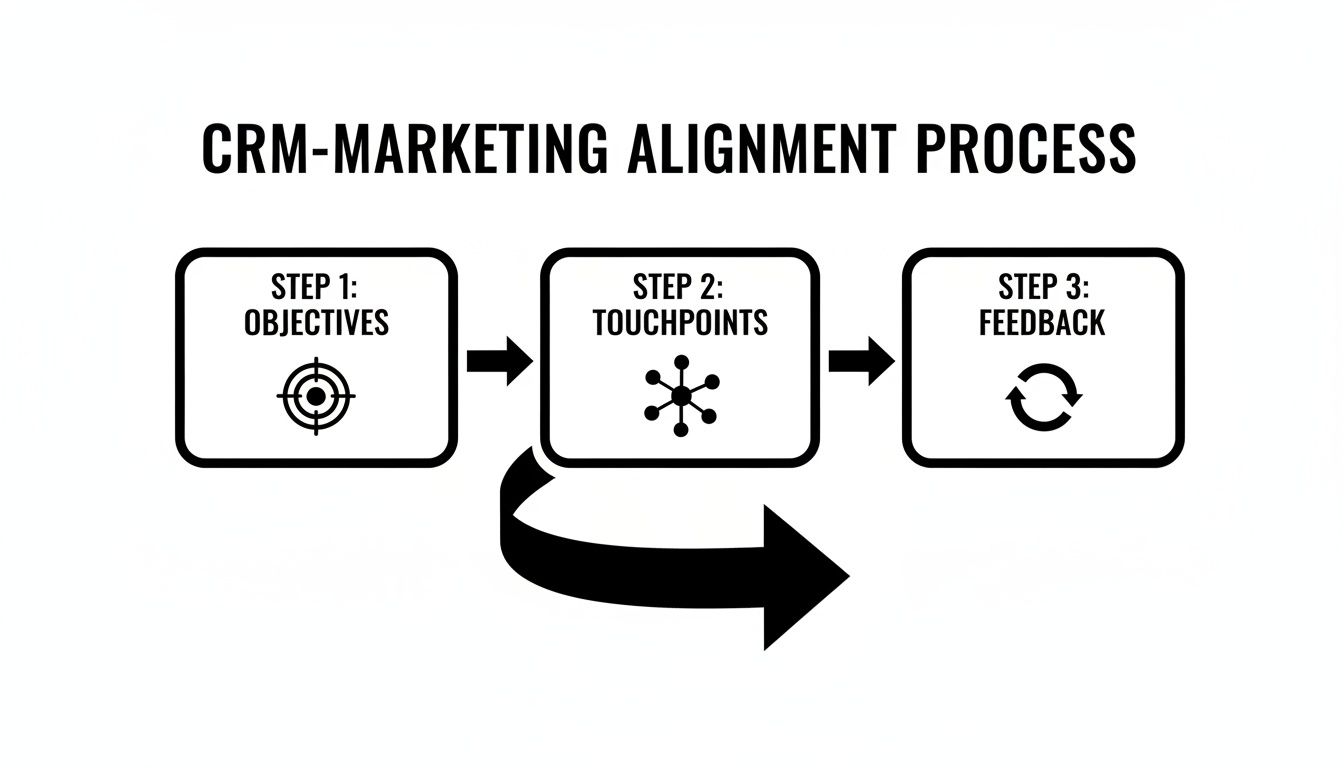
The infographic below illustrates the cycle of setting objectives, mapping touchpoints, and closing the loop with feedback.
CRM Market Growth In 2026
The market keeps compounding, which is why CRM and marketing integration skills keep rising in value:
Gartner puts worldwide CRM software revenue at $128 billion for 2024, up 13.4% year over year. Fortune Business Insights projects growth from $126.17 billion in 2026 to $320.99 billion by 2034, a 12.4% compound annual rate. Cloud platforms and embedded AI features drive the spend.
Best Practices For Sustainable Alignment
Whether you’re on Microsoft Dynamics 365 or Salesforce, consistency is key. Keep marketing and sales in sync with regular check-ins, a shared KPI dashboard, and clear responsibilities.
Discover advanced tactics in our guide on CRM for marketing agencies.
Alignment isn’t a one-time project, it’s an ongoing, data-driven process that fuels growth.
With communication and ownership aligned, your CRM and marketing partnership will thrive.
What Is Digital Customer Relationship Management?
Digital customer relationship management is the practice of building and maintaining customer relationships through connected digital channels. Where traditional CRM tracked calls and meetings, digital relationship management captures every touchpoint automatically: website visits, email opens, ad clicks, chat conversations, and support tickets all land in one customer record.
The payoff is context. When a prospect returns to your pricing page, the CRM logs it, marketing sees it, and sales acts on it the same day. That closed loop separates digital customer relationships from a static contact database.
Three capabilities define a strong digital CRM practice:
- Unified profiles that merge behavior from web, email, ads, and support into one view
- Real-time triggers that turn behavior into action, like a follow-up task or a nurture email
- Consent management that keeps personalization inside privacy rules
CRM Models in Digital Marketing
CRM models in digital marketing describe how customer data gets put to work. Most teams run all three at once, but knowing which model drives which campaign keeps your stack honest.
Operational CRM runs the campaigns, analytical CRM decides who gets them, and collaborative CRM keeps sales, marketing, and service telling one story. Start with the model that fixes your weakest link: teams drowning in manual follow-up need operational automation first, while teams sending one message to every contact need analytical segmentation.
Designing Robust Data Architecture And Integration

A solid data framework underpins any successful digital marketing and CRM effort. When your web analytics feed directly into Salesforce or Dynamics 365, every click or form fill updates in real time.
A leading retail brand saw personalized cart-abandonment emails drive 18% more recoveries within four weeks.
Reliable API Connections
API integrations require more than endpoint pointers. Plan for secure authentication and retry logic to handle hiccups.
Before launch, document every endpoint, leads, contacts, campaign tags, so teams align.
- Define OAuth scopes and token lifetimes to balance security and uptime
- Monitor API volume to avoid rate-limit issues
- Enforce retry and back-off rules for intermittent failures
Key Takeaway: Reliable API setups can cut data delay by up to 40%
This comparison helps you choose the right service limits and payload formats. Verify current allocations in the vendor docs: Salesforce grants Enterprise Edition orgs 100,000 API calls per 24 hours plus 1,000 per user license, and Microsoft grants each paid Dynamics 365 Enterprise license 40,000 requests per 24 hours.
Custom Field Mapping
Inconsistent CRM fields and marketing tags cause duplicates and blind spots. A naming prefix (e.g., MARK_) simplifies mapping.
- Create a mapping document listing CRM fields alongside marketing tags
- Review the list with IT and marketing to spot mismatches
- Automate updates via batch jobs or streaming APIs to stay in sync
This approach reduces sync errors and sharpens segmentation.
Maintaining Data Hygiene
Dirty data undermines personalization. To deliver relevant offers, clean your database regularly.
- Schedule nightly jobs to merge duplicates by email or phone
- Enrich profiles with third-party data for 25% better demographic accuracy
- Use consent flags to stay GDPR-compliant and maintain trust
Case Study
A fashion retailer improved segmentation accuracy by 30% after enriching CRM profiles with purchase, browsing, and loyalty data.
Learn more about why this matters in our guide on why CRM integration matters.
Phased Rollouts And Testing
Don’t go live without testing. Start in a sandbox with a small dataset, verify mapping, and then expand.
Sample mapping for initial tests:
{"mapping": {"WebLead": "CRMLead", "AbandonedCart": "MarketingEvent"}}
- Automate rules to flag missing fields or mismatches
- Roll out by region or product to isolate issues
- Conduct daily sync audits and instantly roll back if needed
A phased rollout lets you scale smoothly without surprises.
Next, we’ll transform this data foundation into revenue-driving automated campaigns.
Building Automated Campaigns And Lead Management

Automated campaigns turn fresh leads into closed deals by reacting to each prospect’s actions. When digital marketing and CRM share real-time data, your team engages prospects at exactly the right moment.
Platforms like HubSpot and Marketo integrate lead scores into custom workflows. A marketing-qualified lead (MQL) might trigger a content drip, while a top-tier score sends an alert to sales, saving reps time and focusing efforts on the most promising contacts.
Designing Behavior-Based Nurture Sequences
Define the behaviors you’ll track: email opens, site visits, demo requests, webinar sign-ups.
Then, decide how each behavior adjusts lead scores or moves contacts into watchlists. Build paths that:
- Use dynamic content blocks for personalized offers
- Define score thresholds that shift leads to new streams
- Automate follow-up tasks like SMS nudges or calendar invites
This approach helped a SaaS startup boost demo sign-ups by 24% in eight weeks. Watchlists also prioritize accounts by revenue potential or firmographics, ensuring no high-value opportunity slips through.
Integrating Dynamic Ad Personalization
Real-time CRM-to-ad-platform sync lets you adapt headlines, images, and CTAs based on account behavior. One company matched ad creative to account tier and site activity, boosting click-through rates by 35% over static ads.
Use API or middleware tools like Zapier, mapping account data to custom audiences while respecting privacy regulations.
- Build lookalikes from high-value CRM segments
- Adjust bids for leads crossing score thresholds
- Rotate creative based on engagement triggers
Test dynamic ads against static ones and track lifts in your CRM dashboard. Over time, refine rules to allocate spend toward top performers.
Key Takeaway: Real-time reporting ties ad spend directly to pipeline growth, enabling swift budget shifts.
Setting Routing Rules And Throttling Controls
Ensure leads land in the right inbox by defining territories or product verticals. Use round-robin or load balancing, and cap daily assignments to prevent rep burnout.
Pause outreach on less relevant channels if prospects interact elsewhere to keep messaging cohesive.
Tip: Excessive follow-ups can cut open rates by up to 30%.
Preventing Common Score Pitfalls
Lead scores can drift if you don’t penalize inactivity or low-intent actions. Set decay rules, move stale leads into re-engagement streams, and archive dormant contacts to protect list health.
- Deduct points for prolonged inactivity
- Launch re-engagement sequences below score thresholds
- Archive dormant profiles to maintain data quality
For a step-by-step on these flows, see our guide on marketing automation implementation.
Keeping Sales Engaged With Qualified Leads
Provide sales with live dashboards showing lead score, recent actions, and watchlist tags. This context empowers personalized outreach.
With automated nurture, precise routing, and throttling, marketing and CRM unite to deliver qualified leads without manual handoffs.
Tracking Performance And Attribution Methods
You gain true campaign insight by blending digital marketing metrics with CRM data, no standalone ad network report tells the full story. By connecting UTM tags, Google Analytics events, and CRM opportunities, you identify the channels that drive results.
Here’s how to keep your data pipeline optimized:
- Define a UTM taxonomy aligned with CRM fields to prevent data loss
- Automate real-time goal syncing from Google Analytics to CRM contacts
- Consolidate CAC, LTV, and pipeline velocity into Power BI or Tableau
- Schedule nightly data pulls so dashboards reflect yesterday’s activity
In one e-commerce overhaul, moving from last-click attribution to full touchpoint stitching improved ROI accuracy by 30%.
Tracking UTM And CRM Signals
Audit your UTM usage before building any dashboards. Create a live spreadsheet mapping source, medium, campaign, term, and content directly to CRM attributes.
Configure Google Analytics goals to update CRM stages. For example, a “checkout_complete” event can advance a deal stage.
“Accurate input yields reliable output”, every tag and integration follows this principle.
Leverage middleware or native connectors, like Zapier, Salesforce API, or Dynamics 365 flows, to automate event syncing.
Choosing The Right Attribution Model
Attribution isn’t one-size-fits-all. Start simple with last-click, then test:
- Inventory all customer touchpoints
- Assign credit based on ROI and strategic priorities
- Test models in a sandbox against actual CRM revenue
- Refine weights until within 5% of real-world ROI
Whether linear, time-decay, or position-based, aim for a balanced view that guides spend decisions.
Building A Unified Analytics Dashboard
A single dashboard merges siloed data into one source of truth. In Power BI or Tableau, blend Google Analytics exports with CRM tables to create interactive reports.
Seeing SEO’s share rise led to increased investment in organic channels. Add filters for product lines, regions, or lifecycle stages, and embed live snapshots in stakeholder portals.
Auditing Data Accuracy
Even the best dashboard fails if data drifts. Weekly, reconcile Google Analytics events with CRM records.
- Compare daily conversion counts
- Validate UTMs against your naming conventions
- Flag unexpected drops in CRM leads
Regular audits catch typos and broken integrations before they distort decisions.
Set alerts for sync failures and review API logs regularly to maintain data integrity.
Optimizing Attribution Models
Attribution evolves with your business. Quarterly, re-evaluate model weights, introduce A/B tests or holdout groups, and feed outcomes into your CRM’s analytics or machine learning modules. Document every change in a log for transparency and rollback capability.
Presenting Insights In Stakeholder Scorecards
A scorecard translates data into action. Your template might highlight:
- CAC trends by channel and cohort
- LTV projections for new vs. repeat buyers
- Pipeline velocity metrics like average sales cycle
- Attribution model shifts
Include charts, callouts, and a one-sentence takeaway for each metric. Distribute scorecards monthly, embedding live dashboards and inviting feedback through inline comments. Engagement rises when teams see their input shape future editions.
By integrating these performance tracking and attribution methods, you transform digital marketing and customer relationship management from guesswork to precision.
Optimizing Strategies And Governance Frameworks
Effective alignment of digital marketing and CRM demands constant tuning and solid guardrails. Define approvals, compliance checks, and performance targets for every email, ad, and workflow.
One financial services team runs monthly A/B tests on segmented email journeys, comparing open rates, click-throughs, and conversions to allocate budget efficiently.

Predictive analytics updates personas before needs emerge. Adjust lifecycle triggers regularly to keep touchpoints timely.
- Defined Roles: Set clear permissions for marketing and CRM teams
- Access Controls: Restrict data entry to authorized users
- Scheduled Audits: Keep segments and contact histories accurate
- Version Tracking: Log workflow changes for quick rollbacks
Automation can drift over time. Monthly deep dives catch misfires or underperforming messages early.
SOP Templates And Best Practices
Standard operating procedures (SOPs) provide governance blueprints:
- Purpose And Scope: Clarify objectives
- Role Definitions: List team members and permissions
- Process Steps: Document actions, inputs, and outputs
- Approval And Review: Define approvers, intervals, and version control
A bank using this framework reduced handoff errors by 40% in two quarters.
- Flag changes by impact level
- Assign owners for each flag
- Archive old SOPs for audit trails
Integrate governance into collaboration tools:
- Push CRM alerts to Microsoft Teams
- Create tasks in Jira or Asana
- Display audit metrics in Power BI dashboards
Governance And Audit Schedules
Quarterly audits ensure data integrity. Review sync errors, orphaned records, and misapplied segments.
One team uncovered 98% of inconsistencies in their first audit and now follows a living schedule with clear scopes and timelines.
Regular audits catch subtle issues before they skew analytics or campaigns.
Performance Scorecards
Unified scorecards combine efficiency and compliance metrics:
Review these in performance meetings. Small tweaks, like adjusting triggers, can boost engagement by 15%.
Communication Cadences
Regular syncs keep teams aligned:
- Weekly Stand-Ups: Status checks on data syncs and urgent fixes
- Monthly Deep-Dives: Analyze A/B results and persona updates
- Quarterly Planning: Review governance and roadmap
- Governance Workshops: Hands-on SOP training
For more on driving user adoption, see our Top 15 Tips to Increase CRM User Adoption.
Cultural embedding of governance requires recognition. Highlight team members who spot data issues, linking accuracy metrics to individual KPIs. This fosters trust and scales smoothly.
Frequently Asked Questions
Common questions about uniting digital marketing and CRM:
- What Is The First Step To Align Digital Marketing And CRM?
- How Can Small Teams Manage CRM Integration Without Engineers?
- Which Attribution Model Works Best For Multi-Channel Campaigns?
- How Do I Maintain Data Quality In CRM Over Time?
- How Does Client Management Work In Digital Marketing?
What Is The First Step To Align Digital Marketing And CRM
Start with a data stream audit, email platforms, web analytics, ad channels, and align with sales on shared metrics.
Map critical touchpoints: email opens, site visits, form fills. One B2B firm synced email interactions into Salesforce and saw a 20% lift in MQL-to-opportunity conversion.
Key Insight: Early alignment audits reduce misalignment by up to 45%.
Run a pilot, sync lead status fields to catch mapping gaps before full rollout.
How Can Small Teams Manage CRM Integration Without Dedicated Engineers
Leverage low-code platforms like Zapier or HubSpot native connectors. No dev team needed.
A startup used Zapier to push form entries into Dynamics 365, cutting manual entry by 70%.
- Focus on lead capture and scoring for quick wins
- Document workflows in a simple runbook
- Schedule monthly reviews to tweak integrations
Another consultancy automated onboarding emails with HubSpot’s flow builder, halving manual steps.
Which Attribution Model Works Best For Multi-Channel Campaigns
Begin with a linear model, it’s straightforward and equalizes touchpoints.
Then, test time-decay or position-based models:
- Audit your touchpoint map in CRM
- Run models on test campaigns
- Compare outputs against revenue data
Tip: Sync daily revenue from CRM to maintain honest attribution.
Position-based attribution helped one retailer identify early engagement channels, boosting email nurture ROI by 30%.
How Do I Maintain Data Quality In CRM Over Time
Implement validation rules, de-duplication, and consistent naming. Appoint a data steward and run quarterly reviews to catch drift.
Regular checks drove duplicates from 12% to 2%, improving segmentation.
Prefix campaign tags with MK_ to prevent mix-ups. Set alerts for validation failures and monitor API logs for sync issues.
How Does Client Management Work In Digital Marketing?
Client management in digital marketing means running every client relationship through the same system you use for prospects: one CRM record per client, with campaigns, approvals, results, and conversations attached.
Agencies and in-house teams handle it the same way:
- Log every deliverable and approval against the client record, so context never lives in one person's inbox
- Share live dashboards instead of monthly decks, so clients see the same campaign data you do
- Set renewal and upsell triggers, so a usage drop or contract date fires a task before the relationship drifts
Teams that manage clients inside the CRM spot churn signals earlier and renew more accounts. The same behavior data that powers marketing powers retention.
These FAQs address friction points and keep digital marketing and customer relationship management in sync. Regular checks, clear communication, and iterative tweaks are your best tools.
For deeper insights, explore our blog.
Partner with Twelverays to unify your digital marketing and CRM and drive measurable growth.
Visit Twelverays Agency to get started today.


