In the B2B world, marketing budgets are always under the microscope. That's precisely why a digital marketing audit is less of a routine check-up and more of a strategic weapon. Think of it not as a report card on past performance, but as a blueprint for future growth, revealing exactly where your budget is effective and where it's being wasted.
Why a Digital Marketing Audit Is Your Engine for Growth
For many B2B and professional services firms, marketing can feel like a black box. You invest in SEO, run paid campaigns, and produce content, but tying those efforts directly to revenue can be a challenge. An audit cuts through that fog, providing the clarity to stop chasing vanity metrics and start driving measurable results.
The process involves a methodical review of your entire strategy, from SEO health and content performance to paid ad ROI and analytics configuration. This isn't just about spotting problems; it’s about uncovering hidden opportunities. You might discover a blog post with high traffic but no leads, or a paid search campaign targeting researchers instead of buyers.
Moving from Guesswork to a Data-Driven Strategy
A well-executed digital marketing audit provides the evidence needed to make a solid case for your strategy to leadership and prove your impact.
With a clear audit, you can:
- Justify Your Budget: Show stakeholders precisely where marketing dollars are delivering the highest return and where you can reallocate funds without sacrificing performance.
- Pinpoint Inefficiencies: Identify wasted ad spend, underperforming content, or technical SEO issues that are hindering growth.
- Align Marketing to Business Goals: Ensure every marketing activity maps directly to a core business objective, whether it’s increasing MQLs or reducing customer acquisition costs.
The real value of a digital marketing audit is its ability to shift your approach from reactive to proactive. It establishes a data-driven foundation for making smarter, faster decisions that move the revenue needle.
Global ad spend surpasses $1 trillion for the first time in 2026, up 5.1% over 2025, and digital alone grows 6.7% to claim 68.7% of total spend, according to Dentsu. As investment climbs, audits are no longer a "nice-to-have", they're essential for staying competitive, especially for B2B companies relying on a mix of paid and organic channels.
To build a more accountable and successful growth engine, you first need to understand the real benefits of data-driven marketing.
Setting the Stage for a High-Impact Audit
Before examining a single metric, the success of your digital marketing audit depends on thorough preparation. This initial planning phase separates a chaotic data-gathering exercise from a strategic review that drives revenue. It’s about defining the "why" before getting lost in the "what."
The primary goal is to tie your audit directly to business objectives. Are you trying to increase marketing-qualified leads (MQLs) by 15%? Or is the main goal to reduce your customer acquisition cost (CAC)? Without this clarity, your audit will lack direction, and its findings will be difficult to translate into meaningful action.
Assembling Your Audit Toolkit
First, you need unrestricted access to your entire marketing tech stack. This isn’t just a technical step; it’s about creating a single source of truth to see how all your platforms connect.
You'll need full admin access to:
- Analytics Platforms: Primarily Google Analytics (GA4) and any other web analytics tools in use.
- Search Consoles: This includes both Google Search Console and Bing Webmaster Tools.
- Advertising Accounts: Google Ads, LinkedIn Ads, Meta Ads, and any other ad platforms.
- Customer Relationship Management (CRM): Systems like Salesforce or Dynamics 365 are crucial for connecting marketing spend to sales outcomes.
- Marketing Automation Software: Platforms such as HubSpot or Marketo.
Securing these credentials upfront will prevent significant delays and headaches later.
Establishing Meaningful Benchmarks
With your tools ready, it’s time to set benchmarks. You can't measure success without a baseline. For a B2B tech firm, this could be as simple as analyzing their demo request conversion rate over the past 12 months.
This process is designed to reveal waste, find hidden opportunities, and prove the value of your marketing.
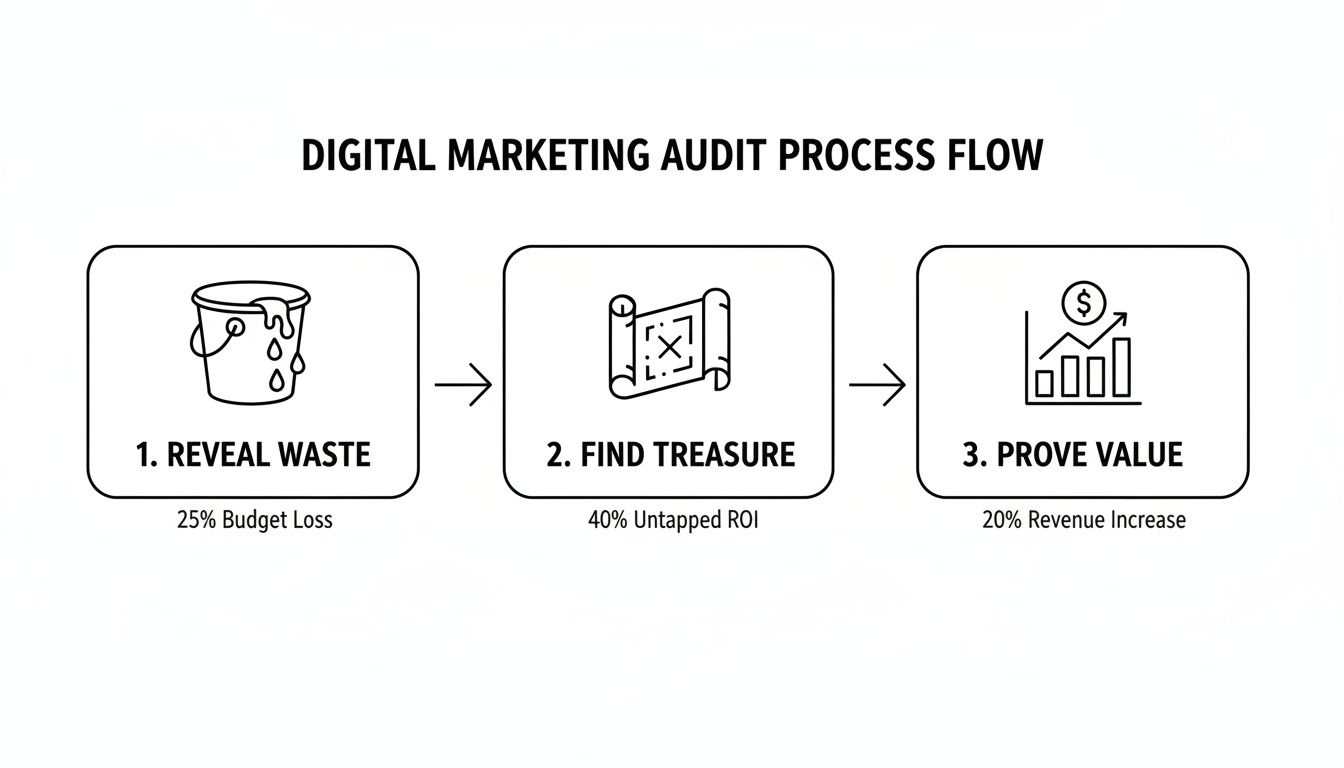
A good audit doesn't just point out what’s broken. It's a strategic process designed to identify what's working so you can replicate that success.
A common mistake is diving straight into channel-specific data without first defining what "good" looks like for the business. An audit without benchmarks is an opinion; an audit with them is a strategic plan.
For example, if the industry average landing page conversion rate is around 2.5%, but yours is stuck at 0.8%, you’ve immediately identified a high-priority area for investigation. That context is vital.
Of course, this all relies on having proper tracking in place. Our guide on creating goals in Google Analytics can help you build a solid foundation. Getting this groundwork right ensures every insight is tied to a measurable, revenue-generating outcome.
A Channel-by-Channel Deep Dive
With your scope defined, it's time to investigate what’s truly happening on a channel-by-channel basis. This is the core of your audit, where we move from high-level planning to a granular, systematic analysis of each active channel. The goal is to determine what’s genuinely driving performance and what’s just draining your budget.

This stage is about asking tough questions and letting the data provide honest answers. Are your SEO efforts attracting the right audience? Is your paid social budget converting into qualified leads? Let's break down what to look for.
Uncovering SEO Strengths and Weaknesses
For most B2B and professional services firms, SEO is the foundation of long-term growth. A proper SEO audit goes beyond keyword rankings to assess the overall health of your organic presence and identify friction points that prevent potential clients from finding you.
Start by examining a few core areas:
- Technical Health: Address behind-the-scenes issues like crawl errors, poor site speed, broken links, and indexing problems.
- On-Page Optimization: Ensure title tags, meta descriptions, and headers are optimized for target keywords and that content is structured for readability.
- Content Gap Analysis: Identify valuable keywords your competitors are ranking for that you aren't. This reveals immediate opportunities to create content that fills a crucial gap.
A common finding is a technically sound website with content that misses search intent. For instance, a blog post like "The Future of Cloud Computing" might attract traffic but generate no demo requests because it appeals to academics, not decision-makers. This indicates a content strategy disconnected from business goals.
Auditing Your Paid Search and Social Campaigns
Paid media offers immediate visibility but requires constant vigilance. It's surprisingly easy to burn through a budget with little to show for it. The goal here is to identify wasted ad spend and reallocate it for maximum impact.
Your audit of paid channels should be laser-focused on efficiency and ROI, not just impressions.
In Paid Search (PPC)
Analyze your Google Ads account for inefficiencies. Are you bidding on broad, expensive keywords that drive clicks but no conversions? Is a low Quality Score hurting performance due to weak ad copy or a poor landing page experience?
A frequent B2B mistake is sending all paid traffic to the homepage instead of a dedicated landing page. Dedicated landing pages routinely convert several times higher than a generic homepage, because they remove distraction and match the intent of the ad that sent the visitor there.
In Paid Social
For platforms like LinkedIn Ads, your audit should focus on audience targeting and creative performance. Are you reaching the right job titles and company sizes, or are your ads being shown to irrelevant audiences?
Look for the Pareto pattern in paid media: a small share of campaigns often drives most of the results. The job is to pause underperformers with confidence and double down on the winners.
The rise of AI makes this even more critical. As of 2025, 86% of SEO professionals have integrated AI into their strategy, up from 65% the prior year, according to the State of SEO survey. Teams that use AI well move faster on keyword research, content production, and analysis. Your audit must account for how your competitors now work.
Optimizing the Conversion Journey
All the traffic in the world is useless if your website can’t convert visitors into leads. A Conversion Rate Optimization (CRO) audit focuses on user experience, identifying barriers that prevent potential clients from taking the next step. This connects your traffic-generating efforts to tangible business outcomes.
Put yourself in a first-time visitor's shoes. Is it immediately clear what your company does and who it helps? Is the path to contacting you simple and intuitive?
Here’s a practical checklist for your CRO review:
- Analyze User Flow: Use a tool like Google Analytics to see where users drop off in the conversion funnel. A high exit rate on a key service page is a major red flag.
- Review Landing Pages: Does the landing page headline match the ad that brought the user there? Is the call-to-action (CTA) clear, compelling, and visible?
- Assess Form Friction: Are your contact forms asking for too much information? Cutting unnecessary fields from a demo request form is one of the most reliable ways to lift lead volume.
By integrating insights from each of these channels, you'll begin to see the complete picture. For a deeper dive into creating a cohesive strategy, explore our guide on powerful multi-channel marketing strategies. This integrated view is what transforms a simple audit into a powerful tool for growth.
To help organize this process, here’s a quick checklist summarizing the key areas to investigate.
Digital Marketing Audit Checklist by Channel
This table provides a solid starting point for a comprehensive review. A great audit looks at each channel individually, then pieces the findings together to understand the full customer journey.
Tying Marketing Actions to Sales Outcomes
A marketing campaign is only successful if it generates revenue. This is where your digital marketing audit connects marketing activities to actual sales results, a critical step where many B2B firms falter. The focus shifts from vanity metrics to data integrity, tracking the journey from lead capture to CRM entry. If this pipeline is leaky, your assumptions are flawed, and opportunities are lost.
Is Your Data Pipeline Actually Working?
First, verify that lead source and conversion data are passing cleanly from your website into your CRM, whether it's Salesforce, Dynamics 365, or another platform. This connection is often fragile and can break without notice. A broken data pipeline makes marketing attribution impossible, preventing you from answering crucial questions like, "Which blog posts are generating qualified leads?"
Meticulously check the following:
- Lead Source Tracking: When a lead submits a form, is the specific source (e.g., "Organic Search - Google," "Paid Social - LinkedIn") captured correctly in the CRM?
- UTM Parameter Integrity: Are custom campaign parameters from your ads passing through your forms and into lead records?
- Hidden Field Population: Are your forms capturing technical details like the GCLID (Google Click Identifier)? This is critical for offline conversion tracking.
A familiar pattern: a firm believes its content marketing is ineffective. The real issue is a misconfigured form that tags every lead as "Direct" traffic. Fix it, and the blog often turns out to be one of the highest sources of qualified sales opportunities.
Auditing Analytics for Conversions That Matter
Next, pivot to your analytics platform, Google Analytics 4 (GA4). Universal Analytics stopped processing data in July 2023, so GA4 is the system that holds your truth now. A true audit focuses on actions that signal business value. Are you tracking the right events, and are they configured correctly? Your GA4 event tracking should directly reflect your business goals.
A classic mistake is treating every conversion as equal. A "Contact Us" submission from a high-intent service page is far more valuable than a newsletter signup from a blog post. Your audit must differentiate these actions.
For any B2B firm, this means auditing key conversion events like:
- Demo Requests: Is your
request_demoevent firing reliably? - Contact Form Submissions: Are you properly tracking
generate_leadevents? - Gated Content Downloads: Is the
download_assetevent capturing leads from whitepapers and case studies?
If these events aren't firing correctly, your entire view of campaign effectiveness is compromised. Proper B2B marketing and sales alignment isn't just a buzzword; it's a technical requirement that starts with clean data.
Closing the Loop with the Sales Team
Finally, ensure your marketing data is being used by the sales team. The audit should investigate if marketing insights are enriching lead profiles in the CRM. This context helps sales have smarter conversations. Can a salesperson see which blog post a lead read before reaching out? This information is invaluable for tailoring their pitch. When you create a seamless flow of information from marketing platforms to the CRM, you turn raw data into actionable sales intelligence.
Turning Audit Findings Into an Actionable Roadmap
An audit report filled with data is interesting, but an audit that sparks change is invaluable. This is where findings from your digital marketing audit become a prioritized plan. A report that sits on a shelf is a waste of effort; the goal is to build a roadmap that gets results. The key is to avoid overwhelming your team with a long list of problems. Instead, translate each finding into a clear, compelling action item.

Prioritizing with an Impact vs. Effort Matrix
An impact versus effort matrix is a powerful way to organize your findings and decide where to focus first. This method helps you categorize each item, creating a clear path forward.
Break everything down into three buckets:
- Quick Wins (High Impact, Low Effort): These are the no-brainers. Think fixing a broken CTA on a high-traffic page or updating title tags on core service pages. These tasks deliver noticeable results without a huge investment.
- Major Initiatives (High Impact, High Effort): These are larger projects like a website redesign or an overhaul of your lead nurturing sequences. They require significant resources but promise substantial returns.
- Future Projects (Low Impact, High or Low Effort): These are "nice-to-haves." They are good ideas but aren't urgent or impactful enough to tackle right now. Park them for future planning cycles.
This approach immediately clarifies what needs to happen now, what needs a project plan, and what can wait.
From Finding to Action Item
Once priorities are set, frame each finding as a concrete action item. This is about storytelling with data to make a compelling case for investment, especially when presenting to leadership.
Consider a common audit finding: "Our top-performing case studies are buried on the website and get little organic traffic."
Stating the problem isn't enough. Translate it into a structured plan.
The Finding: Top-performing case studies are hard to find.
The Action Item: Create a dedicated, SEO-optimized "Success Stories" hub on the main navigation. Repurpose the top three case studies into short-form video testimonials for paid social campaigns.
Expected Outcome: Increase organic traffic to case studies by 40% and generate 15-20 new MQLs from this content within the next quarter.
Resource Needs: 20 hours of web development time, 15 hours of content/design time, and $2,500 in paid social budget.
The second version is a mini business case: clear, measurable, and justifies the required resources. It tells a story of opportunity, not just failure. When building these plans, well-designed visuals are key. Explore these marketing dashboard examples to see how to turn data into clear narratives.
Building a Persuasive Roadmap Presentation
Your final roadmap should be a visual, easy-to-digest document outlining the what, why, and when for each initiative. The true power of a digital marketing audit is demonstrating strategic clarity and a clear path forward. It's about building a data-backed plan that moves your organization from reactive fixes to proactive, revenue-focused growth.
Your Top Digital Marketing Audit Questions, Answered
Even with a solid plan, questions are inevitable. Here are answers to some of the most common ones that arise during a digital marketing audit.
How Often Should We Be Doing This, Really?
The best approach is a rhythm of deep dives and regular pulse checks, rather than a single annual event. Think of it like maintaining a performance car: you need a major annual service, but you also need to check the oil and tires regularly.
Here’s a practical cadence:
- The Big One (Annually): A comprehensive audit should be an annual ritual. This is your chance to zoom out, evaluate the year against business goals, and make major strategic shifts.
- Channel Health Checks (Quarterly): High-spend channels like paid search and social media need a quarterly review to analyze results, tweak targeting, and ensure your budget is working efficiently.
- Technical SEO Scans (Monthly): Technical issues like broken links and slow pages can appear at any time. A quick monthly scan helps you fix these problems before they impact your organic traffic.
Should We Do This In-House or Bring in an Agency?
This decision depends on your team’s time, skillset, and whether you need a fresh perspective. There's a strong case for both approaches.
An in-house audit can be effective if you have seasoned experts. However, an agency excels at uncovering the "unknown unknowns", the critical issues you weren't aware were holding you back.
How Do I Prove the ROI of the Audit Itself?
The ROI of an audit isn't in the report itself; it's in the results of the changes you implement based on its findings. Your job is to draw a direct line from the audit's recommendations to business impact.
An audit report collecting dust has zero value. Its true worth is measured in the action it inspires and the revenue it unlocks. The ROI isn't in the document; it's in the results.
To prove this, track the before-and-after:
- The Fix: You discovered and repaired broken conversion tracking. The Result: You can now attribute an additional $50,000 in pipeline this quarter.
- The Pivot: You reallocated $10,000 from a low-performing campaign to a high-intent one. The Result: Your cost per qualified lead dropped by 30%, increasing the efficiency of your budget.
When you track improvements like this, you build an undeniable case that the audit didn't just pay for itself, it became a critical driver of efficiency and growth.
A comprehensive digital marketing audit is your roadmap to smarter spending and accelerated growth. If you’re ready to uncover hidden opportunities and connect your marketing efforts directly to revenue, the experts at Twelverays can help. We specialize in data-driven audits that provide a clear, actionable plan for B2B and professional services firms. Find out how we can help.