

Salesforce Marketing Cloud (SFMC) is a marketing automation and customer engagement platform that manages and personalizes every interaction a customer has with your brand. The marketing cloud platform unifies email, mobile, social media, advertising, and web experiences into a single, cohesive customer journey, all built on your Salesforce CRM data.
A naming note before we go deeper. The platform you reach for B2C, 1-to-1 engagement is now called Salesforce Marketing Cloud Engagement, the product that grew out of ExactTarget. Salesforce also sells newer editions built directly on the core Salesforce platform: Marketing Cloud Growth, Marketing Cloud Advanced, and Marketing Cloud Next. Since Dreamforce 2025, Salesforce presents this lineup under the Agentforce Marketing banner. We use "Marketing Cloud" below as the umbrella term and call out edition names where they matter.
Key Takeaways
Salesforce Marketing Cloud is the marketing automation and engagement side of the Salesforce platform, built on shared CRM data.
It is not the CRM database itself: Sales Cloud manages pipeline while Marketing Cloud engages the same contacts across email, mobile, ads, and the web.
Core tools are Journey Builder, Email Studio, Mobile Studio, Content Builder, and Contact Builder, with Data 360 supplying real-time data.
Agentforce Marketing and Marketing Cloud Next add AI agents that build segments, draft campaigns, and launch journeys.
A Forrester Consulting study found a 299% three-year ROI for a composite Marketing Cloud customer.
What Is Salesforce Marketing Cloud at Its Core?
At its heart, Salesforce Marketing Cloud focuses on creating a single, 360-degree view of your customer. It’s a sophisticated system built to help businesses move away from disconnected, one-off campaigns and instead design seamless, automated, and deeply personal client journeys.
This strategic shift from isolated tactics to an integrated approach is what makes the platform so powerful. It empowers marketers to deliver the right message, on the right channel, at exactly the right moment to build profitable, long-term relationships.
To provide a clear picture, here's a breakdown of what the platform does and why it's essential for modern marketing:
Salesforce Marketing Cloud At a Glance
Core Function | Description | Key Business Value |
|---|---|---|
Data Unification | Consolidates client data from multiple sources (CRM, web, service) into a single profile. | Creates a complete, 360-degree view of each client for smarter marketing. |
Journey Building | Designs automated, multi-channel communication paths that react to client behavior. | Nurtures leads over long sales cycles and keeps your firm top-of-mind. |
Cross-Channel Messaging | Manages communications across email, mobile (SMS, push), social media, and digital ads. | Delivers a consistent and relevant brand message wherever your clients are. |
Personalization | Uses AI and client data to tailor content, offers, and messaging for each individual. | Makes clients feel understood and valued, increasing engagement and loyalty. |
Analytics & Reporting | Connects marketing activities directly to business outcomes like pipeline and revenue. | Proves the ROI of your marketing efforts with hard data, not just vanity metrics. |
This table illustrates how each component of Marketing Cloud works together to transform disconnected activities into a strategic, revenue-driving operation.
Moving Beyond Basic Marketing Automation
While many platforms can send an email or schedule a social post, Salesforce Marketing Cloud excels by connecting all the dots, from CRM records and website visits to service calls and even in-person meetings. It aggregates this information to build a rich, actionable profile for every contact.
The core mission of Marketing Cloud is to transform raw customer data into intelligent, personalized experiences at scale. It’s about knowing your customer so well that every interaction feels genuinely relevant and valuable.
This deep understanding allows you to anticipate needs and guide clients through a journey that feels natural and helpful, not intrusive. For example, a prospect who downloads a whitepaper can be automatically enrolled in a nurture sequence that sends them relevant case studies, followed by an invitation to a webinar on the same topic a week later. This intelligent orchestration is the hallmark of modern marketing. You can get a deeper look at how Salesforce tools are used to achieve these goals in our detailed guide.
Why It Matters for B2B and Professional Services
For organizations with long sales cycles and high-value clients, the benefits are clear. The platform provides the tools to build and maintain relationships over months or years, ensuring your firm remains top-of-mind from the first touchpoint to the final decision and beyond.
Unified Client View: It breaks down data silos between marketing, sales, and service, so everyone works from the same playbook with the most current information.
Scalable Personalization: Deliver tailored content to thousands of contacts automatically, making every client feel uniquely valued.
Intelligent Automation: Build complex, multi-step journeys that adapt based on client interactions, saving your team time and boosting efficiency.
Measurable ROI: Directly link marketing activities to sales outcomes, so you can prove the value of your efforts with concrete, bottom-line data.
Ultimately, understanding what is Salesforce Marketing Cloud is about recognizing it as a strategic asset for growth. It provides the foundation needed to build a data-driven, client-centric marketing operation that is essential for success today.
How Salesforce Marketing Cloud Works: Studios and Builders
To fully grasp what Salesforce Marketing Cloud is, you need to look under the hood at its core building blocks: the "Studios" and "Builders."
Think of the platform as a sophisticated digital workshop. The Studios are specialized work areas, each equipped with tools for specific channels like email or mobile. The Builders are the central hubs where you bring everything together to construct a seamless customer experience.
Each component has a distinct role, but they are designed to work in harmony, allowing marketing teams to manage complex, multi-channel campaigns from a single interface.
This diagram illustrates the fundamental flow: your marketing strategy is executed across various channels to connect with the customer.
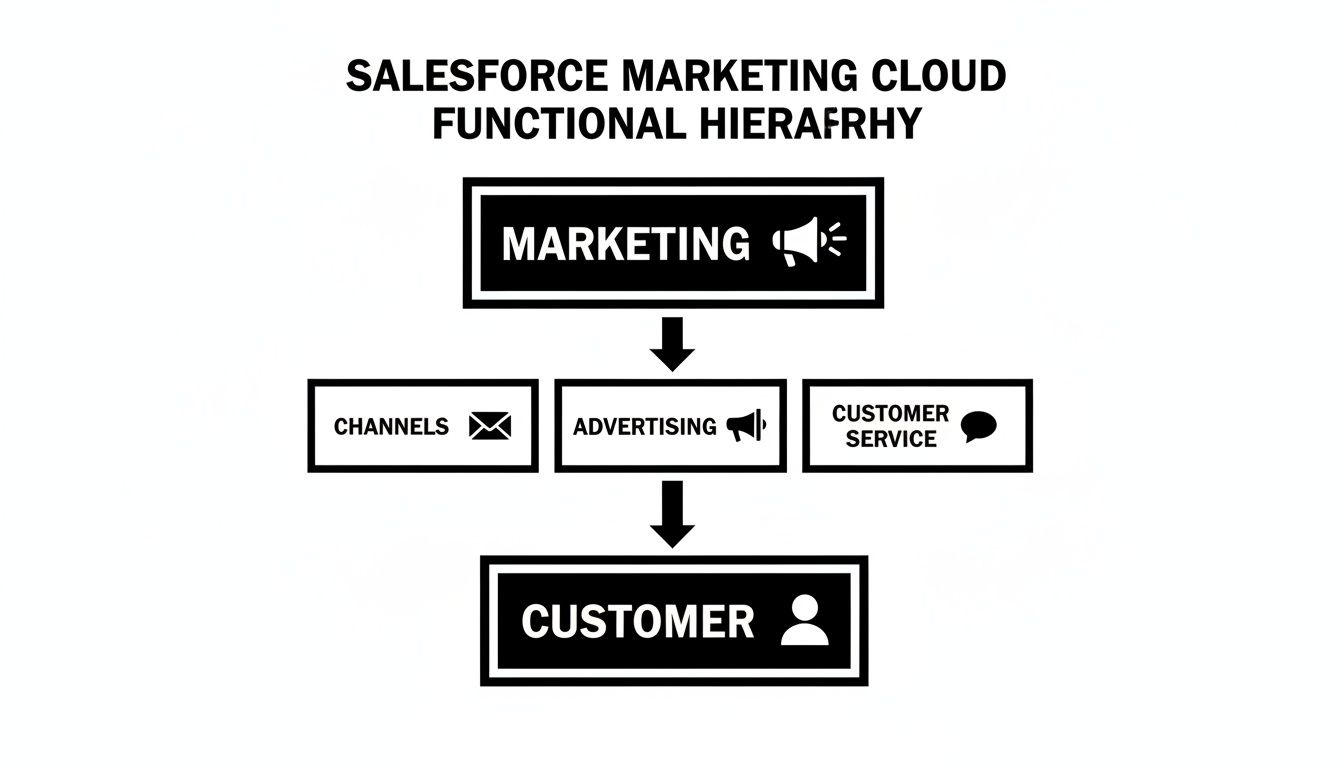
This simple hierarchy makes a powerful point: every tool and channel on the platform exists to deliver a better customer experience.
The Specialized Studios
The Studios are where your channel-specific content and campaigns are created. Each one is a feature-rich environment built to master a particular communication method.
Email Studio: This is the workhorse for all things email. It goes far beyond simple campaigns, allowing you to build dynamic, personalized messages using sophisticated segmentation and automation. For example, a professional services firm could send a tailored monthly newsletter where articles change based on a client's industry or past engagement.
Mobile Studio: This studio centralizes all your mobile marketing efforts. It lets you engage customers through SMS, push notifications, and group messaging. You could, for instance, send an SMS reminder to webinar registrants an hour before the event, boosting attendance rates.
Social management: Salesforce retired Social Studio on November 18, 2024. For social listening, publishing, and engagement, Salesforce now points customers to a Sprout Social partnership rather than a native Studio. Plan social management on that basis.
Advertising: The first-party-data advertising capability was renamed Marketing Cloud Advertising (formerly Advertising Studio). Salesforce is retiring it, with subscriptions non-renewable after August 15, 2026, and is moving advertising to Data Cloud Ad Audiences. You can still activate first-party CRM data to find and target lookalike audiences on platforms like Google, Meta, and LinkedIn. The product surface that does it is shifting to Data 360 (formerly Data Cloud).
These studios are powerful on their own, but their true potential is realized when orchestrated by the Builders.
The Strategic Builders
If the Studios are the individual instruments, the Builders are the conductors. They are the strategic core of the platform, enabling you to design, visualize, and automate customer journeys that span all studios and channels.
Journey Builder is where strategy meets execution. It’s the visual canvas where you map out every step of the customer experience, from the initial welcome email to long-term loyalty campaigns, ensuring every interaction is connected and purposeful.
Journey Builder is arguably the most critical component of the platform. Its drag-and-drop interface allows you to create intricate 1-to-1 customer journeys. You can set triggers based on customer actions, like filling out a form or clicking a link, and then guide them down different paths with personalized content. This is a game-changer for lead nurturing in long B2B sales cycles. If you're curious about the mechanics, you can learn more about how Salesforce can send automated emails as part of these journeys.
Another key component is Content Builder. This cross-channel content management tool allows you to store, manage, and edit all your marketing assets, images, text blocks, and templates, in one central library. This is crucial for maintaining brand consistency and makes it easy to reuse effective content across different campaigns. For example, you can design an email template in Content Builder and then pull it directly into a path in Journey Builder.
This tight integration makes Marketing Cloud a cohesive and efficient platform for any modern marketer.
Unifying Your Data for True Personalization
True personalization is the ultimate goal for marketers, but it remains elusive when customer data is scattered across various systems, CRM, web analytics, e-commerce platforms, and offline events. The real power of Salesforce Marketing Cloud lies not just in sending emails, but in its ability to break down these data silos.
Think of it as the central hub for your customer universe. It pulls in data from every touchpoint, connecting the dots to create a single, cohesive profile for each individual. This is how you transition from simply sending messages to crafting strategic customer experiences.

This unified view is the foundation for delivering experiences that feel responsive and personalized, not automated.
The Role of Contact Builder
The engine behind this data consolidation is a tool called Contact Builder. It's the application within Marketing Cloud that manages and links every piece of information you have on your contacts. Instead of separate lists for email, SMS, and advertising, Contact Builder creates a master record for each person, connecting their email, phone number, and CRM ID into a single unified identity.
This provides a true 360-degree view of your customer. You can see not just who they are, but what they’ve done, what they care about, and how they’ve interacted with your brand across all channels. For B2B firms, this is invaluable. You can track the entire relationship, from an anonymous website visit to a recent sales call, all in one place. You can learn more about the concepts behind this in our guide to customer data platforms.
A B2B Personalization Example in Action
Let's consider a real-world B2B scenario. A prospect named Sarah signs up for a free trial of your software. Later that day, she browses your pricing page. A few days later, she opens a welcome email and clicks a link to a case study relevant to her industry.
Without a unified data platform, these are just disconnected events. With Marketing Cloud, they tell a compelling story:
Trial Signup: A new contact record for Sarah is created in Marketing Cloud.
Website Behavior: Her browsing activity on the pricing page is linked to her profile.
Email Engagement: The case study click is recorded, signaling her specific interests.
Because all this data is centralized, you can create marketing that responds intelligently. An automated rule could instantly alert the assigned sales rep that Sarah is a high-potential lead. Simultaneously, Journey Builder could send her a personalized follow-up email with content tailored to her industry, building trust and guiding her toward a decision.
True personalization isn’t just adding a first name to an email. It’s understanding a customer’s context, anticipating their next need, and delivering a relevant experience that proves you’re listening.
This contextual engagement transforms marketing from a series of broadcasts into a helpful, guided conversation. For enterprise organizations, this isn't just a "nice-to-have"; it's a financial necessity. A Forrester Consulting Total Economic Impact study commissioned by Salesforce found a composite organization realized 299% ROI over three years from Marketing Cloud, a testament to its impact on business growth.
Integrating with Salesforce CRM and Beyond
One of Marketing Cloud's greatest strengths is its ability to connect to the broader Salesforce ecosystem. While it's a powerful platform on its own, its true potential is unlocked when synced with Sales Cloud or Service Cloud, creating a unified business front. This is not just a technical feature; it's a significant business advantage.
The mechanism behind this connection is Marketing Cloud Connect, a smart, two-way data bridge between your marketing efforts and your sales and service teams. Information flows freely back and forth, ensuring everyone is working from the same real-time customer data.

This seamless flow breaks down the traditional barriers between marketing and sales, turning them into a cohesive revenue engine.
Empowering Sales with Marketing Insights
When Marketing Cloud is integrated with your CRM, your sales team gains real-time intelligence. Imagine a salesperson preparing for a call. Instead of going in blind, they can see a complete history of the prospect's marketing engagement directly within their CRM dashboard.
They can see every email opened, link clicked, whitepaper downloaded, and webinar attended. This context turns a cold call into a warm, informed conversation.
More Relevant Conversations: Sales reps can tailor their pitch based on what they know interests the prospect.
Better Lead Scoring: Marketing engagement data automatically scores and prioritizes leads, so sales knows where to focus.
Shorter Sales Cycles: With better information and more targeted conversations, the time to close deals often decreases significantly.
This alignment is crucial. When marketing and sales share the same view of the customer, the entire company becomes more effective at driving revenue. To learn more about how these connections work, check out our guide on what is CRM integration.
Extending Power Beyond the Salesforce Ecosystem
While the native Salesforce integration is a major benefit, Marketing Cloud's capabilities extend further. The platform is designed to be the central hub for all your customer data, regardless of its source. This is made possible through a robust set of Application Programming Interfaces (APIs).
These APIs act as secure gateways, allowing Marketing Cloud to connect with virtually any other business system you use.
By integrating systems beyond the CRM, Marketing Cloud becomes the single source of truth for the entire customer lifecycle, unifying data from sales, service, operations, and finance to create unparalleled customer intelligence.
This means you can pull in data from other critical platforms to enrich your customer profiles and launch even more sophisticated marketing journeys.
Common Integration Scenarios
ERP Systems: Syncing with your Enterprise Resource Planning (ERP) system allows you to use purchase history to trigger post-purchase follow-ups or loyalty campaigns.
Data Warehouses: You can connect to platforms like Snowflake or BigQuery to leverage large datasets for advanced segmentation.
E-commerce Platforms: Integrating with systems like Shopify or Magento enables you to automate abandoned cart reminders and personalized product recommendations.
This extensibility makes Marketing Cloud a true enterprise-grade solution. It doesn't just manage marketing campaigns; it orchestrates the entire customer experience by connecting all the data points that define your customer relationships.
Salesforce Sales Cloud vs Marketing Cloud
Is Marketing Cloud part of Salesforce? Yes. Salesforce sells both products, and once connected they work from the same customer records. The confusion comes from what each one does. Sales Cloud is the CRM system of record: it manages leads, opportunities, and pipeline for your sales team. Marketing Cloud is the engagement layer of Salesforce CRM marketing: it takes those same contacts and runs personalized campaigns across email, mobile, advertising, and the web.
Sales Cloud | Marketing Cloud | |
|---|---|---|
Primary job | CRM: leads, opportunities, pipeline | Marketing automation and cross-channel engagement |
Main users | Sales reps and sales operations | Marketers and demand generation teams |
Works on | Accounts, contacts, and deals | Journeys, segments, and messages |
Typical trigger | A rep updates a deal stage | A customer opens, clicks, or browses |
Buy it when | You need to manage a sales process | You need personalized campaigns at scale |
Most B2B firms run both, synced through Marketing Cloud Connect. The CRM holds the relationship record; Marketing Cloud turns that record into timely, relevant communication that sales can see and act on.
The Future of Marketing with AI and Real-Time Data
Marketing once focused on past actions, what a client did last month or last week. Today, the focus has shifted. Success means acting on what a client is doing right now. This pivot from historical data to real-time action is where AI and instant data processing are creating a significant competitive advantage.
Salesforce Marketing Cloud is at the forefront of this shift, particularly with the rise of Salesforce Data 360 (formerly Data Cloud). This isn't just another feature; it's a fundamental change in how marketing teams operate. It's designed to ingest and make sense of vast amounts of data from all your systems in real time.
The impact on your business is both immediate and powerful. Imagine engaging with clients based on actions they took five minutes ago, not five days ago. This fundamentally changes the speed and relevance of your marketing.
The Power of Predictive Insights
AI within the Salesforce ecosystem isn't just about speed; it's about foresight. By analyzing real-time data streams, AI-powered tools deliver predictive insights that guide your next move.
Consider a professional services firm. The system might identify a high-value client whose engagement has suddenly dropped, flagging them as a churn risk before they disengage. This allows the account team to intervene proactively. Alternatively, it could identify a prospect showing strong purchase intent based on their digital behavior across your website and social channels.
This foresight provides several key advantages:
Proactive Client Retention: Spot and address potential issues before they escalate, strengthening relationships.
Smarter Lead Prioritization: Direct your sales team to the prospects who are most engaged right now, improving efficiency.
Hyper-Personalized Content: Automatically deliver the exact article, case study, or next step a client needs in that moment.
This isn't just about faster marketing; it's about making it smarter and more attuned to your audience's immediate needs. You can explore this topic further in our guide on the role of AI in marketing.
Activating Campaigns at the Speed of Business
The combination of Marketing Cloud and Data 360 represents a significant leap forward for B2B firms. As Salesforce Data 360 matures, it unlocks new levels of customer insight and speed. Firms that master their real-time data strategy can target clients based on actions taken minutes ago, transforming the velocity of their marketing.
Agentforce Marketing and Marketing Cloud Next
Salesforce is now building this around agentic AI. Marketing Cloud Next, announced in June 2025, is the agentic marketing platform Salesforce sells under the Agentforce Marketing banner. Agentforce brings AI agents into the marketing workflow to build campaign briefs, generate segments, draft copy, and launch journeys with less manual effort, so the Salesforce marketer spends time on strategy instead of list pulls. Pairing those agents with Data 360 is where the platform is heading.
The fusion of AI and real-time data in Marketing Cloud moves the goalposts. The new standard is not just personalization, but pre-emptive personalization: addressing a need at the very moment it arises.
This capability makes Marketing Cloud a future-proof platform. It provides the tools to compete in a world where customer expectations for timely, relevant communication are constantly rising. By embracing these tools, your firm can build a more agile, responsive, and effective marketing engine that drives measurable growth.
Partnering for Success to Maximize Your Marketing Cloud ROI
Understanding what Salesforce Marketing Cloud can do is one thing; making it deliver on its promise is another. Proper setup is complex, strategic planning requires expertise, and most in-house teams lack the bandwidth to manage it all. This is where the right partner can bridge the gap between potential and performance.
Engaging an expert is not just about technical implementation; it's about unlocking the platform's full value from day one. A specialist helps you avoid common mistakes that can undermine your return on investment. They bring a strategic perspective to everything, from initial setup and CRM integration to designing customer journeys and activating campaigns, ensuring every action aligns with your business goals.
Beyond Technical Implementation
A true partner focuses on business outcomes, not just technical checklists. They work with you to build a practical, data-driven strategy that delivers measurable growth. This hands-on approach reduces your time-to-value and helps you achieve a higher ROI on your investment.
Here are key areas where a partner adds critical value:
Strategic Roadmap Development: They help you map out a phased implementation that delivers quick wins while building toward long-term marketing maturity.
Complex Data Integration: They ensure a seamless flow of data between Marketing Cloud, your CRM, and other systems to achieve a true 360-degree customer view.
Custom Journey Design: They help you map out and build sophisticated, automated customer journeys that nurture leads and build client loyalty.
Ongoing Activation and Optimization: They provide continuous support to analyze performance, fine-tune campaigns, and adapt your strategy as your business evolves.
Working with a specialist transforms your Salesforce Marketing Cloud investment from a powerful piece of software into a strategic growth engine. It ensures your team is not just using the tools, but mastering them to drive real business results.
This strategic guidance is essential, especially given the platform's rapid evolution.
Staying Ahead of Platform Innovation
The Salesforce ecosystem is constantly evolving, with new products and features released at a rapid pace. For instance, Salesforce's Agentforce and Data 360 products grew to nearly $3.4 billion in Annual Recurring Revenue (ARR), an increase of more than 200% year over year.
Notably, more than 50% of those bookings came from existing customers expanding their use of the platform. You can explore these Salesforce growth trends and their impact for yourself. For marketing leaders, this is a strong vote of confidence. It shows that companies are increasing their investment because they see real value. A skilled partner keeps you informed of these changes, ensuring you're always ready to leverage powerful new capabilities as they emerge.
Frequently Asked Questions
Let's address some of the most common questions that arise when firms consider implementing Salesforce Marketing Cloud.
How Is Salesforce Marketing Cloud Different From Marketing Cloud Account Engagement (Pardot)?
This is a critical distinction. Think of Salesforce Marketing Cloud Account Engagement (formerly Pardot) as a B2B sales cycle specialist. It is designed for nurturing leads through long, complex sales processes, scoring their engagement, and handing them off to the sales team at the right moment. Its focus is on the top of the funnel and aligning marketing efforts with sales plays.
Salesforce Marketing Cloud, in contrast, is the broader platform for managing the entire customer relationship at a 1-to-1 level. It’s not just about the initial sale; it’s about orchestrating experiences across email, SMS, social media, and advertising throughout the entire customer lifecycle. While Account Engagement is sales-focused, Marketing Cloud is about the customer experience, long after the deal is closed.
Is Marketing Cloud a Good Fit for a Mid-Sized Firm?
Absolutely. The decision to use Marketing Cloud should be based on the complexity of the customer journeys you want to create, not company size. For a mid-sized professional services firm aiming to send highly personalized communications to different client segments across multiple channels, Marketing Cloud is often the ideal solution.
The secret is a phased, strategic rollout. You don't have to implement everything at once. Start with core tools like Journey Builder and Email Studio, prove their value, and then expand as your team's confidence and marketing maturity grow. This approach ensures you see a return at every step.
This method allows your team to master the platform's capabilities without being overwhelmed, making it a powerful and manageable solution for ambitious mid-sized businesses.
What Is a Typical Implementation Timeline?
The timeline depends on your objectives. A straightforward implementation focusing on Email Studio and CRM integration could take as little as 6-12 weeks. This establishes your foundational email marketing and data synchronization.
However, a more comprehensive project involving multiple channels (like SMS or social), complex journey automation, and deep data integrations could take 4 to 9 months or longer. The timeline is influenced by several factors:
Data Quality: The cleanliness and organization of your existing customer data is often the biggest variable.
Marketing Goals: Are you building simple newsletters or complex, multi-stage automated journeys?
Internal Resources: The amount of time your team can dedicate to the project is crucial.
This is where a strategic partner can be invaluable. We can help you map out a realistic timeline based on your goals and ensure the project delivers tangible value as quickly as possible.
Is Salesforce Marketing Cloud a CRM?
No. Salesforce Marketing Cloud is marketing cloud software, not a CRM database. The system of record in the Salesforce ecosystem is Sales Cloud, or Service Cloud for support teams. Marketing Cloud reads and writes that CRM data through Marketing Cloud Connect, then acts on it: segmenting audiences, running journeys, and sending messages. That is why the two are licensed separately, and why the marketing cloud CRM pairing is so common. The CRM holds the relationship record, and Marketing Cloud turns it into personalized communication. If you only need to track deals, start with a CRM. If you need automated, cross-channel engagement at scale, you need both.
What Happened to Datorama in Salesforce?
Datorama in Salesforce lives on as Marketing Cloud Intelligence. Salesforce acquired Datorama in 2018 and renamed the product in 2022. It connects marketing data from ad platforms, web analytics, email, and CRM into one reporting layer, so teams track spend, performance, and ROI across every channel without manual spreadsheet work. If a vendor contract or job posting still says Datorama, it means Marketing Cloud Intelligence. For most B2B firms, Intelligence dashboards complement native Marketing Cloud reporting and roll campaign results into the revenue reporting leadership already reviews.
Ready to unlock the full potential of Salesforce Marketing Cloud and drive measurable growth? Twelverays provides expert strategy, implementation, and activation services to ensure your investment delivers maximum ROI. Schedule a consultation with our Salesforce experts today.


