

SEO management isn't a one-and-done task. It's the continuous, strategic process of optimizing your website to increase its visibility in search engine results. This ongoing commitment involves refining your site's technical health, content, and authority to attract a steady stream of high-quality organic traffic.
What Is Modern SEO Management?
Forget the outdated "set it and forget it" mindset. Modern SEO management is the active stewardship of your entire digital presence.
Think of an expert financial advisor managing a high-growth portfolio. They don't just buy a few stocks and walk away; they constantly analyze market trends, make strategic adjustments, and focus on long-term value. This is precisely what SEO management does for your website, it's the engine powering sustainable growth by consistently placing you in front of your ideal customers at the exact moment they're searching for solutions.
This proactive approach is no longer optional. The global SEO market is growing fast, driven by a simple fact: over two-thirds of all online experiences begin with a search engine. For B2B companies and professional services, effective SEO management is the key to capturing this opportunity.
The Three Pillars of SEO Success
To understand what SEO management is, you must grasp its three core pillars. Each addresses a different aspect of your website's performance, and they must work in unison to create a robust, cohesive strategy. If one pillar is weak, the entire structure is compromised.
This diagram visualizes how these essential components interlock.
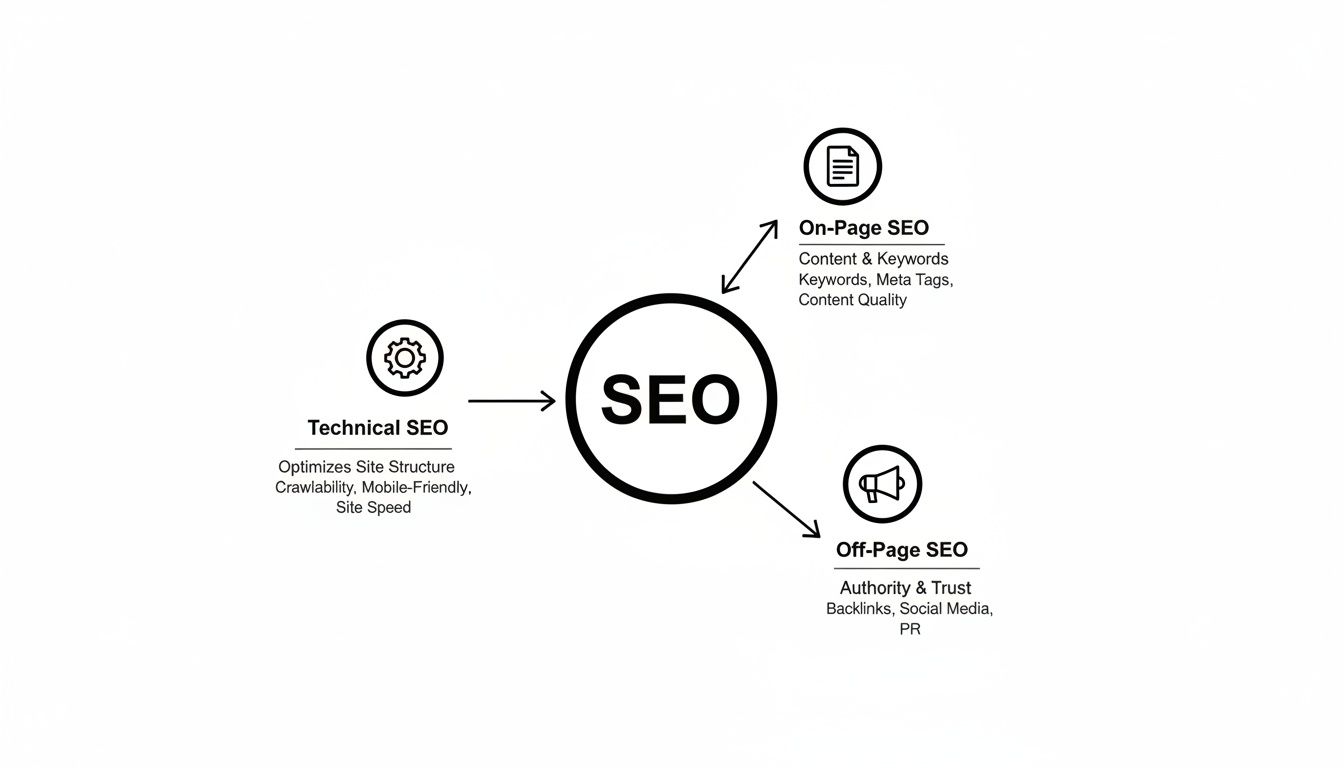
As you can see, Technical, On-Page, and Off-Page SEO are distinct but deeply interconnected, forming the foundation of a holistic strategy.
SEO management ensures your digital storefront is not only visible to the right audience but also provides a seamless experience that turns visitors into loyal clients. It's the difference between building a shop on a forgotten side street versus a flagship store on the busiest avenue.
Here’s a closer look at these three components:
- Technical SEO: This is your website's foundation. It involves optimizing your site's infrastructure so search engines can efficiently crawl, index, and understand your content. Think of it as ensuring your building has solid wiring, good plumbing, and a logical floor plan. You can learn more about how search engines work in our detailed guide.
- On-Page SEO: This pillar focuses on the content on your website. It encompasses everything from keyword research and content creation to optimizing title tags and meta descriptions. This is akin to designing your store’s interior, arranging products logically, and ensuring all signage is clear and helpful.
- Off-Page SEO: This involves all actions taken outside of your website to build its authority and reputation. It primarily focuses on earning high-quality backlinks from other reputable sites, which act as "votes of confidence" for Google. This is your PR and networking, building your store’s reputation within the community.
To clarify how these pillars function within an SEO management strategy, here’s a quick summary.
The Three Pillars of SEO Management at a Glance
Ultimately, a successful SEO management plan keeps all three pillars strong and aligned. When technical health, on-page relevance, and off-page authority work in harmony, you create a powerful flywheel for sustainable organic growth.
Building Your Content and On-Page SEO Blueprint

This is where your SEO strategy truly comes to life. If technical SEO is the foundation of your digital storefront, your content is everything the customer interacts with, the products, the helpful signage, and the expert staff. It’s the most tangible part of your plan, turning abstract goals into a valuable resource that attracts and converts your ideal clients.
The obsolete tactic of "keyword stuffing", forcing a keyword into a page repeatedly, is a relic of the past. Modern SEO management focuses on semantic SEO. This approach is not about matching specific words; it's about understanding the intent behind a user's search and creating a comprehensive web of content that thoroughly answers their questions. The goal is to build a content ecosystem that establishes your B2B firm as the definitive authority.
From Keywords to Topic Clusters
Great content begins with smart keyword research, but the methodology has evolved. Instead of chasing individual, high-traffic keywords, the modern strategy is to build topic clusters. This involves identifying a broad "pillar" topic central to your business and then creating a series of in-depth "cluster" articles that explore related subtopics.
For example, a managed service provider might build a pillar page on "Cybersecurity for Small Businesses." This central hub would then link to more specific cluster content, such as:
- The Importance of Employee Security Training
- A Comparative Analysis of Business Antivirus Software
- How to Develop an Effective Disaster Recovery Plan
- Identifying and Preventing Phishing Attacks
This structure serves two purposes. First, it organizes your content logically, making it easy for visitors to navigate and find information. Second, it signals deep expertise on a subject to search engines, which helps elevate the rankings for the entire group of related pages.
The E-E-A-T Framework in Action
Google's quality guidelines place a massive emphasis on E-E-A-T: Experience, Expertise, Authoritativeness, and Trustworthiness. A core function of SEO management is ensuring every piece of content actively demonstrates these qualities, which is especially vital in the B2B sector where trust is paramount.
Think of E-E-A-T not as a checklist, but as the DNA of your content. It must be woven into every article, case study, and service page to build undeniable credibility with both your audience and search engines.
Putting this into practice means including detailed author bios that showcase credentials, citing credible data to support claims, and featuring customer testimonials or case studies. This shift transforms your website from a digital brochure into a trusted resource, attracting high-quality inbound leads who already recognize your value. For a deeper look, check out our guide on building a powerful SEO content strategy.
Mastering On-Page Optimization Elements
Once you have exceptional content, the final step is optimizing the on-page elements that signal its relevance to search engines. These practical, hands-on tweaks can significantly impact your visibility. On-page work is one of the largest segments of SEO spend, and mastering these fundamentals is non-negotiable.
Key on-page factors to manage include:
- Title Tags: The clickable headline in search results. It must be compelling, include your primary keyword, and accurately reflect the page's content.
- Meta Descriptions: The text snippet under the title tag. While not a direct ranking factor, a well-written description boosts click-through rates by persuading users to click.
- Internal Linking: Strategically linking to other relevant pages on your site. This practice distributes authority, guides users deeper into your content, and helps search engines understand your site's structure.
By carefully managing these elements, you create a smooth user experience while clearly communicating your site's value to search engine crawlers.
Fortifying Your Technical SEO Foundation

Now, let's look under the hood. Technical SEO is the engine that drives your entire strategy, the unseen foundation supporting your content and authority-building efforts. If this foundation has cracks, even the most beautifully designed structure will eventually crumble.
A core part of what is SEO management involves continuously monitoring and improving this technical health, as it directly impacts both rankings and user experience. It's the backend work that ensures search engines can find, crawl, and index your website without any roadblocks.
Why Site Speed Is Non-Negotiable
In a world of instant gratification, a slow website is a silent business killer. Site speed is a critical component of user experience that Google takes very seriously. A page that takes too long to load frustrates visitors, causing them to leave. This sends a negative signal to search engines, indicating your site isn't meeting user expectations.
Research consistently shows that even a one-second delay in page load time can significantly reduce conversions. For B2B firms, this means losing potential leads before they even see your value proposition. Effective SEO management involves optimizing images, cleaning up code, and using fast hosting to deliver a seamless experience. You can dive deeper into this in our article explaining Core Web Vitals in detail.
Ensuring Perfect Crawlability and Indexability
Before Google can rank your content, it has to find and understand it through a process called crawling and indexing. Your role is to make this process as straightforward as possible for search engine "spiders."
This involves a few key technical tasks:
- XML Sitemaps: This is a roadmap of your website that you provide to search engines, listing all your important pages.
- Robots.txt: This file instructs search engines on which parts of your site they should and shouldn't crawl.
- Canonicals: These tags prevent duplicate content issues by telling search engines which version of a page is the "master copy" to be indexed.
A well-structured site with a logical hierarchy and clean internal links helps crawlers navigate your content efficiently, ensuring your most valuable pages are indexed and have a chance to appear in search results.
A secure (HTTPS), fast-loading, and easily navigable website is no longer a luxury, it's an essential prerequisite for success. It shows both users and search engines that your digital presence is professional, trustworthy, and ready for business.
The Rise of Mobile-First and Structured Data
With the majority of searches now occurring on smartphones, Google has fully transitioned to mobile-first indexing. This means it primarily uses the mobile version of your site for indexing and ranking. If your website isn't fully responsive and user-friendly on mobile devices, you're at a significant disadvantage.
Another powerful technical SEO tool is schema markup. This is code you can add to your site to help search engines understand the context of your content. For instance, you can use schema to clearly identify information like:
- Your business's address and phone number
- Reviews and star ratings for your services
- Details about an upcoming webinar or event
Correctly implemented schema can earn you "rich snippets" in search results, those eye-catching listings with star ratings, event dates, or FAQ dropdowns. These enhanced results stand out and can dramatically boost your click-through rate, driving more qualified traffic without necessarily needing a higher ranking.
Earning Authority with Off-Page SEO Strategies

Effective SEO management extends beyond your own website. Once your technical foundation is solid and your on-page content is optimized, the next challenge is building your digital authority across the web. This is the domain of off-page SEO, a set of strategies focused on establishing your brand's credibility in the eyes of both users and search engines.
Think of the internet as a vast community. In this digital ecosystem, links and mentions from reputable sites act as powerful endorsements, like a trusted colleague vouching for your expertise. Off-page SEO is the art of earning these "votes of confidence," signaling to Google that your expertise is recognized and valued.
Link Building as a Function of Brand Building
The core of off-page SEO has always been link building, but the approach has evolved. The outdated practice of acquiring hundreds of low-quality links is obsolete. Today, the focus is on earning high-quality, relevant backlinks from authoritative sources. A single link from a respected industry journal is far more valuable than a thousand links from irrelevant directories.
This is where SEO management intersects with public relations and brand strategy. The objective is to create content and forge partnerships that naturally attract these endorsements. For B2B firms, the question shifts from "How do we get links?" to "How do we become so valuable that others want to link to us?"
High-Impact Strategies for B2B Authority
For professional service firms, off-page authority is built on demonstrated expertise. It’s about showcasing your knowledge in ways that command attention and earn recognition.
Here are a few proven strategies:
- Digital PR: Craft compelling stories and data-backed insights to pitch to journalists and industry publications. A feature or quote in a top-tier outlet can expose your brand to a large audience and earn a powerful backlink. For instance, a consulting firm might publish an original research report that gets cited by business journals.
- Creating Linkable Assets: Develop content designed to be a resource for others in your field. This includes original research, comprehensive guides, or unique data visualizations. When you create the definitive resource on a topic, other websites will naturally link to it.
- Guest Contribution: Writing articles for respected industry blogs remains an effective strategy. It allows you to showcase your expertise, connect with an existing audience, and secure a relevant backlink in your author bio or content.
The core of modern off-page SEO isn't about gaming the system; it's about genuine brand building. Every earned link and brand mention is a testament to your authority and a signal that you are a trusted leader in your field.
Distinguishing Ethical from Outdated Tactics
A crucial aspect of off-page SEO management is knowing which tactics build long-term brand equity and which carry significant risk. Google's algorithms are sophisticated and can easily detect manipulative link schemes. Using outdated practices can lead to severe penalties, potentially making your site invisible in search results.
It's vital to avoid tactics like buying links, participating in link farms, or engaging in excessive link exchanges. These shortcuts may offer a temporary boost but will ultimately damage your reputation and search rankings. The best off-page strategies are sustainable and rooted in creating real value. For a deeper dive, check out our essential guide to link building for boosting your SEO.
The Tech Stack Behind Your SEO Management
Managing SEO without the right data is like flying blind. Your technology stack provides the real-time data needed to fine-tune performance, identify issues before they become critical, and outmaneuver the competition.
Modern SEO cannot be managed by guesswork alone. A suite of specialized tools is necessary to execute, measure, and scale your efforts effectively. The right technology moves your strategy from speculation to calculated, predictable results.
Core Platforms for Strategy and Analysis
At the heart of any serious SEO operation are comprehensive analysis platforms. Tools like Ahrefs and Semrush are the Swiss Army knives of the industry, offering a 360-degree view of the competitive landscape. They are indispensable for identifying keyword gaps, analyzing competitor backlink profiles, and tracking your rankings over time.
A comprehensive analysis platform gives an at-a-glance overview of a site's authority, organic traffic, and keyword footprint.
From a single dashboard, an SEO manager can instantly assess the impact of their off-page strategy on the Domain Rating and identify which keywords are driving valuable traffic.
These platforms allow you to reverse-engineer the success of top players in your space, providing the market intelligence needed to invest your content and link-building resources for maximum impact.
Tools for Technical Health and User Insights
In addition to competitive analysis, you need tools to monitor your own site’s health. A technical crawler like Screaming Frog acts as a digital building inspector, methodically crawling every page to diagnose issues like broken links, redirect chains, and missing meta tags.
Simultaneously, platforms like Google Analytics and Google Search Console reveal how real users interact with your site. They provide direct insight into the queries bringing people to your site, the content they engage with most, and their journey through your digital storefront.
The real power of an SEO tech stack isn’t in any single tool, but in how you integrate the data from all of them. It's about combining competitive insights with technical diagnostics and user behavior to get a complete, actionable picture of your performance.
This reliance on sophisticated systems is fueling growth across the industry. Investment in SEO software keeps rising as strategies become more data-driven. For B2B companies, the right SEO software is central to a data-driven strategy that creates a sustainable competitive advantage.
Connecting SEO to Revenue
The most critical piece of the puzzle is tying SEO data to actual business outcomes. By integrating your analytics with a CRM like Salesforce, you can reframe SEO from a marketing expense to a predictable revenue driver.
This connection allows you to trace a user's entire journey, from their initial organic search to becoming a qualified lead and, ultimately, a closed deal. This is how you prove ROI and elevate SEO to a C-suite conversation about growth.
Measuring SEO Success with Business-Centric KPIs
How do you prove that your SEO management is delivering tangible value? The answer lies in shifting the conversation from "vanity metrics" to business-centric KPIs that resonate with your leadership team.
Effective SEO management is about turning clicks into customers and content into contracts. It requires focusing on the direct impact of organic search on your sales pipeline.
Moving Beyond Vanity Metrics
It's easy to get caught up in numbers that look impressive but lack business context. Hitting the #1 spot for a keyword feels like a win, but if that keyword doesn't drive qualified leads, it's just noise. The real goal is to draw a direct line from SEO performance to the company's financial health.
This requires a deliberate focus on metrics that tell a story of growth and profitability. Instead of just showing a chart of rising organic traffic, you need to analyze its quality, conversion rate, and overall contribution to the bottom line.
The most powerful SEO reports don't just show what happened; they explain why it matters for the business. This is how you transform SEO from a marketing expense into a documented, high-return investment.
To nail this down, let’s distinguish between superficial metrics and those that demonstrate real business impact. Understanding this difference is key to building a compelling case for your SEO efforts. If you want to dive deeper, you can find more marketing KPI examples in our detailed article.
Vanity Metrics vs. Business-Impact KPIs
Focusing on the "right" metrics is crucial. A keyword ranking doesn't pay the bills, but a qualified lead from that ranking does. The table below illustrates this important distinction.
By framing your results this way, you position yourself as a business driver, not just an SEO manager. You’re speaking the language of executives and proving your worth in terms they value.
Calculating SEO ROI and CAC
Ultimately, the most convincing measure of success is a clear financial return. Two of the most powerful KPIs for this are Return on Investment (ROI) and Customer Acquisition Cost (CAC) from the organic channel.
To calculate your organic CAC, divide your total investment in SEO management (including tools, content creation, and personnel costs) by the number of new customers acquired through organic search over a specific period. This single number reveals exactly how much it costs to win a new client using your SEO strategy.
Consistently tracking these bottom-line metrics allows you to build performance reports that not only highlight key wins but also align every SEO action with your company's broader goals. This is how you prove that your SEO management strategy is a powerful engine for profitable growth.
Burning Questions About SEO Management
When considering professional SEO expertise, a few key questions typically arise. It’s wise to clarify these points before committing to a strategy.
How Long Does SEO Management Take to Show Results?
Let’s be direct: SEO is a marathon, not a sprint. While initial technical fixes might provide a small boost in a few weeks, meaningful results, such as improved rankings and increased organic traffic, typically begin to appear within 4 to 12 months.
This timeline depends on your industry's competitiveness, your website's current authority, and the consistency of your efforts. Think of it like planting an orchard: it requires upfront work and consistent care, but the reward is a sustainable, long-term harvest of qualified leads.
What Is the Difference Between SEO and SEM?
These terms are often used interchangeably, but they are distinct. SEM, or Search Engine Marketing, is the umbrella term for all marketing activities on search engines, both paid and organic.
SEO is a specific component of SEM focused on earning organic (unpaid) traffic from search results. The other major part of SEM is PPC (Pay-Per-Click) advertising, where you pay for placement.
A smart SEO management strategy leverages insights from both. For example, PPC data can quickly identify keywords with high purchase intent, providing a proven target for a long-term SEO content strategy. In return, strong organic visibility builds brand credibility and can lower overall ad costs, creating a powerful synergy.
Should We Manage SEO In-House or Hire an Agency?
This decision depends on your company's resources, expertise, and objectives. An in-house team can be effective if you have dedicated experts who stay current with the ever-changing SEO landscape.
For most firms, partnering with a specialized agency is a faster, more effective route. It provides immediate access to a full team of specialists, enterprise-level tools, and proven processes without the significant overhead. An agency also brings diverse experience from various industries, helping you avoid common pitfalls and connect SEO performance directly to revenue through sophisticated reporting and CRM integration.
At Twelverays, we build data-driven SEO strategies that tie directly to your bottom line. It’s time to move beyond guesswork and see how a tailored approach can drive predictable client acquisition. Discover our SEO management services today.


