

An AI agent RFP is a request for proposal used to commission an AI agent implementation. It gives suppliers a shared workflow, required outcomes, and response format for AI vendor selection. A useful RFP for AI agent development explains what the agent may do, how a person will accept its work, and which costs and responsibilities each bidder must describe.
Use the original request for proposal template below to compare implementation proposals for one business workflow. The filled example is hypothetical. Adapt its requirements to your organization before issuing it, keeping the common response format so bidders price the same assignment.
Key takeaways for evaluating AI agent RFP responses
- Every bidder receives the same workflow, source boundaries, approval rules, and response format.
- Mandatory conditions are assessed before weighted criteria.
- Each scored criterion has evidence from the agreed sample task or a stated proposal commitment.
- Commercial responses separate discovery, implementation, licenses, usage, support, and buyer work.
- The proposal names acceptance, handoff, incident, and exit responsibilities.
Define one workflow every bidder must price
For this hypothetical AI implementation RFP, an operations team wants a weekly internal project and vendor status brief. Employees currently review a document library and project tracker, summarize developments, and send the draft to an operations manager. The manager corrects and approves it before staff receive the final version.
The proposed agent reads the authorized records, prepares a sourced draft, and routes it for approval. It may distribute the approved version to the agreed internal audience. It must not modify project records, contact vendors, add new recipients, or distribute an unapproved revision.
State the trigger and operating assumptions. For example, this assignment uses a weekly schedule with a manual rerun requested by an authorized employee. The buyer must supply expected record volume, document types, user roles, and the required review window before suppliers finalize their bids. Those values come from the intended workflow, not a market average.
NIST's AI Risk Management Framework calls for documenting the intended purpose, users, and deployment context of an AI system. A procurement brief can use that principle to establish what bidders are evaluating. The requirements in this article are an original buyer template. NIST AI RMF Core, MAP 1.1
If your team cannot yet name the source systems or approval owner, commission a short discovery engagement first. Its deliverable should resolve those gaps and recommend a bounded implementation scope. An RFP becomes easier to use once the buyer can give suppliers a consistent problem to price.
Give bidders the same scope and constraints
Include the following requirements matrix in the request. For every row, require the bidder to state its proposed approach, supporting evidence, dependencies, exclusions, and responsible party. Ask it to identify whether the requirement is covered by configuration, custom work, an external service, or a buyer task.
The example requirements apply to the hypothetical weekly brief. Change the substantive details before sending the document, and distribute the same revision to every bidder.
| Requirement | Filled example for the buyer's RFP | Required bidder response |
|---|---|---|
| Source systems | Read the authorized document library and project tracker; preserve links to the underlying records | Identify the connection method, setup work, limits, and buyer access requirements |
| Record access | Read only the records and fields approved for this workflow | Describe the access boundary and how it will be verified |
| Output | Produce an editable internal brief with source links, open questions, and a preparation date | Show an example output and explain its format and destination |
| Permitted actions | Create a draft, request approval, and distribute the approved version to the named internal audience | List each action and the condition that authorizes it |
| Human review | The operations manager approves, rejects, or returns the draft for correction | Explain reviewer assignment, missing-reviewer behavior, and handling of changed drafts |
| Incomplete evidence | Flag unavailable records and conflicting statements without inventing a resolution | Describe the behavior and show how the reviewer sees the gap |
| Data handling | Follow the buyer's documented rules for storage, recipients, retention, and removal | Identify where information goes, which providers receive it, and any unmet requirement |
| Acceptance | Demonstrate agreed behavior on buyer-approved examples, including failure cases | Specify test evidence, limitations, defect handling, and buyer signoff |
| Handoff | Supply configuration documentation, operating instructions, ownership records, and training | List delivered assets, access arrangements, and support dependencies |
A requirements matrix is a shared record of what must be delivered and how each supplier proposes to deliver it. Keep requirement identifiers stable when questions arise. That lets reviewers compare responses without losing track of a changed assumption.
Publish clarifications to all bidders through your procurement process. If one supplier identifies a missing access dependency, resolve it for the whole group. Otherwise a later price comparison may reflect different assumptions about what the buyer will provide.
Twelverays offers AI agent implementation around business systems, defined roles, permissions, and handoffs. Ask its team to respond to the same requirements and evidence requests used for other candidates.
Require a comparable commercial response
The commercial response should explain both the initial project and the cost of operating it. Require suppliers to use the same categories, identify the currency, and describe when a figure is an estimate rather than a committed amount.
Use these response fields without inserting invented market prices:
| Cost or assumption | What the bidder must supply |
|---|---|
| Discovery | Scope, deliverable, fee, and whether it is optional or required before implementation |
| Implementation | Design, configuration, integrations, testing, training, and delivery milestones included in the quote |
| Licenses and external services | Required products, account owner, billing party, and current vendor terms used in the estimate |
| Usage | Billing units, assumed activity, expected variability, and how the buyer can review consumption |
| Support | Included operating tasks, service windows, escalation route, and separately priced changes |
| Buyer work | Access setup, source cleanup, subject-matter review, and other work your team must complete |
| Exclusions and changes | Omitted work, assumptions that affect price, and the process for approving scope changes |
Compare an agreed usage scenario across all bids. For the example workflow, that could be the same number of weekly runs, authorized users, and source records supplied by the buyer. Ask for a separate explanation of what changes when those assumptions change.
Keep unknowns visible. If a supplier needs source inspection before quoting an integration, request the inspection deliverable and the decision it will enable. Do not treat an unresolved estimate as a fixed price or silently assume the missing work is included.
Ask suppliers to distinguish reusable product capabilities from custom deliverables. This matters at handoff: a subscription may give the buyer access to a service, while ownership or modification rights for project-specific configuration can be different. Require those distinctions in the response.
Set the evaluation method before the demos
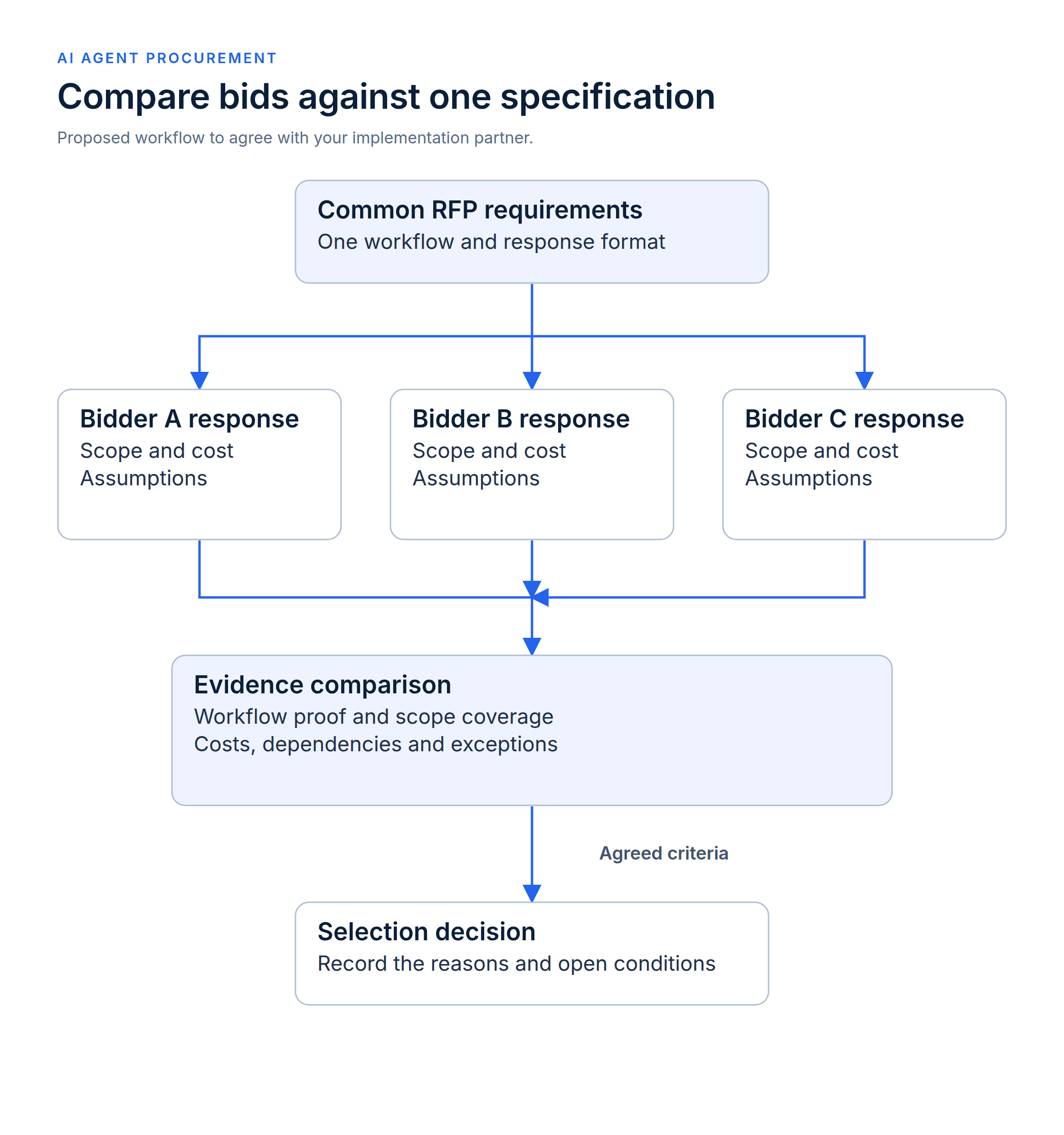
Give bidders the same requirements and response format, then compare evidence, costs and assumptions before selecting a partner.
Mandatory conditions are requirements a proposal must meet to remain eligible for selection. For the hypothetical workflow, these include respecting the agreed source boundary and preventing distribution without approval of the relevant draft. A supplier's attractive optional feature should not compensate for failing a requirement the buyer has defined as mandatory.
Then score the proposals that meet those conditions. The weighting below is illustrative and totals 100 percent. Choose weights that reflect your priorities before issuing the RFP.
| Evaluation criterion | Illustrative weight | Evidence to examine |
|---|---|---|
| Workflow fit | 30% | Coverage of the required inputs, output, actions, and approval process |
| Demonstrated behavior | 25% | Results on the agreed sample, including gaps and failure cases |
| Operating ownership | 20% | Named support responsibilities, documentation, handoff, and access arrangements |
| Commercial clarity | 15% | Comparable costs, usage assumptions, buyer work, exclusions, and change terms |
| Delivery plan | 10% | Proposed team, milestones, dependencies, and review responsibilities |
A rating scale describes the evidence needed to earn each score within a criterion. Define it separately from the criterion's weight. For example, a buyer might use ratings from zero to five, with zero meaning no supporting response and five meaning the requirement is fully supported by the requested evidence. Describe intermediate ratings before reviewers begin.
Under that illustrative method, a workflow-fit rating of four out of five contributes 24 points: four divided by five, multiplied by the 30-point weight. Record the supporting evidence and unresolved conditions alongside the number. A total without reasons is difficult to review later.
Use the same sample task for demonstrations and give bidders the same preparation conditions. NIST's Generative AI Profile cautions against extrapolating broad capabilities from narrow or anecdotal assessments. A demonstration can show behavior under its stated conditions; the buyer still needs evidence for the proposed workflow. NIST Generative AI Profile, MS-2.5-001
Have reviewers record their assessments before discussing a combined score. Resolve disagreements by examining the requirement and evidence. If you change a material criterion, document why and apply the revised method consistently.
Make acceptance and exit requirements explicit
Acceptance is the buyer's decision that the delivered workflow meets the agreed conditions. Define who makes that decision, what evidence they receive, and how unresolved defects are handled before implementation starts.
Name the employee who owns and versions the acceptance test set. The buyer should approve the inputs and expected behavior before the supplier runs it.
For the sample workflow, include a normal brief, an unavailable source, conflicting source statements, a missing reviewer, and a changed draft after approval. The requested evidence should show the output, relevant action records, and how the workflow handled the condition. Agree which defects prevent acceptance and which limitations the buyer may explicitly accept.
Ask bidders to describe their correction and retest process. Avoid assuming a universal number of remediation rounds or a standard acceptance percentage. The response should explain the proposed review period, responsibilities, and commercial treatment of additional work so the buyer can evaluate them.
The deployment handoff needs an asset and access inventory, deployment instructions, and the tested configuration version. Identify buyer-owned accounts, licensed services, configuration, documentation, evaluation examples, and remaining supplier dependencies. Confirm the rights and practical steps needed to operate, modify, or export each item. Specify how the buyer can export briefs, source ledgers, and action records under the agreed data retention rules. Revoke or replace supplier access through the account owner's process rather than assuming every credential can simply be transferred.
Require a change and incident process that names who receives a report, who can pause the agent, and who approves a repair or scope change. Ask what evidence the supplier retains, how the buyer is notified, and which tests must pass before the workflow resumes.
Include an exit scenario: who stops scheduled runs, preserves the required records, removes access, and restores the agreed manual process or replacement workflow. NIST's AI RMF Playbook discusses planned retirement of AI systems, including dependencies and business continuity. That supports asking for an orderly transition plan at procurement time. NIST AI RMF Playbook, GOVERN 1.7
AI operations design is relevant to these operating roles and human handoffs. Keep the RFP focused on the responsibilities required for this agent, with broader organizational work identified separately.
Decide whether an RFP is the right next purchase
Use a full RFP when the workflow is defined, several qualified suppliers can respond, and your team has the capacity to compare their evidence. A shorter discovery brief is appropriate when the main question is still what should be built or which dependencies must be resolved first.
The discovery brief should explain the business problem, available systems, current process, and intended decision. Ask for a scoped recommendation and the evidence needed to proceed. Avoid asking for a fixed implementation price while leaving essential access or approval requirements undecided.
Where the agent connects to existing tools, include workflow automation requirements in the same scope. State which connections are necessary for the initial workflow and which are optional future work.
Buyer FAQs
What should we send with an RFP for AI agent development?
Provide the workflow description, authorized source inventory, sample inputs and expected output, user roles, operating assumptions, and evaluation method. Remove sensitive data that bidders do not need. Explain how they can ask questions and how your team will share material clarifications consistently.
What if a bidder proposes a different approach?
Ask it to answer the common requirements first and describe the alternative separately. Compare what changes in scope, cost, access, operating work, and acceptance evidence. A different approach can be useful, but the buyer needs enough detail to judge it against the original assignment.
Who should own AI vendor selection?
Name a decision owner and involve the people responsible for the workflow, source systems, procurement, and ongoing operation. Assign who evaluates each part of the proposal. The final selection should record the reasons, remaining conditions, and approvals required before work begins.
Bring the workflow to the implementation discussion
Use this template to describe one workflow and the evidence your team needs to approve it. Twelverays can discuss the agent's sources, permitted actions, human review, and operating responsibilities with you. Scope your AI project with the current process and draft evaluation criteria available for review.


