

An AI research agent is a system that gathers and compares information from approved sources to answer a defined business question. When buying an AI research assistant, specify the business research brief it must produce, the evidence behind its claims, and the person who will review it. Those requirements give you a practical basis for comparing implementation proposals.
For an operations or strategy team, the purchase might support a vendor shortlist, a market assessment, or a recurring competitor update. Start with one of those decisions. A useful brief explains what the available evidence supports and which questions still require investigation.
Key takeaways for buying an AI research agent
- The scope names the decision, geography, criteria, approved sources, and research cutoff.
- The sample brief connects material claims to supporting evidence and records conflicts or gaps.
- The business owner has agreed acceptance criteria and reviewed the effort needed to check the brief.
- The proposal separates build, source access, refresh, and employee review costs.
- The handoff names account owners, operating responsibilities, and export options.
Specify the business decision the AI research agent supports
A research scope should name the choice your team expects to make after reading the brief. "Research our market" leaves the supplier to decide what matters. "Identify vendors that appear to meet our documented requirements, and show what remains unverified" gives the work a defined purpose.
Consider this hypothetical purchase: an operations team wants a shortlist of scheduling-software vendors serving Canadian organizations. The team already has mandatory requirements for calendar integration, administrator controls, and data export. It wants public evidence for each requirement before deciding whom to invite to a demonstration.
For this example, the buyer approves vendor product documentation, public help centers, release notes, and independent implementation reviews selected by the research owner. A research cutoff date is the date through which the brief considers available evidence. The buyer sets it before work starts.
The research agent's job is to collect and compare that evidence. The buyer still decides which vendors merit a meeting. The brief should not claim to verify a feature that is only suggested by marketing language or absent from the available documentation.
Give every implementation candidate the same starting package: the decision question, requirements, allowed sources, excluded categories, intended audience, and deadline. Include an existing manually prepared brief if you have one. Explain which parts help the decision and which parts consume unnecessary review time.
Twelverays' AI agent implementation service includes research and analysis agents, with defined data sources, permissions, handoffs, and success measures. Use the brief to turn that service scope into a specific proposed workflow.
Decide what qualifies as usable research evidence
A primary source is evidence published by the organization responsible for the underlying fact, such as a vendor's product documentation. A secondary source interprets or reports on other evidence. Both can contribute to research, but they answer different questions.
For the hypothetical shortlist, current vendor documentation can support a statement about a documented feature. An independent implementation review may raise a useful question about how that feature works in practice. Treat the review as a lead for investigation, and retain the distinction in the brief.
Ask the supplier to record both the publication or update date, when available, and the date the agent accessed the source. Accessing an old page today does not make its claim current. An undated page should remain marked as undated.
Each important assertion needs evidence that supports its wording. A link to a vendor's homepage does not establish a particular integration, export capability, or commercial term. Where the evidence supports only part of a claim, narrow the wording or record the unresolved portion.
NIST's Generative AI Profile specifically recommends reviewing sources and citations in generated outputs during evaluation and ongoing monitoring. That supports checking the relationship between a claim and its evidence, rather than accepting a citation simply because it exists. NIST Generative AI Profile, MS-2.5-003
Agree how much source material the deliverable needs to retain. Usually the reviewer needs a precise location and a short supporting excerpt, not a copy of the entire source. The implementation scope should account for source access and reuse restrictions.
Make the research deliverable inspectable
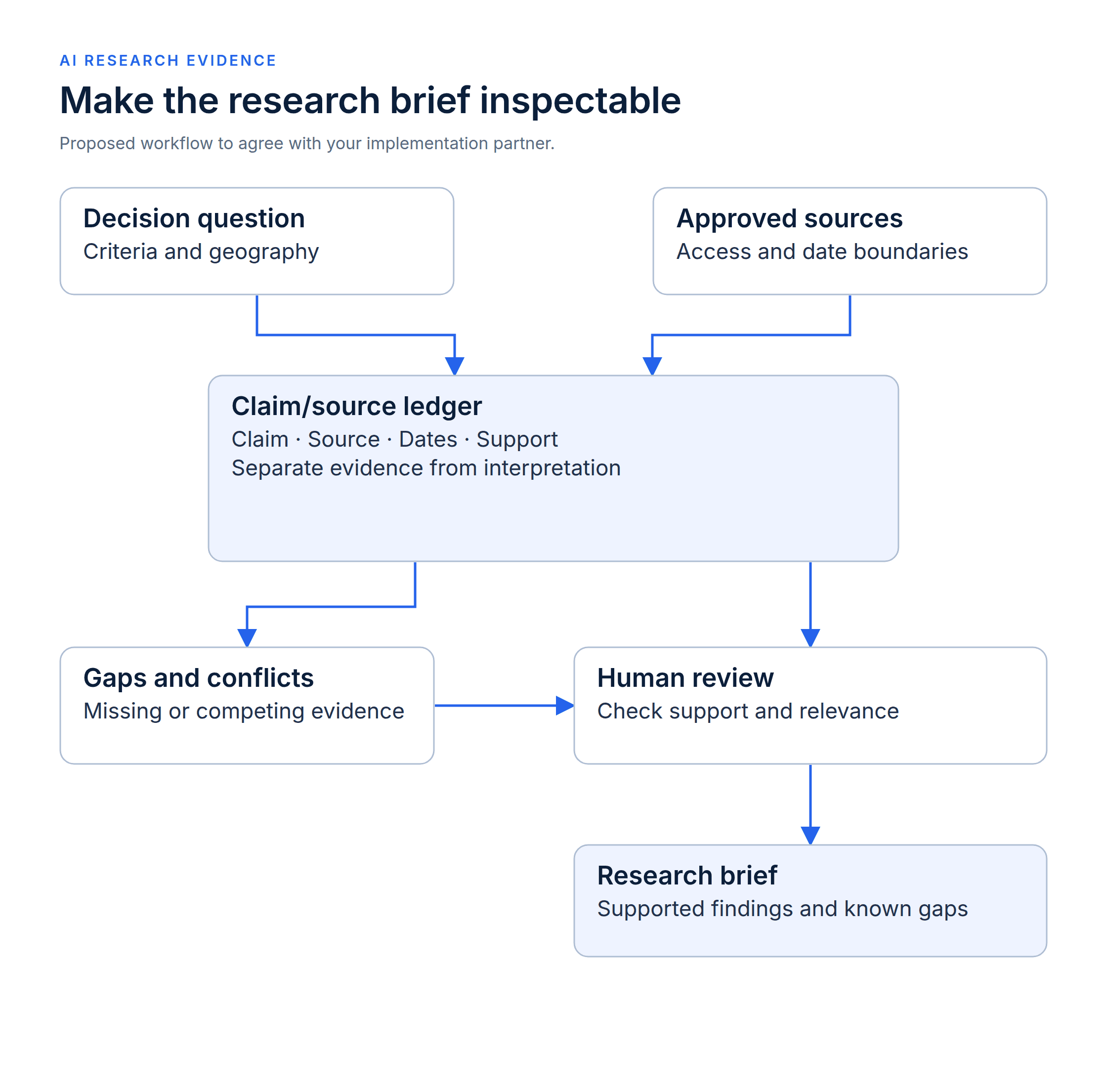
Link each substantive claim to supporting evidence, and carry gaps and conflicting findings into review.
A claim/source ledger is a structured record that connects an assertion to its evidence, dates, and review status. It lets a reviewer move from a conclusion in the brief to the material supporting it.
Use a deliverable specification such as this one. The entries describe the hypothetical scheduling-vendor assignment; they do not assert facts about any actual vendor.
| Deliverable | What the supplier must provide | Buyer review |
|---|---|---|
| Decision statement | A shortlist for demonstration invitations, using the buyer's Canadian-market scope | Confirm the brief answers the intended question |
| Candidate criteria | The buyer's mandatory integration, administrator-control, and export requirements | Separate mandatory requirements from preferences |
| Claim/source ledger | Each capability claim, supporting source location, source date, access date, and support status | Open the evidence and check the exact wording |
| Contradiction log | Conflicting statements, their dates, and any unresolved difference in product or plan scope | Decide whether clarification is needed |
| Evidence gaps | Requirements for which no usable evidence was found within the agreed search scope | Keep the vendor's status unresolved where appropriate |
| Research brief | Supported findings, interpretation, open questions, completion date, and the named reviewer | Approve the conclusion or return specific corrections |
A hypothetical contradiction might be a help article describing an export option while a newer product page limits that option to a different offering. The agent should show both sources and explain the uncertainty. It should not silently choose the statement that makes the comparison easier.
Keep interpretation visible as interpretation. "This vendor should move to the next evaluation stage" is a recommendation derived from criteria. It is not a vendor fact. The reviewer should be able to inspect the criteria and evidence that led to it.
For a recurring brief, retain a change record. Show newly supported claims, removed statements, changed source dates, and unresolved gaps carried forward. That makes the next edition easier to review without suggesting that unchanged text has automatically been reverified.
Set boundaries on the AI research assistant's access and actions
The buyer should approve the source set and the access method before the pilot. Public pages, licensed databases, and internal files can require different access arrangements. The supplier's proposal should identify which sources it can use, what the buyer must authorize, and what happens when a source becomes unavailable.
The source owner should scope credentials to the approved material and remove access when the assignment ends. If a source blocks access or prohibits the intended automated use, record the gap and ask the owner for an authorized alternative. The research scope must exclude covert access bypasses.
Some existing products already support research across several kinds of content. Microsoft documents that its Researcher agent can use web content and work material the user can access, and recommends defining the search scope. Use an available product as a candidate for the sample task before assuming a custom implementation is necessary. This does not establish that it meets your particular evidence or delivery requirements. Microsoft Researcher documentation
Separate collecting evidence from acting on it. A vendor-research assignment does not inherently authorize sending inquiries, creating accounts, purchasing subscriptions, or committing to a supplier. Put any requested outreach into a separately approved workflow with a named owner.
Also define who can receive the resulting brief. A report that combines public research with internal selection criteria may need a narrower audience than its public sources. The proposal should name the storage locations and services that receive source material or briefs, and explain how retention and deletion follow your requirements. Ask how access is removed when the assignment ends and how failed access attempts appear in the research record.
AI operations design is relevant when those responsibilities need to work across several teams. Keep the immediate project bounded to the people and decisions involved in this brief.
Run a pilot against an approved research sample
Ask suppliers to explain the work and fee for a bounded paid pilot. Provide the same approved questions, source boundaries, and deliverable format to each candidate. A polished demonstration chosen by the supplier is useful context, but it does not answer whether the workflow can handle your assignment.
Include an ordinary question with available evidence and a question your reviewer knows is unresolved. Where useful, add an example with conflicting or old sources. The expected behavior for the unresolved case is a clearly described gap, not a forced answer.
Evaluate the brief on these dimensions:
- Support: Does the cited material justify the important factual claims?
- Relevance: Does the output address the criteria and decision you supplied?
- Uncertainty: Are missing evidence, conflicts, and interpretation visible?
- Review effort: What must an employee check or repair before using the brief?
- Repeatability: Can the supplier explain the sources and procedure behind the result?
Acceptance criteria are the conditions the business owner uses to decide whether the brief is ready for its intended decision. Agree them before the pilot. A material unsupported claim about a mandatory vendor requirement may prevent acceptance even if the rest of the brief reads well. A missing nonessential detail might be acceptable if the gap is explicit and the owner agrees. There is no single pass percentage that fits every research decision.
After corrections, ask for the updated brief and a record of what changed. Check whether the correction fixed the specific assertion, affected the shortlist, or requires another search. For recurring work, agree when a changed source or a new requirement triggers renewed review.
NIST's AI Risk Management Framework calls for documenting responsibilities and the intended context of an AI system. Apply that principle by naming the person who accepts the brief and the decision for which the evidence is sufficient. NIST AI RMF Core, GOVERN 2.1 and MAP 1.1
Compare research-agent implementation proposals
Compare proposals against the whole research cycle. Discovery, source connections, extraction, evidence checking, synthesis, delivery, and employee review each need an owner. A low setup quote can leave substantial work with your team if those responsibilities are unclear.
Ask for separate assumptions for the initial build, licensed source access, expected usage, refresh schedule, and support. A recurring brief also needs a rule for missed runs, source failures, and corrections discovered after distribution. Include employee review time as a separate operating cost. Ask each supplier to price its own scope and explain the assumptions behind the quote.
The handoff should include the research specification, source inventory, output format, evaluation examples, known limitations, and operating instructions. Confirm which accounts and configuration your organization controls and what you can export if the engagement ends.
Workflow automation can connect an approved brief to the team's existing task or reporting process. Define the destination and approval point before adding automatic distribution.
Buyer FAQs
Is a research agent the same as a knowledge assistant?
They can use similar retrieval capabilities, but this purchase centers on a commissioned research question and its evidence package. The supplier collects and compares material within an agreed scope, then prepares a brief for review. If the primary need is answering questions against a maintained knowledge collection, define that as a separate use case.
Can the agent guarantee it found every relevant source?
Require the supplier to describe coverage, search boundaries, and limitations. A bounded search cannot establish that no other relevant evidence exists. The deliverable should distinguish "not found in the approved research scope" from "does not exist." Expand the scope when an unresolved issue is important to the decision.
Should the first purchase be a one-off brief or a recurring workflow?
Start with a bounded brief when the decision criteria or output format are still unsettled. Consider a recurring workflow once the team knows what must be refreshed, who reviews changes, and how the output is used. The first assignment should help you define those operating requirements.
Scope a research brief your team can use
Bring one business question, an example of the current research output, and the criteria used to make the decision. Twelverays can discuss the agent's data sources, permissions, review points, and delivery workflow with your team. Scope your AI project.


