

AI reporting automation is a workflow that prepares recurring reports from approved data and routes them through defined checks, review, and distribution. When comparing implementation proposals, start with an existing report and agree how its figures, commentary, corrections, and distribution will be controlled.
The buying decision is about the complete reporting cycle. Connecting a data source and generating a paragraph leaves several questions unanswered: which period the figures represent, what happens when a source is late, who approves an explanation, and how a corrected edition reaches its readers.
A useful first engagement covers one recurring report with named owners. Once your team can verify that report and operate its exceptions, you can decide whether to expand the scope.
Key takeaways for buying AI reporting automation
Before accepting the first reporting cycle, confirm that your team can:
- Reproduce each metric using the approved definitions, period, and inputs.
- Identify late or missing sources and inspect unresolved differences.
- Distinguish measured changes from explanations that still need evidence.
- Approve a specific edition and verify its recipients and access rules.
- Correct a released edition and identify who owns the next reporting cycle.
Choose the report and its accountable owner
Consider a hypothetical weekly sales-pipeline report. The sales director wants to review changes in open opportunities before the Monday leadership meeting. Sales operations owns the CRM definitions, and a revenue operations lead approves the report before distribution. This is an illustrative project, not a Twelverays case study.
The first scope question is what decision the report supports. A list of every field available in the CRM can create more material without helping the meeting. Decide which questions the director needs answered, such as which opportunities changed stage, which expected close dates moved, and which records need an owner to resolve missing information.
The reporting period is the interval covered by the report. The data cutoff identifies when inputs are frozen for that edition; delivery time identifies when the approved edition should reach its readers. A report about the previous week may use a snapshot captured after employees finish updating their records. Your scope should explain that relationship so readers know what they are reviewing.
Name the owner of each input and the final report. The implementation supplier needs someone who can resolve a disputed metric definition. The business also needs a reviewer who can decide whether an explanation is supported and whether an unresolved gap prevents distribution.
Twelverays' AI agent services include reporting workflows. Bring an example of the report you already use to the first discussion, including the manual checks that currently make it trustworthy.
Keep metric calculations traceable
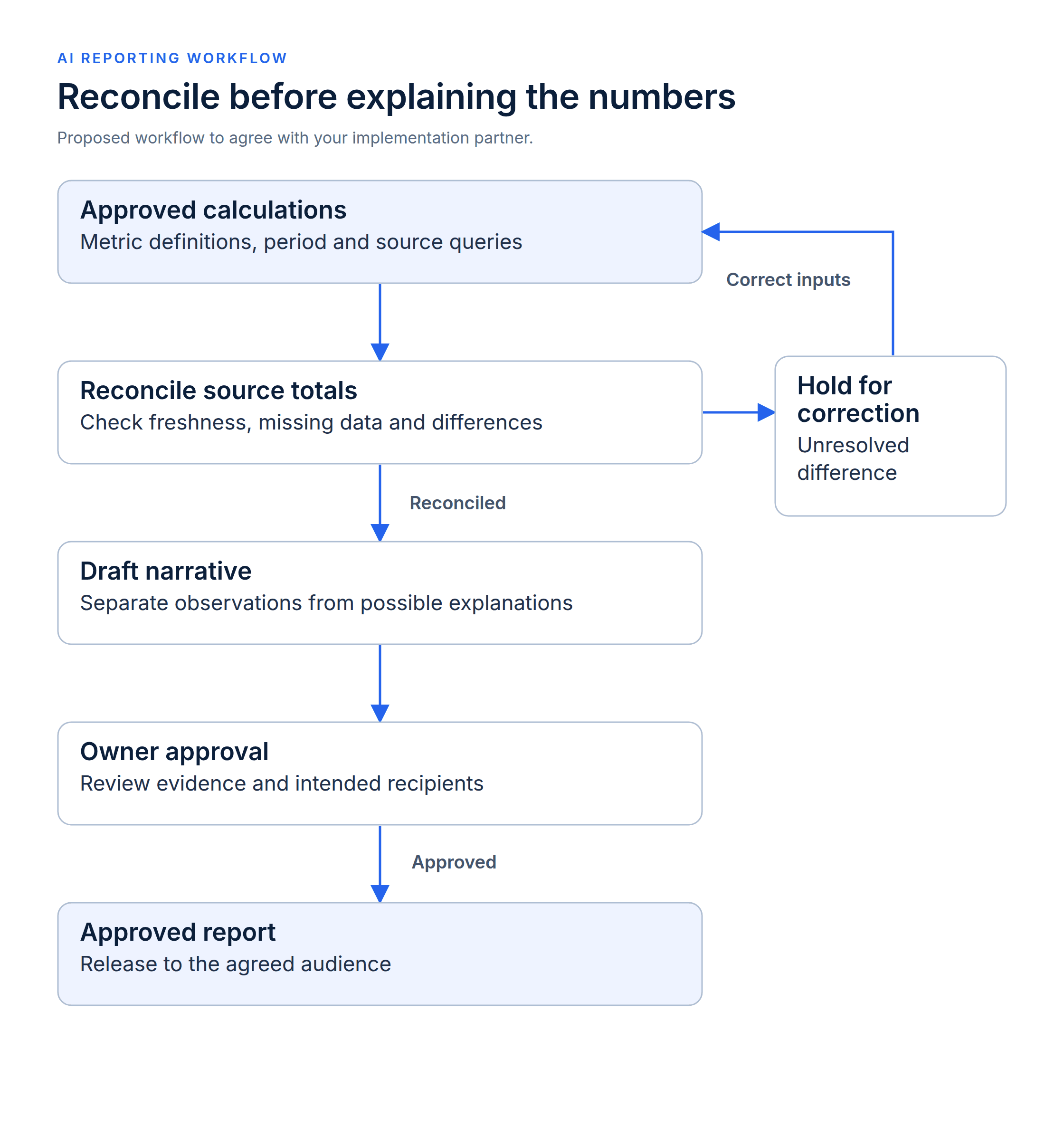
Reconcile approved calculations before drafting explanations, then obtain owner approval before releasing the report.
Reconciliation compares report values with an approved calculation or source total and records unexplained differences. Specify the calculations independently from the generated commentary. Approved queries, formulas, or reporting logic should establish the values that the agent describes. Ask the supplier to show where each value comes from and how the same value can be reproduced.
For the hypothetical pipeline report, “open pipeline” needs a definition. Which opportunity stages are included? Which date determines membership in the period? How are duplicate records, missing amounts, and multiple currencies handled? The business owner should approve these decisions before the supplier treats a total as correct.
Keep the source definitions with the report specification. A phrase such as “use the standard CRM report” is incomplete if employees can change that report's filters without the automation owner knowing. Identify the approved configuration and how changes will be reviewed.
AI-generated commentary introduces another review task. A statement that pipeline declined because a campaign underperformed goes beyond observing a lower total. The report needs supporting evidence for that causal explanation, or it should present the cause as an unanswered question.
According to the NIST Generative AI Profile, organizations should review and verify sources and citations in generated outputs during predeployment evaluation and ongoing monitoring (action MS-2.5-003). In this reporting workflow, a practical response is to separate calculated facts, attributed explanations, and questions that require a person to investigate.
Agree how late data will be handled. Your team might hold the report, publish a clearly limited edition after approval, or issue a later correction. Select the behavior for the report's purpose and make the incomplete source visible to the reviewer.
Require a report that carries its evidence
Ask each bidder to show an example of the proposed output. The following specification is an original format for discussing a recurring operating report. It describes what the buyer should settle, not a fixed consulting package.
| Report element | What the specification records | What the reviewer can inspect |
|---|---|---|
| Reporting period | Start, end, timezone and data cutoff | The period printed on the edition |
| Metric definition | Included records, exclusions and calculation rule | Approved query, formula or source report |
| Source freshness | Latest successful source update used | Refresh record and any missing inputs |
| Reconciled totals | Comparison with the approved baseline | Matching values or explained differences |
| Narrative observation | What changed in the measured values | The relevant rows and comparison period |
| Proposed explanation | Evidence supporting a possible cause | Source evidence or an explicit unknown |
| Approval | Who reviewed this edition and which version | Approval decision and unresolved issues |
| Distribution | Approved audience and destination | The edition sent and its recipient record |
The evidence does not all need to appear in the executive summary. Readers may need a short report, while the reviewer needs the supporting detail. Ask how the implementation will keep those views connected to the same edition.
For example, the report can identify that an opportunity's expected close date moved. The underlying CRM record may contain a seller's explanation, which the report can attribute to that record. If no explanation exists, the report should say that the reason needs confirmation. A confident sentence about the customer's budget would add an unsupported claim.
A report edition is a specific version of a report for a defined period and audience. Version the report when corrections are made. A corrected total should not silently replace an edition that has already informed a meeting. Specify how the owner records the change, approves the correction, and tells affected readers which edition to use.
Specify review and distribution controls
The proposal should describe how a report moves from generated draft to approved edition. Include the reviewer, the information they receive, the actions available to them, and what happens after rejection or a request for changes.
A reviewer might need to correct a narrative explanation without changing the calculated values. Another correction might reveal an error in the underlying filter. These should take different paths: one edits the commentary; the other requires the source logic to be corrected and the affected output regenerated.
For an implementation example, Microsoft's request-information documentation describes an agent flow that pauses, collects input from designated people, and uses that input in subsequent steps. Ask the supplier to demonstrate the review behavior supported by its proposed platform, including limitations relevant to your team.
Distribution needs its own approval boundary. Define who owns the recipient list and what permission changes should prevent access. A report prepared for a department lead should not automatically become available to everyone who can run the workflow.
Test a missed deadline. If a source is unavailable or the reviewer is absent, the system should follow the agreed holding or escalation rule. Record who receives the failure notice and who decides whether a delayed or partial edition is useful.
Twelverays' workflow automation services are relevant to these schedules, handoffs, and notifications. Keep the report's operating rules visible in the engagement scope alongside the generated text.
Price the recurring work in the proposal
Ask bidders to separate the initial implementation from the work required to operate each reporting cycle. Compare the assumptions behind the total as carefully as the amount itself.
Initial work may include source access, metric definitions, connector setup, report formatting, approval configuration, and acceptance testing. Identify which inputs your team supplies and which tasks the proposed engagement includes.
Recurring costs can include software licenses, model usage, source subscriptions, hosting, monitoring, and support. The exact categories depend on the proposed design. A quote should state which are included in the supplier's fee and which the customer buys separately.
Changes also need a treatment. Adding a metric can require more than a sentence in the template if it changes source access or calculation logic. Increasing report frequency can change usage and reviewer workload. Ask how the supplier estimates and obtains approval for those changes.
Use a common comparison worksheet with the report, cadence, sources, audience, and review process held constant. If one bidder assumes a single CRM export and another assumes several live systems, their totals describe different projects.
Keep internal reviewer time in the business case. Your team can measure that time during the pilot rather than relying on an unsupported productivity promise. A report that is quick to generate but slow to verify may need a smaller scope or better supporting evidence.
Accept the first reports before expanding
Choose trial periods with the report owner. Include an ordinary period and examples that exercise the exceptions your team needs to handle: a late update, a missing field, a changed definition, a duplicate record, or a rejected explanation.
Compare the generated report with an owner-approved baseline for the same inputs and period. Investigate differences before deciding that either version is correct. The existing manual report can contain mistakes too, so the acceptance process needs a way to resolve conflicting evidence.
Check the complete cycle. Confirm that the reviewer can inspect support for each important statement, request a correction, approve the intended version, and verify distribution. Record outstanding defects and decide whether they affect the proposed release.
AI operations design helps define who operates this process after handoff. Ask for source ownership, report configuration, run instructions, and the process for pausing or correcting a failed edition.
Buyer FAQs about AI reporting automation
Does AI reporting automation replace a dashboard?
Automated business reporting can complement a dashboard. A dashboard supports exploration and monitoring; this scope produces an edition for a particular audience and reporting period. Start by deciding whether the recurring report adds a decision or review step your existing tools do not already provide.
Should the language model calculate the business totals?
Specify approved calculation logic that your team can reproduce. The agent can draft commentary from those values, with factual and explanatory statements reviewed separately. Ask the implementation partner to show the calculation and reconciliation path.
Can a report be distributed without manual approval?
That is an operating decision the owner must make for the defined report. If the first engagement includes human approval, require the supplier to implement that boundary and show what happens when approval is missing. Any later change should be explicitly authorized and tested.
What should we bring to a proposal discussion?
Bring an existing report, its source definitions, the current preparation steps, and a recent correction or exception. Scope your AI reporting project with Twelverays around one report your team can verify and operate.


