

AI sales enablement is the use of AI to support sales work, including preparation for customer conversations. For AI sales call preparation, define the account brief you are buying: confirmed CRM context, relevant public evidence, unresolved questions, and suggested talking points. The seller should be able to check and correct it before the meeting.
That gives a sales leader a specific implementation to evaluate. The agent prepares context for an existing account and meeting. Its approved scope determines what it can read, where it saves the draft, and whether any further action is allowed.
Key takeaways for AI sales enablement buyers
- The brief matches the intended account, opportunity, and meeting.
- Recorded facts, public evidence, unknowns, and suggested agenda items remain distinguishable.
- The seller can inspect sources, correct the brief, and recover an earlier version.
- The workflow meets the agreed review window and saves to its authorized internal destination.
- The pilot records seller review effort and the defects that prevent acceptance.
Define the pre-call brief a seller needs
Begin with a meeting your team already understands. An existing-account expansion conversation is a useful hypothetical example: the seller needs to know the open opportunity, earlier commitments, attending contacts, and questions that have not been resolved.
The brief should support preparation for that conversation. It does not need a general history of the customer's industry or a collection of unrelated company news. Ask the account owner which information would change the agenda, prevent a repeated question, or identify a commitment that needs attention.
Write down the permitted inputs. Customer relationship management, or CRM, records may supply the opportunity and relationship history. Authorized calendar data may identify the meeting and invited contacts. Approved public sources can add relevant company context. An invitation shows who was invited, not who will necessarily attend or who has purchasing authority.
Account matching is the step that links the meeting to the correct CRM account, contacts, and opportunity. The implementation should use the agreed account and contact identifiers, then flag ambiguity for review. A company name alone may not distinguish related organizations or separate opportunities. Ask the supplier to show what happens when more than one record could match.
Twelverays' AI agent implementation service includes sales assistants connected to business context and systems. A written pre-call brief specification helps your team discuss the data, handoffs, and success measures needed for this particular use case.
Separate CRM facts from public account research
Treat a CRM value as a recorded fact with a source and date. It can still be incomplete, inconsistent, or out of date. The brief should preserve that distinction rather than presenting every available field as the current state of the relationship.
For example, a hypothetical opportunity could show a proposed rollout month while a later meeting note says the customer has not approved the timing. The agent should identify the conflicting records and ask the seller to resolve them. It should not silently promote either statement into a confirmed customer commitment.
Agree which fields and activities are relevant to preparation. The account owner, opportunity stage, open tasks, prior meeting notes, and recorded next steps may be useful. Access to unrelated opportunities or employee communications needs its own justification and authorization.
For public research, require a direct source link and the relevant date beside each substantive assertion. A company announcement can support a statement about what the company announced. It does not establish the customer's budget, buying urgency, or opinion about your proposal. Suggested implications belong in a separate section for seller judgment.
NIST's Generative AI Profile recommends verifying sources and citations in generated outputs during evaluation and monitoring. Apply that to any outside fact a seller might repeat in a conversation. NIST Generative AI Profile, MS-2.5-003
Define freshness by the information's use. An older contract date may remain relevant, while a proposed meeting agenda can change shortly before the call. Source time is when the underlying page or record was published or updated, if that date is available. Retrieval time is when the agent collected it. Ask the supplier to show both dates and flag changes discovered after the first draft.
Ask for a brief sellers can correct
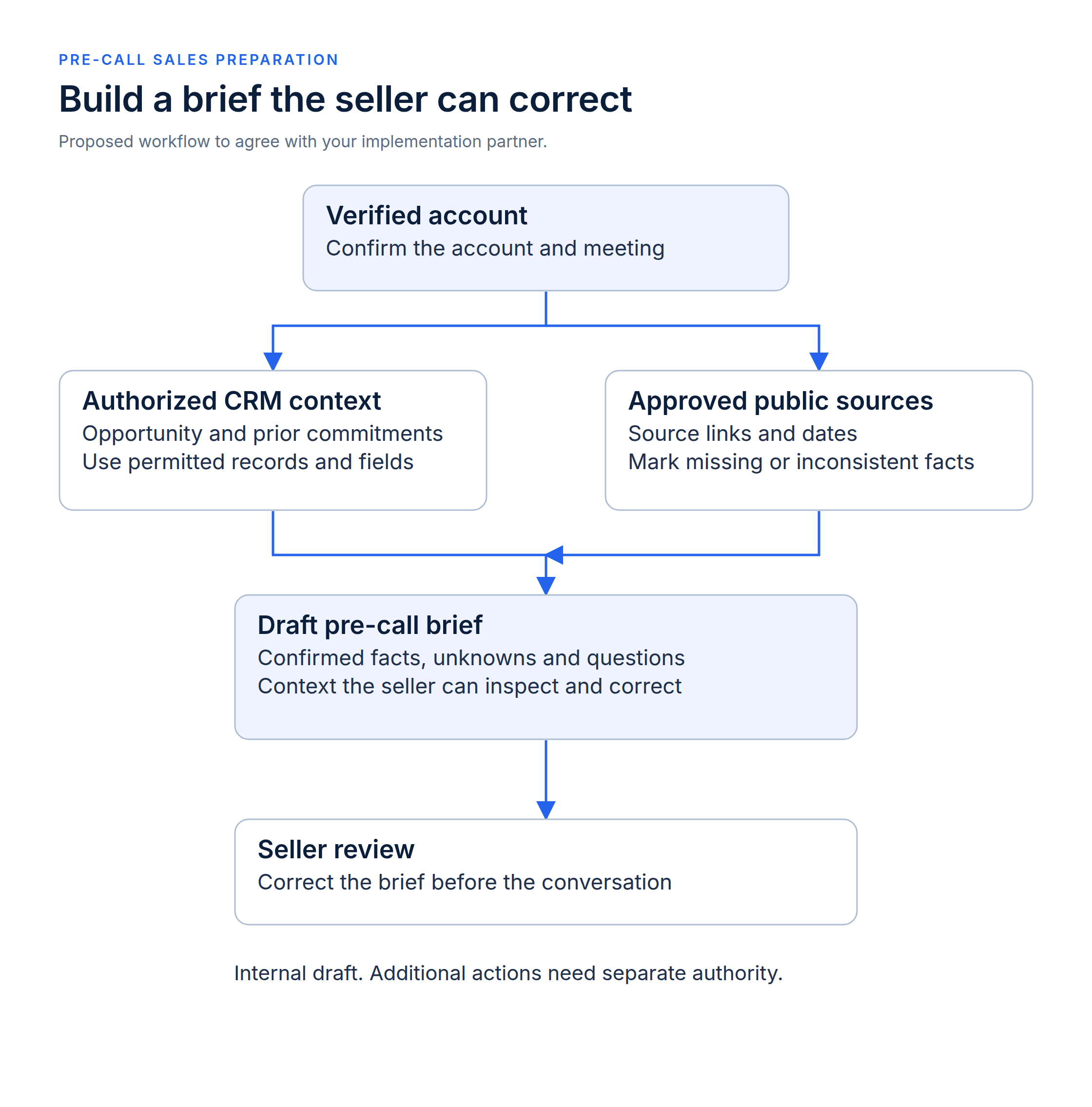
Combine authorized CRM context with approved public evidence, flag unknowns, and let the seller review the brief.
A pre-call brief is a working document that collects the account context and questions a seller needs before a meeting. Its format should help the seller find a mistake, inspect the source, and record a correction without searching through an undifferentiated narrative.
The table below is a filled hypothetical specification for an expansion meeting. Its example entries describe the kind of information to include; they are not facts about a Twelverays customer.
| Brief section | Hypothetical entry | Evidence or seller action |
|---|---|---|
| Meeting identity | Existing-account expansion discussion linked to the selected opportunity | Confirm the meeting, account, and invited contacts |
| Recorded facts | The opportunity is open and its named owner is responsible for the next step | Link the authorized CRM record and show retrieval time |
| Prior commitment | A meeting note records a request for a revised implementation outline | Link the note and check whether the request remains open |
| Public context | A company announcement may affect the subjects to discuss | Cite the announcement and separate its facts from suggested implications |
| Unknowns | The available records do not confirm the customer's approval date | Keep the date unresolved and identify who can clarify it |
| Agenda suggestions | Review the outstanding implementation questions before discussing expansion timing | The seller confirms the proposed priorities before using the agenda |
| Suggested questions | Ask whether the revised outline addresses the concerns recorded in the previous meeting | Label this as a proposed question for the seller to edit |
The seller should be able to mark a statement as incorrect, outdated, irrelevant, or unsupported. Those are different problems. An incorrect account match requires a different correction from a valid fact that does not belong in this meeting's brief.
Decide what a correction changes. Editing the brief should not silently overwrite the CRM record that supplied it. If the underlying record needs repair, send that issue to the authorized record owner through a separate, agreed process. Preserve the connection between the correction and the source so the same error can be investigated if it recurs. Keep the previous brief version so the seller can undo an edit. Any separately authorized CRM correction needs a recovery process controlled by the record owner.
Settle the delivery requirement. Name the internal destination, expected lead time before the call, and behavior when a meeting is rescheduled. If a draft arrives after the useful review window, it should be recorded as a delivery issue even when its contents are accurate.
Check existing sales enablement software before commissioning a build
Ask the implementation partner to assess capabilities already available in your environment. A native feature may cover the initial preparation need, or it may leave a specific gap in source coverage, review, output format, or delivery.
Microsoft documents a meeting preparation card that provides meeting context and a more detailed preparation view. Its stated prerequisites include an external contact saved in CRM, with additional setup for some connections. Those details illustrate why an evaluation should include the actual account matching and connection requirements. They do not prove that every meeting or CRM setup will produce the desired brief. Microsoft meeting preparation documentation
Microsoft also describes Sales agent interactions with CRM data and other sales context, while noting access and setup requirements for different sources. Ask the supplier to demonstrate which sources your authorized users can actually reach in the proposed configuration. Avoid buying a custom connector merely because a demonstration used a different environment. Microsoft Sales agent documentation
The decision can be modest: configure an existing capability, extend a particular step, or build a bounded workflow. Require a written explanation of the unmet requirement behind any extra development. Product access and costs should be checked against current vendor terms during procurement.
Agree what the agent is allowed to change
For this proposed first phase, authorize the agent to read the approved sources and save a draft to the agreed internal destination. Define that destination explicitly. Creating a document or posting a draft is still an action that requires an owner and access permission.
Keep CRM field updates, customer email, and calendar invitations outside this preparation scope unless the buyer separately includes them. A request to prepare for a call does not by itself authorize changing an opportunity stage, contacting an attendee, or booking another meeting.
If your team later adds a write action, describe the affected records, permitted fields, approval condition, and evidence of completion. The supplier should explain how it avoids overwriting a newer human correction and what happens when an action only partly completes. Keep those requirements attached to the added action rather than assuming that approval of the brief covers them.
Name the owner who can pause the workflow and the person who investigates incorrect output. Include how draft versions are retained, how access is removed, and which corrections require the system owner's attention. AI operations design can help define these operating roles and human handoffs.
Evaluate whether the preparation is useful
Use a sample of meetings approved by the sales owner. Include ordinary examples and cases where the source records are incomplete or inconsistent. Ask sellers to review the briefs using the same criteria, and retain their specific corrections alongside any scores.
Assess relevance, factual support, missing context, and review time. Also record whether the brief arrived when promised and matched the correct account. These checks describe the preparation workflow you are purchasing; they do not establish a revenue increase.
A useful baseline is the team's existing preparation process. Record the time spent finding information, checking it, and preparing questions. During the pilot, include the time needed to review and repair the generated brief. Comparing only generation time would leave out work the seller still has to do.
Agree which defects prevent acceptance. A wrong-account brief or unsupported claim presented as a confirmed commitment may require a fix before rollout. A missing optional news item may simply remain an identified limitation. The sales owner should make that decision based on how the brief will be used.
When a brief performs poorly, diagnose the cause before expanding access. Missing context might reflect an incomplete CRM record, an incorrect match, a retrieval problem, or a requirement the project never included. Broader permissions will not necessarily fix those problems.
Compare AI sales enablement implementation proposals
Require bidders to describe the initial data setup, account matching, permitted sources, output design, review process, and delivery workflow. Each proposal should state what your team must supply, including account-owner time for reviewing the pilot. If you plan to add sellers or meeting types after the pilot, ask bidders to separate that expansion's scope, costs, and buyer responsibilities.
Separate implementation work from ongoing software usage, support, and seller training. Ask who handles connection failures, source changes, and updates to the brief format. Have the supplier explain any recurring fees and usage assumptions using its own proposed terms.
The handoff should include the approved source and field list, briefing template, evaluation examples, operating instructions, known limitations, and ownership of the relevant accounts and configuration. A named employee should be able to explain how to report an error or pause a failing run.
Include workflow automation in the scope when the proposed agent needs to deliver its brief through your existing internal tools. Ask the supplier to price each connection and state its access requirements.
Buyer FAQs
Does this require autonomous outreach?
No. The scoped output can remain an internal brief for a seller to review. Outbound messages, CRM updates, and meeting invitations are separate actions. Add them only when the business owner has defined their purpose, permissions, approval requirements, and recovery process.
What if our CRM data is incomplete?
Use the pilot to distinguish missing source information from defects in the agent. Keep unknowns visible and route corrections to the record owner. If essential relationship history is consistently unavailable, address that dependency before expanding the preparation workflow to more sellers.
How should we measure success before a full rollout?
Agree on meeting relevance, factual support, review effort, account matching, and delivery timing. Retain the seller's corrections so the team can see why a brief passed or failed. Choose acceptance criteria for this preparation task, then review whether the operating effort fits the team's capacity.
Scope an internal sales preparation agent
Bring an example meeting, the current preparation process, and the CRM context your sellers use. Twelverays can help discuss the agent's sources, permissions, briefing format, and human review steps. Scope your AI project around the preparation work your team needs to complete.


