

Choose a B2B Google Ads agency by testing how it connects campaign decisions to sales evidence. A B2B PPC agency should explain which enquiries merit follow-up, who records the outcome, and what changes when lead quality falls. Compare each B2B paid search agency on that working process, with a proposal that names the deliverables and the people responsible for them.
Use the selection process to agree on five things: qualified enquiries, delivery responsibilities, reporting definitions, operating authority, and acceptance evidence. The final proposal should let marketing and sales evaluate the same work using the same records.
What should a B2B Google Ads agency deliver?
A B2B Google Ads agency manages advertising intended to reach business buyers. Its contracted work may include search planning, campaign management, creative, landing-page recommendations, measurement, and reporting. The proposal must identify which of these are included and which depend on your team or another supplier.
Start with the commercial problem. A specialist manufacturer seeking distributor enquiries needs different qualification evidence from a software company selling product demonstrations. Give candidates the offer, intended customers, serviceable markets, purchase process, and exclusions. Include the reasons sales currently rejects leads.
Then ask for a scoped recommendation. An agency proposing additional campaigns should identify the buyer need being tested, the destination page, the expected sales follow-up, and the evidence required to continue spending. Recommendations without these connections are difficult to evaluate after launch.
If stakeholders need a shared vocabulary first, use the paid search advertising overview. Keep the selection meeting focused on your operating requirements.
Put Google Ads lead qualification in writing
Lead qualification is the agreed process for deciding whether an enquiry meets your commercial criteria. Write a short definition that sales can apply consistently. Useful criteria can include business fit, location, requested service, buying role, and whether the enquiry describes a problem you can address.
Avoid treating every missing field as disqualification. A prospect may omit company size but provide a credible project description. Ask candidates how they would distinguish incomplete information, poor fit, duplicates, and enquiries awaiting follow-up.
Use a simple decision record:
| Decision | Evidence to record | Responsible reviewer |
|---|---|---|
| Accept for sales follow-up | Relevant need and sufficient contact details | Sales owner |
| Request more information | Missing criterion and next contact attempt | Assigned salesperson |
| Reject as poor fit | Specific reason from the agreed list | Sales owner |
| Remove from lead-quality analysis | Spam, internal test, or confirmed duplicate | Named data reviewer |
These are example categories, not a universal sales methodology. Define your own rules and review a small sample together before using them to judge agency performance.
A marketing-qualified lead (MQL) meets the criteria marketing uses to pass an enquiry to sales. A sales-qualified lead (SQL) meets the sales team's acceptance criteria. Write your specific criteria in the brief and connect each decision to its actual CRM field. The MQL and SQL comparison can help your stakeholders resolve terminology before the agency starts reporting.
Ask a candidate to diagnose falling lead quality
Present this hypothetical scenario: form submissions increased while sales accepted a smaller proportion. Ask what the agency would inspect before changing bids or budgets.
A useful answer examines search demand, targeting, the offer, landing-page expectations, tracking changes, and sales disposition records. It also checks whether the acceptance definition or follow-up process changed. The candidate should separate observations from hypotheses and propose a bounded test.
Score the reasoning. A confident explanation without access to the underlying records is not yet a diagnosis.
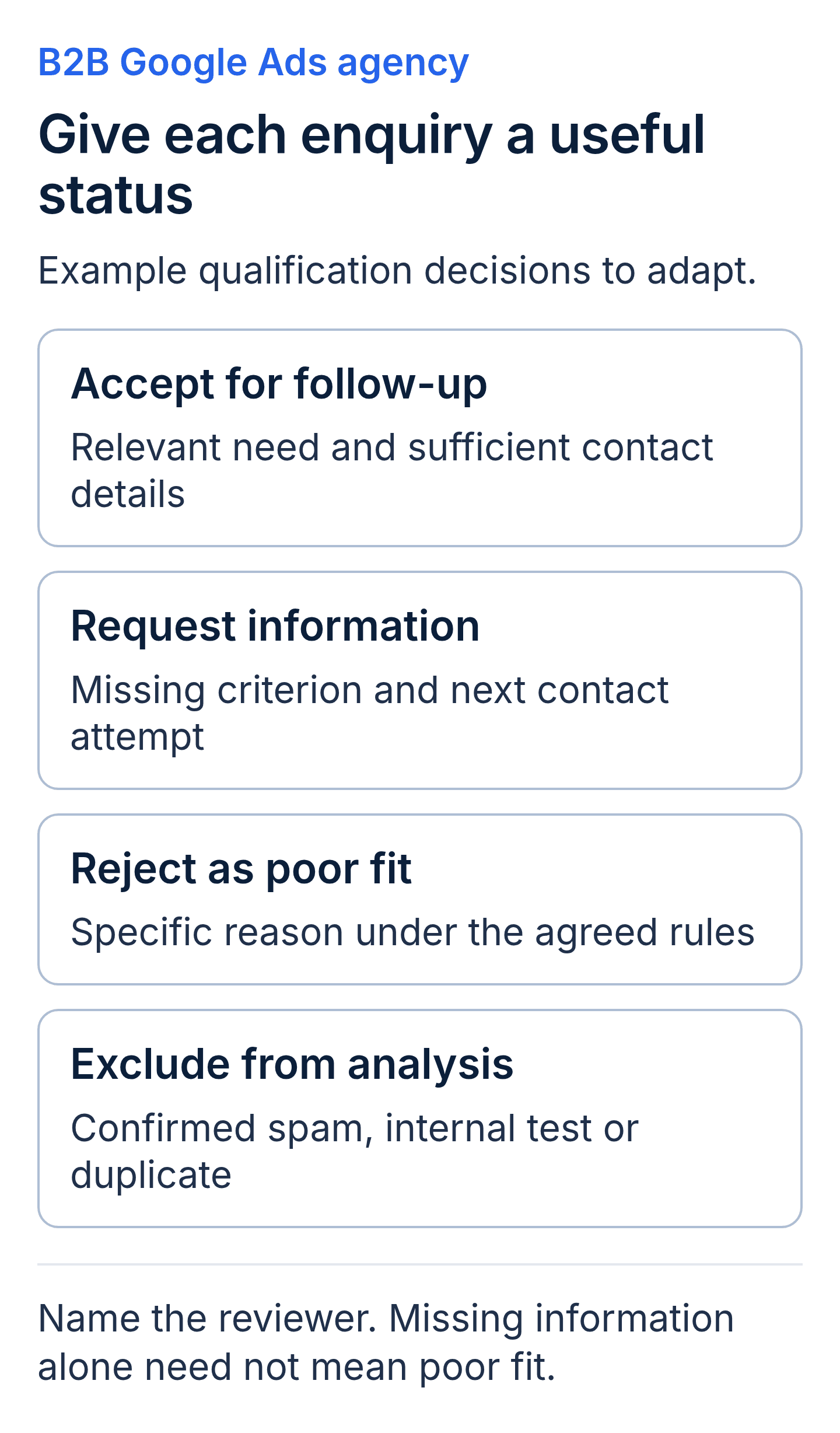
Adapt these categories with sales before judging agency lead quality. Keep incomplete information, poor fit and records excluded from analysis as distinct decisions.
Compare the B2B agency proposal against real deliverables
A sales handoff transfers an enquiry and its qualification evidence to the person responsible for follow-up. The proposal should name both the sender and recipient, including who resolves missing information.
Give each finalist the same scope sheet. Ask them to mark each item as included, separately priced, client-owned, or excluded. This makes differences visible before you compare totals.
| Work area | Request in the proposal | Acceptance evidence |
|---|---|---|
| Campaign planning | Offer, market, exclusions, and initial priorities | Approved campaign brief |
| Landing pages | Who writes, designs, implements, and checks them | Approved page and completed checks |
| Measurement | Conversion definitions and current account review | Settings record and validation results |
| Sales handoff | Routing owner, response expectations, and disposition rules | Reviewed sample enquiries |
| Ongoing management | Review cadence and change authority | Change log with reasons |
| Reporting | Metrics, data sources, filters, and decisions | A sample report you can reproduce |
Ask who actually performs the work and how specialists join the engagement. A named account lead does not resolve whether a developer, analyst, or copywriter is available within the quoted scope.
For landing-page changes, establish who can approve claims and publish revisions. For CRM work, separate campaign management from integration design and maintenance. An agency can identify a measurement gap without including the engineering needed to fix it.
Bring a concrete dependency into the interview: the website team cannot release a requested change this month. Ask how the candidate would adjust the plan, record the limitation, and explain its effect on the proposed evaluation.
Require B2B PPC reporting that supports decisions
B2B PPC reporting should show what happened at each relevant stage, how the numbers were assembled, and what decision follows. Ask for media spend, recorded enquiries, sales-accepted enquiries, and opportunities where those records are available and meaningfully linked.
Cost per accepted enquiry is the included campaign cost divided by sales-accepted enquiries for the defined period or cohort. State whether the cost includes media alone or also management and production. Use the same qualification rule, cost categories, and date basis when comparing suppliers.
Treat industry averages as context. The cost-per-lead discussion by industry cannot determine your acceptable acquisition cost without your own margin, close rate, and sales-cycle evidence. Ask the agency to distinguish verified account history from planning assumptions.
Pipeline means the value of open opportunities under your chosen rules. It is not collected revenue. Attribution assigns credit for an outcome to eligible interactions under a measurement method; it does not by itself establish that advertising caused every credited sale.
An effective review connects findings to actions: investigate a rejection category, revise an offer, repair an incomplete handoff, or retain a test while enough relevant evidence accumulates. Record what would change the decision. Avoid a universal deadline for judging revenue when the account has a longer buying process or incomplete historical data.
Inspect conversion goals before approving optimization
A conversion action is a customer activity selected for measurement in Google Ads. According to Google, primary actions contribute to bidding when their standard goal is used by the campaign; secondary actions normally serve observation. The custom-goal exception matters: a secondary action included in a custom goal can still be used for bidding. These distinctions appear in Google's conversion-action documentation.
Ask the agency to show the goals used by your actual campaigns. Recording a form submission and a qualified lead does not explain which event guides bidding. Require approval for material goal changes and a plan for checking the resulting reports.
Check account access and operating authority
Confirm the Google Ads customer ID, your administrative access, the agency's manager relationship, and who can change users or other linked managers. According to Google, an owner manager does not take the client account's data ownership or administrative rights away; client administrators can unlink it. Google's manager ownership rules recommend granting owner-manager privileges only when those privileges are needed.
Treat ownership of creative files, landing pages, domains, and other assets as separate contract questions. A Google Ads access arrangement does not settle every supplier's intellectual-property or subscription terms.
Google requires third-party providers to disclose applicable management fees in writing before a customer's first purchase and on invoices. Its transparency requirements distinguish the amount charged by Google from provider fees. Request an invoice and reporting example that shows the two amounts separately.
Budget authority defines who may approve spending changes and under which limits. Google's spending-limit guidance says that most campaigns have a daily spending limit of twice the average daily budget and a monthly limit based on 30.4 times that budget. Under those rules, a campaign using an unchanged US$100 average daily budget for a full calendar month can have a US$200 daily spending limit and a US$3,040 monthly limit. Campaign exceptions and mid-month budget changes matter. Ask the candidate to explain the applicable rules, approval process, and pacing review.
Use a practical B2B PPC agency interview scorecard
Have marketing, sales, and the person responsible for measurement assess the same evidence. Use a simple rating: documented, partly specified, or unresolved. Keep a short reason beside every rating.
- Commercial understanding: Can the team connect your offer and exclusions to its proposed campaign priorities?
- Qualification: Can it turn sales feedback into a consistent review process?
- Delivery: Are the people, dependencies, and approval responsibilities named?
- Measurement: Can it explain the actual conversion goals and reporting limitations?
- Continuity: Can you inspect the account and continue operating after the engagement ends?
Request a relevant work sample with confidential information removed. Ask what the agency controlled, what the client supplied, and how the result was measured. Do not assume a percentage improvement from another account predicts yours.
Give the shortlisted team one opportunity to clarify incomplete answers. Record the clarification in the proposed scope, including any added cost or client dependency. This keeps the selection decision tied to the work you will actually purchase.
Before signing, resolve material gaps in writing. A provider with a smaller, clearly defined scope may suit a team with internal specialists. A broader scope may suit a team that needs implementation help. Evaluate those arrangements against your available capacity.
Glossary for the buying team
- B2B: Business-to-business, describing sales to organizations.
- PPC: Pay-per-click, a common advertising charging model and shorthand for paid campaign management.
- CRM: Customer relationship management system, where your team records contacts and sales activity.
- Qualified lead: An enquiry that meets the criteria your team has explicitly agreed.
- MQL: Marketing-qualified lead, accepted under marketing's defined criteria.
- SQL: Sales-qualified lead, accepted under the sales team's defined criteria.
- Pipeline: Open opportunities and their recorded values under stated reporting rules.
- Acceptance evidence: A record showing that a contracted deliverable meets its agreed requirements.
Buyer questions
Should a B2B Google Ads agency guarantee qualified leads?
An agency can commit to specified deliverables and a review process. A promised lead outcome needs a written qualification rule, assumptions, exclusions, and remedy. Google's third-party policy prohibits false, misleading, or unrealistic claims about services, costs, or expected results. Ask for evidence supporting the specific promise before using it to compare bids.
Does the agency need to manage our CRM?
The agency needs reliable sales feedback, which your team can provide through a controlled reporting process or a separately scoped integration. CRM administration does not automatically belong in the agency fee. Name the owners of qualification fields, data validation, and sync failures, then state how the agency receives usable outcomes.
What should be ready before campaign launch?
Approve the offer, destination pages, budget authority, conversion goals, lead routing, and responsibility for follow-up. Record unresolved dependencies and their effect on the launch decision. Use acceptance evidence appropriate to the actual scope rather than assuming every account needs the same onboarding schedule.
Key takeaways
- Select a B2B Google Ads agency using the same qualification rules, deliverables, and evidence requirements for every candidate.
- Approve a written sales handoff with named owners, usable source records, and a way to return rejection reasons.
- Require reports that define their costs, populations, dates, and attribution limits; distinguish pipeline from revenue.
- Verify client account access, separate Google charges from provider fees, and document spending authority.
- Before signing, resolve missing delivery responsibilities and approve the conversion goals that will guide campaign decisions.
Twelverays' paid search services are a starting point for discussing your requirements. Contact Twelverays with your offer, current account structure, qualification rules, and reporting gaps to discuss a suitable scope.


