

The Shift from Generative Chat to Agentic Action
AI agent platforms are becoming the default infrastructure for revenue teams that need results, not more conversations, and the fastest-moving agentic AI tools are built to close exactly that gap. The most important divide in enterprise AI right now isn't between vendors. It's between systems that talk and systems that act.
Agentic AI refers to systems capable of multi-step reasoning, tool use, and autonomous workflow execution: deciding what to do next, calling an API, updating a record, and looping back when something fails. That capacity for multi-step reasoning is the hard line between a true agent and a conventional generative model. An AI agent platform is the software layer that lets a team build, connect, and govern those agents, instead of writing one-off automation scripts for every process.
In 2024, the playbook was chat-first: deploy a chatbot and call it an AI strategy. In 2026, the requirement is action-first, not "can it answer questions" but "can it close the loop." That pressure hits mid-market companies hardest. They've accumulated years of CRM data, marketing signals, and operational records, but lack the connective tissue to wire those sources into workflows that actually move deals or reduce churn.
That gap, data-rich but automation-poor, is precisely where modern AI agent platforms compete for attention. For revenue-focused teams thinking carefully about operations strategy, the architecture question matters as much as the vendor question.
AI Agent Platform Architecture: No-Code vs. Orchestration Frameworks
The right AI agent platform architecture depends on how much engineering capacity a team can realistically deploy, not on which vendor has the flashiest demo. For mid-market teams, that choice comes down to resourcing before it comes down to features.
No Code AI Agent Platform Options
No-code AI workflow automation platforms like Gumloop, Make, and Zapier have made rapid prototyping genuinely accessible: visual builders let RevOps managers wire together LLM calls, API hooks, and conditional logic without writing a line of code. A no code AI agent platform is a visual builder that assembles agent workflows from pre-built blocks instead of custom scripts. The speed advantage is real, a working prototype in days, not sprints, but the ceiling is customization: non-standard processes eventually hit the limits of a drag-and-drop canvas.
Low-Code and Developer Frameworks
Developer-centric frameworks like LangChain and AutoGen sit at the other end, giving engineering teams granular control over agent memory, tool-calling logic, and multi-agent orchestration. The trade-off is steep: these frameworks require dedicated engineering time and rarely slot cleanly into existing RevOps workflows, and that overhead erodes the ROI before most mid-market agents reach production.
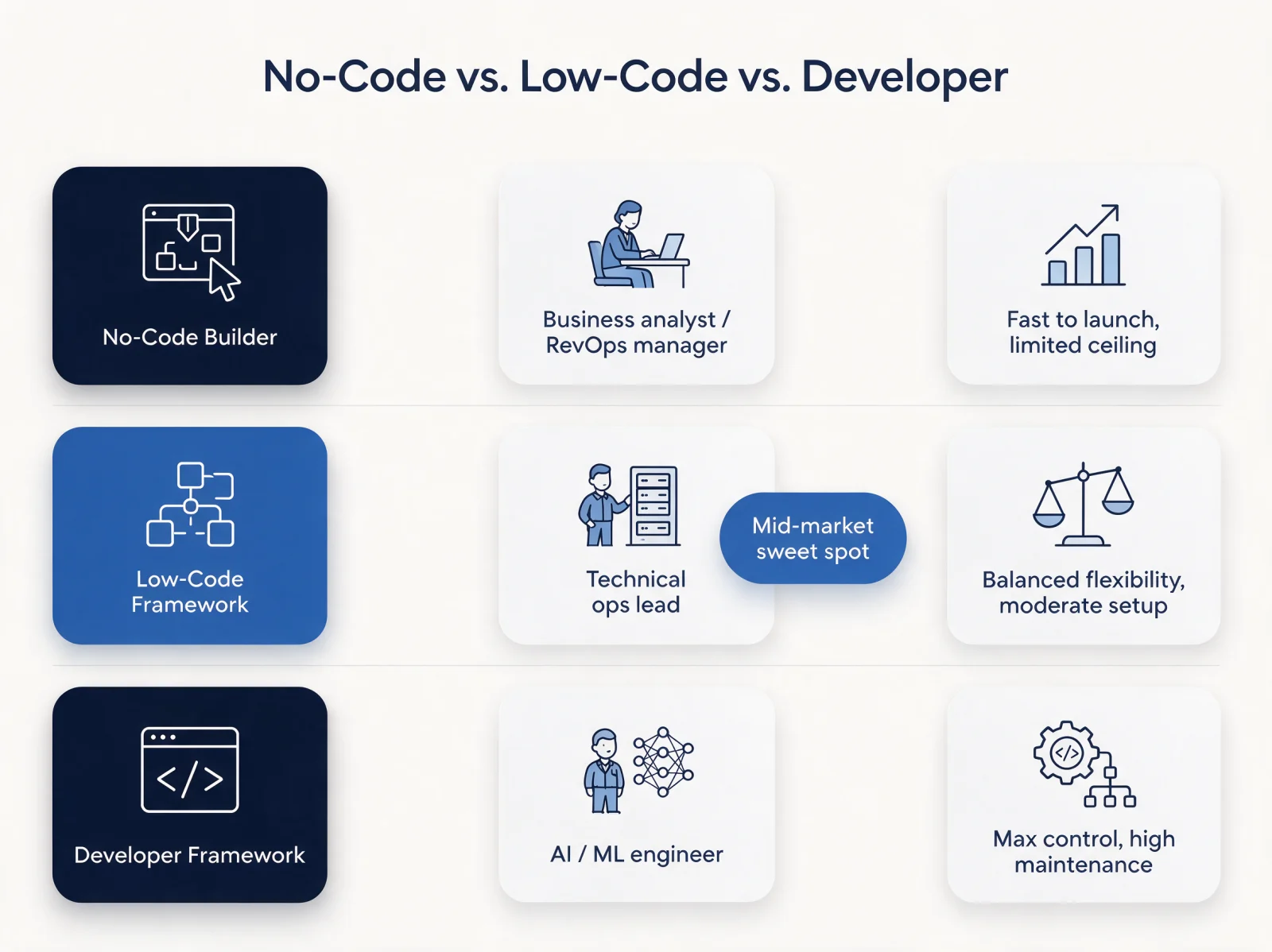
Low-code sits in the practical middle, and it's where mid-market RevOps teams tend to find traction. Platforms that offer pre-built connectors and configurable logic, while still exposing enough flexibility for non-standard processes, match the resource reality of teams without a dedicated AI engineering function. In our own workflow automation engagements, this is where most mid-market builds land.
| Platform Type | Target User | Key Trade-off |
|---|---|---|
| No-Code Builder | Business analyst / RevOps manager | Fast to launch; limited customization ceiling |
| Low-Code Framework | Technical ops lead / RevOps engineer | Balanced flexibility; moderate setup time |
| Developer Framework | AI/ML engineer | Maximum control; high build and maintenance cost |
That architecture decision becomes more consequential when agents need to operate inside your CRM, not alongside it. The stakes are measurable: Gartner predicts more than 40% of agentic AI projects will be canceled by the end of 2027 due to escalating costs, unclear business value, or inadequate risk controls, according to Gartner. Picking the wrong AI agent platform architecture for your team's actual engineering capacity is the single biggest driver of that failure rate.
The CRM Connection: Why Enterprise AI Agents Need Native Data Access
Enterprise AI agents win when they operate inside the same platform that already hosts customer data, not bolted on beside it. The vendors winning the enterprise agent race aren't building the smartest models. They're building agents closest to where customer data already lives.
This is the concept of data gravity: compute and logic should orbit the data, not the other way around. When agents are deployed inside the same platform that hosts customer records, interaction history, and pipeline data, they respond faster and more accurately. An agent that can read a CRM record, trigger a workflow, and update a field in a single session eliminates the latency and error risk of shuttling data between disconnected systems.
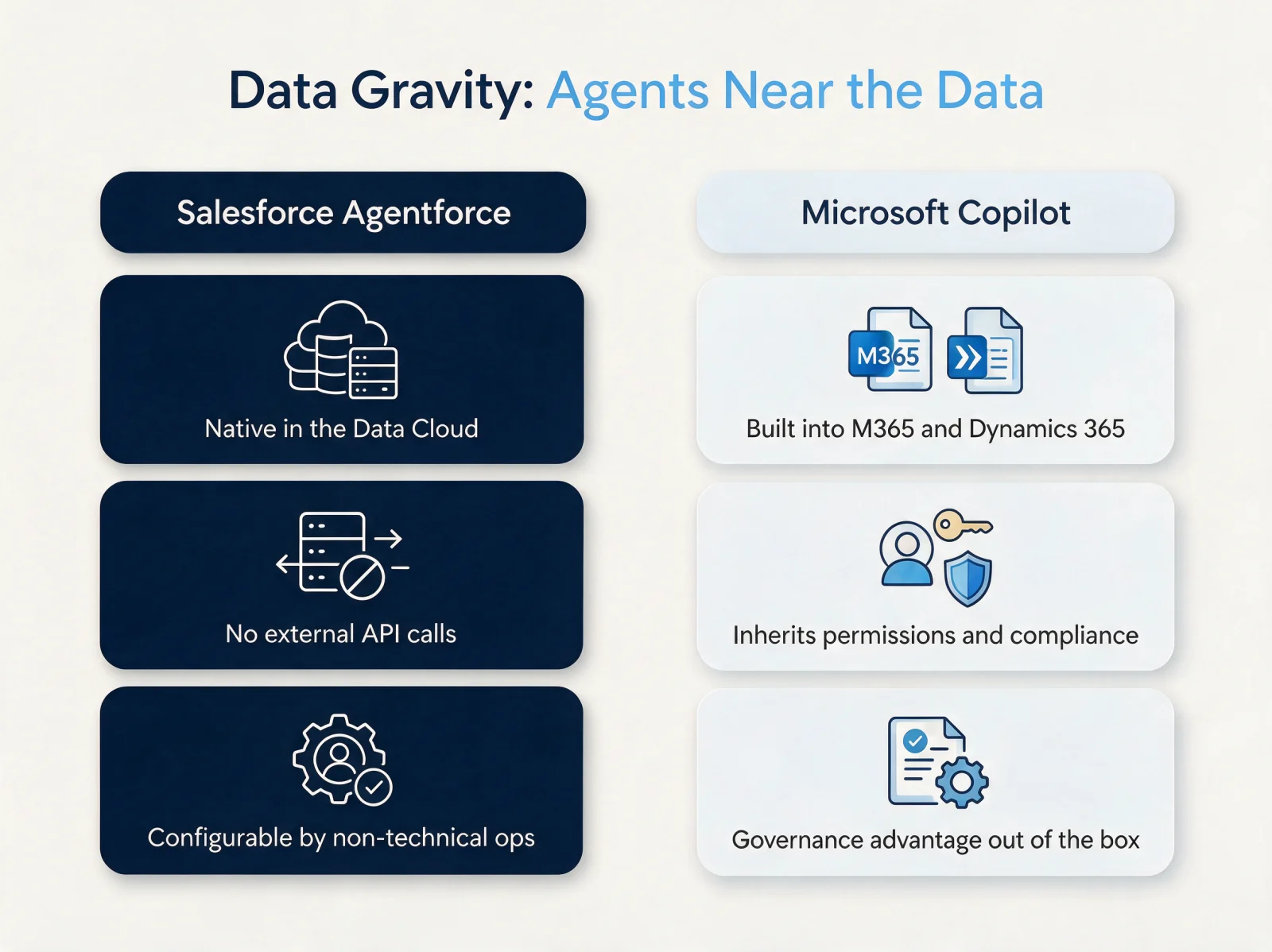
Salesforce Agentforce makes this case most directly. Because it operates natively within the Data Cloud layer, agents access unified customer profiles without API calls to external systems. According to Salesforce, Agentforce agents can trigger actions directly within the CRM flow, removing the middleware that typically introduces data drift and reconciliation headaches, and lowering the barrier to deployment for non-technical operators.
Microsoft Copilot agents take a parallel approach through the Microsoft 365 and Dynamics 365 ecosystem. Agents built in this environment inherit the organization's existing permissions model, compliance boundaries, and data connectors, a meaningful governance advantage standalone tools rarely match out of the box.
The risk of building outside these platforms is what practitioners call Shadow AI: agents built in disconnected tools that quietly bypass the governance, audit trails, and security controls IT teams have spent years establishing. Sound agent design accounts for this from day one, because an agent that works brilliantly in isolation but contradicts CRM data creates more confusion than it resolves.
The urgency behind that native-data argument shows up in the adoption numbers too. Sixty-two percent of organizations say they are at least experimenting with AI agents, according to McKinsey, though just 39% report enterprise-level EBIT impact so far. The gap between experimenting and earning a return is exactly where CRM-native deployment closes ground fastest.
Open Source vs. Proprietary: Agentic AI Tools and Governance
Choosing among open-source and proprietary agentic AI tools is a governance decision first and a technical decision second. The financial and compliance consequences outlast whichever demo won the pilot.
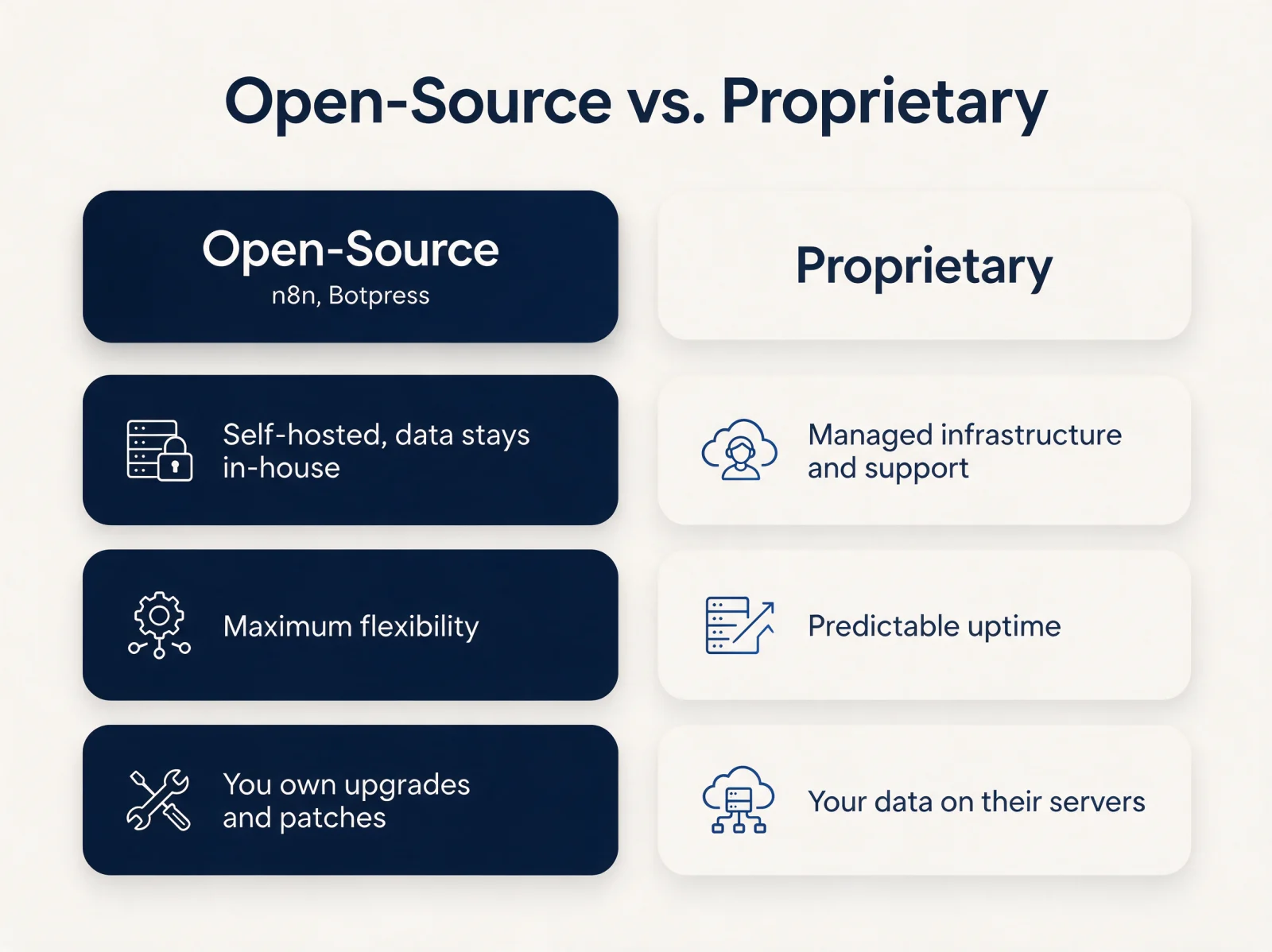
Open-source tools like n8n and Botpress have carved out serious territory by offering flexibility proprietary vendors can't match. Self-hosted deployments mean your data never touches a third-party server, which matters enormously when handling customer PII or financial records. That freedom carries a maintenance tax: your team owns the upgrades, the security patches, and the infrastructure stability, an overhead mid-market IT teams often underestimate until it becomes a crisis.
Closed platforms flip the burden. You get managed infrastructure, dedicated support, and predictable uptime, but your workflow data, prompt history, and business logic live on someone else's servers. Enterprise-grade agent platforms are increasingly judged on SOC 2 compliance and data residency options, since proprietary vendors may restrict where data is processed geographically, creating friction under GDPR, HIPAA, or CCPA. Understanding how agents interact with your existing systems, including ERP and CRM data flows, is essential before signing any vendor contract.
Regardless of which deployment model you choose, human-in-the-loop controls are the safety net that keeps autonomous agents auditable. Agents that execute multi-step actions like sending emails, updating records, or triggering payments need defined escalation thresholds and human review checkpoints built into the workflow architecture from day one. This isn't optional. It's what separates defensible automation from liability exposure.
Security Checklist for IT Leaders - Confirm SOC 2 Type II certification and audit report availability - Verify data residency options match your compliance jurisdiction - Review vendor data retention and model training policies - Establish human-in-the-loop escalation rules before go-live - Map all agent data access to existing permission structures - Require contractual clarity on who owns workflow logic and outputs
Building an AI Agent Workflow Platform: From Pilot to Production
An AI agent workflow platform only earns its budget once agents move from a demo into a measured, monitored production process. Most mid-market initiatives stall exactly at that transition.
The fastest path out of pilot purgatory is targeting use cases with measurable, near-term ROI. Three consistently deliver: lead qualification, where agents score and route inbound prospects before a human touches them; customer support triage, where agents categorize, prioritize, and partially resolve tickets automatically; and automated reporting, where agents pull, format, and distribute performance data on a schedule. Organizations that start with focused, high-frequency workflows see faster adoption than those chasing ambitious end-to-end automation from day one.
Discovery is where the groundwork happens: a clear mapping of existing manual workflows before any automation begins, or you automate chaos rather than eliminate it. Tools that support agentic workflows inside your CRM make this mapping phase far more actionable.
Design introduces a discipline that is rapidly becoming its own specialty: Agent Operations, or AgOps. Borrowed from DevOps thinking, AgOps treats agents as living systems that require monitoring, versioning, escalation logic, and continuous tuning, so they don't drift off-spec as underlying data and processes evolve. Deployment then demands KPIs that go beyond "time saved": task completion accuracy, escalation rate, cost per resolved interaction, and downstream revenue influence, measured from day one to build the business case for expanding agent coverage.
The Role of a Strategic Implementation Partner
Picking a platform is a fraction of the work; execution, integration, and adoption decide whether the investment pays off. A platform like Salesforce Agentforce ships with powerful out-of-the-box features, but connecting it meaningfully to legacy CRMs, custom data schemas, and existing revenue workflows requires deliberate engineering, not just configuration.
In practice, mid-market companies run into a predictable wall. The demo works beautifully, but the production environment is messier: historical CRM data is inconsistent, handoff logic between agents and human teams isn't defined, and success metrics were never tied to revenue outcomes. What looked like a three-week rollout quietly becomes a multi-month integration project.
A strategic partner shifts that outcome. Twelverays designs and runs custom AI agents mapped directly to your revenue workflows, identifying the highest-leverage automation opportunities first and building governance guardrails before scaling. Our agentic AI consulting work walks through the same sequence end to end. The platforms covered throughout this article are genuinely capable, but capability without context produces noise.
The Bottom Line: What You Need to Know About AI Agent Platforms
Choosing an AI agent platform is a revenue operations decision, not a technology decision, and the platform that connects deepest to your existing workflows wins. Mid-market leaders who treat it that way consistently outperform those who don't.
The top-performing platforms in 2026 share one defining trait: robust API ecosystems that make integration genuinely feasible, not just theoretically possible. Here's what that means in practice for mid-market decision-makers:
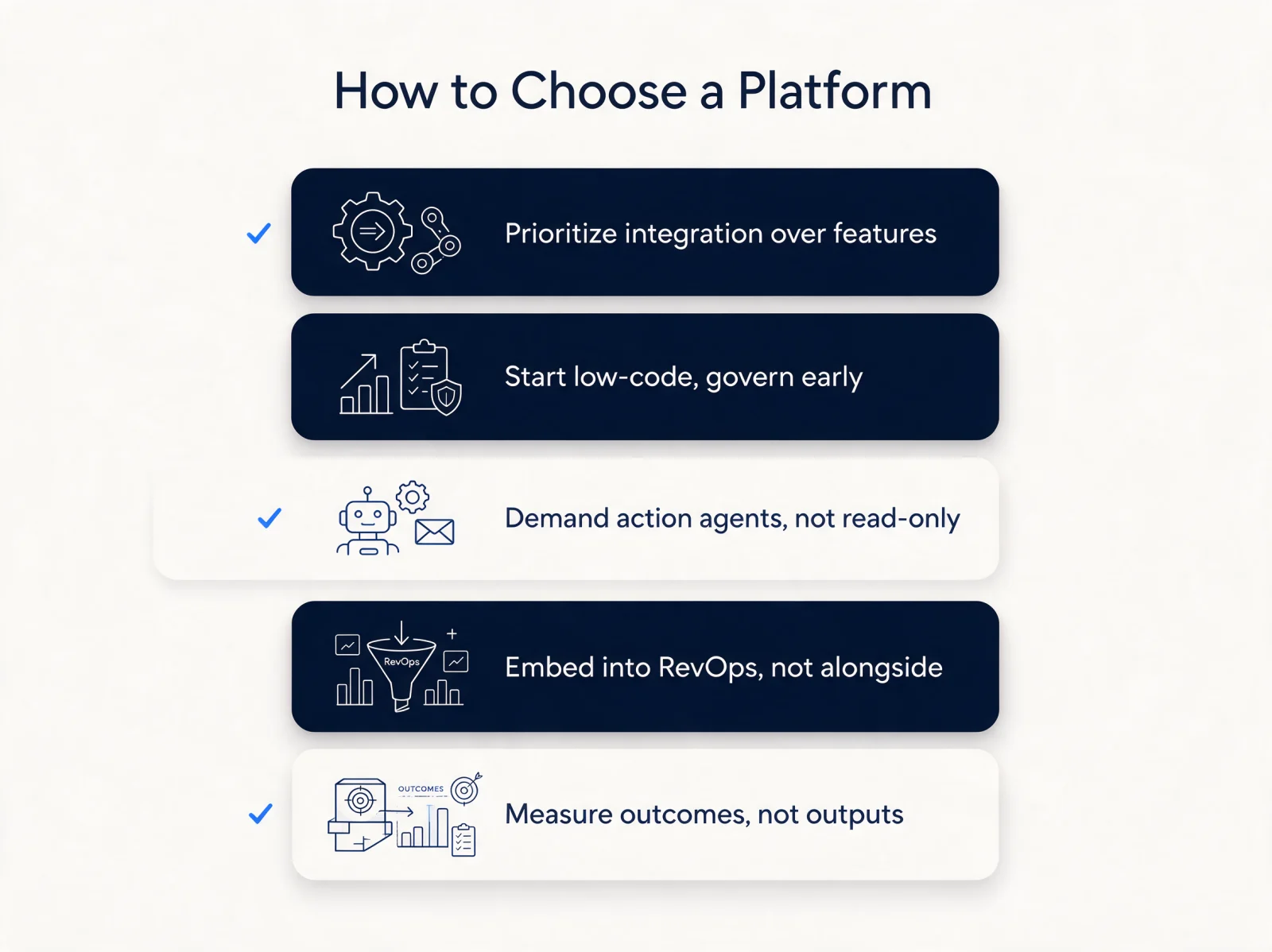
Key takeaways: - Prioritize integration over standalone features. An agent that doesn't connect to your CRM, ERP, or RevOps stack is an expensive chatbot. Evaluate platforms on depth of integration first. - Start low-code, govern early. No-code platforms accelerate time-to-value, but governance (permissions, audit logs, compliance controls) must be architected from day one, not retrofitted later. - Demand action agents, not passive ones. Platforms must be capable of writing to your database, triggering downstream workflows, and closing loops autonomously. Read-only agents don't move revenue. - Embed agents into RevOps, not alongside it. Success depends on connecting AI directly into pipeline management, forecasting, and customer success motions. Microsoft Copilot agents deployed within Dynamics 365 and Microsoft 365 show how deeply embedded agents outperform bolted-on alternatives. - Measure outcomes, not outputs. Track pipeline influenced, time-to-resolution, and revenue per rep, not prompts processed.
The platforms that deliver ROI treat orchestration as the product, not a feature.
Future-Proofing Your Agentic Strategy
The next competitive edge comes from coordinated agent networks, not a single smarter agent. Enterprise AI agents are heading toward collaboration, not isolation.
Orchestration frameworks like AutoGen are already testing multi-agent collaboration for complex B2B sales cycles, where one agent qualifies the opportunity, another drafts the proposal, and a third updates the CRM without human handoffs. A multi agent ai platform coordinates that handoff automatically, and this shift is an active area of development mid-market leaders should be planning for today.
Data readiness is the prerequisite no one wants to talk about. Before any multi-agent architecture can deliver value, it needs clean, structured, accessible data, since agents can only be as intelligent as the records they read. That means investing now in deduplication, field standardization, and workflow documentation, the unglamorous groundwork that determines whether your agentic rollout succeeds or stalls. Whether your stack runs on a Salesforce-powered CRM or a HubSpot-based RevOps setup, the same principle applies: garbage in, garbage out. Getting the CRM foundation right first, a lesson we cover in our CRM software guide, pays off long before the first agent ships.
See how a wealth advisory firm cut client-review prep 68% with governed, CRM-connected AI agents.
The clearest action mid-market leaders can take right now is to audit existing workflows before purchasing another license. Map which processes are rule-based, which require judgment, and which generate the data agents will eventually need. That audit becomes the architectural blueprint for everything that follows. Start there, and let the platform decision come second.


