

Generative AI Consulting: From Use Case to Production
Generative AI consulting services help a business find where generative AI creates real value, then build and deploy it safely, moving past experiments to systems that run in production. Grounded in AI operations design, the consulting closes the gap between "AI could help here" and "AI does help here, reliably."
Generative AI, the models that write, summarize, analyze, and generate, is genuinely powerful and genuinely easy to misapply. The demos are dazzling and the production track record is thinner, because most projects stall between the pilot and the deployment. Generative AI consulting exists to cross that gap: pick the use cases that pay off, build them on your data, and govern them so the output is trustworthy.
What Are Generative AI Consulting Services?
Generative AI consulting services are advisory and build work focused on generative models, applied to a specific business outcome. It covers use-case selection, architecture, implementation, and the governance that makes generated output reliable.
Good generative AI consulting is opinionated about where the technology fits. It is excellent for drafting, summarizing, extracting structure from messy text, and answering questions over your own data. It is a poor fit dressed up as a good one when the task needs guaranteed-correct outputs with no tolerance for a plausible mistake. A consultant worth hiring will steer you toward the high-value, forgiving use cases and away from the traps. That judgment is the same one behind sound AI operations design: the value is in choosing what to build, not building everything.
What Does Generative AI Actually Do for a Business?
It handles language and knowledge work at scale: drafting content, summarizing documents, extracting data from unstructured text, and answering questions over your own information. It turns hours of manual reading and writing into minutes.
The business value is concrete when you name the task. A support team drafts replies from a knowledge base instead of writing each from scratch. A finance team extracts figures from hundreds of PDFs instead of rekeying them. A sales team gets a plain-language answer over the CRM instead of waiting on a report. Each is a real hour saved, repeatedly. The connective tissue is the same across them: the model has to reach your actual data and be governed, which is why generative AI pairs naturally with a self-service analytics capability rather than sitting off to the side.
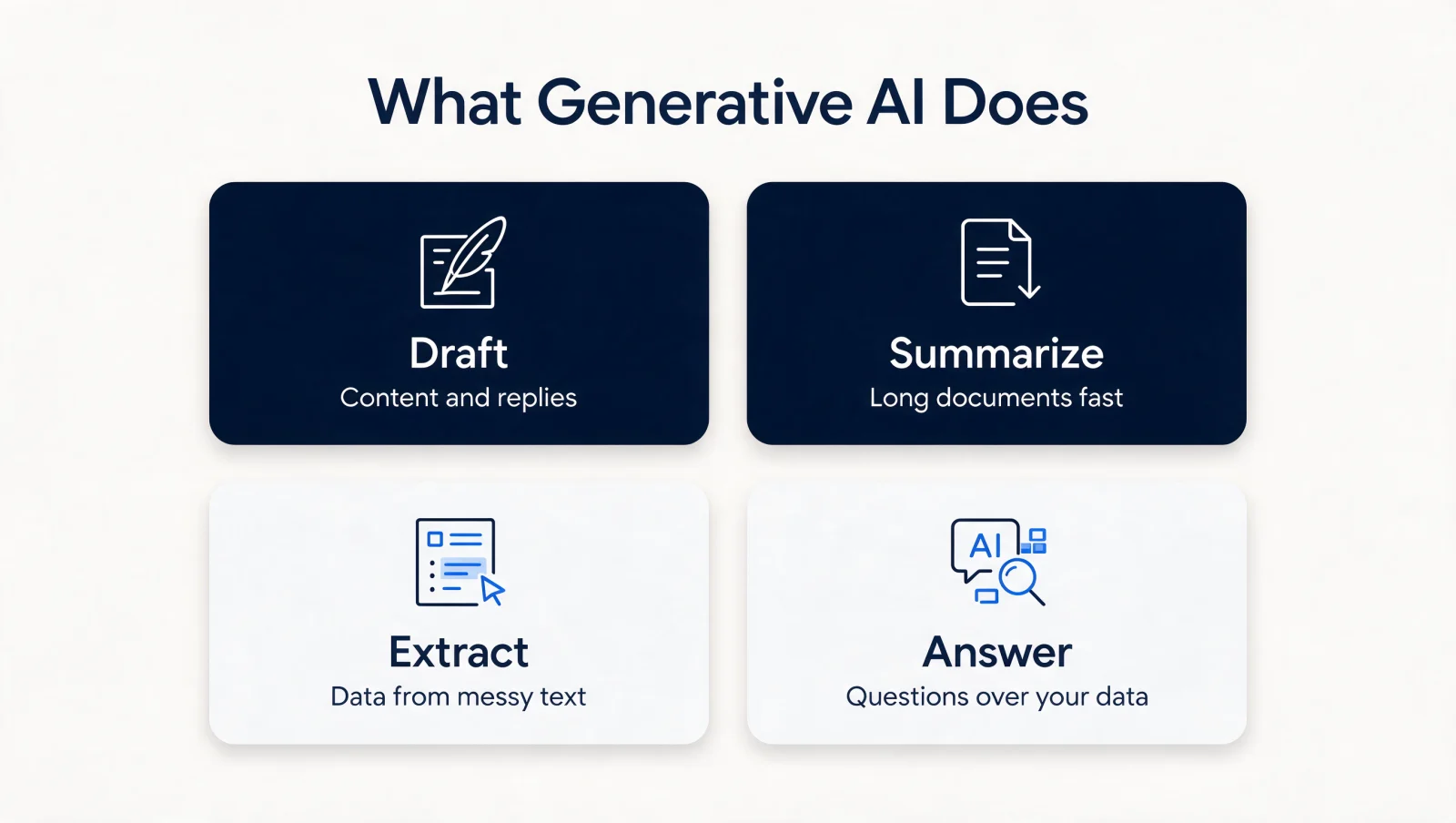
Generative AI handles language and knowledge work at scale.
Where Does Generative AI Deliver Real ROI?
In high-volume language and knowledge work where a small error is recoverable: drafting, summarizing, research, and internal question-answering. The ROI is weakest where outputs must be exactly right every time with no human check.
The ROI test is simple, and the arithmetic is convincing: a support team drafting 50 replies a day saves real hours when each draft drops from 10 minutes to 2.
Test | Ask | Good sign |
|---|---|---|
Volume | Does the task repeat daily? | Automation compounds |
Language fit | Is it reading or writing text? | The model is strong here |
Error tolerance | Is a rare mistake catchable? | Human checkpoint exists |
Spelled out: is the task high-volume, so automation compounds? Is it language- or knowledge-heavy, where the model is strong? And is a rare mistake catchable, so a plausible-but-wrong output does not cause damage? Where all three hold, generative AI pays back fast. Where the task demands guaranteed precision with no review, drafting first-pass content is fine, filing regulatory numbers unchecked is not, the honest answer is to add a human checkpoint or use a different tool. A consultant who promises ROI everywhere is not measuring; they are selling.
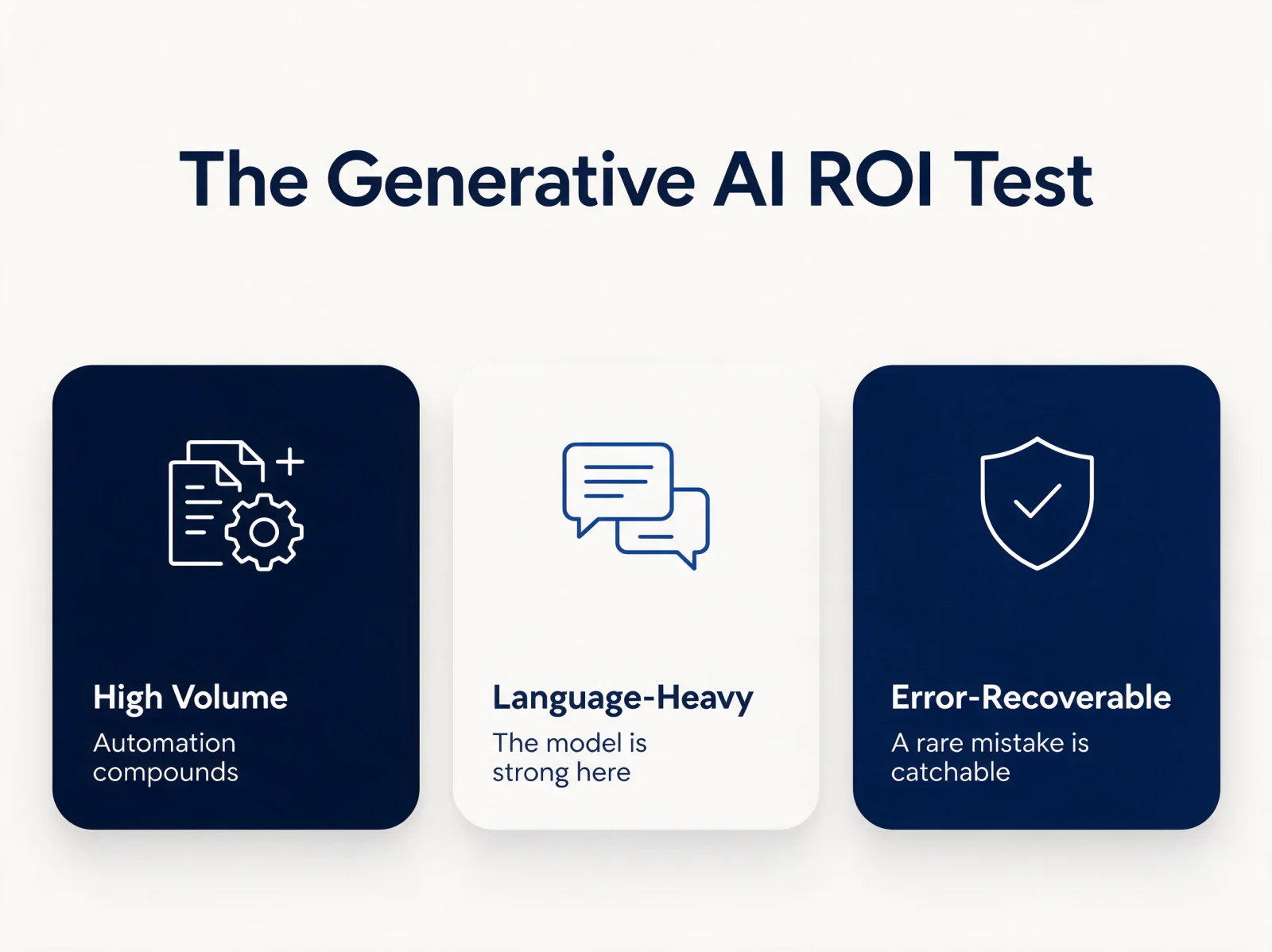
High volume, language-heavy, and error-recoverable is where ROI lands.
Why Do Generative AI Projects Stall Without AI Operations Design?
They stall between a working demo and a trusted production system, because the demo skipped the hard parts: connecting to real data, governing the output, and evaluating whether it is right. Those are 80% of the work and none of the excitement.
The stall is predictable, and it is the norm: McKinsey's State of AI research finds 78% of organizations now use AI somewhere, yet most still struggle to reach bottom-line impact. The pilot ran on clean sample data with the builder watching. Production needs messy real data, a governed connection to it, an evaluation loop that catches wrong answers, and guardrails so the model stays in scope. Teams underestimate all of it because the demo made it look done. This is the same wall that stops many AI pilots from reaching production: the last 20% of visible progress is the 80% of real work.
What Do Generative AI Consulting Services Deliver?
A ranked set of use cases, a governed architecture on your data, a working deployment of the top use case, and the evaluation and guardrails to trust it. Strategy and implementation together, not one without the other.
Generative AI consulting and implementation services belong under one roof, because a real engagement produces both a plan and a running system. It starts by ranking use cases on value and feasibility, so you invest where the payoff is real. It designs the architecture, the model, the governed data layer, the guardrails, then builds and deploys the highest-value case. And it hands you a way to measure the output so trust is earned, not assumed. A strategy with no deployment is a slide deck. A deployment with no governance is a liability. ### The responsible AI governance framework
That is why mature generative AI development consulting services always ship a responsible AI governance framework alongside the build. A responsible AI governance framework is the set of guardrails, review points, and audit trails that keep generated output inside policy. Responsible AI governance is what turns generative ai consulting for business innovation into something a board can approve. As an OpenAI and Anthropic partner, Twelverays builds on the model that fits each use case rather than forcing one everywhere, the same discipline behind our OpenAI consulting work.
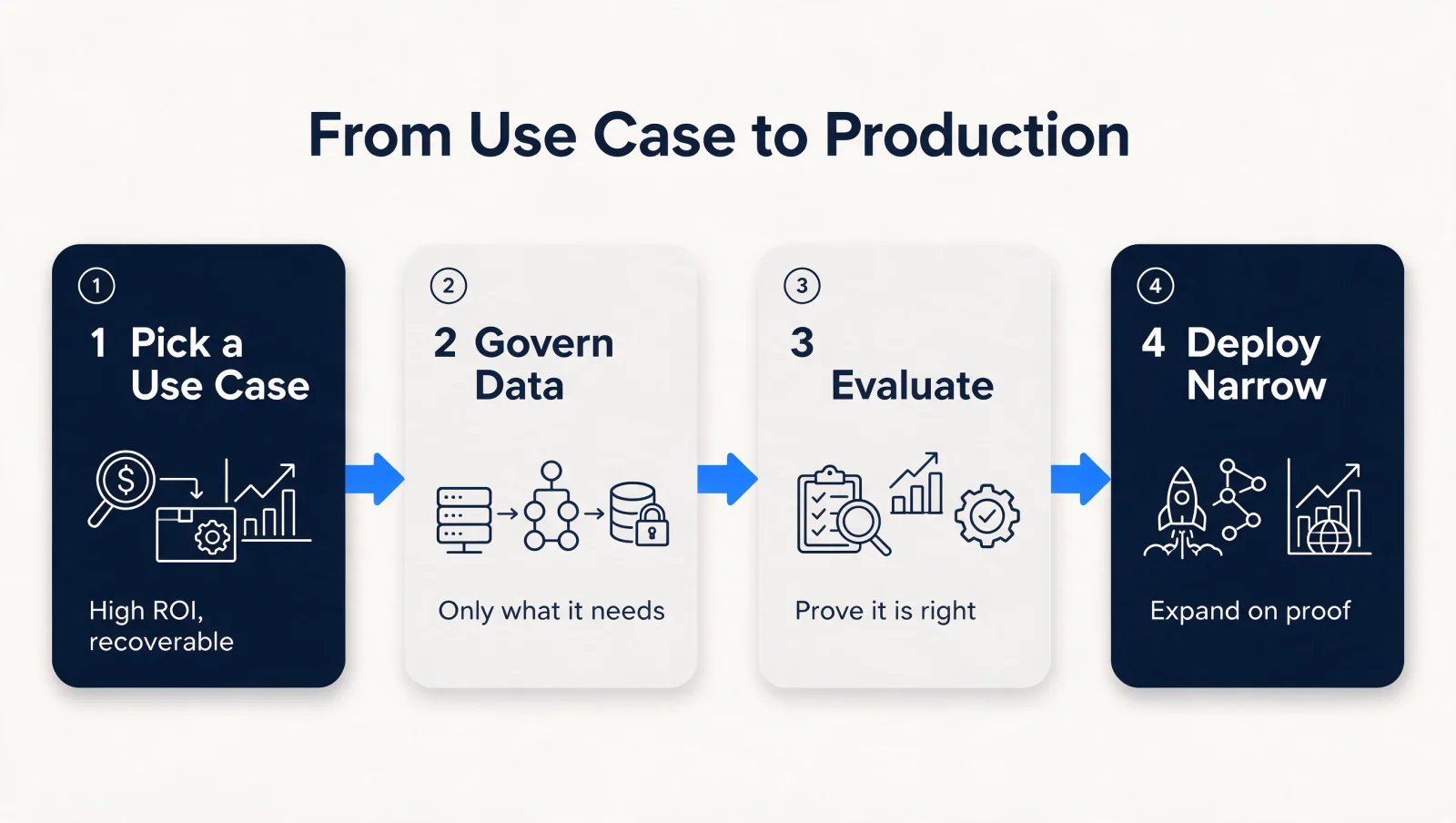
Pick one case, govern the data, evaluate, then deploy narrow.
How Do You Go From Use Case to Production?
Pick one high-ROI use case, connect it to governed data, build in evaluation and guardrails, validate against known-good results, then deploy narrow and expand. Production readiness is a discipline, not a bigger model.
The path is deliberate.
Pick and govern the first case
Choose a single use case where the value is clear and a mistake is recoverable. Give the model a governed connection to only the data it needs. Build the evaluation loop before you launch, so you can prove the output is right. Set the guardrails and the human checkpoints.
Validate, deploy narrow, expand
Validate against results you already trust, then deploy on that narrow slice and widen from proof. What kills these projects is trying to launch broad and perfect at once. The teams that ship start small, measure hard, and expand on evidence.
What Data Does Generative AI Need to Work?
Connected, reasonably clean data with clear access rules. Generative AI does not need a perfect data warehouse, but the systems it draws on must be reachable and the definitions it relies on must be consistent where it matters.
The common blocker is a myth: that you need pristine, fully governed data before you can start. You do not. You need the data relevant to the one use case to be reachable and trustworthy, and you need clear rules for what the model can see. A support-answer assistant needs your knowledge base connected and current, not your entire data estate cleaned. Starting narrow means the data problem is narrow too. Trying to fix all your data first is how generative AI projects die in a two-year prerequisite that never ends. Scope the use case, connect what it needs, and expand from a working win.
Key Takeaways
Generative AI consulting moves generative models from demos to governed production systems.
The strongest ROI is high-volume language and knowledge work where a rare error is recoverable.
Most projects stall on the unglamorous 80%: data connection, governance, and evaluation.
Real generative AI consulting services deliver ranked use cases plus a working, governed deployment under a responsible AI governance framework.
Shipping Generative AI on Your Stack
Generative AI rewards businesses that are disciplined about where they apply it and honest about what it takes to run it. The value is real, and so is the gap between a demo and a system your team trusts. Crossing it is the consulting.
Twelverays is an OpenAI and Anthropic partner, and we select, build, and deploy generative AI on the systems you already run through our artificial intelligence practice. If your generative AI ideas keep stalling before production, book a discovery call and we will scope the use case worth shipping first.


