Power Platform Consulting Services: When to Hire a Partner
Power Platform consulting services are expert help designing, building, and governing solutions on Microsoft Power Apps, Power Automate, and Power BI, so the apps and automations your team builds actually hold up in production. Microsoft Power Platform consulting turns scattered citizen-developer experiments into a governed platform your business runs on.
Most companies already own Power Platform through their Microsoft 365 licensing, and most use a fraction of it. Microsoft's own Power Platform documentation spans five products, Power Apps, Power Automate, Power BI, Power Pages, and Copilot Studio, plus hundreds of connectors, which is exactly why unguided adoption sprawls. The gap is rarely the tooling. It is knowing what to build, building it so it scales past one department, and governing who can automate what. That is the work Power Platform consulting exists to do, and as a Microsoft Solutions Partner for Business Applications, it is work Twelverays delivers on the stack you already license.
Key Takeaways
Power Platform consulting covers strategy, build, and the governance that keeps citizen development safe.
Most companies already license the platform; the gap is knowing what to build and governing it.
Licensing is public: Power Apps Premium runs $20 per user per month and Power Automate Premium $15. The consulting spend buys design, integration, and governance.
The platform is strongest paired with Dynamics 365, sharing one data foundation.
Choose a partner on governance depth and knowledge transfer, and start with one governed, high-value win.
What Is Microsoft Power Platform Consulting?
It is advisory and build work across the Power Platform suite: identifying the processes worth automating, designing the apps and flows, connecting them to your data, and setting the governance that keeps hundreds of flows from becoming chaos.
Microsoft Power Platform consulting spans a spectrum, and the role Microsoft certifies for this work, the Microsoft Power Platform functional consultant, exists precisely because the platform rewards people who understand both the business process and the tooling. At one end, strategy: which of your manual processes should become a Power App, which reports belong in Power BI, and what the build order is. At the other end, delivery: building the solutions, integrating them with Dynamics 365 and your other systems, and training your team to own them. The engagements that pay off do both, because a roadmap nobody builds and an app nobody governs both end the same way: abandoned.
What Do Power Apps Consulting and Power Automate Work Actually Involve?
A consultant maps your processes, picks the right tool for each job, builds the solution, and sets up the environments, security, and data policies that make citizen development safe. The build is the visible half; the governance is the half that decides whether it lasts.
Power Apps consulting is the design and build of custom business applications on Microsoft's low-code platform. Governance is the set of environment, security, and data policies that keep those builds safe. The pattern behind failed Power Platform rollouts is consistent: someone builds a useful flow, it spreads, and two years later the company has 400 ungoverned automations nobody can inventory, touching data nobody approved. A consultant prevents that by setting up the platform properly: environment strategy, data loss prevention policies, connector governance, and a center of excellence so business users can build safely. Then the actual solutions: Power Apps consulting (often searched as PowerApps consulting services) covers the apps that replace spreadsheet processes, a Power Automate consultant designs the flows that remove manual handoffs, the Power BI reporting that replaces month-end scrambles.
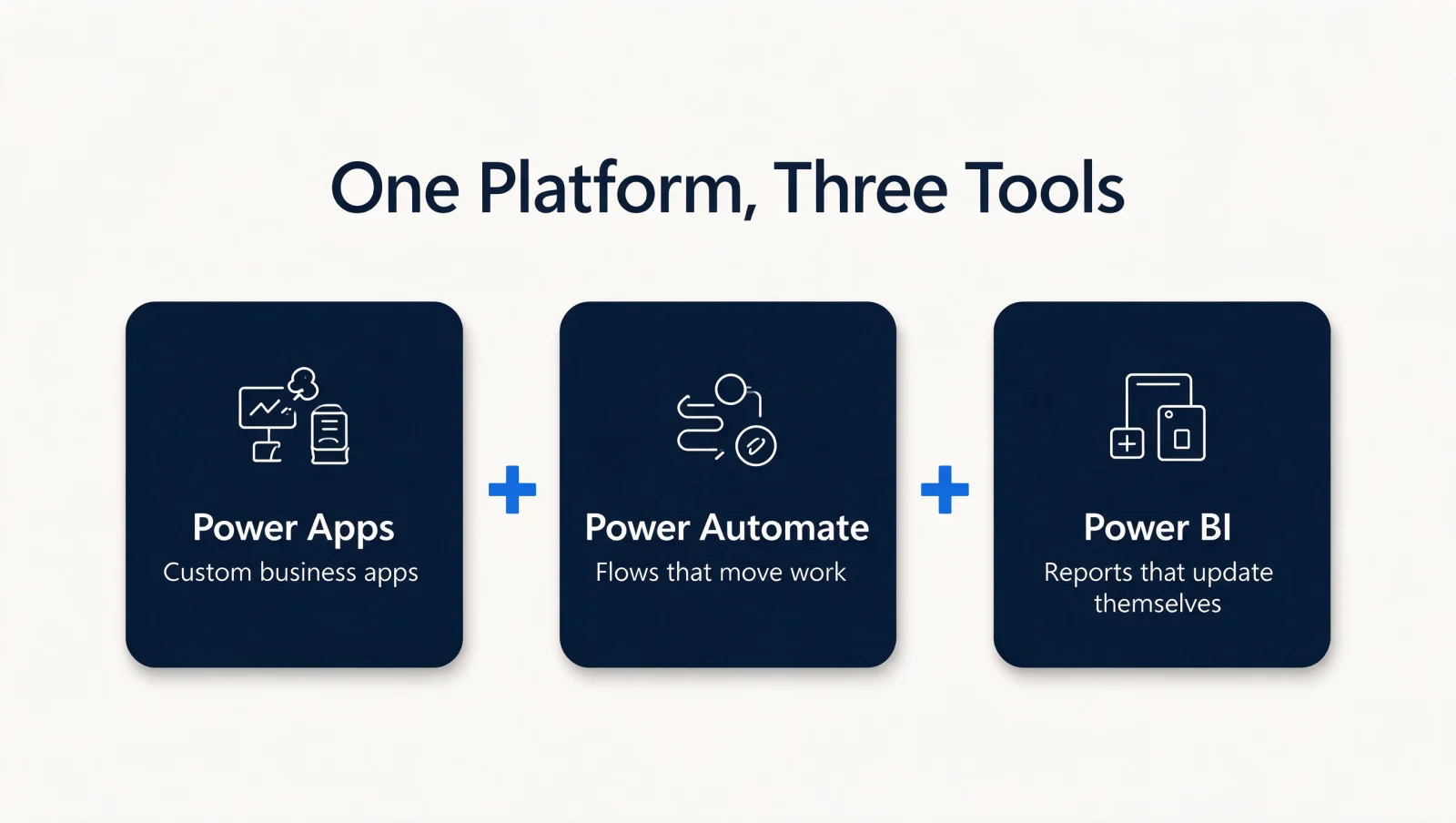
An app captures the data, a flow moves it, a report surfaces it.
What Can You Actually Build on Power Platform?
Custom business apps without custom-software budgets, automations that connect your systems, and reporting that updates itself. The platform covers the long tail of processes too specific for off-the-shelf software and too small to justify traditional development.
Tool | What it replaces | First win example |
|---|---|---|
Power Apps | Paper forms, spreadsheets | Inspection app |
Power Automate | Email-chain approvals | Contract routing flow |
Power BI | Month-end report scrambles | Live sales dashboard |
Real examples are mundane on purpose: an inspection app that replaces a paper form, an approval flow that routes contracts instead of email chains, an onboarding workflow that provisions accounts automatically, a dashboard that pulls sales and finance data into one live view. Individually small, collectively transformative. The full platform is designed so these build on each other: an app captures the data, a flow moves it, a report surfaces it. The compounding is the point.
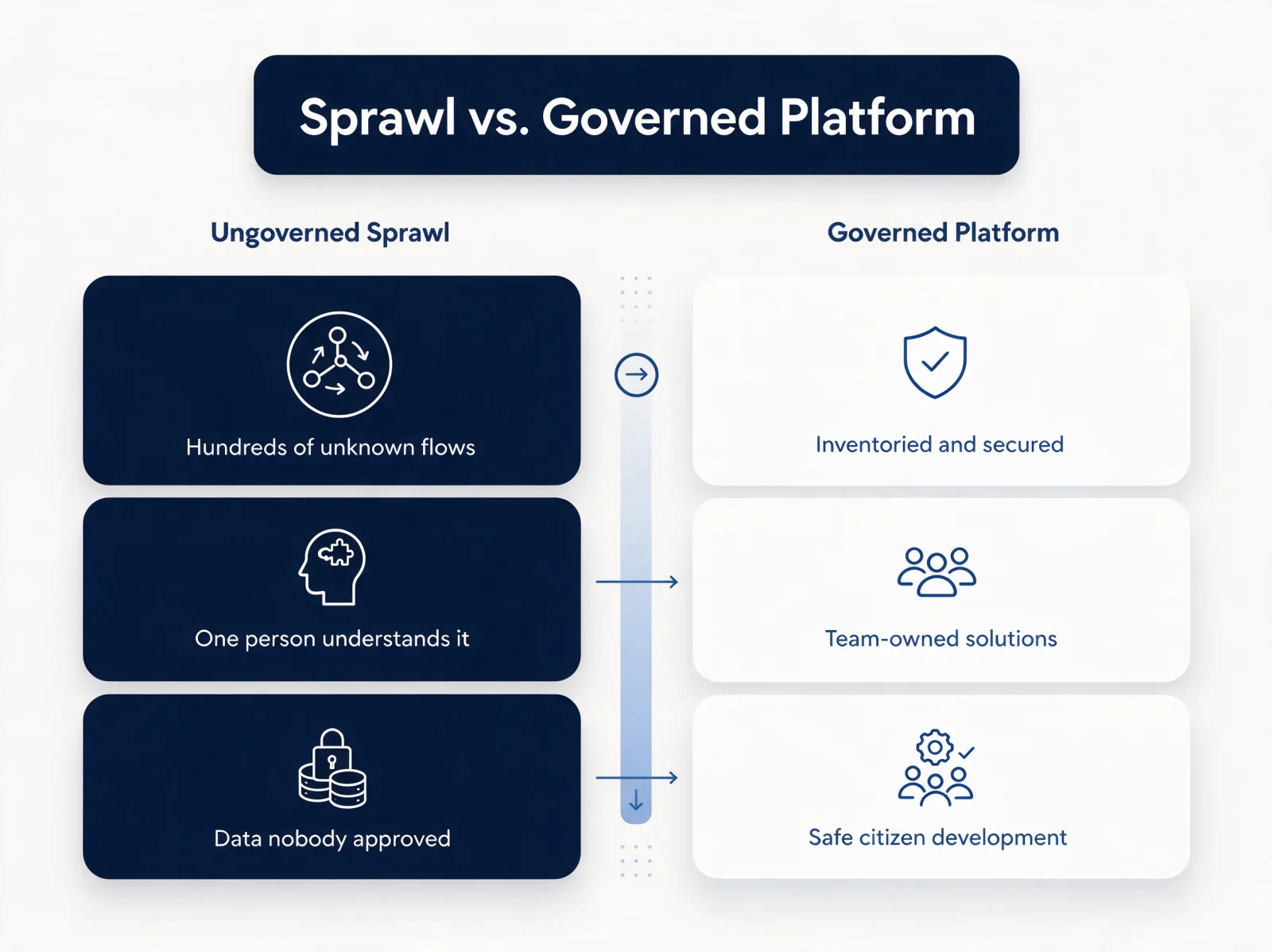
Governance is what separates a platform from sprawl.
When Should You Find a Power Platform Partner?
When you are past the first experiment and the stakes are rising: more users, more data, more flows, and no governance. Also at the very start, if you want the platform set up right before the sprawl begins.
The signals are recognizable. Your team built something useful and now everyone wants one. A critical process quietly depends on a flow one person understands. IT is nervous about what business users are connecting to. Or you know the platform could replace a pile of manual work but nobody has time to lead it. Any of these is the moment a partner pays for itself, because retrofitting governance onto sprawl is far more expensive than starting governed. The same discipline applies across workflow automation generally: the value is in the reliability, not the demo.
How Does Power Platform Fit with Dynamics 365?
They are built on the same foundation, and they are strongest together. Power Platform extends Dynamics 365 with custom apps, automations, and reporting that the out-of-the-box CRM does not cover.
This is where the platform earns its keep in a CRM-centered business. Dynamics 365 Customer Engagement handles sales, service, and customer data; Power Platform wraps it with everything specific to how you operate: a quoting app your reps actually use, an escalation flow that fires when a deal stalls, a Power BI view your leadership checks every morning. Both share the same data layer, so nothing needs a fragile integration. Teams that treat them as one platform get far more from both, which is exactly how our Dynamics 365 practice approaches implementations.
How Do You Choose Power Platform Consulting Services?
Judge process understanding, governance depth, and knowledge transfer, not portfolio screenshots. The right partner leaves your team able to build and maintain solutions, not dependent on the partner forever.
The questions that separate partners quickly: How do you decide what is worth building versus buying? How do you set up environments and data policies before the first app ships? How do you handle the flow that becomes business-critical? And what does handoff look like, will our people be able to extend this? Partners with specific answers understand the platform as an operating discipline. Partners who only show demos are selling the easy part. Microsoft certifications across the modules each scope calls for are worth confirming too, as is real Dynamics integration experience if CRM is in your stack.
What Do Power Platform Consulting Services Cost?
Budget two lines: the licensing you pay Microsoft and the consulting engagement itself. Licensing is public and predictable. Consulting cost scales with scope, integration surface, and how much governance has to be built.
License | Price (paid yearly) | Covers |
|---|---|---|
Power Apps Premium | $20 per user/month | Unlimited apps and Power Pages per user |
Power Automate Premium | $15 per user/month | Premium connectors and attended RPA |
Power Automate Process | $150 per bot/month | Unattended automation |
Copilot Studio | $200 per 25,000 credits/month | Custom AI agents |
Dataverse capacity | $40 per GB/month | Additional database storage |
Those are Microsoft's published rates as of August 2026, per the official Power Apps pricing and Power Automate pricing pages, with volume discounts from 2,000 seats. The consulting line varies more. A scoped first engagement that ships one governed solution costs a fraction of a failed platform program, and it is the model to insist on: fixed scope, named deliverables, a few weeks. Ongoing advisory and managed builds price against the roadmap. Be wary of an open-ended retainer proposed before anything has shipped; pay for an outcome first and expansion second.
How Do You Hire Power Platform Consultants?
Three models: a fixed-scope project, an ongoing platform partner, or dedicated consultants embedded with your team. Match the model to how much ownership your own people can carry.
A fixed-scope project fits the first build and the governance foundation; it has a defined deliverable and an end date. An ongoing partner fits once the roadmap is real: they run Microsoft Power Apps consulting services, Power Automate flows, Power BI reporting, and increasingly Copilot Studio agents as one program instead of disconnected requests. Dedicated consultants fit enterprises with an internal center of excellence that needs extra build capacity. Whichever model you choose, keep two rules. First, hire for the whole platform, not one tool; an app without a flow behind it and a report on top of it leaves most of the value unbuilt. Second, name a governance owner on your side from day one, because a partner who holds all the keys has recreated the dependency you were trying to escape.
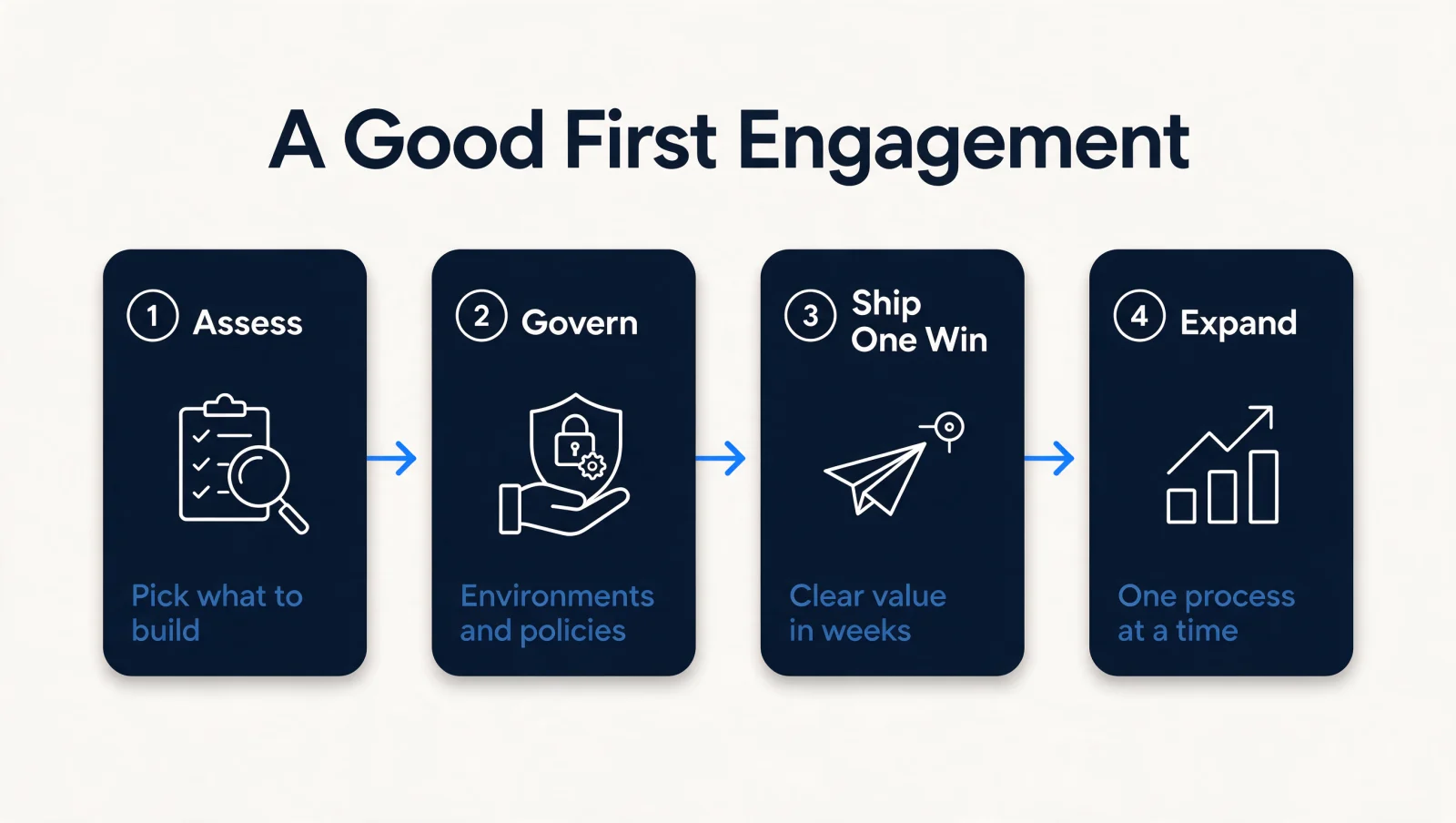
Assess, govern, ship one win, then expand.
What Does a Good First Engagement Look Like?
Governance foundation plus one high-value solution shipped, in weeks. Prove the model on a contained win, train the team on it, then expand one process at a time.
Weeks one to two
A healthy engagement starts with a short assessment: which processes are candidates, what the platform setup requires, and what the first build should be. Then it ships that first solution, an app or automation with clear before-and-after value, on a properly governed foundation.
What it avoids
What it avoids is the six-month platform program with nothing live, and the opposite failure of shipping fast on an ungoverned foundation that has to be rebuilt. Value early, governance underneath, expansion on proof.
Getting Real Value from the Platform You Already Own
Power Platform is the rare enterprise tool most businesses already pay for and underuse. The difference between a pile of licenses and a platform your operations run on is deliberate design: the right first builds, a governed foundation, and a team trained to own it.
Twelverays is a Microsoft Solutions Partner for Business Applications, and we design, build, and govern Power Platform solutions alongside our Dynamics 365 practice. If your team is sitting on unused Power Platform licenses or ungoverned sprawl, book a discovery call and we will scope the first build worth shipping.