

How to Choose an AI Consulting Company in 2026
Choose an AI consulting company on three things: whether they understand your operations, whether they can build and integrate on your actual stack, and whether they govern what they ship. Most AI consulting companies pitch the same promises; the same filter works for a solo AI consultant or a full artificial intelligence consultancy. The demo is the least important signal. Delivery discipline is the most important.
The market is crowded and the claims are loud. Every firm says it does AI, and the quality gap between them is enormous. The ones worth hiring treat AI as an operations problem they implement and govern, not a demo they hand off. This guide is the filter: what these firms do, the types to know, what to look for, and the red flags that save you a wasted six months.
What Does an AI Consulting Company Actually Do?
A good AI consulting company finds where AI creates real value in your business, then designs, builds, and deploys it safely into production. The work spans strategy, architecture, integration, and governance, not just advice.
AI strategy and readiness is the assessment work that opens a good engagement: where AI fits, whether your data can support it, and what to build first. The label covers a wide range of depth. Some firms stop at strategy: a report on where AI could help, then they leave. Others only build, with no view on whether the use case was worth it. The firms that deliver do both, they choose the high-value use cases and ship them into production on your systems. The through-line of good work is that AI is treated as an operations discipline, the same principle behind AI operations design: decide what AI controls, who approves, and how you measure it.
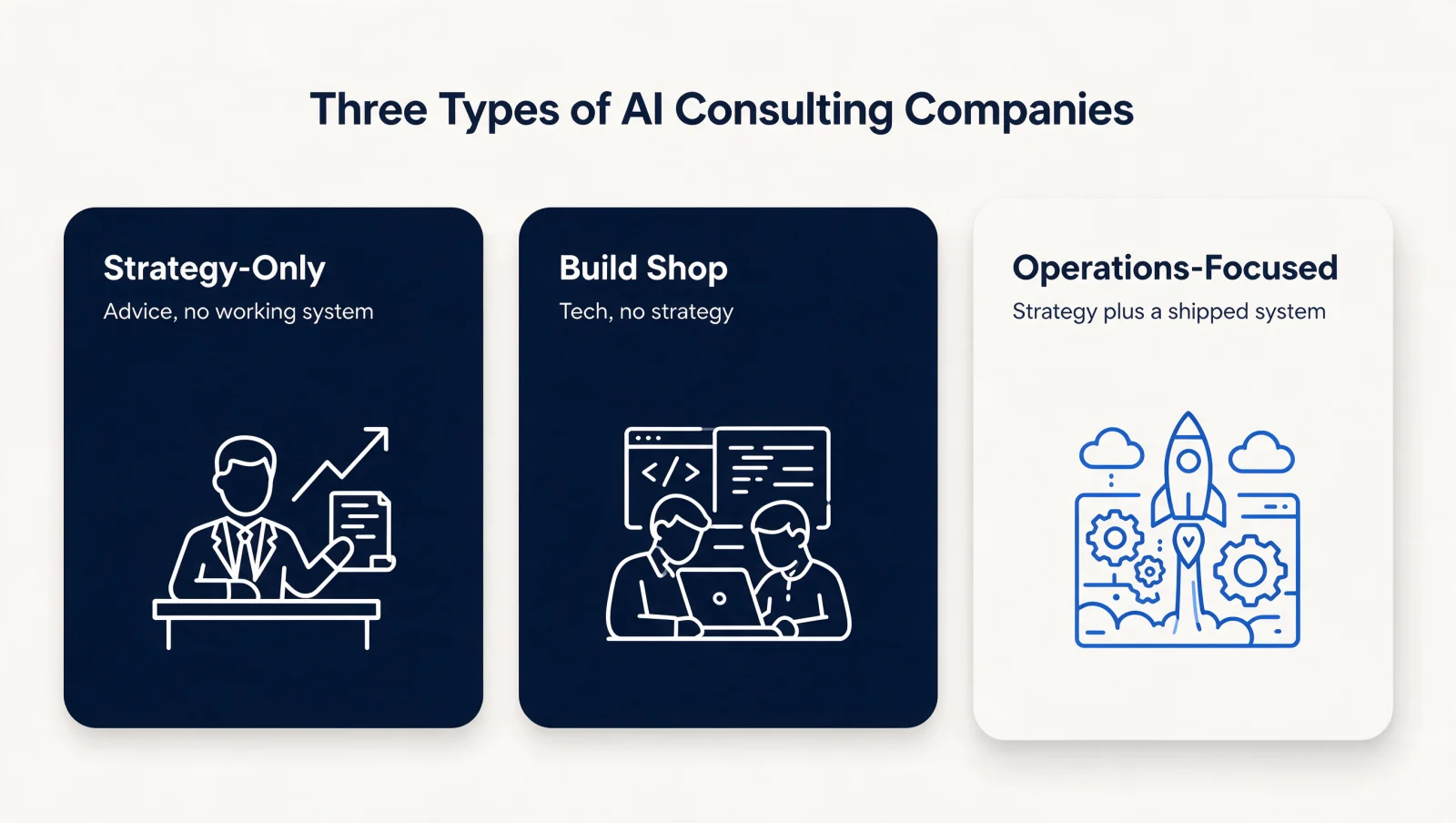
Strategy-only, build shop, or operations-focused. Most need the third.
What Are the Types of AI Consulting Companies?
Three broad types: strategy-only advisories, model-focused build shops, and operations-focused firms that do both. Most businesses are best served by the third, because a strategy you cannot implement and a build with no strategy both fail.
Knowing the types saves you from a mismatch.
Type | Delivers | Gap |
|---|---|---|
Strategy-only advisory | Thinking, roadmaps | No working system |
Model-focused build shop | Technology | No business case |
Operations-focused firm | Strategy plus a shipped system | Rarer to find |
Strategy-only advisories produce good thinking and no working system, useful if you already have a strong build team. Model-focused build shops love the technology and often skip the question of whether the use case earns its keep, which is how you get an impressive tool nobody uses. Operations-focused firms start from your process, pick what is worth automating, and ship it governed. For most mid-market companies without a large internal AI team, the third type closes the gap the other two leave open.
What Should You Look For in an AI Consulting Company?
Process understanding, integration depth, governance rigor, and honesty about what AI cannot do. A firm that starts with your operations and admits where AI is a poor fit is worth more than one that promises AI everywhere.
The signals that matter are unglamorous. Do they start by understanding your process, or by pitching their tool? Can they integrate with the systems you actually run, or do they need you to adopt their platform? How do they govern the output, and what happens when the AI is unsure? And crucially, will they tell you where AI is the wrong answer? A firm that says AI can solve everything is not being honest; the good ones scope tightly and steer you away from the traps. The same filter applies whether you need an AI automation agency or a broader partner.
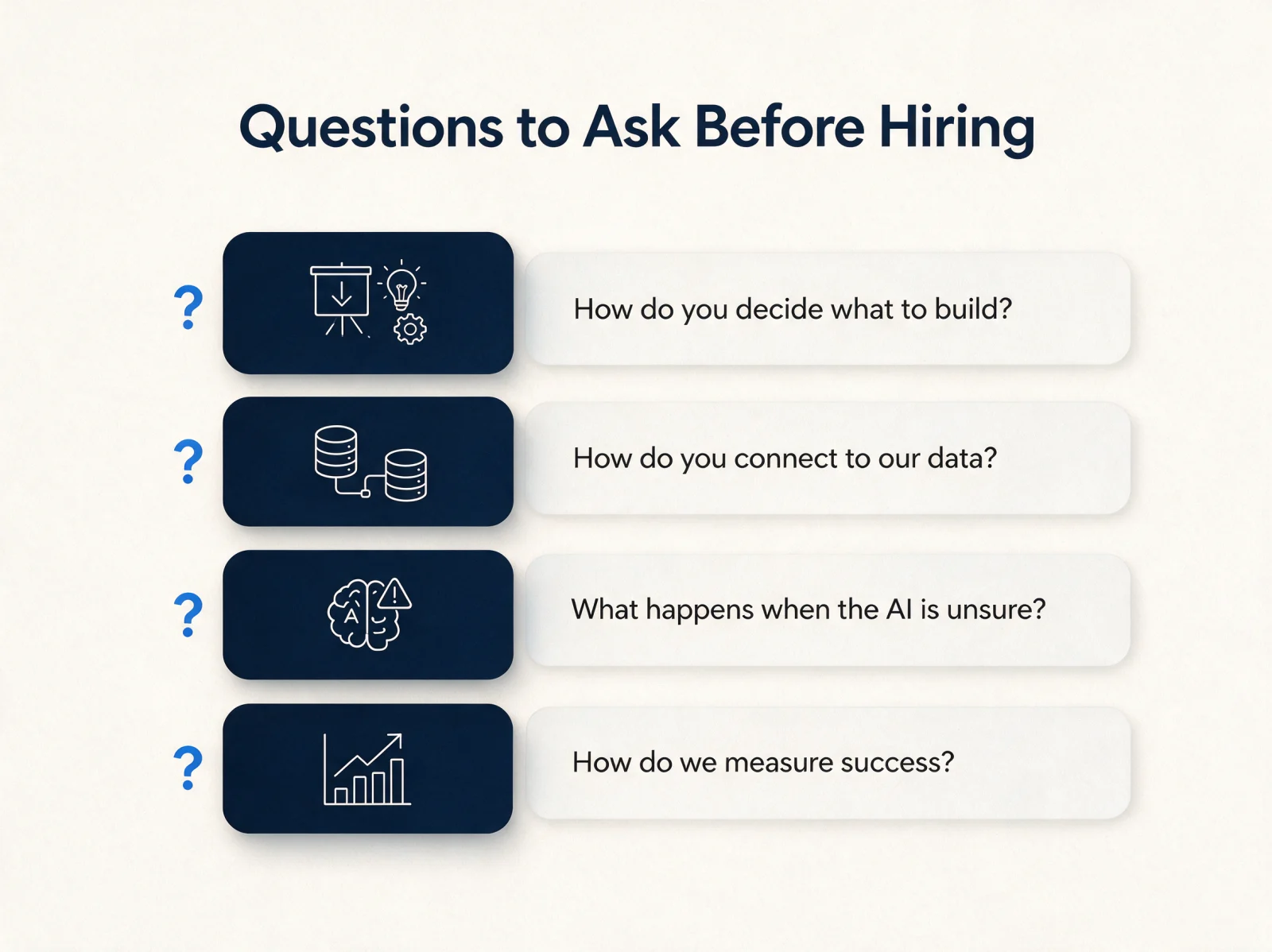
Ask how they build, integrate, and measure, and expect specifics.
What Questions Should You Ask Before Hiring One?
Ask how they decide what to build, how they connect to your data, how they measure that it works, and to walk you through a comparable project end to end. Specific answers signal real delivery; vague ones signal a demo.
Five questions separate AI consulting firms fast:
How do you decide which use cases are worth building?
How will you connect to our existing systems?
What happens when the AI produces a wrong or uncertain answer?
How do we measure whether it is working after launch?
Can you walk us through a real project from problem to production?
Firms that answer with specifics, real trade-offs, real integration detail, real governance, understand delivery. Firms that redirect to a capabilities deck are selling the easy part. As an OpenAI and Anthropic partner, Twelverays shares a scope and outcome overview on request so the path is clear before you commit.
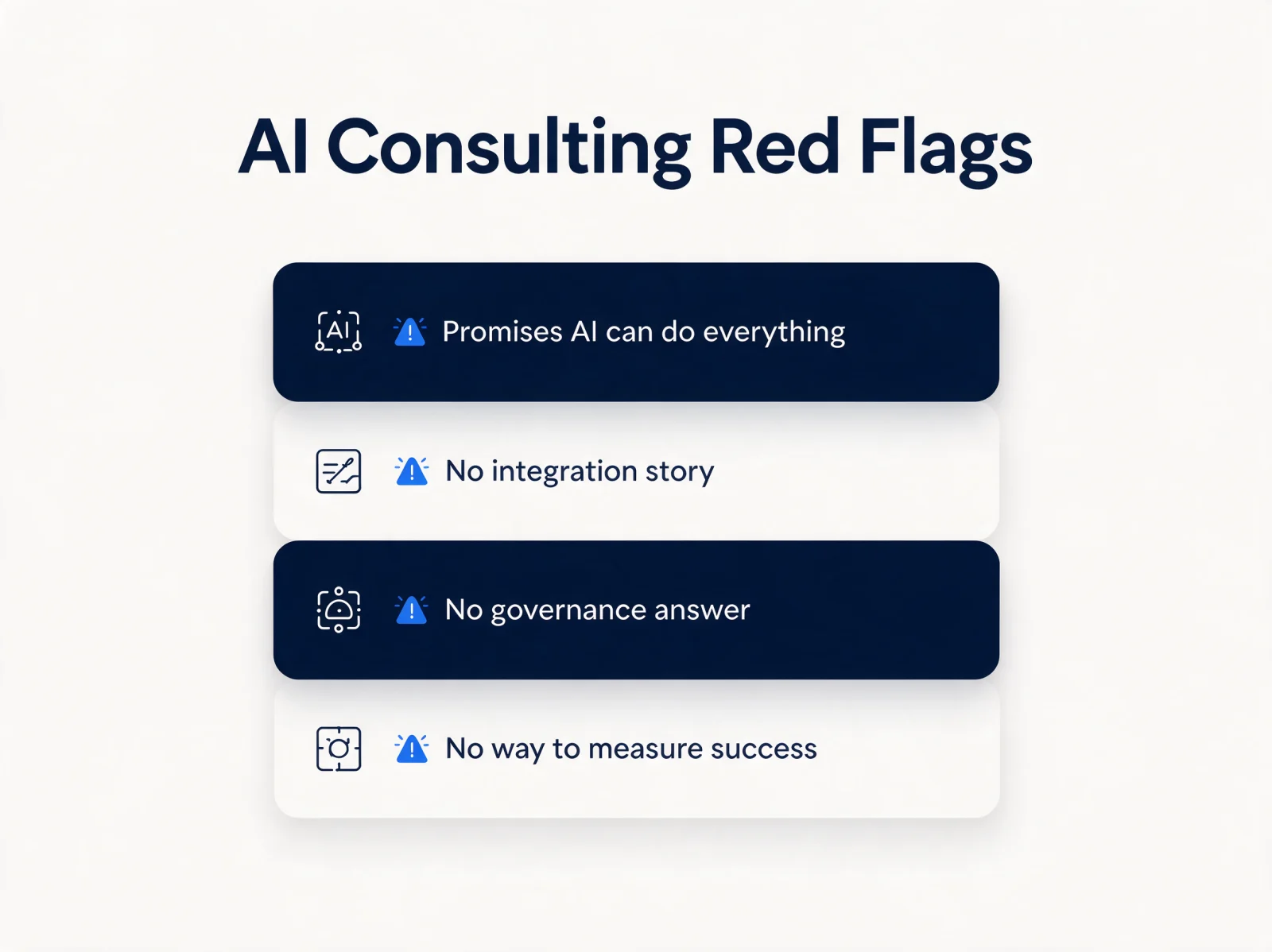
Beware AI-everywhere promises and no governance answer.
What Are the Red Flags in AI Consulting Firms?
Watch for AI-everywhere promises, no integration story, no governance answer, and no way to measure success. The biggest red flag is a firm that leads with the model instead of your problem.
The warning signs cluster, and they matter because adoption is now the norm: McKinsey's State of AI research finds 78% of organizations already use AI in at least one function, so the differentiator is no longer whether a firm can talk about AI, but whether it ships. A firm that says AI can automate anything is not scoping; it is selling. A firm with no clear answer for how it connects to your stack will hand you an island. A firm that cannot explain how it catches wrong outputs is shipping you a liability. And a firm with no success metric is asking you to trust a demo. Above all, be wary of any pitch that centers the technology instead of your operations, because the value was never in the model. It is in applying it to the right problem, safely.
How Is an AI Software Consulting Service Priced?
Common models are fixed-scope projects, blueprints that hand off an architecture, and managed retainers that run the system for you. Price should track the depth of delivery, not the length of the slide deck. The right structure depends on whether you need a plan, a build, or an ongoing operator.
Pricing structures tell you what you are actually buying. A fixed-scope project fits a defined build with a clear finish line. A blueprint engagement fits teams that want the architecture and will build in-house. A managed retainer fits businesses that want the firm to run and improve the system over time. What matters is that the price maps to real delivery, integration, governance, a working system, rather than to advisory hours that leave you with a report. Scope the outcome first, then the structure follows.
How Long Until You See Results From AI Consulting?
A well-scoped first engagement should show a working result in weeks, not quarters. If a firm cannot point to value inside the first project, the scope is too broad or the delivery discipline is missing.
Timeline is itself a signal of quality. A firm that starts narrow, one high-value use case, connected and governed, should have something running and measurable within the first engagement, not a year of strategy before anything ships. If the proposal is all roadmap and no near-term deployment, that is a warning: real delivery produces an early, provable win. Ask any firm you are considering when you will see the first working result and how they will measure it. A specific, near-term answer signals delivery discipline. A vague "it depends on the transformation journey" signals a slide deck. Value early, expansion on proof, is the shape of a healthy engagement.
Key Takeaways
Choose on operations understanding, integration depth, and governance, not the AI demo.
Three firm types exist; most businesses need the operations-focused kind that does both strategy and build.
Ask how they decide what to build, connect to your data, and measure success, and expect specific answers.
The biggest red flag is any firm that leads with the model instead of your problem.
Choosing a Partner That Ships
The AI consulting market rewards firms that talk well and penalizes buyers who cannot tell talk from delivery. The filter is simple: does the firm understand your operations, can it integrate and govern on your stack, and will it tell you where AI does not fit. Everything else is a demo.
Twelverays is an OpenAI and Anthropic partner, and we design, build, and run AI on the systems you already operate through our artificial intelligence, AI operations design, and workflow automation practices. If you are evaluating AI consulting companies, book a discovery call and we will show you what disciplined delivery looks like.


