

A CRM RFP template should give implementation partners the same problem to price and the same requirements to answer. In a CRM implementation RFP, define the business process, delivery boundaries and acceptance evidence before asking for a total. Your CRM partner selection criteria can then distinguish a credible delivery plan from an incomplete response.
CRM means customer relationship management. An RFP, or request for proposal, is a document inviting suppliers to explain how they would meet a defined need. This template is for buying implementation services. You can copy its prompts and tables into your procurement document; there is no separate download required.
Set the purpose of your CRM implementation RFP
State whether the platform is selected, shortlisted or still open for evaluation. Choosing software and selecting a delivery partner are related decisions, but the responses need to show which decision each recommendation addresses. If several platforms remain under consideration, ask for separate product-fit and implementation responses.
Use the CRM selection guide for the software decision. Keep the RFP focused on the work you intend to buy and the evidence needed to approve it.
Before sending the document, name the business sponsor and procurement contact. Confirm who can answer questions about sales processes, customer service, data and security. If the intended launch date is fixed, explain the dependency behind it, such as a system retirement or contract expiry. A date without that context gives candidates little basis for proposing a workable sequence.
Copy this CRM RFP template into your scope brief
Complete each prompt with your current information. Mark an unknown as an assumption to validate, and ask respondents to state how it affects their estimate.
| Scope prompt | Information the buyer should supply |
|---|---|
| Business problem | Describe the handoff, reporting or service problem the project must address. |
| Processes | List the sales and service workflows included, with a named business owner for each. |
| Users | Identify roles, approximate numbers, locations and access restrictions. |
| Existing systems | Name what will be replaced, retained or connected, and any relevant retirement dates. |
| Data | Estimate record volumes, history, attachments, known duplicates and missing fields. |
| Integrations | Identify launch requirements, later phases, system owners and available documentation. |
| Constraints | State the budget range, decision dates, internal availability and required approval steps. |
| Exclusions | Identify work already assigned elsewhere or deliberately deferred. |
Add a short outcome statement: “The service team needs to transfer accepted customer requests to the correct owner and report unresolved work by age.” This is an illustrative process outcome. Replace it with the result your project sponsor needs, then define how the team will observe that result.
Separate that outcome from an implementation acceptance condition. A configured handoff can be tested before launch. A future revenue increase depends on more than the implementation team and should not be treated as proof that a configuration deliverable is complete.
Include a buyer-contribution schedule. State when subject-matter experts can attend workshops, who can prepare a data extract and when approvers can review designs. Request that each partner identify additional customer effort in its response.
Turn CRM RFP requirements into answerable scenarios
Ask vendors to respond to business scenarios, supported by the relevant product requirements. For each one, include the user, starting condition, action and expected result. This allows the delivery team to explain the proposed configuration and any dependency it cannot yet confirm.
The following rows are illustrative. They are not claims about functionality included in every CRM subscription.
| Requirement | Priority | Evidence at acceptance | Respondent must explain |
|---|---|---|---|
| An accepted enquiry reaches the assigned sales owner. | Required for launch | Test record, assignment result and notification history. | Routing rules, exceptions and any required license. |
| A manager sees the agreed pipeline total for their team. | Required for launch | Report reconciled to an agreed set of deals. | Included records, amount definition, permissions and filters. |
| Imported contacts remain linked to the correct company. | Required for launch | Mapping document and representative relationship checks. | Matching identifiers, duplicate treatment and rejected records. |
| A failed integration transaction reaches a support owner. | Required for launch | A controlled failure and documented recovery result. | Error detection, retry method and maintenance responsibility. |
Give each requirement an identifier so questions, estimates and acceptance results can refer to the same item. Add optional requirements separately and request their incremental cost. This helps prevent a desirable future capability from obscuring a missing launch requirement.
Require respondents to distinguish standard configuration, additional subscriptions, custom development and unsupported requests. Configuration effort and software entitlement are separate questions. Ask for current official documentation supporting a proposed capability and a written explanation of where custom work begins.
For example, HubSpot documents required import properties and unique identifiers for updating existing records. Its import-file guidance also distinguishes subscription-dependent technical limits. A migration response should explain how the candidate will meet those requirements for your records, rather than merely promising to “import the database.”
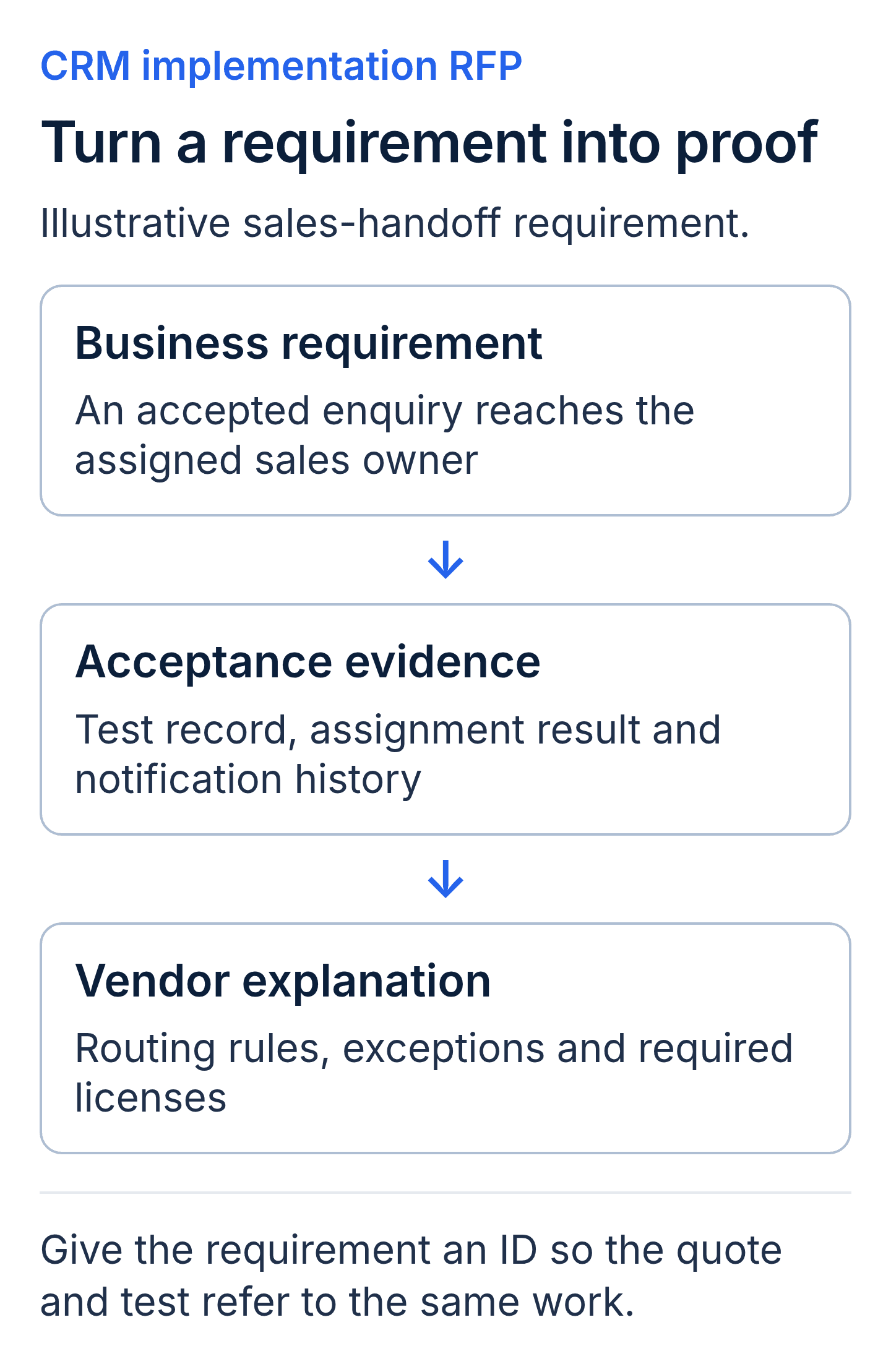
One RFP row should connect the business behavior to acceptance evidence and the supplier’s stated dependencies.
Request a delivery plan and ownership response
Ask each partner to complete the following questionnaire in the same order. A clear response should connect the proposed method to your scope, rather than repeating a general description of the firm's process.
- What discovery decisions must be approved before configuration begins?
- Which deliverables will document the process design, data mapping and access model?
- Who prepares, cleans and approves the data, and what happens to rejected records?
- Which integrations are included, and who maintains each connection after launch?
- Where will configuration and custom development be tested before release?
- Who writes the acceptance tests, supplies test data and approves the results?
- How will the team handle open work, final data changes and incoming requests during cutover?
- What training, administrator documentation and support are included at handover?
Request dependencies and buyer time commitments beside each phase. If an estimate assumes a clean export or a configured identity provider, it should say so. Ask the partner to explain what changes if the assumption proves false and who approves the revised work.
For Salesforce work, a useful evidence reference is the Trailhead guide to planning org changes. It describes development and testing environments, source control and change-tracking records. Your RFP can ask the candidate to explain its corresponding approach without requiring every project to use the tutorial's exact environment arrangement.
The CRM implementation guide provides background for reviewers who need more context on delivery phases. The supplier's response should still identify the deliverables and responsibilities specific to your purchase.
Build a CRM vendor evaluation scorecard
Decide how you will evaluate proposals before reading them. Start with mandatory conditions, such as an essential security requirement or a required integration. Record whether a response meets each condition, needs clarification or fails it. A high score elsewhere should not silently override a failed mandatory requirement.
Then score the quality of the qualified responses. The weights below are illustrative and total 100%. Change them to reflect your priorities before issuing the RFP.
| Evaluation area | Sample weight | Evidence reviewers should assess |
|---|---|---|
| Process fit | 25% | Specific answers to the launch scenarios and their exceptions. |
| Delivery approach | 25% | Named deliverables, realistic dependencies and acceptance planning. |
| Data and integrations | 20% | Mapping, migration rehearsal, failure handling and maintenance ownership. |
| Commercial clarity | 20% | Comparable scope, stated assumptions and clear change boundaries. |
| Handover and support | 10% | Training, administrator access, documentation and support coverage. |
Use a shared rating scale, such as zero for no response and five for a complete, evidenced response. Define the intermediate scores too. Reviewers should record the supporting passage or unanswered question beside each rating.
For this sample model, a rating of four out of five in a category weighted at 25% contributes 20 points. Calculate the result consistently, then discuss material differences between reviewers. The number supports a decision; it does not resolve an unexplained exclusion or replace commercial judgment.
Compare the cost behind each CRM implementation proposal
Provide a common cost-response table covering software, implementation services, connectors, migration, training and ongoing support. Ask the respondent to mark each item as included, separately priced, buyer-provided or excluded. Require the billing currency and applicable commercial assumptions.
Choose a comparison period that fits your planned commitment. Total cost of ownership, or TCO, is the cost of acquiring and operating the solution over that stated period. Include recurring subscriptions and agreed support in the comparison, while keeping uncertain future work visible as assumptions. Do not treat an unpriced change allowance as a committed fee.
For time-based work, request rates, estimated effort and any approval or spending cap. For fixed-fee work, identify the acceptance milestones and change triggers. If a vendor proposes a retainer, ask what capacity or deliverables the recurring fee purchases. Compare these responses against the same scope instead of assuming that one pricing model is inherently preferable.
The article on costs created by a poorly scoped CRM implementation offers additional planning context. Use the current supplier proposals, rather than a generic estimate, for your procurement calculation.
Use CRM partner selection criteria at the shortlist meeting
Send each shortlisted candidate the same follow-up scenarios. Include a representative workflow and a known exception, such as an integration arriving after the intended launch. Ask the candidate to explain the effect on scope, sequencing and customer effort.
Disclose known dependencies and ask suppliers to explain the unresolved ones. Share material clarifications with all respondents so revised quotes remain comparable.
Before selecting a provider, agree how proposal commitments will appear in the statement of work, or SOW. This document should identify deliverables, responsibilities and acceptance conditions. Microsoft's Dynamics 365 testing guidance provides a useful example of linking tests to business requirements, recording results and obtaining stakeholder approval. Apply the principle to your chosen platform and delivery method.
Key takeaways
- Give candidates the same process scope, data assumptions and launch constraints.
- Request scenario responses that identify configuration, licensing, custom work and unsupported requirements.
- Use mandatory conditions before applying the weighted scorecard.
- Compare costs over a stated period with the same inclusions and responsibilities.
- Carry the selected proposal's commitments into the SOW and acceptance plan.
CRM RFP template buyer FAQs
How many requirements should the first version contain?
Include enough to describe the funded project and distinguish qualified responses. There is no useful universal row count. Prioritize launch requirements and group optional work separately so respondents can price it without obscuring the base scope.
Should we disclose our budget?
A budget range can help candidates propose an appropriate scope. Decide what to share under your procurement process, and ask suppliers to show what is achievable within the stated constraint and what would require additional funding.
What if we have not chosen a CRM?
State that platform selection remains open. Request separate explanations of software fit, licensing assumptions and delivery scope. Ask shortlisted providers to identify which recommendations depend on their chosen platform.
What should happen after the scorecard is complete?
Resolve material assumptions, confirm the proposed delivery team and document the reasons for selection. Agree the deliverables, customer responsibilities and acceptance evidence before authorizing implementation.
Terms for the procurement document
| Term | Meaning |
|---|---|
| RFP | Request for proposal inviting suppliers to respond to a defined purchase. |
| SOW | Statement of work describing delivery obligations and boundaries. |
| UAT | User acceptance testing against agreed business requirements. |
| TCO | Total cost of ownership over the buyer's stated comparison period. |
Twelverays' revenue operations services include CRM implementation, migration, integrations and reporting. Bring your scope brief and unresolved procurement questions to a discovery call to discuss the implementation work your RFP needs to describe.


