

A Google Ads HubSpot integration should make your qualification decisions usable in advertising reports. Define HubSpot Google Ads conversion tracking before connecting accounts: which outcome matters, what makes a contact eligible, and who approves the data shared. A HubSpot lifecycle stage conversion needs a clear business meaning before it becomes a useful campaign signal.
For a B2B team, the buying decision is whether the proposed work can produce a reliable feedback process from sales to advertising. Request an event definition, permission review, controlled test plan, and reporting handover. A connected-account badge proves only one part of that work.
Key takeaways
- Define qualification in the CRM before choosing the event sent to Google Ads.
- Inspect account access, subscription eligibility, and the exact event settings in scope.
- Distinguish contact lifecycle changes from deal-stage changes and form submissions.
- Compare HubSpot events and Google Ads reports using documented populations and dates.
- Approve campaign goal changes separately from connection and event validation.
Scope the Google Ads HubSpot integration you need
A Google Ads HubSpot integration connects selected advertising and CRM functions across the two products. Your project might include connecting an ad account, reviewing ad tracking, configuring lifecycle conversion events, or improving reporting. List those deliverables individually because completing one does not establish that the others are ready.
Start with the business question. Perhaps marketing can count enquiries but cannot distinguish those accepted by sales. In that case, the project needs a qualification definition and a dependable way to record that decision. A new report cannot supply a sales outcome that nobody records.
Write down the current HubSpot portal, Google Ads customer account, website forms, qualification process, and responsible teams. Include existing conversion actions and automations that might already send similar events. This inventory helps the supplier identify duplicate work and dependencies before quoting.
If broader portal setup is needed, use the HubSpot implementation guide to frame that separate scope. Keep the advertising integration focused on the outcomes and records it actually needs.
Verify HubSpot Google Ads conversion tracking prerequisites
HubSpot's Google Ads connection requirements specify an individual Google Ads account, rather than a manager account, and the relevant access for the connecting user: Publish access to HubSpot's ads tool and Admin access to the individual Google Ads account. Review these permissions with the account owners before scheduling implementation.
Record the connection owner and how authorized staff will maintain access if that person changes roles. Ask the supplier to show which accounts are being connected. A shared Google login can have access to several accounts; your acceptance record should identify the intended customer account unambiguously.
Subscription checks belong in discovery. HubSpot's conversion-event documentation lists Marketing Hub Starter, Professional, and Enterprise, with limits that depend on subscription. Confirm the event capacity available in your portal and include any required purchase separately in the proposal. Do not assume account connection availability settles every event or reporting entitlement.
Ask for the specific tracking prerequisites of the proposed event type. A form-submission event and a lifecycle-change event are different configurations. Avoid a blanket statement that every route needs the same pixel, deal association, or website change.
Define the HubSpot lifecycle stage conversion
A lifecycle stage categorizes a contact or company within your marketing and sales process. HubSpot documents lifecycle stages and their update behavior in its lifecycle-stage guide. A contact's lifecycle stage, its lead status, and the stage of an associated deal are distinct fields with different purposes.
Before choosing an event, have marketing and sales complete a short definition:
| Decision | What to specify | Who approves it |
|---|---|---|
| Qualification | Evidence that makes the enquiry sales-ready | Sales lead |
| Source property | Exact contact lifecycle property and stage | HubSpot owner |
| Update mechanism | Person or automation that records the change | Process owner |
| Exceptions | Spam, duplicates, tests, and incomplete enquiries | Marketing and sales |
| Event destination | Intended Google Ads account and conversion action | Advertising owner |
| Value | Meaning of any assigned event value | Commercial owner |
These are suggested decision fields, not a universal qualification model. A software demonstration and a consulting enquiry may need different evidence. Define the rule that fits your offer and make it understandable to the people recording outcomes.
Use the MQL and SQL comparison to settle terminology. Then map the agreed definition to the actual property and update process. Renaming an event does not make inconsistent source data reliable.
Separate stage movement from commercial value
An assigned conversion value can represent an estimate used for advertising decisions. It is not automatically booked revenue, profit, or a deal amount. Document the calculation and its owner before enabling value-based reporting or bidding.
If revenue is part of the project, specify the relevant deal associations, amount definition, and reporting capability separately. A lifecycle event alone does not establish a complete revenue-attribution implementation.
Document contact eligibility and data sharing
HubSpot's Google Ads conversion-event guidance says lifecycle changes must occur after the event is created. It also describes contact-sharing options and supported matching through a click identifier or shared contact data. Inspect the chosen population and data settings rather than assuming every contact is included or that GCLID is always mandatory.
Create an eligibility sheet for the event. Record the stage, event creation time, contact population, selected data fields, and handling of the consent property used by your organization. Have the responsible owner approve those choices before data transfer is enabled.
Keep the technical setting and the organization's policy decision distinct. An optional control in a product interface is not a legal determination about your data use. Ask the relevant privacy owner to confirm the permitted fields, purpose, retention, and access boundaries for the proposed configuration.
Request redacted evidence in the project handover. It should show the configuration and test outcome without copying personal contact details into a widely shared document. Identify who can access diagnostic records and where those records will be retained.
For existing contacts, check the timing of the qualifying change against the event definition. Do not promise a historical backfill without evidence that the selected method supports the requested period and data.
Make HubSpot qualified lead reporting reproducible
HubSpot qualified lead reporting counts records that meet a defined qualification rule within a stated population and period. A useful report tells the reader which property, date, filters, and exclusions produced the number.
Ask for a sample that separates recorded enquiries, qualified contacts, selected conversion events, and attributed Google Ads results. Each stage answers a different question. Include the person responsible for investigating an unexpected difference.
| Reporting layer | Buyer question | Evidence to retain |
|---|---|---|
| CRM qualification | Which contacts met our rule? | Saved filter and sampled source history |
| Event configuration | Which changes were eligible for sharing? | Event settings and approved population |
| Connection operation | Was the event active and were errors reported? | Available status and diagnostics |
| Advertising result | What did Google attribute under this action? | Action settings, columns, and date basis |
Choose a reporting period that makes sense for the available data. If a contact qualifies after the enquiry period, the report needs to explain how that later outcome is counted. Avoid mixing an enquiry cohort with a qualification-date total without labeling the difference.
Ask the supplier to reproduce one number from the underlying records during acceptance. This is more useful than approving a polished dashboard whose filters only the supplier understands.
Explain Google Ads HubSpot attribution differences
Google Ads HubSpot attribution comparisons require consistent definitions, dates, and attribution settings. HubSpot's event documentation cautions that its totals and Google's All conversions totals are not expected to match. It also notes limits on access to event-sync logs when no error is present. The scope should state what discrepancies can be investigated with the available evidence.
Begin with the conversion action and contact population. Then compare the report's date basis, time zone, eligibility rules, and processing delay. An unexplained difference deserves investigation, but identical totals are not a universal acceptance requirement.
Attribution assigns credit under a measurement method. It does not by itself prove the additional sales caused by a campaign. Use the marketing attribution guide to align stakeholders before asking an integration report to answer a causal question it cannot resolve.
Confirm which events influence bidding
Google's primary and secondary conversion documentation distinguishes standard-goal primary actions from observation-focused secondary actions. A secondary action included in a custom goal can still be used for bidding. Inspect the actual campaign goals and record the approved settings.
Separate form submissions from qualified outcomes when reviewing those goals. If several events describe stages of one sales journey, ask how the campaign configuration treats them. Require an explicit decision about the optimization goal rather than assuming that every event shown in a report should guide bidding.
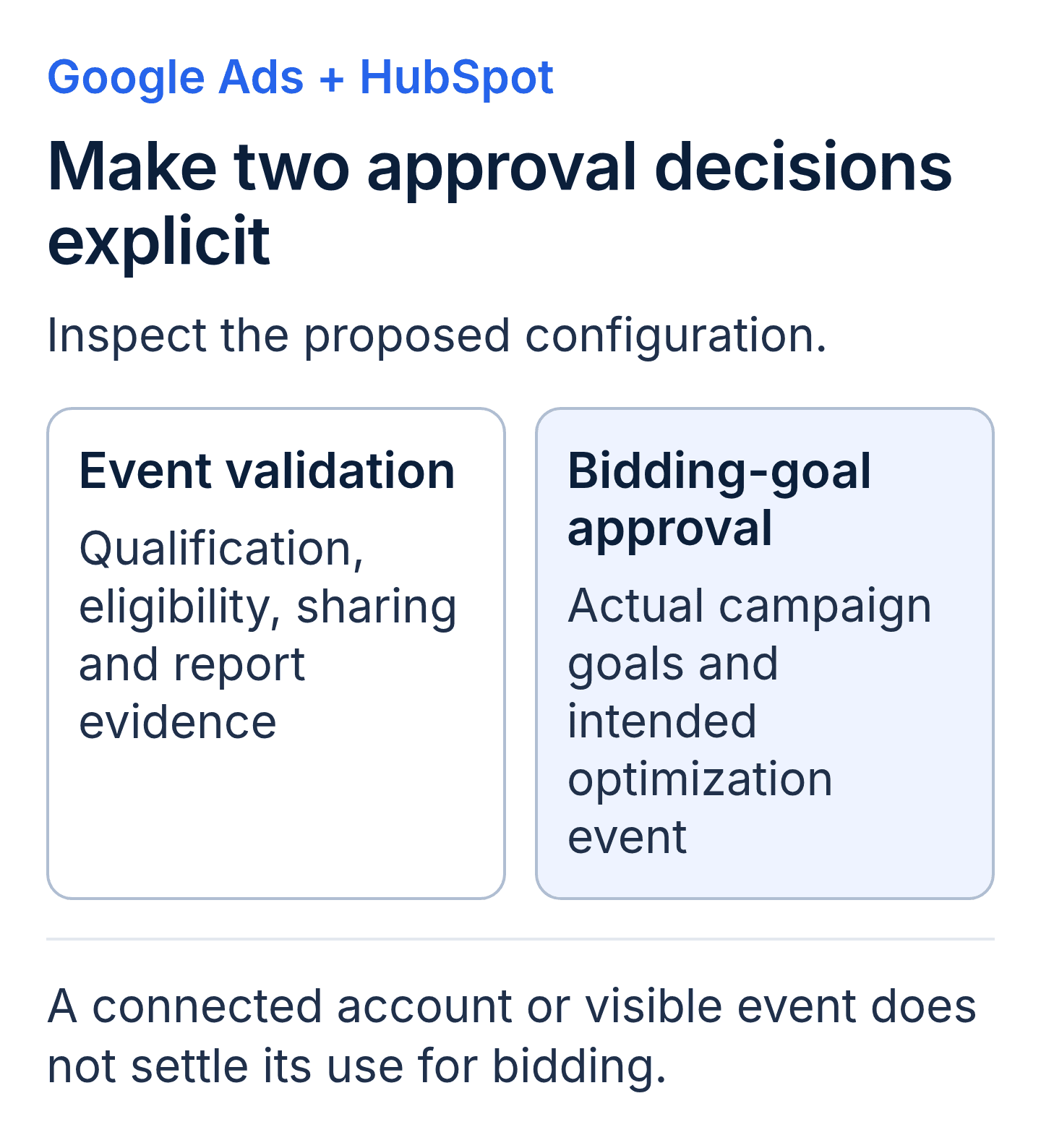
Keep event validation and bidding-goal approval distinct. Inspect the campaign settings and record the advertising owner’s decision before using an outcome for optimization.
Put HubSpot ads integration testing in the contract
Ask for a controlled test plan that covers expected behavior and important exceptions. Use an appropriate environment and approved records. Artificial test events should not contaminate production bidding or sales reporting.
- Qualifying change: Trace an approved example from its source property to the configured event and available downstream evidence.
- Non-qualifying record: Demonstrate that the selected population excludes a record outside the agreed rule.
- Missing matching data: Record the observed treatment and the documented limitation.
- Data-sharing restriction: Confirm that the configured handling follows the approved policy decision.
- Multiple stage changes: Review the intended events and guard against unintended optimization goals.
- Paused or failed connection: Show how the owner identifies the condition and decides what to do next.
For each case, retain the expected result, actual result, reviewer, and unresolved limitation. Distinguish a verified setting from a verified transfer and an attributed conversion. Some observations require processing time or eligible advertising interactions; document those dependencies.
Before handover, agree who maintains event definitions, monitors status, investigates discrepancies, and authorizes changes. Include a change log and a concise recovery procedure. If a lifecycle process changes, review the connected measurement before comparing performance across the change.
Glossary for the buying team
- CRM: Customer relationship management system, where contacts and sales activity are recorded.
- Lifecycle stage: A contact or company classification within the marketing and sales process.
- Deal stage: A position in a sales pipeline for a particular deal.
- MQL: Marketing-qualified lead, meeting the criteria agreed by marketing.
- SQL: Sales-qualified lead, meeting the criteria agreed by sales.
- GCLID: Google Click Identifier, used by supported Google Ads measurement methods.
- Conversion action: A defined activity tracked in Google Ads.
- Attribution: The method used to assign credit for an outcome to eligible interactions.
Buyer questions
Can we connect the accounts before agreeing on qualification?
Account connection can be a separate task, but qualified-lead reporting still needs a stable definition and recording process. Put those dependencies in the scope so connection completion is not mistaken for acceptance of the full measurement project.
Must every qualified lead have an associated deal?
Do not apply a blanket deal requirement to contact lifecycle events. Define the event you intend to track. If the project also measures deal revenue, specify its associations, values, and reporting requirements as additional work.
What should the implementation quote include?
Request discovery, access review, event definitions, configuration, controlled testing, reporting validation, documentation, and operating ownership. Identify website work, portal cleanup, subscriptions, and ongoing support separately so you can compare suppliers on the same scope.
Twelverays' paid search services provide a starting point for the advertising requirements. Contact Twelverays with your HubSpot lifecycle rules, connected accounts, and current reporting gaps to discuss the work needed.


