

Google Ads management cost is the price of the provider's agreed work, separate from the advertising you buy from Google. When reviewing Google Ads agency fees, compare fixed fees and percentage of ad spend pricing against the same deliverables. A lower quote becomes meaningful only when you know who will maintain campaigns, test measurement, implement changes and report qualified sales opportunities.
For a business-to-business (B2B) marketing team, start with the handoff between advertising and sales. A campaign can produce form submissions while leaving unanswered questions about lead quality, routing and revenue. Put that work into the proposal before comparing monthly totals.
Twelverays offers paid search services. Use the questions below to define the scope you need from a delivery partner and the evidence you will use to accept it.
What Google Ads management fees should explain
Ask each provider to divide the engagement into initial implementation, recurring management and separately commissioned projects. These categories show which costs continue and which depend on a specific deliverable.
Google's transparency requirements for third parties require management fees to be disclosed to new customers in writing before the first purchase and on customer invoices. Google also distinguishes its advertising charges from the provider's fees. This is a useful starting point for reviewing a quote, although it does not determine what the provider includes.
Request a written answer to three commercial questions:
- What work does the recurring fee purchase, and what evidence shows it was completed?
- Which implementation tasks must finish before the account can meet the agreed measurement requirements?
- Which charges can increase without a new statement of work or your approval?
A statement of work (SOW) describes the purchased deliverables, responsibilities, assumptions and acceptance conditions. Treat an unexplained phrase such as "full management" as a prompt for those details.
Compare PPC management pricing structures
Pay-per-click (PPC) management pricing can use several charging structures. Use the same account, markets and expected work when requesting alternatives. Otherwise, a fee comparison mixes different services.
| Fee structure | Basis of the charge | Proposal detail to request | Scope question |
|---|---|---|---|
| Fixed fee | An agreed amount for defined recurring work | Included accounts, campaigns, markets and review responsibilities | Which additions require a revised fee? |
| Percentage of spend | A stated percentage applied to a defined spend amount | The calculation base, minimums, thresholds and treatment of credits | Does extra spend change the work or only the charge? |
| Performance-linked fee | Payment linked to an agreed business event | Event definition, attribution period, exclusions and reconciliation process | Who resolves disputed or unqualified events? |
| Blended fee | A combination of the above | Separate calculations for each component | Can the same event or work item produce overlapping charges? |
For percentage-based terms, ask whether the base is actual platform spend, an authorized budget or another amount. Record how paused campaigns and a mid-period budget change affect the invoice. Do not assume a higher media budget automatically adds landing-page development or customer relationship management (CRM) integration.
For a performance-linked arrangement, define the payable event before discussing the rate. A form submission, a sales-accepted opportunity and a closed sale represent different work and different dependencies. Agree who records qualification, how duplicate inquiries are handled and when the parties reconcile disputed events.
The useful comparison is the total charge for a defined business situation, with the assumptions visible. No single fee structure answers the scope question by itself.
Build a like-for-like cost worksheet
Separate the agency fee from the complete cost of operating the account. Our explanation of what paid search advertising is covers the channel itself; this worksheet is for evaluating the purchase.
Fill the following rows with figures from each proposal. Blank amounts are intentional: these are buyer inputs, not suggested market rates.
| Cost line | Amount to obtain | Timing and boundary to record |
|---|---|---|
| Google advertising | Your approved media budget | Billing account, spend authority and budget-change approval |
| Management | The quoted fee or formula | Billing period, included work and minimum term |
| Initial setup or remediation | A defined project charge, if applicable | Deliverables, dependencies and acceptance before closeout |
| Tracking and CRM work | Included scope or separate quote | Systems, fields, tests and ongoing maintenance owner |
| Landing-page work | Included scope or separate quote | Recommendations, copy, design, build and deployment |
| Creative and tools | Each applicable charge | Usage rights, subscriptions, renewals and limits |
| Exit and transition | Contract terms or a defined allowance | Documentation, access changes and unfinished work |
For a United States or Canadian engagement, identify the currency on every quoted amount. Ask the provider to state applicable taxes, payment terms and any cross-currency billing assumptions. A dollar sign alone leaves the comparison incomplete.
Add internal responsibilities beside the cash costs. Someone must approve claims, supply source material, release website changes and maintain sales qualification records. Identify those people before accepting a timetable that depends on them.
Use one comparison period across proposals and show upfront payments separately. Record both the recurring commitment and the initial work required to make it usable. A proposal that excludes implementation needs a separate implementation estimate before you can approve the complete budget.
Price measurement and landing-page work explicitly
Conversion measurement is the process of recording a defined action and connecting it to the reporting used for decisions. For a B2B buyer, specify which action matters: a submitted form, a qualified inquiry, an accepted opportunity or a sale.
Ask who owns the route from the website to the CRM. The proposal should name the fields, record owner, lead-routing rules and test evidence. If it includes sending permitted conversion outcomes back to Google Ads, require a scoped design, the necessary approvals and a way to check that the records arrive as intended.
Use a controlled test inquiry to review the complete handoff. Confirm that the form reaches the correct destination, the sales team can identify it and the agreed reporting records the intended event. Keep test data distinguishable from actual demand. Require the provider to document any missing access or customer dependency that prevents completion.
Landing-page scope deserves its own line. A recommendation to shorten a form does not establish who will rewrite it, implement the change, approve it or check it after release. Separate copy, design, development and deployment responsibilities. Ask whether later changes to forms or CRM fields require additional maintenance.
This distinction matters when comparing cost per acquisition. A report needs a defined acquisition event and cost basis before two figures can be compared. Request both the calculation and the underlying record, with access appropriate to the people reviewing it.
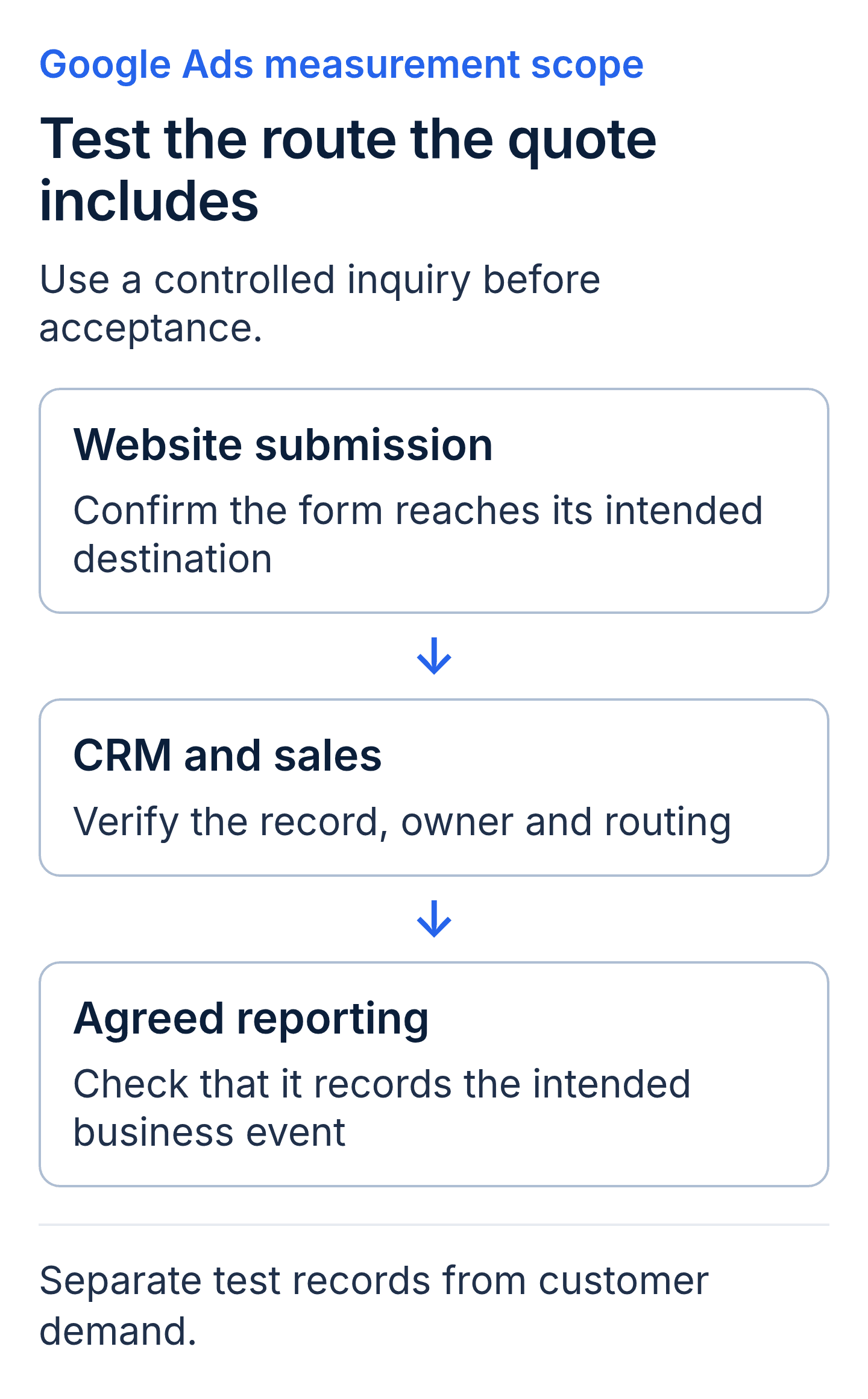
Use a controlled inquiry to inspect the website, CRM and reporting work in the quote. Record missing access or customer dependencies that prevent a check from being completed.
Make Google Ads management scope reviewable
Acceptance criteria are observable conditions used to decide whether a deliverable is complete. They help a marketing owner review work without prescribing every platform action.
| Work area | Evidence to request | Customer responsibility to name |
|---|---|---|
| Search-term and targeting review | Findings, proposed exclusions and the reason for material changes | Approval of brand, product and market boundaries |
| Spend oversight | Budget review and a record of approved changes | Named budget approver and escalation contact |
| Campaign changes | Change record with purpose and subsequent review | Timely approval where the contract requires it |
| Measurement | Test results and a list of unresolved discrepancies | Website, CRM and sales-team participation |
| Testing | Hypothesis, scope, review point and resulting decision | Approval of offers, claims and implementation |
| Reporting | Platform costs, service fees and agreed business outcomes | Consistent qualification definitions and feedback |
Agree a reporting cadence that fits the decision being made. A spend exception needs an escalation route; a longer sales cycle needs a clear reporting cutoff. Put both into the operating agreement without treating every report as evidence of immediate revenue impact.
Ask what changes the fee: additional markets, new product lines, more accounts, unusual approval requirements or urgent requests. Document the process for pricing and approving those changes. Keep unfinished implementation work visible rather than letting it disappear into an undefined recurring fee.
Agree spend authority and account access
Media spend is the amount charged for advertising delivery. Keep its authorization separate from approval of the agency's service invoice.
Google's budget guidance, checked in September 2026, explains that an average daily budget can produce different spending on individual days. Do not describe that setting as a guaranteed hard daily ceiling. Ask the provider to explain the limits applicable to your campaign setup and who monitors the agreed budget.
Record which changes require approval and how an urgent spend concern reaches the responsible person. Include the customer account identifier, billing arrangements and the people who retain administrative access.
Google's manager-account ownership documentation distinguishes manager ownership permissions from the client's ownership of its data and administrative rights. Review the actual access arrangement. Ask how the manager relationship will be removed and which other assets require their own handover.
Include reporting definitions, campaign documentation, creative rights and outstanding changes in the exit record. Account access alone does not answer every question about the material used to operate the campaigns.
Buyer glossary for reviewing the proposal
| Term | Meaning | Evidence to request |
|---|---|---|
| Management fee | Payment for the provider's agreed services | The fee calculation and included work |
| Media spend | Platform charges for advertising delivery | A separately identifiable Google charge |
| Conversion | The specific action counted for measurement | Event definition and a successful test |
| Attribution | The rule used to connect an outcome to marketing activity | Stated method, reporting period and limitations |
| Qualified lead | An inquiry that meets your agreed sales criteria | Qualification fields and a named decision owner |
| Acceptance criteria | Observable conditions for completing work | Test results or a reviewed deliverable |
Google Ads fee questions to settle before signing
Is ad spend included in the management fee?
Request separate amounts and billing responsibility in writing. If the provider presents one total, require the breakdown between Google charges and service fees. Check whether setup, tools and website work add further costs.
Does a percentage fee include tracking?
The percentage defines the calculation, not the deliverables. Tracking is included only to the extent described in the agreement. Ask whether the scope covers initial configuration, end-to-end testing, CRM feedback and maintenance after customer systems change.
Can an industry lead-cost benchmark tell me which quote is better?
It can help frame questions, but it does not establish comparable delivery scope or your definition of a qualified lead. Use average cost per lead by industry as background, then evaluate the proposal against your own funnel and measurement requirements.
What happens when the budget changes or the engagement ends?
Both should have written terms. For budget changes, specify the revised calculation and approval process. For exit, agree the notice period, access changes, final reporting, documentation and treatment of unfinished work before signing.
Key takeaways
- Compare Google advertising charges, management fees and implementation costs as separate lines.
- Match each fee structure to defined deliverables, exclusions and approval rules.
- Require measurement and landing-page responsibilities to include testable acceptance evidence.
- Record customer access, spend authority and exit deliverables before approving the engagement.
Bring the scope behind your quote
Bring your current spend, competing proposals, CRM milestones and known tracking gaps to a Twelverays conversation. Identify the internal owners for approvals, website changes and sales feedback. These inputs make the discussion specific enough to define an accountable engagement. Book a discovery call to discuss the delivery scope behind your Google Ads management cost.


