Before you touch a single bid or write a line of ad copy, you need to build a rock-solid foundation. This is a non-negotiable step. Time and again, campaigns fall flat not because of poor bidding or creative, but because they were built on a shaky, disorganized setup from the start.
Starting with a strategic audit and a clear, logical structure is the single most important part of optimizing a PPC campaign. Think of yourself as an architect before you become a painter, you must get the blueprint right first.
This foundational process is about diagnosing structural flaws, defining what success truly looks like for the business, and organizing everything for maximum relevance and control. Skipping this stage is like building a house on sand; it’s only a matter of time before it all comes crashing down.
This simple flow chart breaks it down into the three core pillars of a strong PPC foundation.
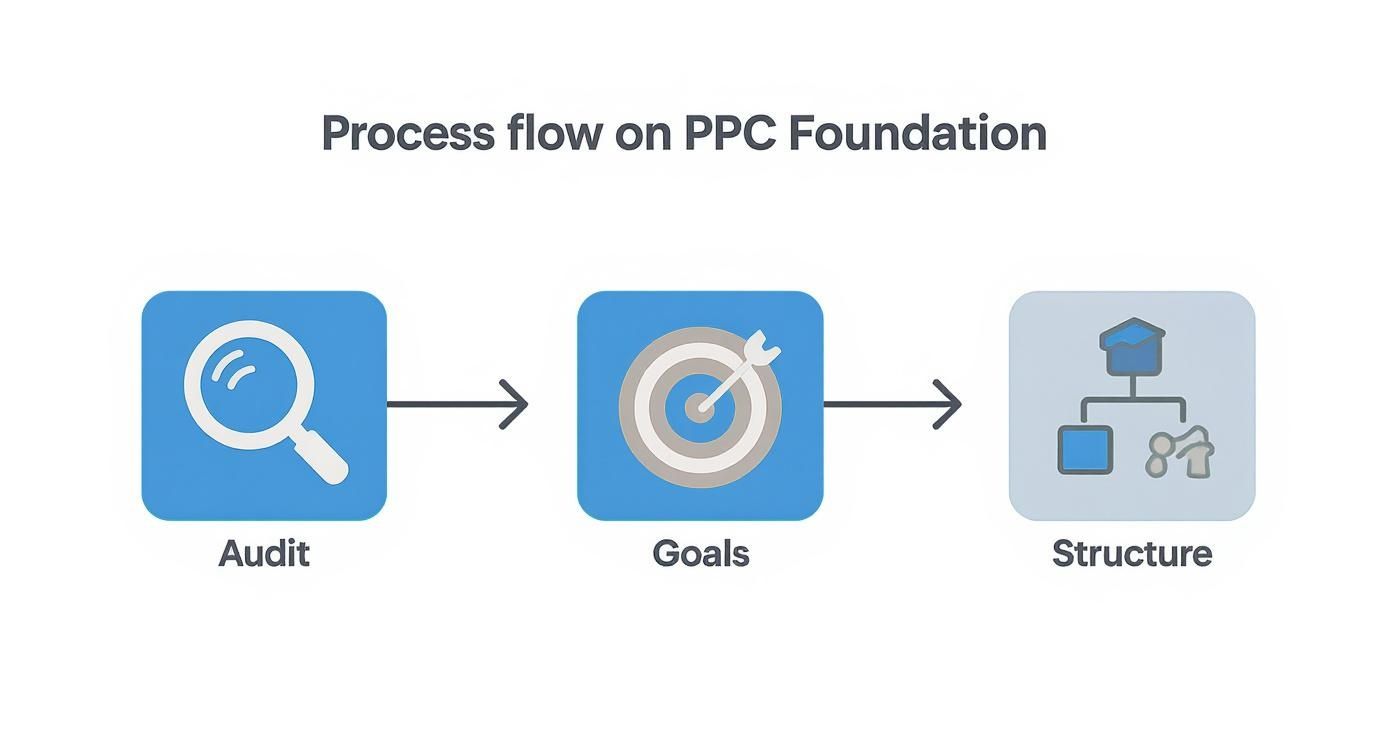
Following this sequence, Audit, Goals, Structure, ensures that each step logically informs the next, creating a stable and scalable framework that makes all future optimization efforts meaningful.
Conduct a Strategic Account Audit
The first move is always to look back before moving forward. A proper account audit isn't just about finding what's broken; it's about uncovering hidden opportunities and spotting historical performance patterns. Dive deep into your account's history to see where your budget has been working hard and where it's been wasted.
Keep an eye out for these key red flags:
- Low Quality Scores: Pinpoint any ad groups where Quality Scores are consistently below 5/10. This is a massive indicator of a disconnect between your keywords, ads, and landing pages.
- Wasted Spend on Search Terms: Scrutinize your search term reports. This is almost always the fastest way to find quick wins by adding new negative keywords and stopping budget bleed.
- Impression Share Lost to Budget or Rank: Identify campaigns that are constantly limited by budget or suffering from a low ad rank. This tells you exactly where you either need to invest more budget or drastically improve relevance.
This diagnostic phase gives you a clear baseline and, more importantly, a prioritized list of issues to address.
Define Business-Driven Goals and KPIs
Let’s be honest: clicks and impressions are vanity metrics. True optimization begins when you tie every campaign effort to tangible business outcomes. What does a "win" actually mean for your organization? Is it a qualified lead, a product sale, or a demo request?
Moving beyond surface-level metrics is crucial. Your goal isn't just to get more clicks; it's to drive revenue or acquire high-value customers. Every optimization decision should be measured against its contribution to these core business objectives.
Instead of chasing a high Click-Through Rate (CTR), shift your focus to metrics that directly impact the bottom line, such as:
- Cost Per Acquisition (CPA): How much does it cost to acquire one new customer?
- Return on Ad Spend (ROAS): For every dollar you invest in ads, how much revenue are you generating?
- Lead-to-Close Rate: What percentage of PPC-generated leads convert into paying customers?
Defining these KPIs from the outset ensures you're optimizing for profit, not just for traffic. If you're new to this, it's worth understanding the fundamentals of what paid search advertising is and how it works.
Design a Logical Account Structure
Your account structure dictates everything: your ability to control spend, measure performance, and optimize effectively. A well-organized structure aligns campaigns and ad groups directly with your business offerings and the customer's journey. It's the difference between a neat filing system and throwing all your documents into one giant box.
A common and highly effective approach is to structure campaigns by service or product line. Within each campaign, create tightly-themed ad groups where a small cluster of closely related keywords triggers specific, hyper-relevant ads.
For example, a campaign for "IT Consulting Services" might have separate ad groups for "cybersecurity consulting," "cloud migration services," and "network infrastructure support." This granularity improves your Quality Score, lowers your costs, and ensures the right message reaches the right person.
Mastering Keyword Intent and Bidding Strategy
Once your account structure is locked in, it's time to focus on the engine of your campaigns: keywords and bidding. This is where you control who sees your ads and what you’re willing to pay for a click. Effective optimization isn't just about finding keywords; it's about mastering user intent and pairing it with a smart bidding approach.
Getting this balance right has never been more critical. The average cost-per-click (CPC) across industries rose about 12% year-over-year to $2.96 in early 2026, putting pressure on campaign profitability. However, conversion rates have improved in 65% of industries, proving that meticulously optimized campaigns are winning. You can dig into the numbers yourself in this breakdown of current PPC analysis benchmarks.
Decoding Keyword Intent with Match Types
The secret to attracting traffic that converts lies in the nuance of keyword match types. Each one acts as a different filter, giving you precise control over how closely a search must match your keyword to trigger an ad.
- Broad Match: Use this as a discovery tool to cast a wide net and uncover new search terms. Be warned: it demands an aggressive negative keyword list to prevent burning cash on irrelevant clicks.
- Phrase Match: Your everyday workhorse. It strikes the sweet spot between reach and relevance, showing your ads on searches that carry the same meaning as your keyword.
- Exact Match: This is your scalpel. Reserve it for bottom-of-funnel, high-intent keywords where you’re confident a specific search will lead to a conversion. You'll get less volume, but the quality is typically top-tier.
A common mistake is to dump all keywords into one ad group with the same match type. Instead, segment them strategically. For instance, a campaign for "B2B CRM Software" could have a phrase match ad group for terms like "crm software for small business" and a separate exact match ad group targeting "[best b2b crm platform]". To delve deeper into this strategy, check out our guide on how to use keyword clusters.
A robust negative keyword list is your campaign's most powerful shield. Regularly review your search term report and proactively add irrelevant queries to prevent wasted ad spend before it accumulates. This simple, ongoing task is one of the highest-impact optimizations you can perform.
Choosing the Right Bidding Strategy
With your keywords dialed in, the next question is how you'll bid on them. Modern ad platforms like Google Ads offer a powerful suite of automated bidding strategies that use machine learning to optimize for your goals in real-time.
The right choice depends on your campaign objectives.
- For Lead Generation: When your goal is getting demo requests or form fills, Target CPA (Cost Per Acquisition) is often your best bet. You tell the platform what you’re willing to pay for one conversion, and the algorithm works to hit that number.
- For E-commerce or Sales: If you're tracking actual revenue, Target ROAS (Return On Ad Spend) is the way to go. This strategy focuses on maximizing the revenue value from your campaigns, aiming for a specific return on every dollar you spend.
Remember, these automated strategies are data-hungry. They need a steady stream of conversions, at least 30-50 per month per campaign, to perform optimally. Without sufficient data, the algorithm is flying blind, and your results will be inconsistent.
This is where manual bidding still has its place. For a brand-new campaign with no conversion history, or a niche campaign with very low volume, manual CPC puts you in the driver's seat. You set your own max bids and make adjustments based on your analysis, providing a stable foundation while you gather the data needed to switch to an automated strategy later.
Creating Ad Copy and Landing Pages That Convert
Getting a click is just the first step. The real win is turning that click into a customer, which is where your ad copy and landing page come in. Think of them as two halves of the same conversation. When they’re perfectly aligned, your campaigns don't just generate traffic, they drive business.
Your ad copy is the first handshake. Its job isn't just to get attention but to set the right expectations. You’re not trying to get every click; you want the right click from someone who is a good fit for your offer.
Write Ad Copy That Pre-Qualifies, Not Just Clicks
Good ad copy does more than list what you do. It must address a specific pain point and promise a clear solution, connecting the searcher's problem to your service.
Here’s a simple framework:
- Mirror Their Intent: If someone searches for "B2B cybersecurity consulting," your headline should say exactly that. It's an instant confirmation that they're in the right place.
- Focus on the Outcome: Instead of "We offer IT services," try "Protect Your Data with Expert Cybersecurity." It’s about the benefit they get, not the service you provide.
- Give a Clear Call-to-Action (CTA): Tell them precisely what to do next. "Get Your Free Quote," "Request a Demo," or "Download the Guide" are all direct and action-oriented.
A great ad makes a promise. A great landing page delivers on it. This crucial link is called message match, and it’s non-negotiable for high conversion rates.
The Power of Systematic A/B Testing
You’ll never know what works best until you test it. Systematic A/B testing involves running different ad variations simultaneously to see which one your audience responds to. The key is to be methodical, don't just test random elements.
Start with the components that make the biggest difference:
- Headlines: Pit a benefit-driven headline against a feature-focused one.
- Descriptions: Test social proof (e.g., "Trusted by 500+ Businesses") against a unique selling proposition (e.g., "24/7 Threat Monitoring").
- Calls-to-Action: Compare a low-commitment CTA like "Learn More" against a higher-commitment one like "Schedule a Consultation."
Let each test run long enough to gather meaningful data, a few hundred clicks or a couple of weeks, depending on your traffic. Once you have a clear winner, pause the loser, iterate on what worked, and launch a new test. This constant cycle of improvement is how you build a winning campaign over time.
Optimize the Landing Page Experience
Once someone clicks your ad, the landing page has one job: get them to convert. Every element on the page, from the headline to the form fields, should push them toward that goal. Eliminate distractions like navigation bars, unrelated links, or competing offers that can tank your conversion rate.
A high-converting landing page must have:
- Strong Message Match: The landing page headline should echo the promise made in your ad, immediately reassuring visitors.
- Persuasive Copy: Use clear, straightforward language that builds on the ad's benefits. Bullet points are great for making key advantages easy to scan.
- A Singular, Obvious CTA: Your conversion button should be impossible to miss, with clear text telling people what to do. Don’t make them hunt for it.
Today, mobile's influence in PPC optimization has grown substantially, with mobile devices now driving the majority of search ad impressions and about 63 to 65% of all PPC ad clicks in the U.S. This shift underscores the necessity for PPC campaigns to prioritize mobile-friendly ads and landing pages. In fact, dedicated PPC landing pages can significantly boost conversion rates, by about 65% compared to general website pages, highlighting the importance of tailored user experiences. You can discover more insights about these PPC statistics on digitalsilk.com.
This mobile-first reality means your pages must load fast and be simple to use on a small screen, with large fonts, easily tappable buttons, and short forms. For a much deeper look, check out our guide on how to optimize landing pages for better results. When you treat your ad copy and landing pages as a single, unified experience, you create a frictionless path from click to conversion.
Go Beyond Keywords with Advanced Targeting and Automation
If you're still relying solely on basic keywords, you're leaving money on the table. Modern PPC optimization is about reaching your ideal customer with surgical precision. This means layering advanced audience targeting with smart automation to shift from simply capturing existing demand to actively creating it.
When you nail this, you stop chasing clicks and start building relationships with the right people at the right time. Every dollar of your ad spend suddenly starts working a lot harder.
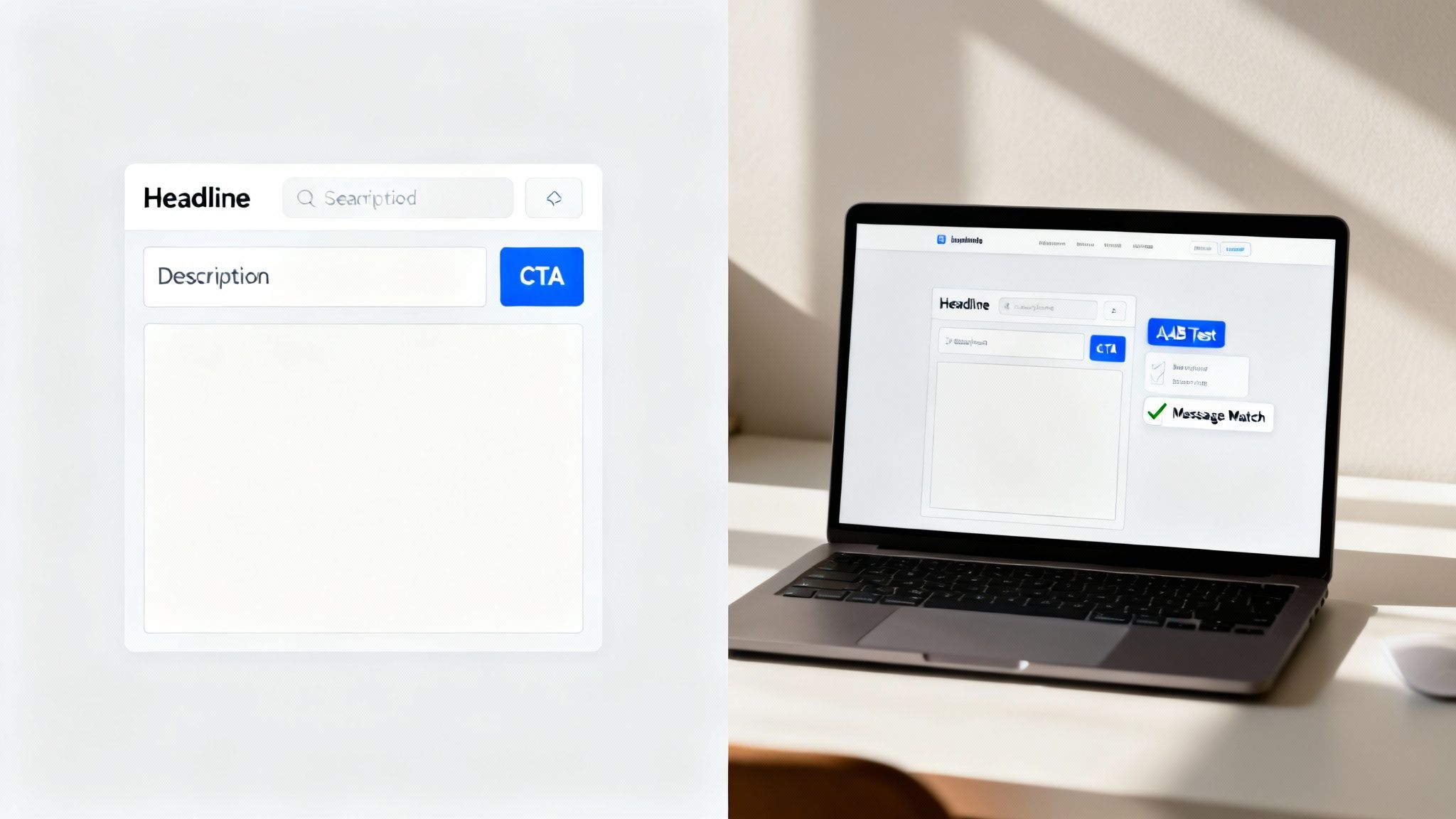
This kind of interface represents the new reality of PPC: combining compelling creative with sharp, data-driven audience signals. Today's ad platforms are built to connect your unique messaging with precisely defined user segments, all powered by AI.
Reach Your Ideal Customer with Audience Segmentation
Keywords tell you what a user is looking for, but audiences tell you who that user is. Layering audience signals onto your campaigns is one of the most powerful levers you can pull to improve performance. It lets you fine-tune bids and messaging based on a user’s behavior, interests, and history with your business.
Here are a few essential audience types to get you started:
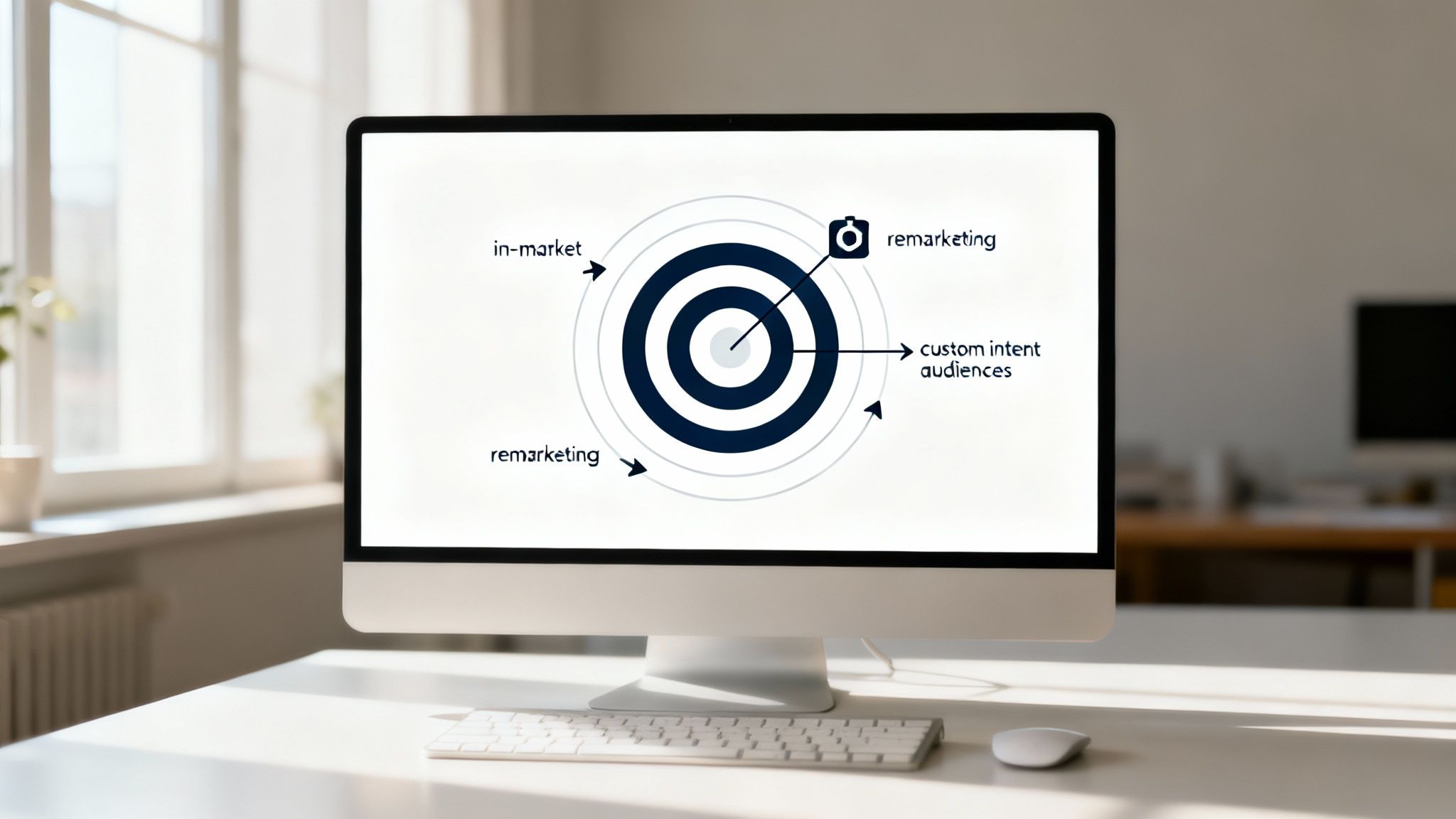
- In-Market Audiences: These are people Google has identified as actively researching products or services like yours. They're a prime target for your offers.
- Custom Segments: Build your own audience by telling Google which keywords, URLs, and apps your ideal customer engages with. The level of control here is incredible.
- Remarketing Lists for Search Ads (RLSA): This is non-negotiable. RLSA lets you serve different ads or bid more aggressively for users who've already visited your site. They're familiar with your brand and much more likely to convert.
By layering these audiences, you can build a far more sophisticated strategy. For instance, you could bid 25% higher for someone who is in the market for "B2B software solutions" and has previously visited your pricing page. This is the kind of precision that separates amateur campaigns from professional ones.
Make AI and Automation Your Strategic Partners
Automation isn't about setting and forgetting. It’s about empowering you, the strategist, to focus on what matters: high-level planning, creative testing, and scaling what works. Let the machines handle the repetitive, data-heavy lifting.
The rise of AI in campaign management has been a huge development. For example, the integration of AI in PPC, such as with Google's Demand Gen campaigns, has led to a 14% increase in conversions on average. And with 59% of PPC professionals now using large language models to write ad copy, these tools have become standard practice. You can discover more insights about these PPC statistics on coupler.io.
Here are two key areas where you can put automation to work right now.
Harnessing Performance Max and Demand Gen
Platforms like Google's Performance Max (PMax) have completely changed the game. They automate targeting, bidding, and ad creation across Google's entire network from a single campaign, using AI to find converting customers you’d likely miss with standard search alone.
Giving up manual control can feel daunting, but the key is to feed the machine high-quality inputs:
- Strong Creative Assets: Provide a rich mix of images, videos, headlines, and descriptions. The more assets PMax has, the more combinations it can test to find winners.
- Valuable Audience Signals: Guide the algorithm by providing your remarketing lists and custom audiences. This helps the AI find lookalike users much faster.
- Accurate Conversion Tracking: PMax is 100% goal-oriented. If your conversion data is messy, its performance will be, too. For a detailed guide, our Google Performance Max checklist to get you ready is a great resource.
Similarly, Demand Gen campaigns help you create awareness on visual platforms like YouTube, Discover, and Gmail, connecting with users before they even start searching.
Practical PPC Scripts for Everyday Tasks
For more granular control, PPC scripts are a game-changer. These small pieces of code run in the background of your Google Ads account to automate routine tasks, monitor performance, and alert you to problems.
Think of PPC scripts as your personal digital assistant. They can check for broken links, monitor Quality Score changes, or pause ads for out-of-stock products, saving you hours of manual work and preventing costly mistakes.
You don't need to be a developer to use them. Many pre-built scripts are available online that you can simply copy and paste. Setting up a script to email you a weekly report on campaigns with significant CPA changes can help you stay ahead of performance without having to live inside the ads platform 24/7. This blend of broad AI-driven campaigns and task-specific scripts gives you the best of both worlds: powerful reach and precise control.
Measuring Performance and Scaling Your Wins
You can craft brilliant campaigns with slick ads, but if you can’t accurately track what’s working, you’re just guessing. Effective optimization is impossible without solid measurement. This is where you connect every click and every dollar to real business outcomes, turning a mountain of data into a clear roadmap for growth.
The end game isn't just about running ads; it's about building a predictable, scalable system for customer acquisition. That process starts with flawless tracking and ends with a repeatable method for scaling your wins.
Setting Up Flawless Conversion Tracking
Your entire optimization strategy lives and dies by the quality of your conversion data. Inaccurate or incomplete tracking is the fastest way to make terrible decisions, like cutting a campaign that’s actually driving offline sales or scaling one that only brings in junk leads.
To get a true picture of your campaign’s impact, you have to go beyond just placing a pixel on your thank-you page.
Modern tracking requires a multi-layered approach:
- Enhanced Conversions: This lets you securely send hashed first-party data (like email addresses) from your website to Google. It's a lifesaver for filling in conversion gaps caused by browser restrictions, giving you a more complete view.
- Offline Conversion Imports: For many B2B or service businesses, this is non-negotiable. The most valuable actions, a signed contract, a deal marked "won" in a CRM, happen offline. Importing this data connects the final sale to the specific campaign, ad group, and keyword that started the conversation.
- Call Tracking: If phone calls are a key source of leads, dynamic number insertion is a must. This technology assigns a unique phone number to each user session, allowing you to trace every call back to its exact digital source.
These methods ensure you’re not just tracking leads but attributing actual revenue back to your ad spend.
Focus on Metrics That Drive Business Growth
With solid tracking in place, you can stop obsessing over vanity metrics and focus on the numbers that matter to the business. While CTR and CPC are useful for diagnosing issues, they don't tell you if your campaigns are profitable.
The KPI you should live by depends entirely on your business model:
Understanding your ROAS is especially critical for making smart budget decisions. If you need a refresher, we have an in-depth article that explains how to calculate Return on Ad Spend effectively. These are the metrics that get you buy-in from leadership and justify investing more in your PPC engine.
Building Reports That Tell a Clear Story
Data is useless if it doesn't lead to action. Your reports shouldn't be a data dump; they need to tell a story about what happened, why it happened, and what you’re going to do about it. Frame your analysis around key business questions.
Instead of just listing campaign performance, structure your report with insights like this:
- "Campaign X saw a 15% decrease in CPA last month after we rolled out new ad copy focused on our primary differentiator."
- "Our data shows RLSA audiences convert at a 40% higher rate than new visitors. This is a clear opportunity to increase bids for this segment."
This narrative approach turns a dry report into a strategic document that guides future decisions and proves the value of your work.
On average, businesses earn $2 in revenue for every $1 spent on PPC advertising, representing a 100% return on investment. Furthermore, conversion rates for PPC campaigns are approximately 50% higher than for organic search, demonstrating PPC's power to drive immediate action and deliver directly measurable results. You can discover more insights about these PPC statistics on coupler.io.
A Repeatable Process for Scaling Your Wins
Once you've found a profitable campaign, ad group, or targeting strategy, the final step is to scale it up without breaking what made it successful. Scaling isn't just about cranking up the budget; that’s a common mistake that can backfire. It requires a more methodical approach.
Here’s a simple framework for scaling intelligently:
- Increase Budgets Incrementally: Avoid drastic budget hikes. Bump up your daily budget by 15-20% at a time, then wait a few days to a week. Analyze the impact on CPA or ROAS before making another change. This prevents the platform's algorithm from re-entering a volatile "learning phase."
- Expand Targeting Strategically: If a campaign is performing well, look for logical ways to expand. Can you target a new geographic market? Can you use your best-performing custom audience as a seed for a new lookalike audience?
- Reinvest in Top Performers: Dig into your data and find the 20% of ads, keywords, or audiences driving 80% of your results. Double down on what's proven to work by giving these clear winners more budget and creative attention.
By following this measure-analyze-scale loop, you transform PPC optimization from a series of one-off tasks into a sustainable engine for business growth.
Got Questions About PPC Optimization? We've Got Answers
https://www.youtube.com/embed/3Yq0BbW3hxo
It's natural to have questions when you're deep in the weeds of pay-per-click advertising. To help, we've compiled answers to some of the most common questions from advertisers on how to optimize PPC campaigns.
How Often Should I Be Optimizing My PPC Campaigns?
There's no single magic number, but a rhythm of weekly and monthly check-ins strikes the right balance for most accounts, blending quick tactical tweaks with bigger-picture strategic moves.
- Weekly Check-ins: This is your time for fine-tuning. Dive into search term reports to find new negative keywords, monitor budget pacing, and watch for any major performance shifts like a sudden CTR drop or a CPA spike.
- Monthly Reviews: Think bigger picture. This is when you analyze performance trends, roll out new A/B tests for ad copy or landing pages, and make strategic decisions on bidding strategies or audience targeting.
What’s a Good Quality Score, and How Can I Improve It?
A Quality Score of 7/10 or higher is a good target. This score indicates a strong connection between your keywords, ads, and landing pages. If you're not there yet, focus on these three core areas:
- Ad Relevance: Your ad copy must directly reflect the intent behind the keywords in its ad group.
- Expected Click-Through Rate (CTR): Write compelling, benefit-driven copy that stands out on the results page and gives users a reason to click.
- Landing Page Experience: The page you send traffic to must be highly relevant to the ad, load quickly, and be easy to navigate, especially on mobile.
Improving these components not only boosts your Quality Score but almost always leads to lower costs and better ad placements.
Should I Stick with Manual Bidding or Switch to Automated?
For most advertisers today, automated bidding is the way to go. The machine learning behind platforms like Google Ads can process signals and adjust bids in real-time at a scale a human simply can't match.
Automated strategies like Target CPA or Target ROAS are incredibly effective, but they need data to learn. You’ll want a steady stream of at least 30-50 conversions per month for the algorithms to really hit their stride.
Manual bidding isn't obsolete, but its role has become very specific. It’s best suited for a brand-new campaign with no conversion history or for seasoned pros who need absolute control over a low-volume, high-stakes campaign.
Why Are My Conversion Rates So Different Across Ad Platforms?
It's completely normal to see performance vary widely between platforms. You're dealing with different audiences, user intents, and ad formats. Someone actively searching for a solution on Google is in a different mindset than someone scrolling through products on Amazon.
A one-size-fits-all approach doesn't work. For example, Amazon Ads convert at about 11.55%, roughly 8x the typical e-commerce rate of 1.33%. As you can discover in more PPC statistics on coupler.io, this highlights why tailoring your strategy to each platform is essential for success.
Ready to stop guessing and start growing? The experts at Twelverays build data-driven PPC strategies that deliver measurable results. Contact us today for a free consultation and discover how we can optimize your campaigns for maximum ROI.