Let's be clear: inbound marketing and content marketing aren't two separate disciplines. They are the engine and the fuel for modern B2B growth. Think of inbound as the strategic framework, the system for attracting, engaging, and delighting clients. Content marketing is the high-octane fuel that makes the entire machine run.
Why Inbound and Content Are Better Together
Many firms treat inbound strategy and content creation as separate functions, which is a significant mistake. They are two sides of the same coin, and fusing them creates a powerful, sustainable system for acquiring clients.
Inbound marketing answers the 'why' and the 'how', it's the strategy for pulling ideal customers toward you. Content marketing delivers the 'what', the valuable articles, guides, and videos that capture attention and build trust.
When this synergy is achieved, you move beyond simple "brand awareness." You build a predictable engine for generating high-quality leads, guiding them through often long and complex sales cycles, and ultimately, driving revenue. For professional services firms where expertise is paramount, this integrated approach isn't just beneficial; it's essential.

A Shift From Interruption to Attraction
Traditional marketing is built on interruption, cold calls, intrusive ads, and unsolicited emails. This "outbound" approach focuses on pushing a message onto people who likely aren't ready to listen.
The combined inbound and content marketing strategy flips that model. Instead of interrupting, you attract. You create helpful, relevant content that speaks directly to the problems, questions, and goals of your ideal client.
This attraction-based model is more efficient. HubSpot's research on inbound cost-per-lead put inbound at roughly 62% less per lead than outbound. That study is more than a decade old, so treat the exact figure as directional. The direction holds: content and search compound, cold outreach does not. For firms, this means reinvesting budget into assets that keep working, like content and SEO, instead of outreach that stops the moment you stop paying.
To give you a clearer picture of this strategic shift, here’s a breakdown of how these two approaches fundamentally differ.
Ultimately, inbound creates assets that work for you 24/7, while outbound efforts stop the moment you stop paying for them.
The core principle is simple: Be the answer your prospects are searching for. When a potential client has a problem, your content should be the first helpful resource they find. This builds immediate credibility and positions your firm as a trusted advisor, not just another vendor.
Building a Revenue-Focused Framework
A winning inbound program isn't just about creating content for its own sake. It demands a clear framework that ties every asset back to a business goal. This ensures your marketing is a measurable investment, not just an expense line.
This playbook is designed to walk you through building that exact framework, starting with a deep, obsessive understanding of your audience. You can see how this all comes together by checking out these powerful inbound marketing examples.
Here are the key pillars we'll build on:
- Audience-Centricity: Every blog post, whitepaper, or webinar must be rooted in the genuine pain points and ambitions of your ideal clients.
- Strategic Distribution: Great content is useless if no one sees it. It must be easily discoverable where your audience already spends their time.
- Seamless Nurturing: Once you capture a lead's interest, automated workflows must deliver the right information at the right time, guiding them toward a sales conversation.
- Data-Driven Optimization: We don't guess. You must constantly measure performance to see what’s working, what isn't, and where to double down for the best results.
Building Personas That Actually Drive Strategy
Every solid inbound marketing content marketing plan is built on a deep understanding of the audience. If your client personas are just a document of generic demographics and assumptions, they aren't just useless, they actively undermine your strategy.
To create content that genuinely connects and compels action, you must move beyond guesswork and build personas grounded in real-world data.
The best insights are often hiding in plain sight within your own company. Your CRM, whether it’s Salesforce or Dynamics 365, is a goldmine. Analyze the data from your best clients. What are the common threads in their industries, company sizes, and job titles? More importantly, what specific problems were they trying to solve right before they engaged with you? This data provides a rock-solid, fact-based foundation.
But CRM data only paints part of the picture. The real magic happens when you gather insights directly from the source: your clients and your sales team.

Uncovering Real Pains and Triggers
To truly understand your ideal client, you need to speak with them. Quantitative data gives you the "what," but qualitative insights, the stories and frustrations, provide the crucial "why." This is where you uncover the emotional drivers and day-to-day challenges that trigger a buying decision.
Start by interviewing your best, most successful clients. The key is not to ask about your services directly, but about their world.
Key Interview Questions to Ask:
- "Walk me through a typical day. What are your biggest frustrations?" This uncovers the daily pain points your content can solve.
- "What specific triggers made you realize you needed a solution like ours?" This helps pinpoint the exact moment of need.
- "What does success look like for you in your role over the next year?" This reveals their goals and aspirations, which you can align your content with.
Next, have frank conversations with your sales and customer service teams. They're on the front lines daily, hearing unfiltered objections, questions, and concerns from prospects and customers. For a structured approach, check out our guide on how to create effective buyer personas.
The goal isn't just to list pain points; it's to understand their context. A client's "pain" isn't just "inefficient processes." It's the frustration of working late, the fear of falling behind competitors, or the pressure from leadership to improve ROI.
Synthesizing Data into Actionable Personas
Once you’ve gathered this intelligence, it's time to synthesize it into a living persona that your team can use to guide content strategy. It's more effective to focus on one to three core personas that truly represent the bulk of your ideal clients than to create a dozen vague ones.
For each one, build a narrative that brings them to life.
This detailed profile transforms "Marketing Director Maria" from a vague concept into a relatable person. Now, when your team brainstorms content, you're no longer asking, "What should we write about?"
Instead, you’re asking, "What article would help Maria solve her biggest challenge this week?"
That shift is the key to creating content that doesn't just attract traffic, it builds trust and drives business growth.
Designing a Strategic Content Calendar
An idea without a solid plan is just a wish. This is where we get tactical and turn rich audience insights into a structured editorial calendar that drives results. A well-designed calendar is the essential bridge between your inbound marketing content marketing strategy and the consistent execution required to win.
The goal is to stop creating random, one-off content pieces. Instead, we’ll build topic clusters, tightly interlinked groups of content centered around a high-value subject. This model is excellent for SEO because it signals deep expertise in a specific area to search engines.
At the heart of every cluster is a pillar page: a definitive, comprehensive guide on a broad topic your ideal client persona cares about. From this pillar, you create several pieces of cluster content, like blog posts or videos, that explore specific subtopics. Crucially, each cluster piece links back to the pillar, creating a powerful internal linking structure that boosts your authority for the entire topic.
From Personas to Pillar Pages
Where do pillar page ideas come from? Go straight back to your persona research.
Look at the "Primary Goals" and "Key Challenges" you mapped out for your ideal clients. Those are goldmines for pillar page topics.
Let's take "Marketing Director Maria," whose biggest challenges are proving ROI and stretching a small team. Right away, we have some powerful pillar page ideas:
- The Complete Guide to Measuring B2B Marketing ROI
- How to Scale Content Production for Small Marketing Teams
- Building a Lead Nurturing Machine on a Shoestring Budget
These topics aren't just targeting a keyword; they're speaking directly to her professional anxieties and goals. This is the core of effective inbound marketing content marketing: solving real problems.
Once a pillar topic is locked in, you can start mapping out the supporting cluster content. For more detail on building the schedule, check out our guide on how to create a content calendar that drives results.
Mapping Content to the Buyer’s Journey
Not all content serves the same purpose. A prospect just realizing they have a problem needs something very different from a decision-maker actively comparing vendors. Mapping your content formats to the specific stages of the buyer's journey ensures you deliver the right message at the right time.
A common mistake is creating too much decision-stage content (like case studies) for an audience still in the awareness stage. You must earn their trust with educational content first before you try to sell.
Aligning your formats this way creates a seamless, logical path for your audience, guiding them from initial interest to a sales conversation. The table below provides a practical framework for matching content types to each stage for maximum impact.
Content Format to Buyer's Journey Alignment
This table offers a practical guide to matching the most effective content formats to each stage of the B2B buyer's journey. Using this alignment helps maximize engagement and guide prospects smoothly toward conversion.
By strategically deploying these formats, you meet your audience where they are, providing the exact information they need to move forward with confidence.
Prioritizing Your Content Production
Now you have a list of potential topics and formats, but you can't do it all at once. The final step is smart prioritization. You need a pragmatic way to focus your team's limited resources on the assets that will move the needle for your inbound marketing content marketing efforts.
A simple impact vs. effort matrix is perfect for this. Score each idea by asking two key questions:
- Potential Impact: How much value will this give our target persona? How likely is it to attract high-quality traffic and generate leads?
- Creation Effort: How much time, money, and expertise will this take to produce at a high standard?
Start with the high-impact, low-to-medium-effort items. These are your quick wins that build momentum. Save the high-impact, high-effort projects, like a comprehensive industry report, for your quarterly "big rock" initiatives. This strategic approach ensures you’re not just busy, but productive.
Mastering Content SEO and Distribution
Creating standout content is a massive achievement, but it's only half the battle. For your inbound marketing content marketing efforts to move the needle, people have to find what you've created. This is where you master the mechanics of modern SEO and build a smart, multi-channel distribution engine.
It all starts with a fundamental shift in how you approach keyword research. The old-school method of chasing the highest search volume is outdated. Today, it’s all about user intent: understanding the why behind a search.
What are they trying to accomplish? Are they looking for a high-level explanation (informational intent), weighing their options (commercial intent), or ready to hire someone (transactional intent)? Nailing this alignment is essential for ranking well and attracting clients, not just traffic.
The Modern SEO Optimization Checklist
Before any content goes live, it needs a thorough SEO check-up. This isn’t about stuffing keywords into every sentence; it’s about structure, clarity, and making your content helpful for both people and search engines.
Run every asset through this pre-publish checklist to give it the best possible shot at ranking:
- Strategic Keyword Placement: Is your main keyword woven naturally into the page title, URL, H1 tag, and the first paragraph?
- Compelling Meta Description: Does your meta description accurately summarize the value and entice someone to click?
- Clear Heading Structure: Are you using H2s and H3s to create a logical flow? This makes your content scannable for readers and easier for Google to understand.
- Optimized Images: Have you compressed large images to improve page speed? Have you added descriptive alt text for accessibility and context?
- Internal Linking: Are you linking to other relevant pages on your site? This spreads "link equity" and guides visitors to your most important content.
The single biggest on-page SEO mistake is forgetting the user. A fast-loading, mobile-friendly page with clean formatting will almost always outperform a slow, clunky page. Google rewards content that people actually stick around to read.
Building Your Distribution Engine
SEO is your long-term organic growth flywheel. But you can't just publish and pray for it to spin on its own. A proactive distribution strategy sparks initial momentum and amplifies your content's reach from day one. The goal is to get your content in front of the right audience on the platforms where they already spend their time.
Distribution isn't an afterthought; it needs to be part of your content plan from the start. For a deeper look at the process, you can learn more about building a complete SEO content strategy on our blog.
Here’s what a powerful, multi-channel approach looks like in practice:
- LinkedIn Amplification: For any B2B firm, LinkedIn is ground zero. Don't just share a link. Pull out a powerful statistic, a sharp quote, or a challenging question from your article to create a native post. Tag relevant people or companies to pull them into the conversation.
- Email Marketing Nurturing: Your email list is your most direct line to your audience. Segment your list and send new content only to the subscribers who will find it most relevant. Frame the email around the specific problem your content solves for them.
- Strategic Content Repurposing: This is the ultimate efficiency play. One major piece of content can be repurposed into a dozen smaller assets, extending its lifespan and reach without starting from scratch.
The Power of Repurposing
Let’s make this real. Imagine you just published a massive pillar page: "The Complete Guide to Measuring B2B Marketing ROI." Instead of moving to the next project, you can mine this one asset for weeks of content.
Here’s how that single guide gets atomized:
- Five Short Blog Posts: Break out each section into its own focused article (e.g., "5 KPIs Every B2B Marketer Should Track").
- A LinkedIn Carousel: Turn key stats and ideas into a simple, visual slide deck.
- An Email Mini-Course: Drip out one chapter of the guide via email each day for a week to nurture new leads.
- A Webinar or Video Script: The outline of your pillar page is a ready-made script for a live event or a series of short videos.
- Infographics and Checklists: Visualize the data or create a downloadable checklist from the actionable steps.
This "atomization" mindset is fundamental to a successful inbound marketing content marketing program. It respects your team's time and budget while ensuring your core message reaches the widest possible audience in their preferred format.
Connecting Content to Your CRM and Sales Pipeline
Great content gets you noticed, but traffic alone doesn't pay the bills. The real power of an inbound marketing content marketing strategy is turning anonymous visitors into qualified leads and, ultimately, clients. This is where you connect your content machine directly to your CRM and sales pipeline.
It starts the moment a visitor wants more. This is when your calls-to-action (CTAs) and landing pages become critical. A CTA isn't just a button; it's a clear invitation to get more value, and it must relate directly to the content they just consumed.
For example, after a post on "Choosing the Right Cloud Services Provider," a generic "Contact Us" button is a dead end. A far more powerful CTA would be "Download Our MSP Vendor Comparison Checklist." You're offering immediate, tangible value that moves them from passive reader to active prospect.
Designing High-Conversion Landing Pages
Once someone clicks a compelling CTA, they land on a page with one job: to convert them. A high-converting landing page is ruthlessly focused, stripped of all unnecessary navigation or competing links.
Every effective landing page includes:
- A Crystal-Clear Headline: It should echo the promise of the CTA, reassuring the visitor they’re in the right place.
- Concise, Benefit-Oriented Copy: Use bullet points to spell out the benefits. What problem will this download solve for them?
- A Simple, Frictionless Form: Only ask for what you need. For a top-of-funnel offer like a checklist, a name and email are sufficient.
View the form as a value exchange. They're trusting you with their contact details, so make it obvious that what you're providing in return is worthwhile.
Integrating with Dynamics 365 and Salesforce
Getting the lead is just the first step. What happens next is what separates successful content programs from the rest. A rock-solid integration with your CRM, like Dynamics 365 or Salesforce, is non-negotiable. Manually exporting leads is a surefire way to let opportunities slip through the cracks.
When a prospect fills out a form, that data should flow instantly into your CRM. This triggers the next critical phase: automated lead nurturing, ensuring every new contact gets the right message at the right time.
Here's a look at the entire content engine, from initial research all the way through distribution.
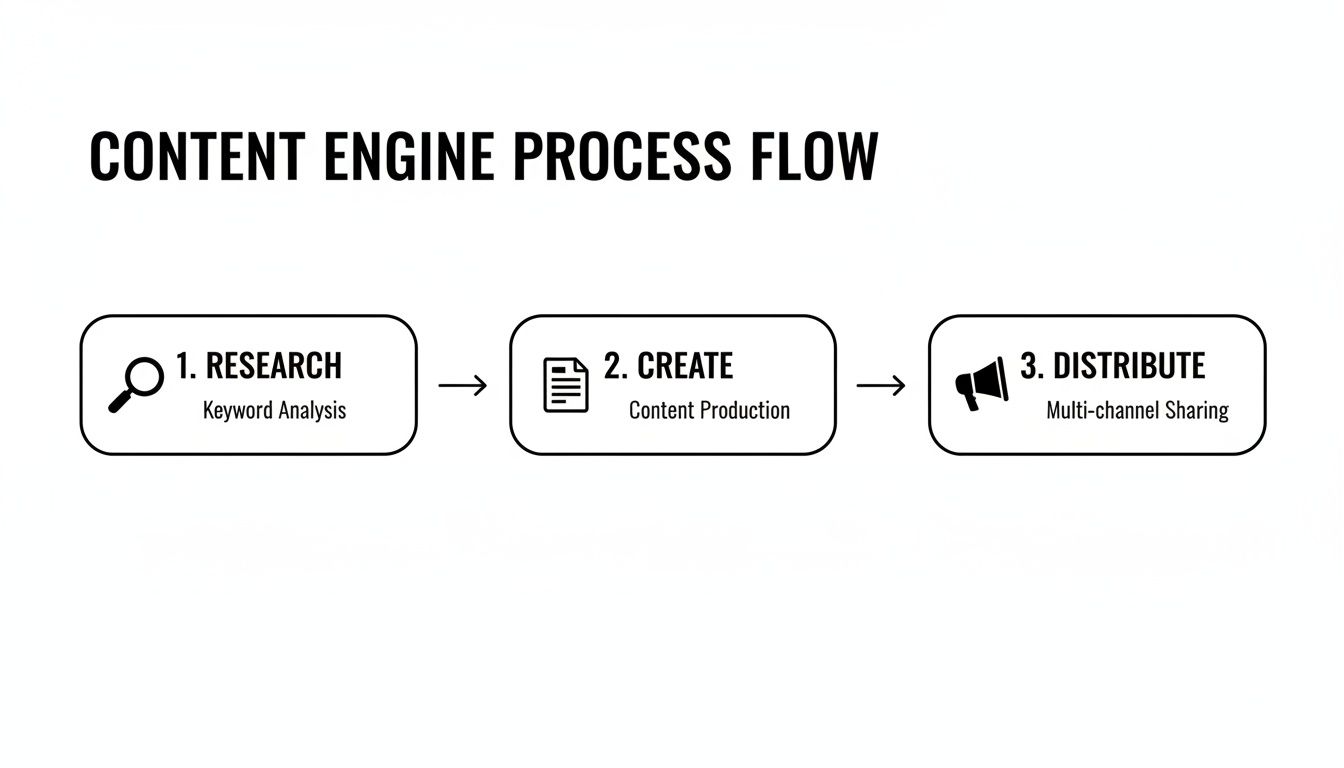
This systematic process ensures every piece of content has a clear purpose in moving leads down the pipeline.
Automating Nurturing Workflows
Inside your CRM, you can build automated email sequences, or "workflows," triggered by the specific content a lead downloaded. This isn't spam; it's a continuation of the conversation.
For example, the person who downloaded the "MSP Vendor Comparison Checklist" could be entered into a simple three-email sequence:
- Email 1 (Immediate): Delivers the checklist and links to a related blog post like "5 Common Mistakes to Avoid When Switching IT Providers."
- Email 2 (3 Days Later): Shares a case study of how you helped a similar company.
- Email 3 (7 Days Later): Offers a short, no-obligation consultation.
This automated, relevant follow-up works. The Annuitas Group found that nurtured leads make 47% larger purchases than non-nurtured leads, a long cited industry figure rather than a recent study, but the direction still holds. It’s a powerful way to build trust and stay top-of-mind.
The goal of nurturing is not to pester, but to provide relentless value. Each email should feel less like a sales pitch and more like helpful advice from a trusted expert.
Scoring Leads for Sales Handoff
Not all leads are created equal. Someone who grabbed one checklist is at a different stage than a prospect who has downloaded three whitepapers and visited your pricing page. This is where lead scoring comes in.
Within your CRM, you can assign point values to different actions:
- Downloaded a whitepaper: +10 points
- Visited the pricing page: +15 points
- Job title is "Director" or above: +20 points
- Company size is over 100 employees: +15 points
Once a lead hits a predetermined score (e.g., 100 points), the system automatically flags them as a Marketing Qualified Lead (MQL) and assigns them to a sales rep. This is a game-changer, ensuring your sales team invests their time on educated, engaged prospects.
The salesperson can see the entire history of the content that prospect consumed, allowing for a much more relevant and effective first call. This intelligence dramatically shortens the sales cycle. To dig deeper into this connection, you can read about how digital marketing and customer relationship management work together in our detailed article.
Measuring Performance and Proving ROI
Your inbound marketing content marketing is getting clicks and shares. That's great, but it's not enough. Sooner or later, leadership will ask the big question: what’s the ROI?
Forget vanity metrics like page views and social shares. To prove your content's business value, you must connect what you publish to what the C-suite cares about: pipeline, revenue, and customer acquisition cost.
This is about building a feedback loop where data drives every decision. The ultimate goal is to draw a clear line from the first blog post a prospect reads to the final, signed contract. It’s how you prove marketing is a profit center, not an expense.
Building Your Performance Dashboard
To prove ROI, you need a single source of truth. A unified dashboard is key, pulling data from your website analytics, marketing automation platform, and CRM, think Salesforce or Dynamics 365. This is where you connect marketing actions to sales outcomes.
Your dashboard shouldn't just be a wall of traffic stats. It needs to be built around the key conversion points in the buyer’s journey.
Here are the essential KPIs you need to be tracking:
- Traffic-to-Lead Conversion Rate: How well does your content convert readers into known leads? This metric puts your CTAs and landing pages under the microscope.
- Lead-to-MQL Rate: Are you attracting good leads? This tells you how many new contacts show real buying intent, proving your content is reaching the right audience.
- Content-Influenced Pipeline: What is the total dollar value of sales opportunities where a prospect engaged with your content before talking to sales? This is a massive leading indicator of future revenue.
- Content-Attributed Revenue: The bottom line. How much closed-won revenue can you trace directly back to your inbound content program? This is the number that gets you more budget.
The most powerful conversation you can have with leadership isn't about page views. It's walking into a meeting and saying, "Our content program influenced $1.2 million in new sales pipeline last quarter and directly sourced $350,000 in closed deals."
A Framework for Continuous Improvement
Once you have this data, the guesswork stops. You can start optimizing with surgical precision. This data-first approach creates a powerful cycle of continuous improvement where small tweaks compound into massive gains.
Let's say a blog post gets a ton of traffic but its traffic-to-lead conversion rate is flat. You’ve pinpointed a problem. Now, you can A/B test the CTA. Perhaps the offer isn't right, try swapping a generic guide for a tactical checklist. Test your button copy, color, and placement to see what moves the needle.
This same logic applies to your entire strategy. Identify your winners, the assets that consistently bring in high-quality leads, and double down on those topics and formats. Then, find the content that’s falling flat. Your options are to either overhaul it or stop investing in similar pieces.
This ruthless focus on what works is how you maximize your content ROI.
Got Questions? We’ve Got Answers.
Here are a few common questions we hear from clients when they're mapping out their inbound marketing plan.
How Long Does Inbound Marketing Take to Show Results?
This is the most common question, and the honest answer is: inbound is a long game, not a quick hack. With consistent effort, you can expect to see meaningful traction in qualified traffic and leads around the 3 to 6-month mark.
The real magic happens after that. Inbound marketing has a powerful compounding effect. Once your content library matures and search rankings solidify (usually after six months), many firms see their growth curve bend upwards dramatically.
What’s the Difference Between Inbound Marketing and Content Marketing?
It’s easy to confuse these two, but they are not the same. Think of it this way:
Content marketing is the act of creating the assets, the blog posts, whitepapers, videos, and case studies. It’s the valuable information you provide.
Inbound marketing is the entire strategic engine. It’s how you use that great content, plus SEO, social media, and email, to pull people toward your brand. Content is the fuel; inbound is the engine that turns that fuel into business momentum.
How Do I Measure the ROI of My Content?
To get a true read on your ROI, you must connect the dots between someone consuming your content and becoming a customer. This is about revenue, not vanity metrics.
Using your CRM and analytics tools is non-negotiable. You need to be able to attribute new leads and, eventually, customers back to the specific content they engaged with.
Specifically, you’ll want to track:
- The conversion rate from lead to customer for each content asset.
- The total pipeline value influenced by your content library.
- The final revenue generated from those leads, measured against your content creation and promotion costs.
Ready to stop guessing and start seeing real results from your content? Twelverays builds data-driven inbound programs that connect marketing efforts directly to revenue. Discover how we can help you grow.