

For an IT company, marketing is a different ballgame. It’s not about flashy ads or quick wins; it’s about strategically building trust, demonstrating expertise, and guiding clients through a long, often complex, sales cycle. A well-executed digital marketing strategy does more than fill a spreadsheet with leads, it creates a reliable pipeline of high-value clients who already see you as the authority.
Why Digital Marketing Is a Growth Engine for IT Companies

Let’s be honest: marketing for IT, tech, and SaaS companies comes with a unique set of hurdles. Your products are intricate, the sales process can drag on for months, and your buyers are sharp experts who demand solid proof, not clever promises. This is where old-school marketing tactics fall flat. They simply don't build the deep-seated trust needed to get a deal across the finish line.
This is precisely why a smart approach to digital marketing for IT companies isn’t just an expense, it’s a powerful engine for growth. It transforms marketing from a cost center into a measurable, revenue-driving machine. Instead of shouting into the void, you're building a system that attracts, educates, and nurtures the right decision-makers.
Moving Beyond Basic Lead Generation
The real goal isn't just a list of random contacts; it's a predictable pipeline of ideal clients. That requires a strategy covering every step of the buyer's journey, from the moment they realize they have a problem to the final handshake.
With a strong digital presence, you can:
- Establish Industry Authority: High-value content like technical whitepapers, deep-dive blog posts, and detailed case studies prove you know your stuff and become the resource people turn to.
- Shorten the Sales Cycle: By educating potential clients online, you’re answering their questions and handling objections before they ever speak with sales.
- Reach Decision-Makers Directly: Forget gatekeepers. Channels like LinkedIn ads and hyper-targeted search campaigns get your message straight to the CIOs, IT Directors, and other key players.
The secret to effective digital marketing for tech firms is alignment. Every marketing activity must tie directly to a business goal. You must use data to prove its value and steer every decision.
To help you get there, let's look at the core strategies we'll be covering. Think of these as the foundational pillars of a successful digital marketing program for any IT or tech firm.
Core Digital Marketing Pillars for IT and Tech Firms
This guide provides a complete framework to put these pillars into practice. We’ll walk through everything from building accurate buyer personas and picking the right channels to integrating it all with your CRM, whether it's Salesforce or Dynamics 365. This is how you build a marketing machine that delivers sustainable growth.
For an even deeper look, you can explore our detailed guide on marketing for tech companies, which offers more specific insights.
Defining Your Ideal Tech Buyer
Before you spend a single dollar on a campaign, you must know exactly who you're talking to. In the world of digital marketing for IT companies, generic labels like 'CIO' or 'IT Director' don't cut it. A title tells you a person's role, but it reveals nothing about their real-world frustrations, what drives their decisions, or what keeps them up at night.
Truly effective marketing starts with building a buyer persona: a detailed, semi-fictional profile of your perfect customer. This isn't just an academic exercise; it's the foundation for every piece of content you create, every ad you run, and every email you send. A well-crafted persona ensures your message lands with precision.
Moving Beyond Job Titles
To build a persona that feels like a real person, you need to get personal. Dig into the human side of your ideal buyer. What are their day-to-day responsibilities? What specific technical roadblocks are they hitting with their current systems? And most importantly, what personal or professional wins are they trying to achieve?
Getting these answers requires a mix of solid research and actual conversations. The most valuable insights almost always come from talking to your existing customers. Ask them about the problems they faced before they found you, why they chose your solution, and what the implementation process was really like. This feedback is gold for understanding the decision-making triggers of your future clients.
A great buyer persona doesn't just list demographics. It tells a story about a person's goals, frustrations, and the specific language they use to describe their problems. This allows you to create messaging that truly connects.
Uncovering Pains and Motivations
The goal is to bring your persona to life by answering specific, probing questions. You want to understand their world so intimately that you can anticipate their needs.
Here are the key areas you need to investigate:
- Primary Goals: What does "success" look like in their role? Are they measured on uptime, cost reduction, or team productivity?
- Biggest Challenges: What obstacles are in their way? This could be anything from clunky legacy system integrations to a lack of skilled people on their team.
- Information Sources: Where do they go for answers? Do they trust industry blogs, peer reviews on sites like G2, technical forums, or formal analyst reports?
- Decision Criteria: When evaluating a new tech solution, what matters most? Is it security and compliance, or are they focused on scalability, ease of use, or total cost of ownership?
A persona for a SaaS product targeting CTOs at fast-growing startups will have different pain points than one for a managed IT services provider targeting CFOs at established enterprises. The startup CTO is likely obsessed with rapid scalability and API integrations, while the enterprise CFO is more concerned with compliance, security, and predictable costs.
Understanding these distinctions is everything. For more guidance, check out our guide on how to create buyer personas for your business.
Building a High-Performance Marketing Channel Strategy

Once you have a crystal-clear picture of your ideal tech buyer, the next move is figuring out where to find them. The goal isn’t to be everywhere at once; it’s to show up in the right places with a message that solves a problem. For IT companies, this means building a channel strategy where every piece works together, guiding prospects from their first inkling of a problem all the way to a signed contract.
A high-performance strategy weaves search, content, and paid media into a single engine designed to attract, engage, and convert high-value accounts. Each channel plays a part, but their combined power is what drives predictable growth.
Technical SEO for Expert Audiences
Traditional SEO often chases broad, high-volume keywords. But for IT companies, the gold is in capturing highly specific, technical search queries. Your audience isn’t just Googling "IT solutions", they’re searching for answers to complex problems using precise language. This is where a specialized approach to SEO gives you a serious edge.
Your most valuable organic traffic will often land on technical documentation, API references, detailed tutorials, and deep-dive blog posts that dissect a niche problem. Optimizing these assets is non-negotiable.
Here’s how to do it:
- Keyword Research for Experts: Pinpoint the specific, long-tail keywords and questions that developers, engineers, and IT managers use. Think "how to integrate X with Y API" or "best practices for Z security protocol."
- Structured Data Implementation: Use schema markup to give search engines context about your technical content. This can earn you rich snippets in search results, like code samples or Q&A formats, which dramatically boost click-through rates.
- Internal Linking Strategy: Build a logical web of links connecting your high-level solution pages to your granular technical content. This passes authority and helps users and search engines navigate the full scope of your expertise.
A strong technical SEO foundation makes you visible at the exact moment a potential client is looking for a solution you provide. It’s about being the answer, not just another option.
For instance, a company selling a data migration tool should create and optimize content around specific error codes, database compatibility snags, and step-by-step migration guides. When a database admin searches for a fix to a niche error and your guide pops up, you’ve instantly built credibility.
Content Marketing That Drives Decisions
Content is the fuel for your entire marketing engine. This is especially true in B2B tech, where decisions are built on a foundation of logic and proof. The goal isn't just to pull in an audience; it's to arm your ideal buyers with the information they need to justify a purchase to their team and leadership. This is where content becomes a powerful sales tool, particularly for Account-Based Marketing (ABM).
While blog posts are great for top-of-funnel awareness, you need heavier-hitting assets to move accounts down the pipeline. These high-value pieces become the cornerstones of your lead nurturing and ABM campaigns.
Your content arsenal should include:
- Whitepapers and Ebooks: These let you go deep on a complex topic, showcasing your company's expertise. They're perfect for capturing leads from decision-makers in the research phase.
- Case Studies: Nothing builds trust faster than proof. Detailed case studies that lay out a specific customer's challenge, your solution, and the measurable results are arguably your most potent content for late-stage prospects.
- Webinars and Demos: Interactive formats give you a platform to show your solution's capabilities in real time. You can answer specific questions from a qualified audience, speeding up the sales cycle.
Of course, you have to adapt to what's happening now. About 86% of SEO teams now use AI in their workflow, and sites that lean on AI-assisted content report roughly 30% more organic traffic inside six months. Blogging stays a core channel: about 80% of businesses still run a blog. Match the depth of each piece to the buyer's stage, with short explainers for the first click and long technical pieces to earn the shortlist. On top of that, with mobile devices accounting for about 62% of global web traffic, a flawless mobile experience is table stakes.
Strategic Paid Media for Precision Targeting
Organic channels build long-term authority, but paid media gives you immediate, targeted visibility. For IT companies with long sales cycles and high-value clients, the precision of platforms like LinkedIn and Google Ads is indispensable. The goal isn't to cast a wide net; it's to perform surgical strikes, reaching the exact decision-makers within your target accounts.
LinkedIn Ads, in particular, are a powerhouse for B2B tech. You can target users by their company, job title, industry, and seniority level. This means you can put a cybersecurity case study right in front of CISOs at Fortune 500 financial firms.
Advanced paid media tactics for IT companies include:
- Account-Based Advertising: Upload a list of your target companies and serve ads exclusively to employees at those organizations.
- Retargeting: Re-engage website visitors who checked out specific pages (like pricing or technical docs) with ads that speak directly to their interests.
- Google Ads for High-Intent Keywords: Bid on specific, bottom-of-the-funnel keywords that signal a user is ready to buy, like "Salesforce integration partner" or "managed cloud services pricing."
When you combine these channels, you create a seamless journey. A prospect might first find you through an optimized technical blog post (SEO), download a whitepaper (Content), and then see a targeted case study ad on LinkedIn (Paid Media). Each touchpoint reinforces your expertise and nudges them closer to a conversation. For a closer look at integrating these efforts, check out our guide on multi-channel marketing strategies.
Using CRM Integration for Smarter Marketing

Your marketing campaigns generate massive amounts of data. But what good is that information if it’s locked away in different systems, completely disconnected from your sales team? Running marketing without a direct line to your sales data is like trying to build a puzzle with pieces from five different boxes. You might get a glimpse of the picture, but you’ll never see the whole thing.
This is why integrating your marketing platforms with a CRM like Salesforce or Dynamics 365 isn't just a "nice-to-have", it's a foundational requirement for any serious digital marketing for IT companies. It demolishes the walls between marketing and sales, creating a unified view of the entire customer journey. When these systems communicate, you stop guessing and start making data-backed decisions that grow revenue.
This isn't just a technical task; it's a strategic one. The digital marketing software market is set to explode from USD 121.71 billion in 2026 to USD 248.29 billion by 2031. Cloud-based solutions are leading the charge, holding 69.47% of the market in 2025, signaling a massive industry-wide move toward connected, data-driven systems. You can discover more insights about the digital marketing software market from this report to see where things are headed.
Creating a Single Source of Truth
The point of CRM integration is to build a single source of truth for every lead and customer. When a prospect engages with your marketing, clicks an ad, downloads a whitepaper, watches a webinar, that activity should appear instantly in the CRM for your sales team to see. This creates a seamless handover and gives salespeople the context they need for smarter conversations.
Imagine a sales rep prepping for a call. Without integration, they see a name and an email. With integration, they see the whole story.
Key data points to sync include:
- Lead Source: Did they find you through a specific Google Ads campaign, a technical blog post, or a webinar?
- Website Behavior: Which pages did they visit? Did they linger on the pricing page or read a case study?
- Content Downloads: Did they grab your whitepaper on cybersecurity or the ebook on cloud migration?
This turns a cold call into a warm, informed conversation. The salesperson already knows the prospect's potential pain points before picking up the phone.
By arming your sales team with marketing intelligence directly in their CRM, you shorten the sales cycle. They spend less time asking basic qualifying questions and more time addressing specific challenges.
The Feedback Loop for Campaign Refinement
CRM integration isn't a one-way street. It doesn't just push marketing data to sales; it pulls sales outcomes back to marketing. This feedback loop is the magic ingredient for measuring what truly matters and calculating the real return on investment (ROI) of your campaigns.
When a deal is marked "Closed-Won" in Salesforce, that information can be sent back to your marketing analytics platforms. Suddenly, you can see which channels, campaigns, and even specific blog posts are generating the most revenue, not just the most leads.
This data-driven feedback loop empowers you to:
- Refine Lead Scoring: Give higher scores to leads who interact with content that historically leads to closed deals, ensuring sales focuses on the hottest opportunities.
- Optimize Ad Spend: See which ads are driving actual revenue? You can now confidently double down on what works and kill what doesn't.
- Prove Marketing's Value: Ditch vanity metrics and walk into the boardroom with a clear report showing exactly how much revenue marketing influenced.
Ultimately, integrating your marketing with a CRM turns a cost center into a growth engine. It closes the loop between spending and earning, giving you the clarity needed to scale effectively. If you want to dig deeper into the mechanics, check out our article on what is CRM integration.
Measuring Marketing Success with the Right KPIs
In IT marketing, it’s easy to drown in data. Clicks, impressions, and social media likes might look great on a weekly report, but they don’t pay the bills. These are vanity metrics. They feel good to look at but have no real connection to revenue.
To prove your marketing is working, you need to focus on Key Performance Indicators (KPIs) that tell a clear story about business growth. It's about building a framework that gets the C-suite's attention, one that moves beyond surface-level activity and measures what truly hits the bottom line. From the first touchpoint to long-term loyalty, this is how you justify budgets and steer your strategy with hard data.
Focusing on Full-Funnel Metrics
A common pitfall is measuring only one piece of the puzzle. A successful marketing program for an IT firm needs to track metrics across the entire customer journey, top, middle, and bottom, to get the complete picture.
Top-Funnel KPIs (Awareness): This is about attracting the right audience. Forget just counting website visits. Instead, focus on organic traffic from target keywords and the number of new user sessions. These metrics tell you if your SEO and content are reaching qualified prospects.
Mid-Funnel KPIs (Consideration): Once you have their attention, you need to know if they’re interested. Track metrics like Marketing Qualified Leads (MQLs), content download rates for your whitepapers or case studies, and your cost per lead (CPL). These numbers show whether your content is compelling enough to turn an anonymous visitor into an identifiable contact.
Bottom-Funnel KPIs (Decision): This is where marketing’s impact on revenue becomes undeniable. The most critical metrics live here: Customer Acquisition Cost (CAC), Customer Lifetime Value (CLV), and marketing-influenced revenue. These KPIs draw a straight line from your campaigns to closed deals, providing undeniable proof of your ROI.
Justifying Spend with Business-Oriented KPIs
Let’s face it: executives want to see how marketing dollars translate into financial results. This is more critical than ever as investment in paid media ramps up.
The global social media ad market is set to jump by 12% in 2025, while digital video ad spend is projected to climb 14% to $72.4 billion. This spend makes sense when you consider that 76% of social users say content influences what they buy. But with marketing budgets hovering at just 7.8% of company revenue and 84% of CMOs struggling with strategy, the pressure to prove every dollar's worth is immense. You can read the full analysis on 2025 marketing spend and trends to get a sense of the stakes.
A well-designed marketing dashboard doesn't just report numbers; it provides insights. It should clearly show the relationship between ad spend in a channel like LinkedIn and the pipeline generated from that specific investment.
To achieve that level of clarity, your team must track the metrics that resonate with business leaders.
A perfect example is your CLV to CAC ratio. A healthy ratio, often cited as 3:1, is a powerful statement. It demonstrates that the customers you're bringing in are worth significantly more than what you spent to acquire them. This single metric can justify a budget increase far more effectively than a report showing thousands of clicks.
Ultimately, measuring success is about shifting the conversation from "what did we do?" to "what did we achieve?" By adopting a KPI framework focused on business outcomes, you can confidently show that marketing isn't a cost center, it's a primary driver of growth. For a closer look at specific metrics you can use, feel free to explore these marketing KPI examples.
Your Digital Marketing Implementation Roadmap
A great strategy is one thing, but turning it into tangible results is another. A successful digital marketing program for IT companies doesn't spring to life overnight; it’s built methodically. This roadmap breaks down everything we've discussed into a practical timeline, helping you shift from planning to execution.
Think of this as your blueprint for sustainable growth, moving logically from building awareness to driving bottom-funnel conversions.
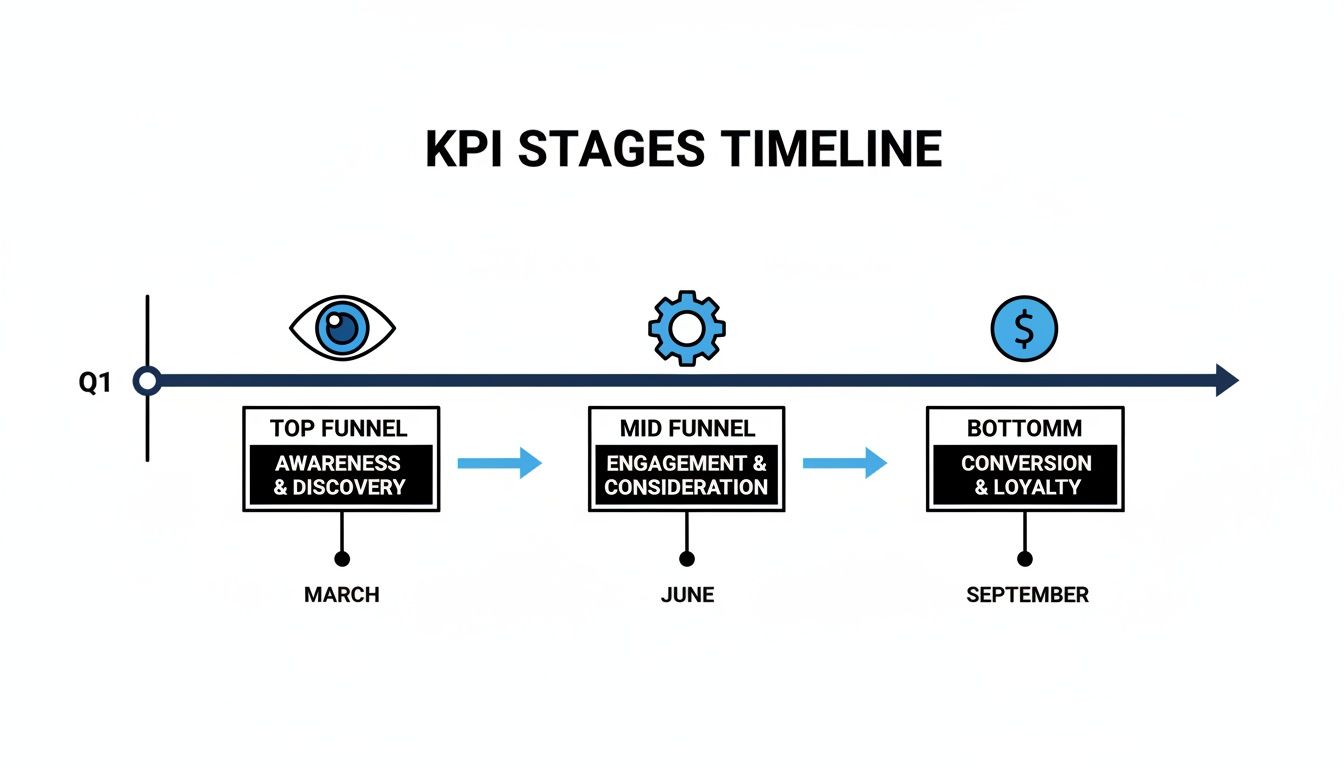
This visual timeline shows how your marketing efforts, and the KPIs you use to measure them, will evolve, starting with top-of-funnel brand building and progressing toward revenue impact.
Phase 1: Foundational Setup (Months 1-3)
The first few months are about building a rock-solid foundation. Skipping these steps is like building a skyscraper on sand; your campaigns will eventually collapse. The goal here isn't speed, it's clarity and technical readiness.
Your main goals for this phase are:
- Develop Buyer Personas: Talk to your best clients and your sales team to create detailed profiles of your ideal tech buyer. Go beyond job titles to uncover their pain points, motivations, and decision-making criteria.
- Conduct a Technical SEO Audit: Your website is your digital storefront. A comprehensive audit will uncover critical issues holding you back, like indexing errors, slow page speeds, or incorrect schema markup, ensuring search engines can find and rank your content.
- Set Up Analytics and Reporting: Establish your KPI framework. Configure your analytics tools and build a dashboard that tracks top, middle, and bottom-funnel metrics that tie directly to your business goals.
The foundational phase isn't about generating a flood of leads right away. It's about ensuring that when you launch campaigns, you're aiming at the right people, your website is technically sound, and you can measure every outcome.
Phase 2: Campaign Launch and Optimization (Months 4-9)
With your foundation in place, it's go-time. This is when you activate your channels and start building momentum. The focus shifts to creating valuable content and launching targeted campaigns that attract and engage your ideal buyers.
Key milestones for Phase 2 include:
- Content Creation Engine: Consistently produce high-value content that speaks directly to your personas, such as technical blog posts, in-depth whitepapers, and persuasive case studies.
- Initial Paid Media Execution: Launch your first targeted campaigns on LinkedIn and Google Ads. Aim to reach specific decision-makers at your target accounts with messaging that addresses their defined pain points.
- CRM Data Integration: Ensure every lead from your marketing channels flows cleanly into your CRM, giving your sales team the context they need for meaningful follow-up conversations.
Phase 3: Scaling for Growth (Months 10+)
By this point, you should have a steady stream of data telling you what’s working. This final phase is about using those insights to double down on your winners, expand your reach, and implement more sophisticated automation to work smarter.
Here's what you'll be focused on:
- Analyze and Reallocate Budget: Use your KPI dashboard to find your highest-performing channels and campaigns. Shift your budget to maximize your return on investment and cut what isn't delivering.
- Explore New Channels: Your data and audience insights might point you toward new opportunities. Now is the time to test other channels or content formats, like hosting webinars or investing in video marketing.
- Implement Advanced Automation: Build out lead nurturing sequences and marketing automation workflows. This will help guide prospects through their buying journey at scale, freeing up your team to focus on more strategic initiatives.
Frequently Asked Questions
When it comes to digital marketing for IT companies, a few key questions always surface. Leaders wrestle with how to budget, allocate resources, and, most importantly, prove that their marketing efforts are moving the needle. It's one thing to be busy with marketing activities; it's another to translate that into tangible business results.
Let's tackle some of the most common hurdles with straightforward, expert answers. These insights are designed to bring clarity to the big decisions that can either accelerate your growth or hold you back.
How Do I Prove Marketing ROI to Executives?
The secret is to speak their language: revenue. Forget about clicks and vanity metrics. The C-suite wants to know how marketing investments impact the bottom line.
Your job is to build a dashboard that draws a straight line from marketing activities to sales outcomes. Focus on metrics that tell a clear financial story:
- Customer Acquisition Cost (CAC): Show exactly what it costs to land a new client through each marketing channel.
- Customer Lifetime Value (CLV): Demonstrate the long-term value of the customers marketing brings in. A healthy CLV to CAC ratio (ideally 3:1 or higher) is irrefutable proof of profitable marketing.
- Marketing-Influenced Revenue: Dig into your CRM data to track every deal that had a marketing touchpoint. This proves how your team is directly feeding the sales pipeline.
When you frame marketing performance in terms of cost, value, and revenue, you shift the conversation from an expense review to a strategic discussion about growth.
What Is a Realistic Digital Marketing Budget for an IT Company?
There's no magic number. Your budget depends on your growth ambitions, market competitiveness, and business stage. That said, a solid benchmark for B2B companies is to allocate between 5% and 10% of total revenue to marketing.
A startup trying to carve out market share might push that closer to 15%, while a more established firm could comfortably invest around 7-8%.
Think of your budget as a fluid resource. Start with a plan that aligns with your channel strategy, perhaps dedicating funds to technical SEO, content for an ABM push, and targeted LinkedIn campaigns. From there, monitor your KPI dashboard and be ready to move money to the channels delivering the best return.
Should We Handle Marketing In-House or Outsource to an Agency?
This decision comes down to your internal expertise, resources, and goals. Both models have their perks, and many successful companies land on a hybrid approach.
- In-House Team: This works best if you have a deep, nuanced understanding of your niche and need day-to-day control. It builds incredible internal alignment but comes with the significant cost of salaries, training, and a full marketing tech stack.
- Outsourcing to an Agency: This is the fast track to specialized expertise. Need top-tier technical SEO, a paid media wizard, and a CRM integration pro? An agency provides all of that without the overhead of full-time hires. A good partner also brings a wealth of industry experience and battle-tested processes.
- Hybrid Model: For many, this is the sweet spot. An internal marketing director or manager works in lockstep with a specialized agency. You get the best of both worlds: deep internal product knowledge combined with external strategic firepower and execution muscle.
Ultimately, it boils down to one question: can you effectively execute a complex, multi-channel strategy? If you lack the bandwidth or specific skills in-house, partnering with an expert agency can get you measurable results much faster.
Ready to build a marketing engine that drives real growth for your IT company? At Twelverays, we specialize in data-driven digital marketing and CRM solutions that deliver measurable results. Schedule a consultation with us today to see how we can help you achieve your business goals.


