

Staring at a blank page before a major campaign costs you momentum. This is precisely why a solid marketing campaign planning template isn't just a helpful document; it’s your single most valuable asset for turning ambitious ideas into a predictable engine for growth.
A well-structured template ensures every action you take is intentional, measurable, and directly tied to tangible business outcomes.
Why a Strategic Blueprint Is Non-Negotiable

Without a formal plan, marketing efforts can easily dissolve into a jumble of disconnected tactics. A well-designed template, on the other hand, forces the crucial conversations that must happen before a single dollar is spent. It’s more than a document; it’s a strategic tool that helps secure buy-in, justify your budget, and draw a straight line from activity to business impact.
This structured approach is essential in modern marketing, where accountability is paramount. Stakeholders are no longer impressed by vanity metrics. They want to see exactly how marketing investments generate leads, build the sales pipeline, and ultimately, drive revenue.
Fostering Alignment Across Teams
One of the most significant benefits a campaign plan delivers is its power to align different departments. Silos begin to crumble when marketing, sales, and product teams all work from the same playbook. The sales team understands the campaign’s core message and target audience, equipping them for more effective conversations with the high-quality leads marketing delivers.
This simple act of sharing a plan helps sidestep common pitfalls, such as:
- Sales being unprepared for a sudden influx of new leads.
- Marketing creating content that misses the specific pain points sales hears about daily.
- Customers receiving confusing or conflicting messages from different parts of the company.
Ultimately, a shared plan gets everyone rowing in the same direction. This creates a seamless, powerful customer experience that turns prospects into advocates and separates high-performing campaigns from disjointed efforts.
A marketing campaign plan is more than a checklist; it's a communication device. It tells everyone involved, from the C-suite to the content creator, what success looks like and how their specific role contributes to achieving it.
From Reactive Tactics to Proactive Strategy
Many marketing teams fall into a reactive cycle, constantly putting out fires or chasing new trends without a clear "why." A campaign planning template flips that dynamic. It fosters a proactive, data-driven mindset where every channel, message, and tactic is chosen for a specific, strategic reason. For deeper insights on this topic, exploring the benefits of data-driven marketing can provide valuable context.
This strategic foundation also makes your campaigns far more agile. With clearly defined goals and KPIs, you can quickly see what’s working and what isn't, empowering you to pivot and reallocate resources intelligently. Instead of guessing why a campaign fell flat, you have a framework to diagnose the problem and optimize for better results. This methodical process is what transforms your marketing function into a reliable driver of business growth.
Breaking Down a High-Impact Campaign Plan
A truly effective marketing campaign plan is a living blueprint that guides every decision. It deconstructs a massive, ambitious goal into smaller, interconnected parts, ensuring everything works in harmony.
Here, we move from the why of planning to the what. Let's dissect the core components that make our downloadable marketing campaign planning template such a powerful tool. Each section builds upon the last, creating a natural progression from your high-level vision to tactical execution.
The Executive Summary
Think of the Executive Summary as your campaign's elevator pitch. It’s a concise, high-level overview for stakeholders who need to grasp the campaign's purpose and potential impact without getting lost in the details. While placed at the beginning, this section is best written last.
It must answer three questions clearly:
- What’s the main goal? (e.g., Generate 150 MQLs for our new cybersecurity service in Q3.)
- Who are we targeting? (e.g., Heads of IT at mid-market logistics firms.)
- How will we achieve it? (e.g., Through a targeted webinar series, supported by LinkedIn ads and a robust email nurture sequence.)
This summary immediately sets the stage and helps secure crucial buy-in by demonstrating a clear, strategic vision tied to business results.
Defining Your SMART Goals
Vague objectives like "increase brand awareness" are the enemy of effective campaigns. They're impossible to measure and difficult to achieve. The template guides you to define SMART Goals: Specific, Measurable, Achievable, Relevant, and Time-bound. This framework turns ambiguous ideas into concrete targets.
Instead of a generic goal, a SMART goal looks like this:
Goal Example: Increase marketing-qualified leads (MQLs) from the financial services sector by 30% (from 200 to 260 per month) by the end of Q4, using our new "Fintech Compliance" whitepaper as the primary lead magnet.
This level of clarity provides your team with a definitive finish line and a clear benchmark for success. Every subsequent part of your plan, from messaging to channel selection, must directly support this specific goal.
Building Detailed Target Audience Personas
You cannot craft a compelling message without a crystal-clear picture of your audience. This is where detailed audience personas become your secret weapon. A persona is a semi-fictional deep dive into your ideal customer, created from market research and real data about your existing clients.
Our marketing campaign planning template encourages you to go beyond the basics. For a B2B campaign, an effective persona includes:
- Job Title and Responsibilities: What does their day-to-day work involve? What pressures do they face?
- Key Pain Points: What business challenges keep them up at night? For a Head of IT, this might be data security vulnerabilities or outdated legacy systems.
- Goals and Motivations: What does success look like in their role? Are they driven by cutting costs, fostering innovation, or mitigating risk?
- Information Sources: Where do they go for information online? Are they active in specific LinkedIn groups, reading industry publications, or seeking answers in tech forums?
Imagine you’re targeting "IT Ian," the Head of IT at a mid-sized logistics firm. Knowing he's overwhelmed by compliance demands and fears a data breach allows your messaging to speak directly to his reality. Instead of listing generic features, you can offer "streamlined compliance reporting and ironclad data security." This deep understanding is what makes a campaign resonate.
Crafting Your Key Messaging and Offer
Once your goals and audience are defined, it's time to build your messaging hierarchy. This exercise ensures your communication is consistent, powerful, and focused. It breaks down into a core message and several supporting pillars.
The core message is the single most important idea you want your audience to remember. For "IT Ian," it might be: "Our platform simplifies cybersecurity compliance, so you can focus on innovation."
The supporting pillars are the proof points, the key benefits that make your core message credible.
- Pillar 1 (Efficiency): "Automate compliance reporting in hours, not weeks."
- Pillar 2 (Security): "Protect sensitive data with enterprise-grade threat detection."
- Pillar 3 (ROI): "Reduce the risk of costly compliance fines and data breaches."
Your primary offer is the call-to-action that makes this messaging tangible. It’s what you want your audience to do, download a whitepaper, register for a webinar, or book a demo. The offer must feel like a natural next step that provides real value and directly addresses their pain points.
Mapping Your Channel and Content Strategy
Finally, it's time to decide where and how to deliver your message. An effective channel strategy isn't about being everywhere at once; it's about being in the right places where your audience is already engaged.
Your persona research is your guide. If "IT Ian" is active in specific LinkedIn groups and reads certain tech blogs, those become your priority channels. A strong strategy also weaves multiple touchpoints together. You can explore how different platforms amplify your message in our guide on building multi-channel marketing strategies.
For instance, you might run LinkedIn Ads to drive webinar registrations, then follow up with a targeted email nurture sequence sharing relevant case studies. Your content plan maps out the specific assets needed for each channel and stage of the buyer's journey.
This structured approach ensures you aren't just creating content for its own sake. Every asset has a specific job, and they all work together within a cohesive system designed to guide your ideal customer from initial awareness to a sales conversation. When every piece is connected, your marketing campaign planning template becomes a powerful machine for driving predictable, measurable results.
Defining and Measuring Campaign Success
A well-crafted marketing plan is meaningless if you can't prove it worked. Without clear definitions, "success" is just a vague concept. This is where we move beyond ambiguous goals and commit to data-backed measurement.
The first step is applying the SMART framework to every objective: Specific, Measurable, Achievable, Relevant, and Time-bound. Many campaigns fail because their goals are too vague from the start. A solid plan transforms a general aim into a concrete target like, "Increase Q1 product sales by 25% among adults aged 30-34." This level of detail enables precise audience segmentation, which directly improves personalization and conversions. You can see how monday.com breaks down using templates for SMART goals.
This process turns your plan from a to-do list into a strategic contract with clear accountability.
This flowchart illustrates the powerful flow from defining goals to shaping your audience and message.
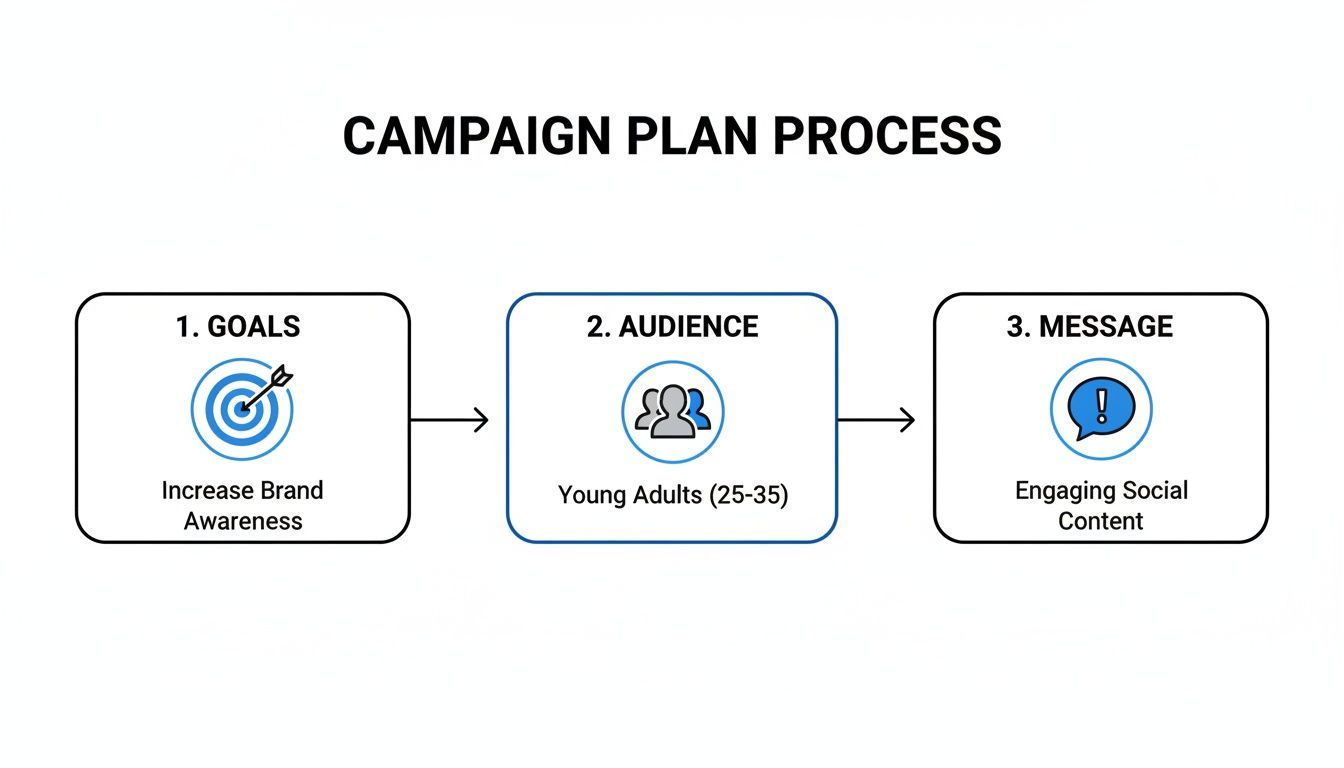
As you can see, your goals are the foundation. Every decision about your audience and messaging flows directly from what you aim to achieve.
Selecting KPIs That Truly Matter
Once your SMART goals are set, it's time to choose the right Key Performance Indicators (KPIs) to track your progress. It's easy to get sidetracked by vanity metrics like impressions or likes, which indicate activity but reveal nothing about business impact.
For any B2B campaign, your KPIs must tie directly to the sales pipeline and revenue. Here’s how to shift your focus from vanity to value:
- Instead of Website Traffic, measure Marketing Qualified Leads (MQLs). This focuses on visitors who have shown genuine interest and fit your ideal customer profile.
- Instead of Click-Through Rate (CTR), measure Cost Per Acquisition (CPA). This tells you exactly how much you're spending to acquire a new customer.
- Instead of Social Media Engagement, measure Sales Qualified Leads (SQLs). This tracks how many leads from social channels were strong enough for sales follow-up.
A strong B2B goal might be: "Generate 75 qualified sales appointments from our webinar series in Q2 at a cost-per-appointment under $250." The KPIs are integrated directly. You’ll track total appointments and CPA to determine success. For more ideas, consult our guide on choosing the right marketing KPI examples for your business.
Integrating KPIs with Your CRM for Closed-Loop Reporting
Defining KPIs is only half the battle; tracking them effectively is what truly matters. The most powerful way to do this is by creating a closed-loop system between your marketing activities and your CRM platform, such as Salesforce or HubSpot.
This integration is the key to proving ROI. It allows you to trace a lead's entire journey, from the first ad they clicked to the final sale. Without it, you lack the data to determine which channels or messages are actually driving revenue.
Expert Insight: Closed-loop reporting isn't just about measurement; it's about optimization. Suppose closed-loop data shows your LinkedIn leads close at a higher rate than other channels. Now you know exactly where to double down for the next campaign.
Setting this up involves a few practical steps:
- Implement Tracking Pixels: Ensure tracking codes, like the Meta Pixel or LinkedIn Insight Tag, are correctly installed on your website and landing pages.
- Use UTM Parameters: Tag every campaign URL with unique UTM parameters. This tells your analytics and CRM the source of each lead (e.g.,
utm_source=linkedin&utm_medium=cpc&utm_campaign=q2_webinar). - Configure CRM Integration: Set up your marketing automation platform to automatically pass this source data into your CRM when a new lead is created, connecting the initial marketing touchpoint to the sales outcome.
By connecting these dots, your marketing campaign plan becomes a dynamic tool that not only guides your strategy but also delivers the hard data needed to prove your team's contribution to the bottom line.
Mapping Your Campaign Budget and Timeline
A brilliant strategy remains an idea until you commit real resources to it. Without a realistic budget and a clear timeline, even the most creative campaigns are destined to fail. This is where your marketing campaign planning template transitions from a strategic document into a financial and operational roadmap.
This step is about making smart choices and allocating funds for maximum impact. More importantly, it ensures every dollar spent can be tied back to a specific goal. For most B2B campaigns, this means replacing guesswork with a data-driven case for your spending.
Allocating Resources for Maximum Impact
How you allocate your budget reveals your campaign’s priorities. A common mistake is pouring the majority of funds into paid media while neglecting the cost of content creation or the technology required for tracking. A balanced approach ensures every part of your campaign is set up for success.
The best campaigns are planned meticulously, with budgets locked before launch. This discipline pays off. Marketers who document their strategy are 414% more likely to report success, and marketers who set goals are 377% more likely, per CoSchedule's marketing strategy survey. That same discipline directs resources to high-impact channels, a critical practice for professional services and B2B SaaS firms that require predictable growth.
A well-structured budget is your campaign’s financial blueprint. It not only dictates what you can do but also forces you to prioritize what you should do to achieve your goals most efficiently.
To illustrate, here’s a common budget breakdown for a B2B digital marketing campaign. Use this as a starting point, adjusting it based on your unique goals and channels.
Sample B2B Marketing Campaign Budget Allocation
This table provides a typical breakdown for allocating funds across a B2B digital marketing campaign, helping you consider all necessary investments beyond just ad spend.
Using a structure like this makes it easier to gain leadership approval. For a deeper dive into financial planning, review our guide on marketing budget allocation best practices.
Creating a Clear Project Timeline
With your budget secured, it's time to map out a detailed timeline. This is more than a list of due dates; it's a visual plan for your entire campaign, complete with dependencies, milestones, and clear ownership. A well-crafted timeline keeps marketing and sales teams synchronized for a smooth launch.
An effective technique is to work backward from your target launch date. This immediately helps determine if you've allocated enough time for each project phase.
Here’s a simplified look at the key milestones:
- Week 1-2 (Strategy & Planning): Finalize campaign goals, messaging, and budget within the template.
- Week 3-4 (Content & Creative): Develop all assets, ad copy, landing pages, email sequences, and visuals.
- Week 5 (Technical Setup): Configure tracking pixels, build landing pages, and test CRM integrations.
- Week 6 (Launch & Activation): Go live with all channels and initiate the marketing-to-sales handoff process.
- Week 7-12 (Optimization & Reporting): Monitor KPIs weekly, adjust spend based on performance, and report on progress.
Project management tools like Asana or Trello are invaluable here. Transferring these milestones to a shared project board provides visibility and accountability, ensuring every piece of the puzzle falls into place for a flawless launch.
From Planning to a Flawless Launch

This is where strategy meets execution. The bridge between a well-crafted plan and a live, effective campaign is your pre-launch checklist. In this final phase, you address the small details to prevent major issues later. Your marketing campaign planning template now transitions from a strategic document into a real-world operation.
Too many campaigns falter at launch because this stage was rushed. A flawless launch isn’t about luck; it's the result of methodically verifying every technical detail and ensuring every team member is prepared.
Your Essential Pre-Launch Technical Audit
Before spending a single dollar on ads, a thorough technical audit is non-negotiable. This process confirms that your data collection systems are working, which is essential for measuring success against your defined KPIs. There is nothing worse than discovering a week into a campaign that your conversion tracking was broken from the start.
Your technical checklist should cover these minimum requirements:
- Verify All Tracking Pixels: Confirm that your Google Analytics, LinkedIn Insight Tag, and other pixels are firing correctly on every landing page and thank-you page.
- Test CRM Integrations: Submit a test lead through every form. Does the data appear correctly in your CRM, tagged with the proper source and campaign name?
- Review All Creative Assets: Perform a final review of every image, video, and piece of ad copy. Confirm everything has final approval and is uploaded to the correct platforms with the right specifications.
A clean technical setup is the foundation of data-driven marketing. The principles in our guide on setting up Google Ads conversion tracking apply to nearly every platform and are worth reviewing.
Mastering the Marketing-to-Sales Handoff
For any B2B campaign, the handoff from marketing to sales is the moment of truth where potential revenue is either captured or lost. A smooth transition depends on clear communication and agreed-upon rules of engagement. This is precisely why a Service Level Agreement (SLA) is critical.
An SLA is a formal pact that defines responsibilities, eliminating ambiguity and ensuring high-quality leads receive prompt and effective follow-up from the sales team.
A strong SLA doesn't just define timelines; it creates a pact of accountability between marketing and sales. It ensures that marketing is committed to delivering quality leads and sales is committed to pursuing them with vigor.
A robust SLA should clearly define:
- Lead Qualification Criteria: What constitutes a Marketing Qualified Lead (MQL) versus a Sales Qualified Lead (SQL)? Be specific about criteria like company size, job title, or actions taken.
- Follow-Up Timelines: How quickly must sales contact a new MQL? A Harvard Business Review study found that firms contacting a prospect within an hour were nearly seven times more likely to qualify the lead. Wait 24 hours and you are more than 60 times less likely.
- Lead Nurturing Process: What happens to leads who aren't ready to buy? Define the process for returning them to marketing for further nurturing.
Arming Your Sales Team for Success
Finally, an effective handoff is about more than process; it's about empowerment. Your sales team needs to be equipped with key insights and messaging from your campaign plan to have meaningful conversations with new leads.
Provide them with a simple briefing document pulled directly from your marketing campaign planning template. This brief should highlight the campaign's core message, the target audience's pain points, and the specific offer the lead engaged with.
This context makes a significant difference. When a salesperson knows a lead downloaded a whitepaper on "cybersecurity compliance for logistics firms," they can open the call with immediate relevance. This simple piece of information transforms a cold follow-up into a warm, consultative discussion, radically improving the chances of converting that lead into a customer.
Your Campaign Planning Questions Answered
Even with the best template, questions arise during implementation. A solid marketing campaign planning template provides the structure, but knowing how to adapt it to real-world scenarios is crucial. Here, we address some of the most common questions from marketing leaders.
These practical answers will help you navigate challenges, from tight budgets to securing executive sign-off.
How Do I Adapt This Template for a Small Budget Campaign?
With a smaller budget, ruthless prioritization is key. Focus your energy on the sections that deliver the most strategic value: SMART Goals, Target Audience, and Key Messaging. Getting these three elements right is non-negotiable.
Instead of a sprawling, multi-channel campaign, adopt a surgical approach. Select one or two channels where your audience is most active and where you can achieve a decent return. This might be a hyper-focused content marketing effort or a targeted social media campaign on a single platform. Use the budget section to track every dollar, ensuring each action ties directly back to your primary goals.
What’s the Best Way to Present This Plan for Executive Buy-In?
When presenting to leadership, you need to speak their language. Lead with business outcomes, not marketing jargon.
Start your presentation with the Executive Summary and your SMART Goals. Frame your objectives in terms of revenue, pipeline growth, and customer acquisition, the metrics that matter most to them.
Use the budget section to present a clear, data-backed projection of the return on investment (ROI). Instead of saying, "We'll increase conversion rates by 2%," translate that into financial terms: "This plan projects a $250,000 increase in sales pipeline by improving our lead-to-customer conversion rate." Keep your presentation concise, confident, and focused on the bottom line.
Can I Integrate This Template with Tools Like Asana or Monday?
Absolutely, and you should. Think of this template as your strategic blueprint (the "why" and the "what"). Project management tools like Asana, Trello, or Monday.com are your tactical engines (the "how" and the "when").
A plan without an execution system is just a wish list. Integrating your strategic template with a project management tool creates a seamless workflow from high-level vision down to the daily tasks required to bring it to life.
Once your plan is approved, transfer the key deliverables and dates from your Timeline section into your project management software. Break them down into specific tasks, assign owners, and set deadlines aligned with your campaign milestones. This creates a single source of truth for execution and ensures everyone knows their responsibilities.
How Often Should I Review My Campaign Plan After Launch?
Your campaign plan is not a static document; it’s a living guide. For any campaign running longer than a few weeks, regular check-ins are essential. Hold weekly or bi-weekly reviews of performance against your KPIs. This isn't about micromanagement; it's about agility.
Use real-time data from your analytics platforms and CRM to identify what's working and what isn't. If a channel is underperforming, don't hesitate to reallocate that budget to a more effective tactic. A nimble, data-informed approach is the only way to maximize the value of your campaign.
Ready to move beyond guesswork and build campaigns that deliver predictable, measurable growth? The team at Twelverays specializes in creating data-driven marketing strategies that align with your business goals. Let's talk about building your next successful campaign.


